ORIGINAL ARTICLE: Suhail Ahmad Rather, N. Ramadas, Vijay Kodiyalam, and Arul Lakshminarayan (2023), Absolutely maximally entangled state equivalence and the construction of infinite quantum solutions to the problem of 36 officers of Euler, Phys. Rev. A 108, 032412. https://doi.org/10.1103/PhysRevA.108.032412
Article Abstract: Ordering and classifying multipartite quantum states by their entanglement content remains an open problem. One class of highly entangled states, useful in quantum information protocols, the absolutely maximally entangled (AME) ones, are especially hard to compare as all their subsystems are maximally random. While it is well known that there is no AME state of four qubits, many analytical examples and numerically generated ensembles of four-qutrit AME states are known. However, we prove the surprising result that there is truly only one AME state of four qutrits up to local unitary equivalence. In contrast, for larger local dimensions, the number of local unitary classes of AME states is shown to be infinite. Of special interest is the case of local dimension 6, where it was established recently that a four-party AME state does exist, providing a quantum solution to the classically impossible Euler problem of 36 officers. Based on this, an infinity of quantum solutions are constructed, and we prove that these are not equivalent. The methods developed can be usefully generalized to multipartite states of any number of particles.
Introduction
Introduction
Here we review some basic concepts and definitions used in this post.
Orthogonal Latin squares and absolutely maximally entangled (AME) multipartite quantum states
Orthogonal Latin squares and absolutely maximally entangled (AME) multipartite quantum states
A Latin square (LS) of order is a array filled by numbers from each appearing exactly once in each row and column. Two Latin squares Κ and L of order , with entries and in i- th row and j- th column, are called orthogonal Latin squares if the pairs occur exactly once .Example of orthogonal Latin squares of size 3.K=
, L=
, KL=
Note that there are no repetitions of numbers along any row and column in K and L, and all nine pairs: {11,12,13,21,22,23,31,32,33}, appear in KL.
d
dd
[d]:={1,2,⋯,d}
d
Κ
ij
L
ij
2
d
,∈[d][d]
K
ij
L
ij
1 | 2 | 3 |
2 | 3 | 1 |
3 | 1 | 2 |
1 | 2 | 3 |
3 | 1 | 2 |
2 | 3 | 1 |
11 | 22 | 33 |
23 | 31 | 12 |
32 | 13 | 21 |
Mapping to multipartite pure quantum states
Mapping to multipartite pure quantum states
Canonical examples of entangled states are the two-qubit Bell states: . These are maximally entangled states of two-qubits in which states of individual qubits are maximally mixed.Orthogonal Latin squares of order can be used to define a special quantum state of four quantum systems each having -distinguishable states . These four-party states are highly entangled, and in fact have maximal entanglement in all three balanced bipartitions. Such states are multipartite generalization of the canonical two-qubit Bell states, and are called absolutely maximally entangled (AME) states. AME state have useful applications in quantum error correction, quantum teleportation, and quantum secret sharing. An AME state of four qudits (-level quantum systems) can be obtained from orthogonal Latin squares and as follows:It can be shown that all subsystems consisting of one or two qudits are maximally mixed, and hence there is maximal entanglement in all bipartitions.For example, the following AME state of four qutrits (a qutrit is a 3-level quantum systems) is obtained from orthogonal Latin squares of size 3 shown above:, where the entries from orthogonal Latin squares are shown in boldface.Equivalently, orthogonal Latin squares of size define a special permutation matrix of size that remains unitary under following matrix rearrangements defined in product basis:, . where and are called realignment and partial transpose operations. There is a bijection between such permutation matrices that remain unitary under both and operations [Phys. Rev. A 72, 012314 (2005)]. A bipartite unitary matrix which remains unitary under and operations is called 2-unitary [Phys. Rev. A 92, 032316 (2015)]. Orthogonal Latin squares provide a construction of the simplest 2-unitary matrices that are permutation matrices. However there are 2-unitary matrices that cannot be obtained from orthogonal Latin squares as discussed below.Mathematica functions for these matrix rearrangements are given below.
[|0〉|0〉±|1〉|1〉]
±
Ψ
1
2
d
d
d
K
L
Ψij
1
d
d
∑
i,j1
K
ij
L
ij
Ψ[|1111〉+|1222〉+|1333〉+|2123〉+|2231〉+|2312〉+|3132〉+|3213〉+|3321〉]
1
3
d
P
2
d
klij:〈k|〈i|P|l〉|j〉
R
P
klij:〈k|〈j|P|i〉|l〉
Γ
P
R
Γ
R
Γ
R
Γ
In[]:=
Reshuffle[ρ_]:=Block{dim}, dim=Sqrt[Length[ρ]]; IfAnd[SquareMatrixQ[ρ],IntegerQ[dim]], Reshuffle[ρ,{{dim,dim},{dim,dim}}] (*else*), Message[Reshuffle::argerr] Reshuffle::argerr="Reshuffle works only for square matrices of dimension \!\(\*SuperscriptBox[\"d\", \"2\"]\)×\!\(\*SuperscriptBox[\"d\", \"2\"]\), \where d is an Integer, for other dimensions use ReshuffleGeneral";Reshuffle[A_,{n_,m_}]:=Flatten Table[Flatten[Part[A,1+i1;;n[[2]]+i1,1+i2;;m[[2]]+i2]],{i1,0,n[[1]]n[[2]]-1,n[[2]]},{i2,0,m[[1]]*m[[2]]-1,m[[2]]}],1;PartialTranspose[a_]:=Module[{dim,sdim,temp},dim=Dimensions[a][[1]];sdim=Sqrt[dim];temp=Partition[a,{sdim,sdim}];temp=Map[Transpose,temp,{2}];temp=ArrayFlatten[temp];Return[temp];];
Thirty-six officers problem of Euler
Thirty-six officers problem of Euler
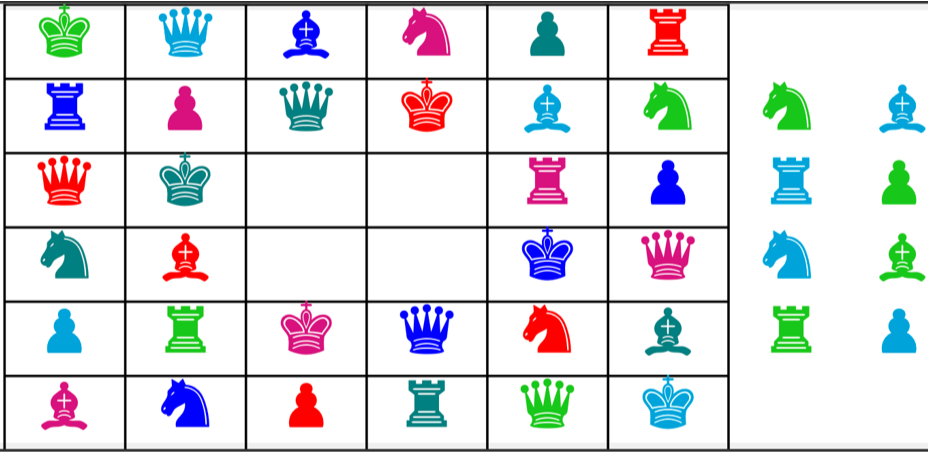
This puzzle concerns an arrangement of 36 officers and is stated as follows:“Six army regiments each have six officers of six different ranks. Can the 36 officers be arranged in a 6x6 arrangement so that no row or column repeats a rank or regiment?”Solution to this puzzle is equivalent to finding orthogonal Latin squares of size 6; OLS(6). In 1779, L. Euler conjectured that OLS(d) do not exist for , such as In particular, Euler conjectured that the thirty-six officers problem has no solution. It is easy to see that OLS(2) do not exist however the existence of OLS in other dimensions remained elusive for a very long time. In 1901, G. Tarry provided an exhaustive proof that OLS(6) do not exist and thus proving that the thirty-six officers problem of Euler indeed has no solution. In 1959, R. C. Bose and S. S. Shrikhande constructed OLS(22) and E. T. Parker found OLS(10) providing counterexample of Euler’s conjecture. Later R. C. Bose, S. S. Shrikhande and E. T. Parker proved that OLS(d) exist for all except and 6.The pair of Latin squares of size 6 that comes close to being orthogonal is shown below using colored chess pieces. It can be checked there are are no repetitions of a given chess piece and color in the grid having an unfilled grid in the middle. If grid is completed with the chess pieces shown on the right , it can be observed that there are repetitions of colored chess pieces in the resulting arrangement. For example, completing the grid with first four chess pieces shown on the right, green colored Knight and cyan colored Bishop are repeated.
d4n+2
d=2,6,10,14,....
d
d2
66
22
66
66
66
Consequence for AME states
Consequence for AME states
As discussed above one can obtain a special class of AME states of four qudits from OLS (d). As OLS(2) and OLS(6) do not exist, the corresponding special AME states of four qubits (two-level systems; ) and four quhexes (six-level systems; ) do not exist. It was known for nearly two decades that AME state of four qubits; AME(4,2), does not exist [Phys.Lett.A 273,213 (2000)], and thus unsurprisingly above construction based on OLS does not result in AME states for qubits. However, the existence of AME of four quhexes remained elusive and this was listed as one of the open problems in well-known open problem lists in quantum information. This open problem was solved positively in Phys.Rev.Lett.,128,080507 (2022), and explicit construction of an AME(4,6) state was given. Equivalently, an explicit construction of a unitary matrix of size 36 consisting of complex entries which remains unitary under both R and Γoperations was given. Note that there is no permutation matrix of size 36 that remains unitary under both R and Γ operations due to the non-existence of OLS (6).
d=2
d=6
Local unitary (LU) equivalence and LU invariants
Local unitary (LU) equivalence and LU invariants
Classifying multipartite qudit states based on local unitary (LU) equivalence in which one is allowed to perform arbitrary unitary transformations on individual qudits is of importannce both theoretically as well as experimentally. Analogous to pure states, notion of LU equivalence between multipartite operators can be defined. We focus on LU equivalence of bipartite unitary operators in unitary group defined as follows: is LU equivalent to if there exist single-qudit gates ,∈U(d) such that
U()
2
d
U
1
U
2
u
1,2
v
1,2
U
2
u
1
u
2
U
1
v
1
v
2
This provides a notion of equivalence class or local orbit of a bipartite unitary.
Now the question is when is is LU equivalent to ? The answer lies in evaluating invariants of LU equivalence: a quantity defined in terms of matrix elements of is said to be an invariant of LU equivalence if it is the same for all unitaries in the LU class of .
If, then and are not LU equivalent. However, if then may or may not be LU equivalent.
A complete set of invariants is discussed in the published work that provide necessary and sufficient condition for LU equivalence. Our main focus is on distinguishing or classifying 2-unitary matrices and as explained in the published work these can be distinguished by the invariants obtained from the spectrum of the following (unitary) operator:
U
1
U
2
I(U)
U
U
If
I()≠I()
U
1
U
2
U
1
U
2
U
2
I()I()
U
1
U
2
A complete set of invariants is discussed in the published work that provide necessary and sufficient condition for LU equivalence. Our main focus is on distinguishing or classifying 2-unitary matrices and as explained in the published work these can be distinguished by the invariants obtained from the spectrum of the following (unitary) operator:
L[U](⊗)(U⊗U)
S
24
†
U
†
U
S
24
where is the swap operator between subsystem 2 and 4, (|i〉|j〉|k〉|l〉)|i〉|l〉|k〉|j〉.
Mathematica function for constructing the functional operator is given below, and it is illustrated that its spectrum is the same for all unitaries in the LU class of .
S
24
S
24
Mathematica function for constructing the functional
L[U]
U
SWAP24[d_]:=Module[{S24ten,S24},(*CreateatensorS24tenofzeroswithshape{d,d,d,d,d,d,d,d}*)S24ten=ConstantArray[0,{d,d,d,d,d,d,d,d}];(*FillS24tenwithonesaccordingtotheswappattern*)Do[S24ten[[i,l,k,j,i,j,k,l]]=1,{i,d},{j,d},{k,d},{l,d}];(*ReshapeS24tenintoamatrixofshape{d^4,d^4}*)S24=Flatten[S24ten,{{1,2,3,4},{5,6,7,8}}];(*AssertthatS24isorthogonal(S24.Transpose[S24]shouldbeequaltotheidentitymatrix)*)Assert[UnitaryMatrixQ[S24]];Return[S24]]LUmat[U_,d_]:=Module[{U2,LU},(*AssertthattheshapeofUis{d^2,d^2}*)Assert[Dimensions[U]=={d^2,d^2}];(*CalculateU2astheKroneckerproductofUwithitself*)U2=KroneckerProduct[U,U];(*CalculateLUusingtheSWAP24function*)LU=SWAP24[d].ConjugateTranspose[U2].SWAP24[d].U2;Return[LU]]
Continuous families of inequivalent 2-unitaries of size 16
Continuous families of inequivalent 2-unitaries of size 16
Here we illustrate that enphasing leads to 2-unitaries that are not LU equivalent by providing an explicit form of the invariant in terms of the enphasing parameter.
Continuous families of inequivalent 2-unitaries of size 36
Continuous families of inequivalent 2-unitaries of size 36
As explained in the introduction 2-unitary permutation of size 36 does not exist. Despite this negative result, it was shown in Phys. Rev. Lett. 128, 080507 (2022) that a 2-unitary matrix (containing complex entries) of size 36 exists. This provided the first example of a 2-unitary matrix that cannot be obtained from orthogonal Latin squares, and provides a quantum solution to quantum version of the thirty-six officers problem of Euler. The matrix form of the 2-unitary matrix of size 36 is given below.
Unitary matrix of size 36 that remains unitary under R and Γ obtained in Phys . Rev . Lett ., 128 : 080507
2-unitary of size 36: golden AME(4,6) state
2-unitary of size 36: golden AME(4,6) state
See the full input matrix here: https://www.wolframcloud.com/obj/c720523b-1bc4-49d0-b0de-d27a5a72c430
Below we check the 2-unitary properties of the above matrix.
First we illustrate that arbitrary enphasing of the above 2-unitary matrix does not preserve 2-unitary properties:
One-parameter family of inequivalent quantum solutions
One-parameter family of inequivalent quantum solutions
We take a special one-parameter enphasing such that 2-unitary properties are preserved, and then illustrate using LU invariants that the 2-unitary obtained are not LU equivalent. One such enphasing is given below:
Now we evaluate the LU invariants, and illustrate that the above enphasing leads to 2-unitaries of size 36 that are not LU equivalent.
25-parameter family of inequivalent quantum solutions
25-parameter family of inequivalent quantum solutions
Click on the output matrix above for high resolution version, or find it here: https://www.wolframcloud.com/obj/0ee29361-c622-4f1c-94e3-da866e8695f5
Derivation of equations : Setting the elements of the list equal to zero gives the set of equations.
List of parameters
Full list of equations
Total number of equations
Coefficient matrix and its rank
Solving the list of equations
Click on the output matrix above for high resolution version, or find it here: https://www.wolframcloud.com/obj/d261a38e-1c3d-4d2d-add0-6d50a1bb5e0c
2 - unitarity verification
Conclusion
Conclusion
CITE THIS NOTEBOOK
CITE THIS NOTEBOOK
The problem of 36 officers of Euler: state equivalence & construction of infinite quantum solutions
by Suhail Ahmad Rather
Wolfram Community, STAFF PICKS, March 5, 2024
https://community.wolfram.com/groups/-/m/t/3135622
by Suhail Ahmad Rather
Wolfram Community, STAFF PICKS, March 5, 2024
https://community.wolfram.com/groups/-/m/t/3135622