Lie algebras and curvature in discrete geometry
by Antonia Seifert
Heidelberg University, Max Planck Institute for Astronomy Heidelberg
by Antonia Seifert
Heidelberg University, Max Planck Institute for Astronomy Heidelberg
Based on the cardinal structure on a quiver, this project aimed to define a Lie algebroid structure on a quiver geometry. The approach is based on the path algebra of the quiver, whose basis elements are paths. The definition of the Lie bracket and its relation to curvature on a quiver was investigated. We were able to define a Lie bracket on quivers such as square lattice and cube. Based on cardinal transitions needed for that purpose, an appropriate notion of cardinal transport was defined, which can then be used to define torsion and curvature on the quiver. Furthermore, it appears that these give rise to a frame bundle structure on the tangent bundle, which is in turn a Lie algebroid. However, understanding these structures requires further investigation.
◼
The package used for this project can be found on GitHub: https://github.com/taliesinb/QuiverGeometry. To run this notebook, please install and load the package first.
Paths on a Quiver
Paths on a Quiver
The following shows a series of paths for the quiver (shown on the right), and their corresponding path words:
$q=SimpleLabeledQuiver[ {DirectedEdge["x","y","a"|"b"],DirectedEdge["y","z","b"|"c"],DirectedEdge["z","x","c"|"a"]}, GraphLegendNone];ExtendedGraph[$q,GraphLegendAutomatic];SpacedRow[ PathWordPlot[$q,Path["x","a"]], PathWordPlot[$q,Path["y","A"]], PathWordPlot[$q,Path["x","ab"]], PathWordPlot[$q,Path["x","abC",PathAdjustments{1"Bend"}]], PathWordPlot[$q,Path["x","aca"]], Labeled["",""], Labeled[ExtendedGraph[$q,GraphLegendPlaced[Automatic,Left]],""]]
Out[]=

We’ll now perform the path composition to yield :
(x:a:y)·(y:b:z)
(x:ab:z)
In[]:=
PathComposePlot[ $q, Style[Path["x","a"],$Red], Style[Path["y","b"],$Blue], Style[Path["x","ab",PathAdjustments{1"Bend"}],$Purple]]
Out[]=
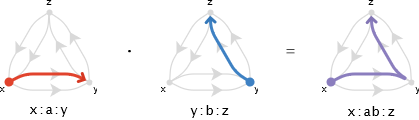
As an example of a path composition that is not defined, consider . Since , this composition is not defined, which we indicate with the “result” ⊥.
(x:a:y)·(z:c:x)
y≠z
In[]:=
PathComposePlot[$q, Style[Path["x","a"],$Red], Style[Path["z","c"],$Green], None]
Out[]=
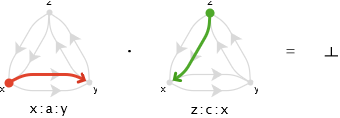
The structure given by the paths on the quiver is the one of a groupoid, since the group operation path composition is not defined for some of the combinations of elements
Square Lattice
Square Lattice
We’ll first start with the square lattice (only a finite portion shown):
In[]:=
LatticeQuiver["Square"]
Out[]=
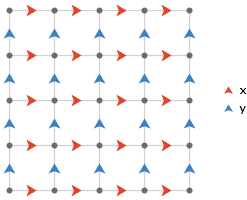
We can set up a path algebra, a non-commutative vector space with basis of all finite-length paths:
Out[]=
PathAlgebra
Here’s an example of a vertex field, an element of the vector space formed of linear combinations of empty paths (which start and end at a single vertex):
Out[]=
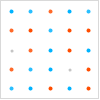
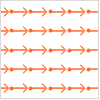
Here’s an example of an cardinal edge field, whose elements are all the edges labelled with a given cardinal:
Out[]=
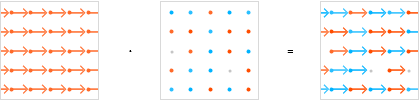
We can compose these two vectors, which is determined by composing each possible pair of basis elements in the two vectors:
Out[]=
Another important operation is translation, in which we translate the elements of a path vector along any applicable elements of a translator:
Out[]=
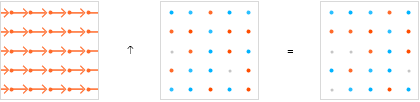
Out[]=
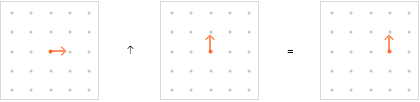
Translation performs parallel transport, which is achieved by taking the path word of each element of the translated vector, and rewriting its cardinals as necessary whenever we change charts along the element of the translator. For a square lattice, there is only one chart, and so parallel transport is trivial.
We can combine translation and composition via “translate-compose”, written , which translates along , and composes it with :
t⊕p
p
t
t
Out[]=
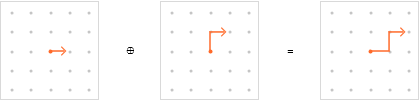
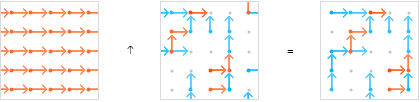
Let’s look at a more complicated case:
Out[]=
Similarly, we can perform “translate-invert-compose”, written , which translates along , and then inverts its path word, then composes it with :
t⊖p
p
t
p
Out[]=
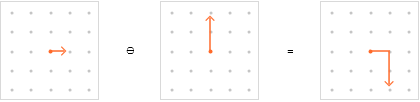
We can use to compare two paths that start at the same vertex:
⊖
Out[]=

By forming the shortest path equivalent of the result, we obtain the difference between the head of the left and the head of the right path.
Cube
Cube
We wish to characterize the curvature of the cube, show below:
We’ll work with a subdivided cube, which has more vertices on its faces, which will emphasize the cardinal structure:
The cardinal structure will be derived from the rotational symmetries of the cube in three-dimensional space, though we will only consider its topological aspects and forget about these symmetries:
Putting these cardinals together we arrive at a cardinal quiver:
We’ll work with the following charts, which correspond to the cardinals which are present on each face:
The cardinal transitions are determined by the relationship (parallel or antiparallel) of the shared cardinals on the edges that border each pair of faces. Here we light one two such pairs of shared edges, and show the corresponding transport that occurs when we transition between their charts:
We can summarize all these relationships in a single quiver, called the atlas. Vertices of the atlas are charts in the original cube, and edges represent transitions between charts, which inherit the original cardinal that moves between those charts. We additionally label each edge in the atlas with the cardinal transport associated with that chart transition.
Because the vertices of the atlas are associated with faces of the cube, and edges of the atlas are associated with neighboring cube faces, the atlas is technically the graph of the dual polyhedron of the cube, namely the octahedron. We can display it in three dimensions to make this clearer:
Concluding remarks
Concluding remarks
In the course of the project, we explored a wide range of concepts related to discrete geometry on quivers in general and Lie algebroids in particular. Due to the focus on Lie algebroids we were able to find structures associated with that, such as the tangent bundle, and to define a Lie bracket, torsion and curvature on this structure. However, other directions remained less explored although they cover interesting concepts. In particular, the relation of the tangent bundle as a Lie algebroid to the path algebra is a possible next step to investigate. The frame bundle and the group action on it deserves further investigation, too. Furthermore, the role of weights in the path algebra for the curvature tensor is not yet clear but is another interesting direction to focus on.
Related to weights, a portion of this project was spent investigating analogs of the forward, reverse, and central finite difference from discrete calculus, and generalizing these to arbitrary path vectors. This approach was not used directly in the definition of the covariant derivative above, but could also prove to be a way of defining the Lie derivative and hence the Lie bracket. Additionally, a more focussed investigation on the connection of Lie algebras and Lie groups in the discrete setting would be interesting too. In particular, the famous BCH formula connects to the structure of the Lie algebra to the behavior of the Lie group near the identity. Understanding the discrete analog of the BCH construction would be an interesting direction to pursue.
In terms of the interpretation of the results obtains here, analysing other objects apart from the square lattice and the cube could yield further insights. Particularly, all of the platonic solids admit a cardinal structure and atlas analogous to that discussed here for the cube. It would be interesting to investigate these same constructions in these alternative contexts. The corners of the cube can be seen as discrete sources of positive curvature (similar statements hold for the other platonic solids). Generalizing this to infinite lattices, we can imagine constructing defective lattices that contain a particular density of positive and negative disclinations. If a suitable method can be found to reason about these, it should be possible to produce models of hyperbolic and other infinite non-Euclidean geometries.
Keywords
Keywords
◼
Quiver Geometry
◼
Path Algebra
◼
Lie Algebroid
◼
Curvature
Acknowledgment
Acknowledgment
Mentor: Taliesin Beynon
I am deeply thankful with my mentor Taliesin Beynon for supporting and guiding me throughout the Summer School. Thank you, Tali, for hours and hours of meetings and for all your advice and ideas without which the project would not have gotten this far.
I also want to thank Stephen Wolfram and the entire Summer School team for organizing this great experience and making this fantastic time possible.