The media likes to focus on total solar eclipses, for obvious reasons. Total solar eclipses can be observed with the naked eye and are spectacular to behold if you are lucky enough to be in the path of totality. But, not all solar eclipses are total eclipses. There are solar eclipses that, no matter where you are on Earth, will not have a path of totality. Such eclipses are partial eclipses. On March 29, 2025 there will be a partial solar eclipse.
In[]:=
eclipse=SolarEclipse[DateObject[{2025,3,29}]]
Out[]=
As shown in the following map, only the far northeastern US and Canada will be able to see the partial eclipse, at least in North America. Africa, Europe and Asia will be able to observe the partial eclipse at lower magnitudes of coverage.
In[]:=
SolarEclipse[eclipse,"EclipseMap"]
Out[]=
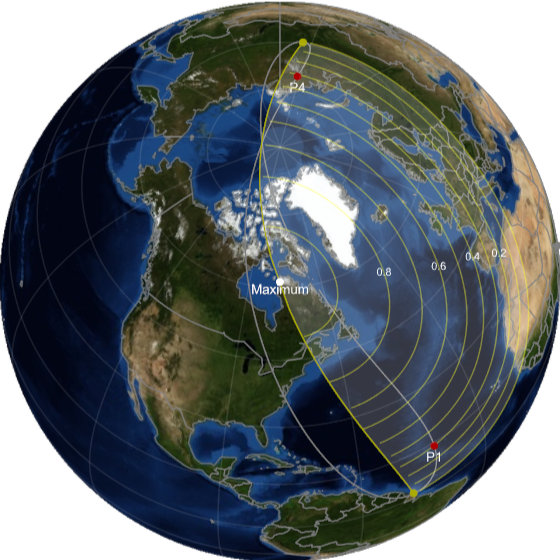
The maximum of the eclipse can be observed here.
In[]:=
maxloc=SolarEclipse[eclipse,"MaximumEclipsePosition"]
Out[]=
GeoPosition[{61.2602,-77.2118}]
The nearest cities to this location can be computed as follows:
In[]:=
nearestcities=GeoNearest["City",maxloc,10]
Out[]=
,,,,,,,,,
In[]:=
Grid[{#,GeoDistance[maxloc,#]}&/@nearestcities,Dividers->All]
Out[]=
From the maximum eclipse location, the maximum magnitude is about 94%.
In[]:=
SolarEclipse[eclipse,"MaximumEclipseMagnitude"]
Out[]=
0.937966
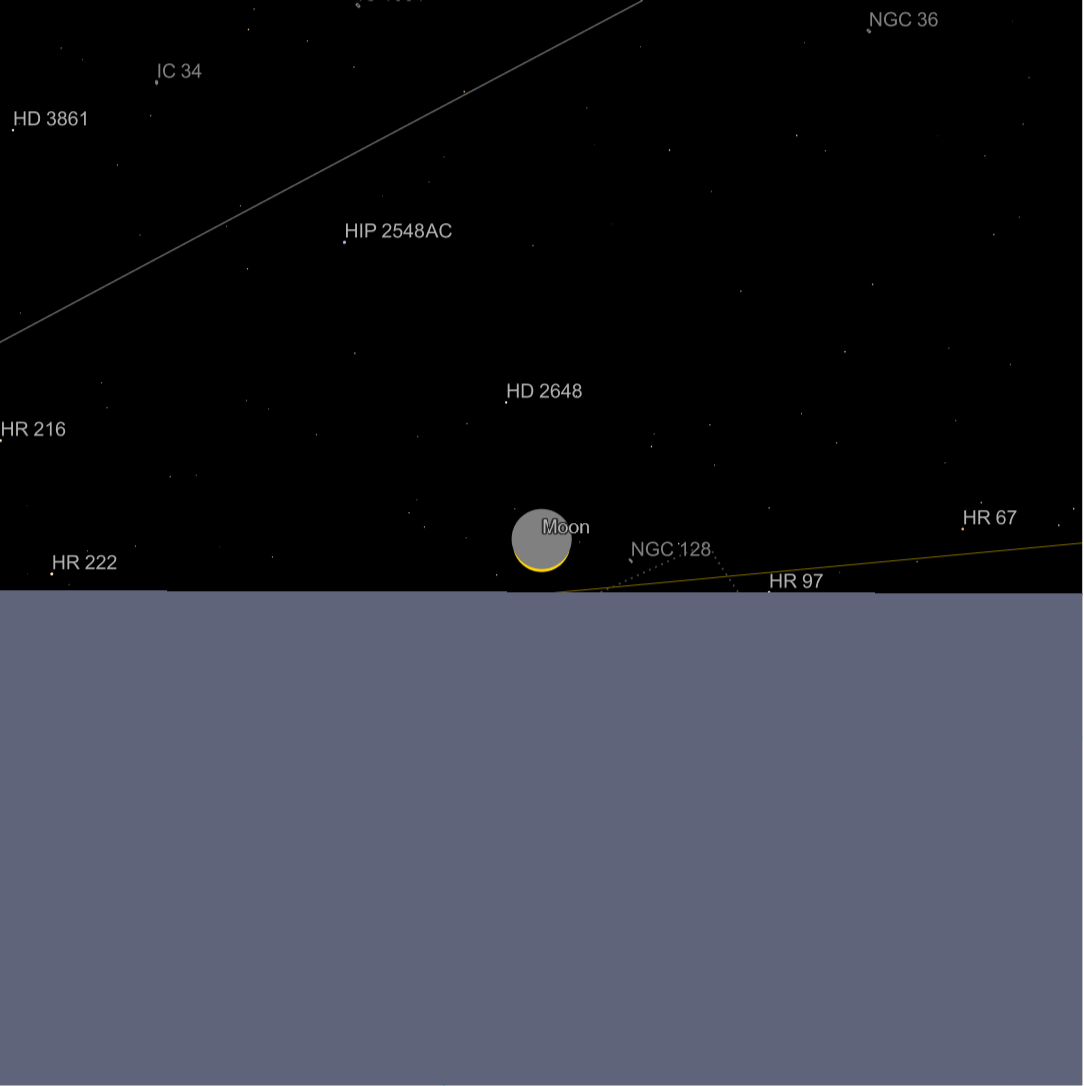
This maximum phase happens shortly after sunrise. The Sun and Moon can be seen just above the horizon, shown in light blue.
In[]:=
AstroGraphics[{Entity["Star","Sun"]},AstroReferenceFrame->{"Horizon",eclipse,maxloc},AstroRange->Quantity[5,"AngularDegrees"]]
Out[]=
From the US, states like Maine will be able to see the eclipse (weather permitting)
In[]:=
loc=Entity["City",{"Bangor","Maine","UnitedStates"}];
The maximum eclipse observed in Bangor, Maine can be computed.
In[]:=
bangormax=SolarEclipse[eclipse,{"LocalMaximumEclipseDate",loc}]
Out[]=
But this is about 2 minutes before sunrise.
In[]:=
Sunrise[loc,DateObject[bangormax,"Day"]]
Out[]=
But about 6 minutes after local maximum eclipse, the Sun and Moon will be above the horizon.
In[]:=
AstroGraphics[{Entity["Star","Sun"]},AstroReferenceFrame->{"Horizon",bangormax+Quantity[6,"Minutes"],loc},AstroRange->Quantity[5,"AngularDegrees"]]
Out[]=
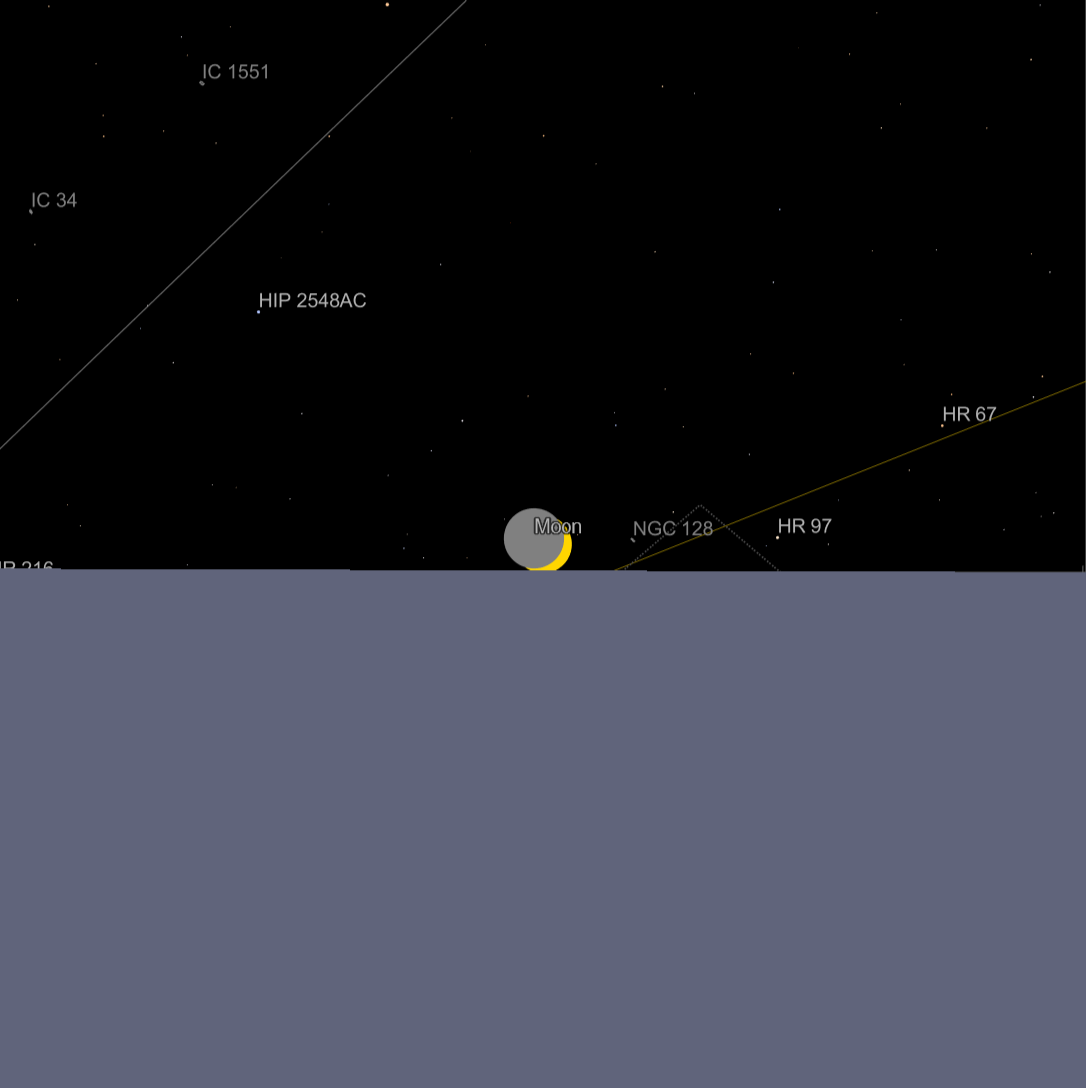
As long as you have eclipse viewing glasses or other safe viewing equipment, you can observe this eclipse as the Sun is rising. The Sun will appear as a pair of horns rising above the horizon. A nice target for properly protected cameras.
CITE THIS NOTEBOOK
CITE THIS NOTEBOOK
Partial solar eclipse on March 29, 2025: visible in parts of the northern hemisphere
by Jeffrey Bryant
Wolfram Community, STAFF PICKS, March 27, 2025
https://community.wolfram.com/groups/-/m/t/3434084
by Jeffrey Bryant
Wolfram Community, STAFF PICKS, March 27, 2025
https://community.wolfram.com/groups/-/m/t/3434084