We study the connection between field theories in d-dimensional spacetime and fields propagating in d+1-dimensional spacetime from a causality-based perspective. Instead of relying on specific Lagrangians or large-N expansions, we propose that the correspondence arises from a shared underlying causal structure.
The Wolfram Model causal graph does not encode a particular field theory but captures the causal relationships common to both boundary theories and potentially AdS bulk descriptions. The d+1 AdS dimension emerges as a measure of computational or causal depth, while d-dimensional spacetime appears as an effective boundary description.
The Wolfram Model causal graph does not encode a particular field theory but captures the causal relationships common to both boundary theories and potentially AdS bulk descriptions. The d+1 AdS dimension emerges as a measure of computational or causal depth, while d-dimensional spacetime appears as an effective boundary description.
Introduction
Introduction
The study of interconnected systems extends beyond traditional networks and appears in natural, biological, and engineered contexts. Even simple setups, such as interacting particles in a physical system, can display rich collective behavior. Rule - based rewriting models such as the Wolfram model allow us to systematically explore how local interactions generate global patterns and emergent phenomena. These approaches play a key role in physics, providing insight into many-body dynamics, phase transitions, and other fundamental processes . Importantly, this framework admits possible dual description between different spaces : a d-dimensional boundary can be represented within a (d + 1)-dimensional bulk within the same multiway causal graph. This makes it possible to explore dualities between theories defined in different dimensions. In particular, it suggests a correspondence between gauge theories on the boundary and gravitational theories in the bulk. In short, the goal of this work is to understand the duality between d- and (d + 1)-dimensional spaces, as well as how holography operates in the Wolfram model. To this end, we will examine causal and branchial graphs. For this we will demonstrate a few computational examples. Our code generates the causal graph corresponding to two evolution steps of a graph rewriting rule in the Wolfram Model. We will also explore the corresponding branchial graphs here.
Causal Graphs
Causal Graphs
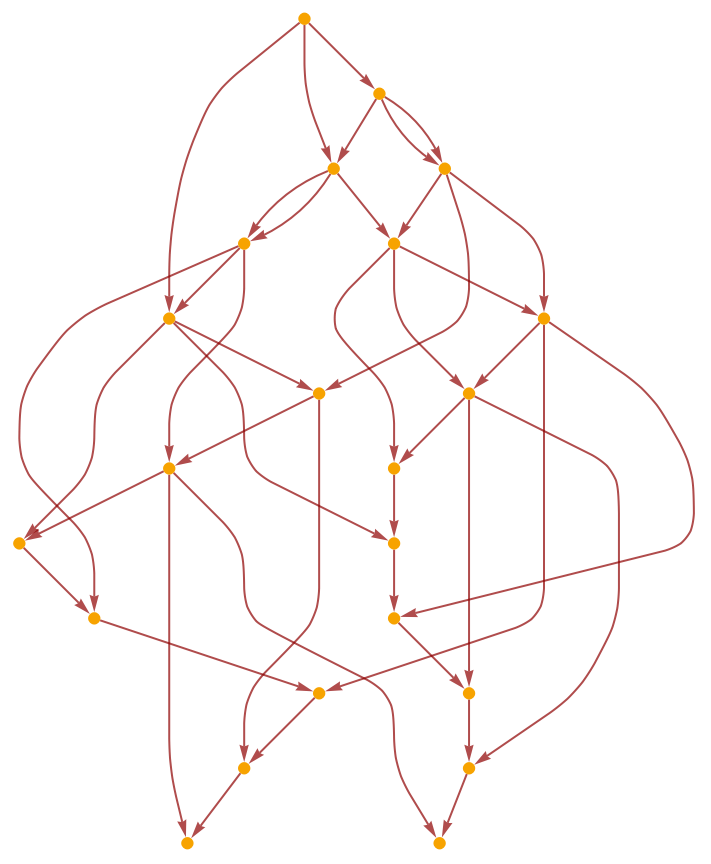
Now let us examine causal graphs in the Wolfram model.
The LayeredCausalGraph is a graphical representation used to visualize causal relationships in multi-dimensional systems in a layered manner. Each layer corresponds to a specific time step or stage, making it easier to understand how local rules generate global causal structures.
In[]:=
ResourceFunction["WolframModel"][{{1,2},{2,4}}->{{1,4},{4,2},{3,4}},{{1,2},{2,3},{2,2}},12,"LayeredCausalGraph"]
Out[]=
Multiway Systems
Multiway Systems
Multiway Systems
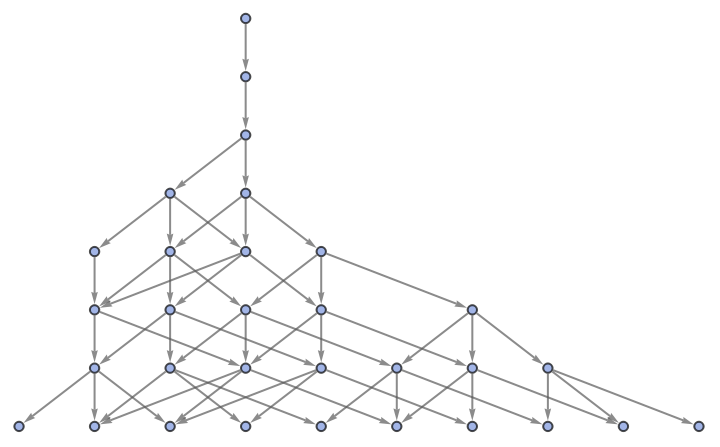
A Multiway System explores all possible evolutions of a system from given rules, forming a branching network that captures every potential outcome and path.
In[]:=
Graph[ResourceFunction["MultiwaySystem"]["WolframModel"->{{{x,y},{y,z}}->{{x,y},{y,z},{z,x}}},{{{0,1},{1,2}}},7,"StatesGraphStructure"],GraphLayout->"LayeredDigraphEmbedding",AspectRatio->.6]
Out[]=
In[]:=
Graph[ResourceFunction["MultiwaySystem"]["WolframModel"->{{{x,y},{y,z}}->{{x,y},{y,z},{z,x}}},{{{0,1},{1,1}}},3,"CausalGraphStructure"],GraphLayout->"LayeredDigraphEmbedding",AspectRatio->.5]
Out[]=
In[]:=
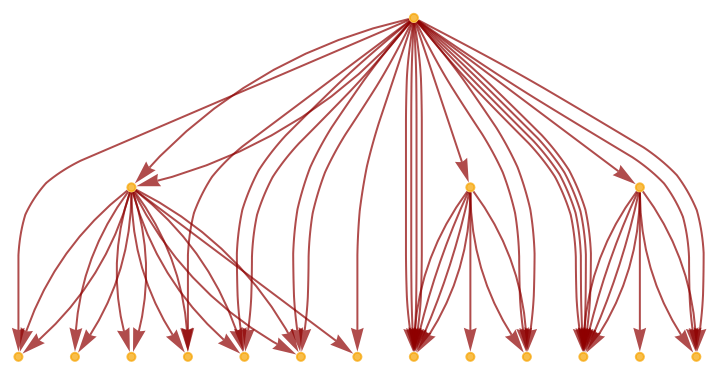
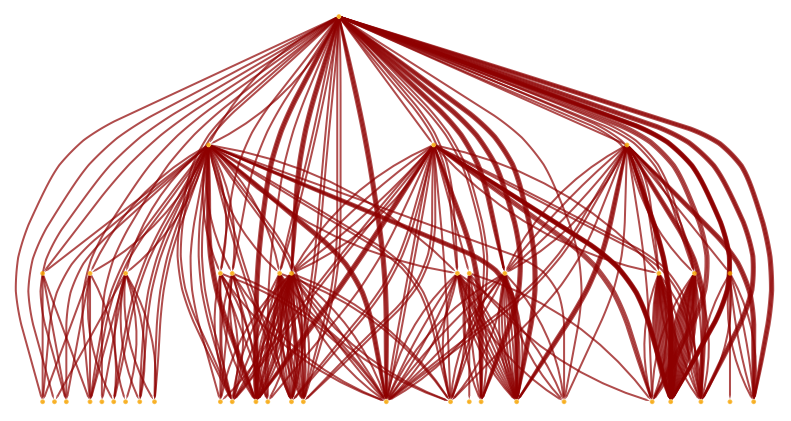
The Multiway System captures all possible evolution histories of a rewriting system. The CausalGraphStructure of the multiway system represents how events influence each other over time, forming a network of cause - and - effect relations that reveals the system's global causal structure. This graph shows both, branching and merging of causal edges.
In[]:=
Graph[ResourceFunction["MultiwaySystem"]["WolframModel" -> {{{x, y}, {y, z}} -> {{x, y}, {y, z}, {z, x}}}, {{{1, 2}, {2, 2}}}, 4, "CausalGraphStructure"] , GraphLayout -> "LayeredDigraphEmbedding", AspectRatio -> .5]
Out[]=
Graph[ResourceFunction["MultiwaySystem"]["WolframModel" -> {{{a, b}, {a, z}} -> {{x, y}, {y, z}, {z, x}}}, {{{1, 2}, {1, 1}}}, 3, "CausalGraphStructure"] , GraphLayout -> "LayeredDigraphEmbedding", AspectRatio -> .5]
Out[]=
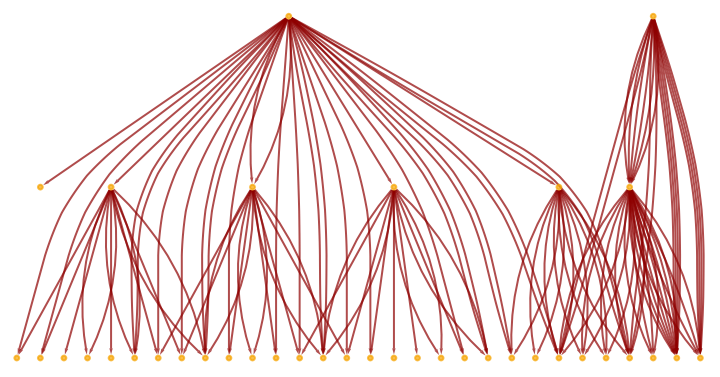
In[]:=
ResourceFunction["MultiwaySystem"]["WolframModel"->{{{1,2},{1,3}}->{{2,3},{3,4},{1,3}}},{{{0,0},{0,0}}},(*initialembeddingcoordinates,optional*)5,(*numberofsteps*)"StatesGraphStructure"(*outputasstatesgraph*)]
Branchial graphs
Branchial graphs
WenowexplorebranchialgraphsintheWolframmodel.
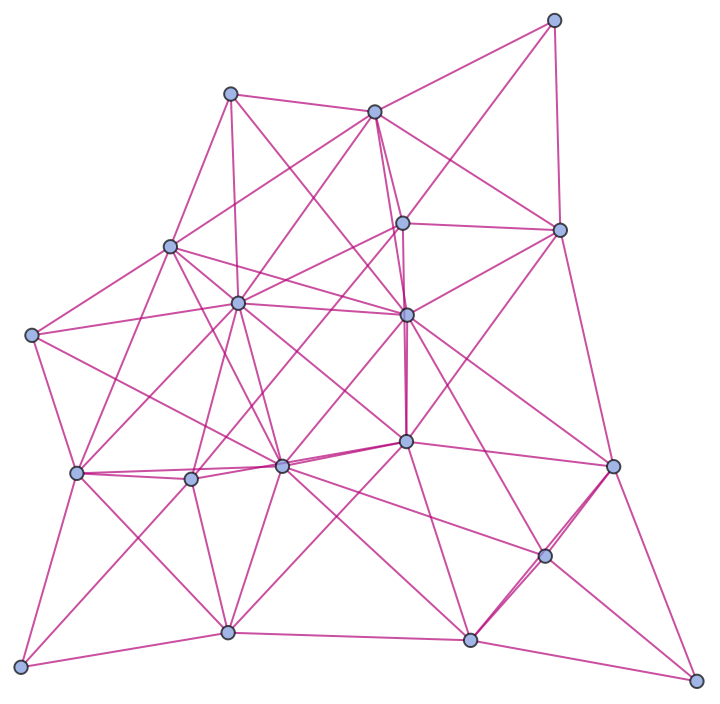
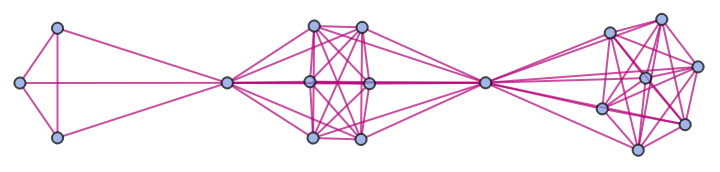
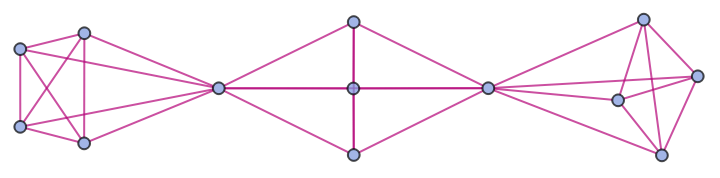
The graphs below show the branchial structure of a MultiwaySystem, representing all possible entangled states of the system over time. Each node corresponds to a system state, and edges denote state entanglements (signalling a common parent state one update earlier).
In[]:=
Table[ResourceFunction["MultiwaySystem"]["WolframModel"->{{{x,y},{y,z}}->{{x,y},{y,z},{z,x}}},{{{0,1},{1,2},{1,3}}},t,"BranchialGraphStructure"],{t,4,6}]
Out[]=
,
,
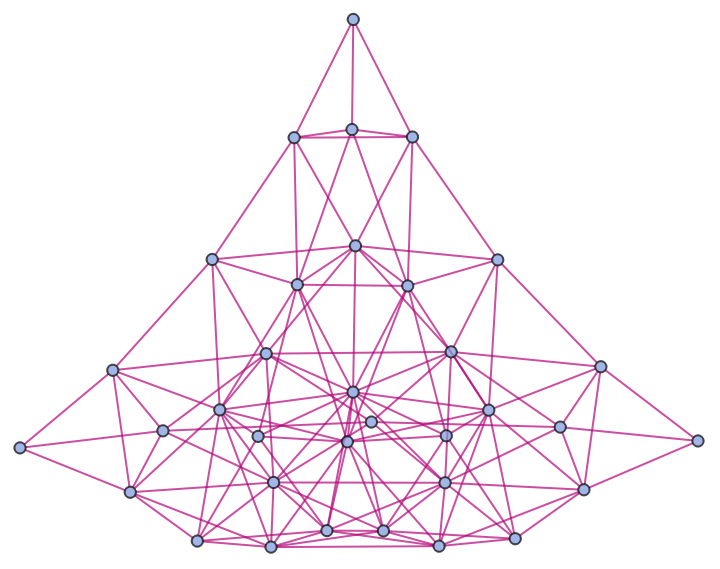
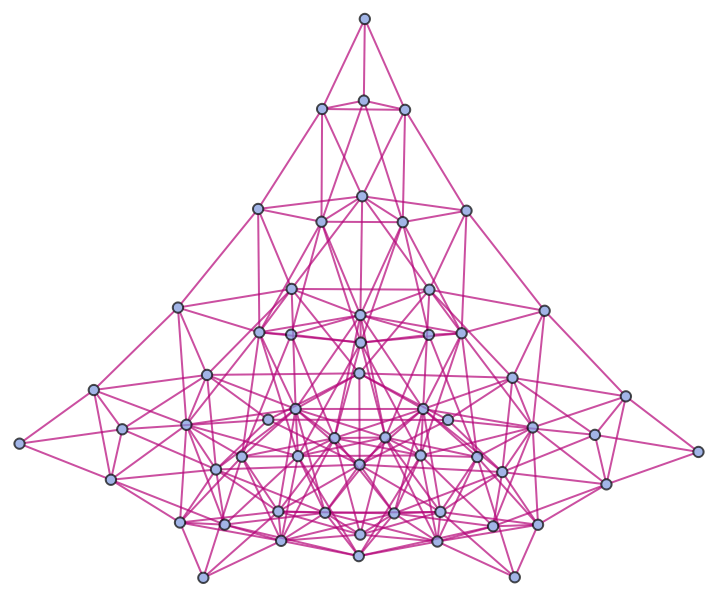
We show the branchial structure of a MultiwaySystem generated by the given WolframModel rules. The three graphs above show the evolution of branchial graphs over time.
In[]:=
ResourceFunction["MultiwaySystem"]["WolframModel"->{{{x,y},{x,z}}->{{x,y},{x,w},{y,w},{z,w}}},{{{0,0},{0,0}}},3,"BranchialGraphStructure"]
Out[]=
In[]:=
ResourceFunction["MultiwaySystem"]["WolframModel"->{{{x,y},{x,z}}->{{x,y},{x,w},{y,w},{z,w}}},{{{1,0},{1,0}}},3,"BranchialGraphStructure"]
Out[]=
In[]:=
ResourceFunction["MultiwaySystem"]["WolframModel"->{{{x,y},{x,z}}->{{x,y},{x,w},{y,w},{z,w}}},{{{1,0},{1,1}}},3,"BranchialGraphStructure"]
Holographic Correspondence
Holographic Correspondence
Now, to investigate holography, we have to look at multiway systems. One example of what we need is the causal graph of multiway systems. CausalGraph shows how events in the bulk influence each other through cause - and - effect relationships. On the boundary, this structure appears in an effective, simplified form. Bulk dynamics are thus reflected on the boundary.
BranchialGraph: Shows the different possible evolution of boundary data, such as the dual quantum states or field configurations. These appear as cross-sections of the bulk geometry captured by the causal multiway graph.
Concluding Remarks
Concluding Remarks
In the Wolfram Model, causal and branchial graphs together provide a clear visual representation of the holographic duality. All cause-effect relationships and possible evolutions in the bulk are encoded in the boundary theory. Both the bulk and the boundary are fundamentally quantum
Acknowledgments
Acknowledgments
Thanks to Stephen Wolfram, for planting the seed of a question that unfolded into a universe of hypergraphs, and for suggesting this project. Thanks also to Stephanie Bowyer and Xerxes D. Arsiwalla, for charting the constellations of guidance for me. And to everyone behind the Wolfram Summer School, for crafting a realm where curiosity and creation converge.
References
References
CITE THIS NOTEBOOK
CITE THIS NOTEBOOK
Holographic duality between causal and branchial graphs
by Narmin Nasibova
Wolfram Community, STAFF PICKS, January 16, 2026
https://community.wolfram.com/groups/-/m/t/3608412
by Narmin Nasibova
Wolfram Community, STAFF PICKS, January 16, 2026
https://community.wolfram.com/groups/-/m/t/3608412