1. Introduction
1. Introduction
“The cat’s out of the bag,” said the mathematician Andrew Granville, reflecting on the rapid improvement of AI systems. His phrase captures the mood of the moment: by 2025-26, large language models (LLMs) had become powerful enough to move from impressive demonstrations to serious mathematical and scientific use. AI systems reached gold-medal level at the International Mathematical Olympiad, while newer research workflows began using LLMs together with symbolic tools to explore large mathematical spaces and even help resolve some open problems [1-5]. Many mathematicians now see this as a turning point: AI is becoming ready for “prime time” as a research companion in mathematics, physics, and related sciences - helping researchers test ideas rapidly and discover connections that might otherwise remain hidden.
As AI rapidly becomes part of mathematical work, those who love mathematics find themselves in a strange and fascinating moment. On one hand, these systems are already helping us test ideas more efficiently, explore examples, write code, and even hint at possible new discoveries. On the other hand, their growing power naturally raises a troubling question: if machines become vastly more capable, will human mathematicians eventually become unnecessary? This tension between assistance and anxiety now lies at the center of many conversations about the future of mathematics [6-8].
In this article, I will examine that tension carefully by asking a central question: what remains human in doing mathematics in the age of AI? I will explore how modern large language models work, how they may contribute to new mathematics, and what futures may emerge as they improve. I will also discuss why exact computational systems such as the Wolfram Language (WL) remain essential: language models are powerful for pattern recognition and exploration, but mathematics ultimately depends on precision, symbolic structure, and exact computation. At the same time, I will argue that AI has deep limits in the open-ended search for genuinely new ideas. Mathematics is not only about producing correct steps quickly, but also about choosing meaningful directions, seeing unexpected bridges between distant concepts, and deciding what is worth understanding. In that larger picture, the human role and symbolic computation do not disappear; they become even more important.
2. Making Mathematics Computable
2. Making Mathematics Computable
2.1 A Graph of All Possible True Statements
2.1 A Graph of All Possible True Statements
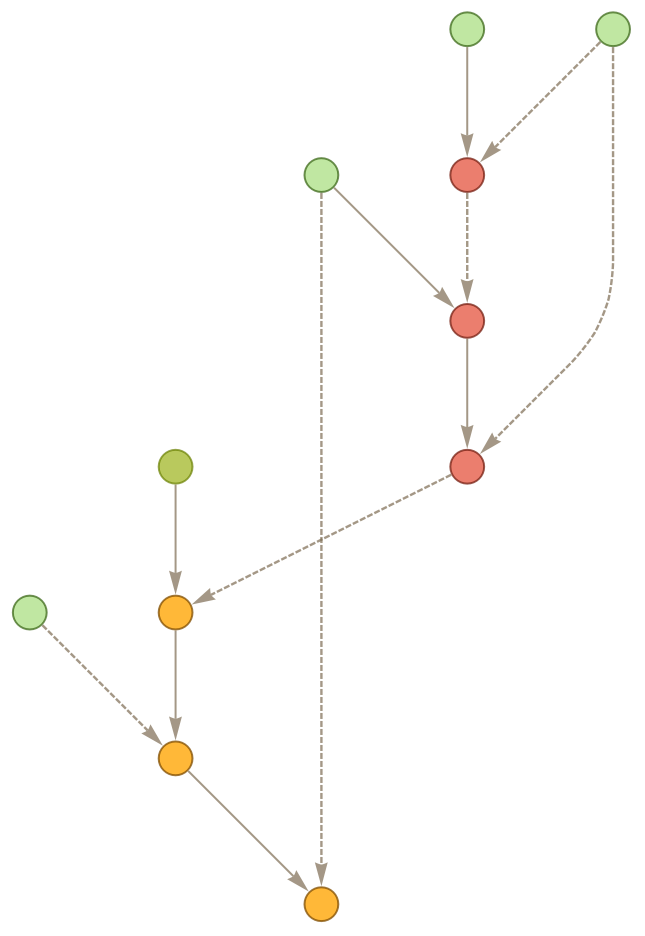
If we want machines to seriously study, explore, and eventually discover mathematics, then we must formalize the abstractions of mathematics: definitions, constructions, concepts, patterns of dependence, and the ways several ideas combine to produce a new one. One natural way to think about this is to represent mathematics as an infinite graph. In this picture, the nodes correspond to true statements, while the edges encode the logical relationships that connect them.
In the course of a proof, one may also introduce temporary nodes — for example, assumptions, axioms, lemmas, or auxiliary constructions — that help build a path through the graph before being discharged or incorporated into the final argument.
This abstraction is a kind of compression. A long proof can be collapsed into a theorem name. A repeated construction can be packaged as a function. A recurring pattern can be promoted into a new concept. Such abstractions are not cosmetic; they are what make mathematics navigable in spite of its explosive combinatorial growth. I would phrase this more informally by saying that a new mathematical idea often creates a new bridge. It connects two regions that previously seemed far apart, shortens many later routes, and suddenly makes whole families of results easier to see. Seen this way, the importance of a theorem is not only that it proves one fact, but that it changes the connectivity of the landscape.
This perspective is especially natural from the standpoint of the Wolfram Language. In WL, every expression already has a compositional form: a head together with arguments, such as f[a, b], Plus[x, y], or Integrate[g[t], t]. The head can be viewed as an operation tying several inputs into a single output expression, and that output can itself become part of a larger construction. In this way, WL provides a concrete symbolic framework in which mathematics can be seen not merely as text, but as a network of structured compositions.
Here is a Wolfram Language demonstration of this idea. In it, we represent a small portion of calculus as a graph of formal relationships and then show how the integration-by-parts formula can be derived from the fundamental theorem of calculus, the product rule, and the linearity of differentiation. The following code constructs these rules and uses FindEquationalProof to generate a proof graph:
In[]:=
calculusAxioms={ForAll[f,formalIntegral[formalDerivative[f]]==f],ForAll[f,formalDerivative[formalIntegral[f]]==f],ForAll[{f,g},formalDerivative[product[f,g]]==sum[product[f,formalDerivative[g]],product[g,formalDerivative[f]]]],ForAll[{f,g},formalDerivative[sum[f,g]]==sum[formalDerivative[f],formalDerivative[g]]]};integrationByPartsProof=FindEquationalProof[ForAll[{f,g},sum[formalIntegral[product[f,formalDerivative[g]]],formalIntegral[product[g,formalDerivative[f]]]]==product[f,g]],calculusAxioms];
In[]:=
integrationByPartsProof["ProofGraph"](*tooltipsshowtheaxiomsandintermediatesteps*)
Out[]=
2.2 Graph to Hypergraph
2.2 Graph to Hypergraph
In an ordinary graph, an edge connects two vertices. In a hypergraph, a single hyperedge may connect several inputs to one or more outputs. This is the fundamental way hypergraphs generalize the concept of a graph, enabling the representation of complex, multi-way relationships. This makes it much better suited to mathematics, where a new statement or object often arises from combining several earlier ingredients at once. This viewpoint is used in [9] to describe a hypergraph, in which nodes represent mathematical expressions, while hyperedges represent the rules by which they are built from simpler constituents.
2.3 Combinatorial Exploration
2.3 Combinatorial Exploration
Hilbert’s dream was that mathematics could be placed on a completely precise formal foundation: one would specify axioms and rules of inference so clearly that all valid reasoning could, in principle, be carried out mechanically, and the consistency of the system itself would be secured by finitary means. Gödel showed the limits of this hope: any sufficiently expressive consistent formal system contains true statements that cannot be proved within that system, and such a system cannot establish its own consistency by its own internal resources. Turing, Church, and others then clarified the computational side of the limitation, showing that there can be no universal procedure that decides mathematical truth in full generality [10]. Gödel and Turing did not kill Hilbert’s dream; they made it deeper. They showed that the mathematical universe is too rich to be exhausted by any single formal machine, yet they also made clear that every serious attempt at discovery must move through a vast combinatorial space of symbolic possibilities - the “Mathematical Hypergraph”.
3. How an LLM Works Through a Math Problem
3. How an LLM Works Through a Math Problem
An LLM solves a math problem in a very different way from a human mathematician. It does not look at the problem and “understand” it in the full human sense. Instead, it reads the words, symbols, and structure of the problem, and then predicts what kinds of mathematical steps are most likely to come next. This prediction is based on patterns it has learned from a huge amount of training data: textbooks, worked examples, formulas, proofs, and explanations. So when it sees a familiar kind of problem, it can often produce the right method by recognizing the general pattern. For example, it may notice that a quadratic equation usually leads to factoring, completing the square, or using the quadratic formula, and then continue by generating the next likely step in that direction. See [11].
What makes this impressive is that the process can still look a lot like reasoning. As the LLM writes one step, that step changes the context for the next one, so it can build a multi-step solution piece by piece. In effect, it performs a guided search through many possible lines of attack, while its training helps it stay near the paths that often work. So an LLM is often best understood not as a mind that truly “knows” mathematics, but as a very powerful pattern-based system that can imitate many parts of mathematical problem solving surprisingly well.
This also explains its weakness: if the problem requires a genuinely new idea, or if it drifts onto a slightly wrong path early on, it may continue confidently in the wrong direction. So modern LLM-based math systems are often made stronger by connecting them to symbolic software such as SymPy, Wolfram Language, or other computer algebra tools. In that setup, the LLM does not have to do everything by itself. It can propose a step, send part of the calculation to a symbolic engine, and then use the result to continue. For example, it may ask the external tool to expand an expression, solve an equation, compute an integral, check whether two formulas are equivalent, or test a numerical example. This gives the system a kind of calculator-and-verifier alongside its language abilities.
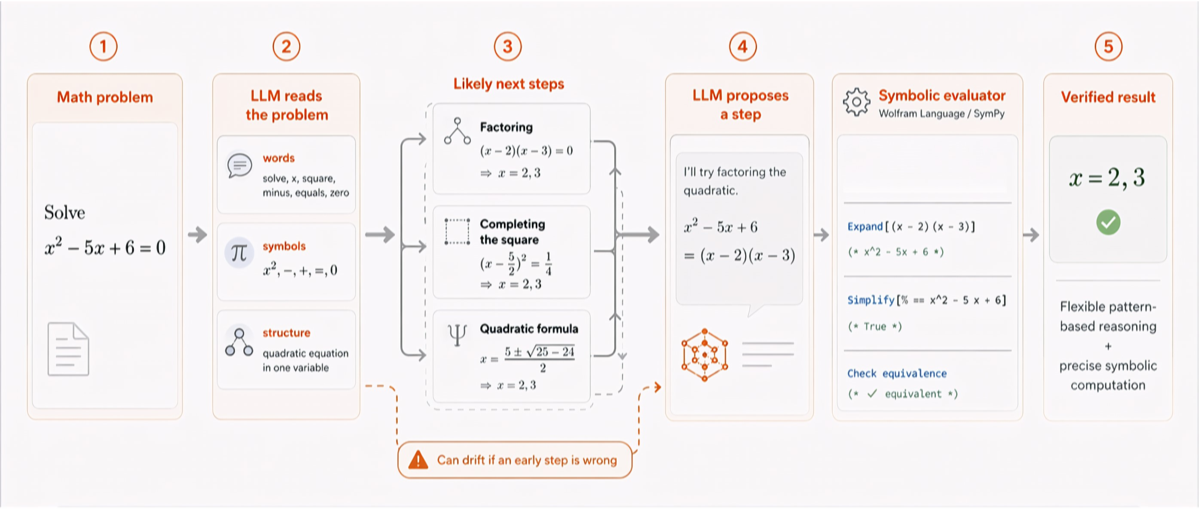
Figure 1: How an LLM works through a math problem with symbolic verification
4. Can LLMs Discover New Mathematics?
4. Can LLMs Discover New Mathematics?
Yes, at least in a limited sense, LLMs can already contribute to new mathematics. This is now visible across several categories: Olympiad-level mathematics [1, 2, 12-13], research-level mathematical discovery [14-16], and previously unsolved or open problems [3, 4, 17].
To see how this work, we should first ask what a new mathematical “dis-covery” actually is. It is not just a derivation - it is the finding of a genuinely new connection, statement, method, reformulation, or proof idea that was not previously part of standard mathematical knowledge. In the language of the mathematical hypergraph, it is the creation of a new hyperedge: a new bridge linking concepts, formulas, structures, or methods in a way that was not known before.
But not all new bridges are equally important. Mathematics contains many local connections that are true but narrow: a special-case identity, a small lemma, a technical shortcut, or a reformulation that helps only in one corner. These are still discoveries in a weak sense. We are obviously interested in more important discoveries: they unify scattered facts, shorten many paths at once, or open an unexpected route between previously distant areas. In that sense, it is about compression: how much understanding is gained by the new bridge. A minor result adds one more fact; a major result reorganizes a whole region of the subject. A publishable theorem is something that makes the mathematical landscape meaningfully simpler, clearer, or richer. One may imagine a heuristic “compression index”: the extent to which a proposed result unifies, simplifies, or reframes what was previously scattered.
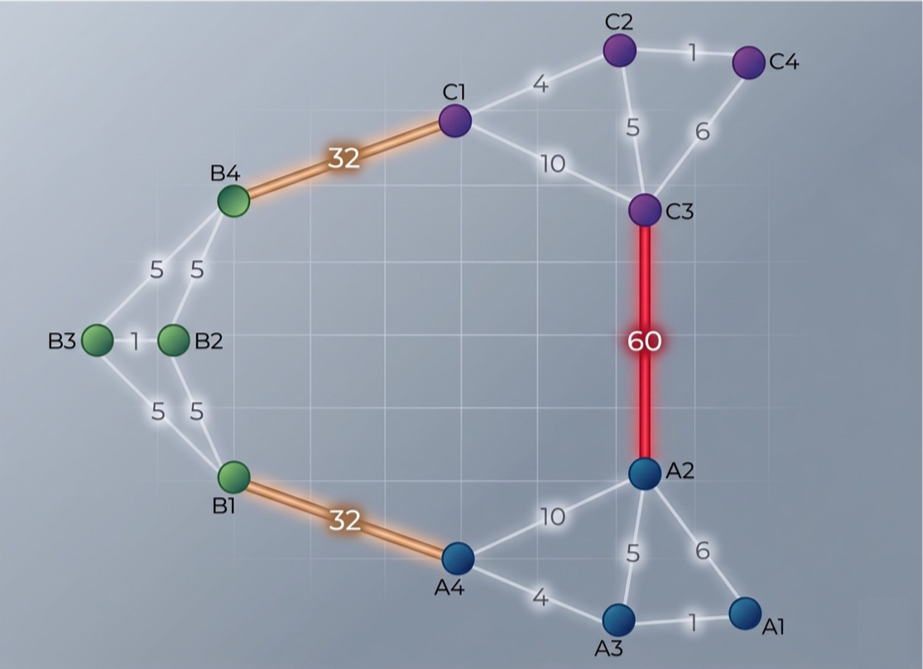
Figure 2: Compression index on the mathematical hypergraph: higher values indicate bridges that compress more structure into a single connection
How, then, might an LLM participate in such discovery? The key idea is that discovery is often a search problem. A mathematician may suspect that some hidden relation exists — perhaps between two formulas, two structures, or two distant parts of a theory — even before the route is visible. The LLM can then serve as an exploratory partner. It can propose candidate lemmas, substitutions, auxiliary definitions, reformulations, analogies, or intermediate conjectures. Most of these will fail. But that is not unusual: such research proceeds through many failed paths before a fruitful one is found.
In this sense, LLM-based discovery can be understood as a mixture of guided search and random search. It is guided because the model has absorbed a large amount of mathematical structure from its training data. It has statistical knowledge of what kinds of definitions, transformations, proof patterns, and analogies tend to make sense. But it also has a random or exploratory side, because genuine discovery often requires moving away from the safest and most standard continuation. New bridges often require trying something less expected.
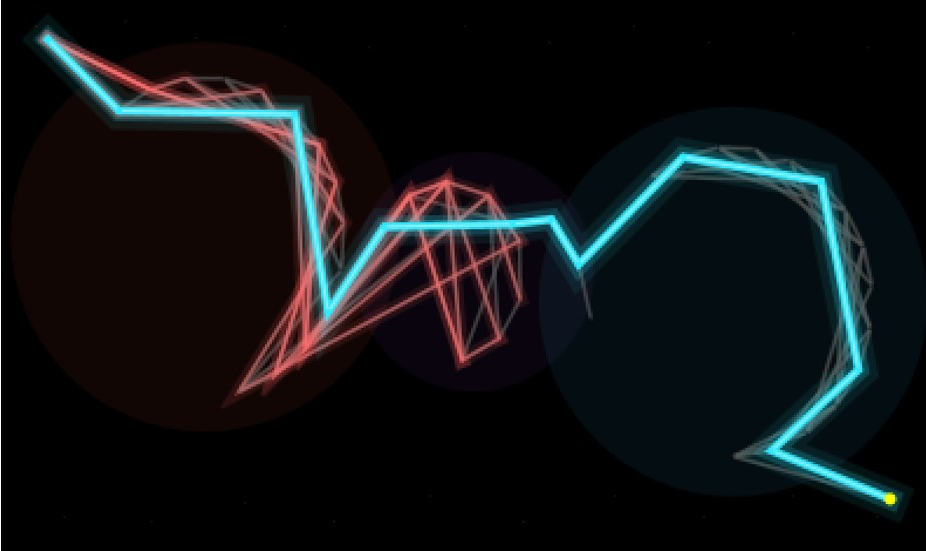
animationGuidedRandomSearch[]:=;animationGuidedRandomSearch[]
Figure 3 (animation): Mathematical discovery as search: many exploratory paths fail before a hidden connection is found. Failed paths are shown in red, and the successful bridge in bright cyan. Only the final snapshot is shown; run animationGuidedRandomSearch[] to see the animation.
This connects directly to the token generation. At each step, the model has a probability distribution over possible next tokens. In routine problem solving, choosing high-probability tokens often works well, because the task is to stay near a known method. But to reach a genuinely new idea, the system may need to sample a lower-probability continuation instead — perhaps a rarer substitution, an unusual auxiliary object, a different viewpoint, or a nonstandard intermediate conjecture. Most such moves will be useless. But occasionally one opens a path that the safest continuation would never have reached.
For example, suppose a human has an intuition about the still-open question of whether every interval from to contains a prime. The human does not yet see a proof, but suspects that the problem might connect to some unexpected transform, auxiliary sequence, or density principle. An LLM agent could then explore many candidate intermediate statements and reformulations much faster than a human could enumerate them by hand. Most will be dead ends. But the value lies in broadening the search over plausible bridges.
2
n
2
(n+1)
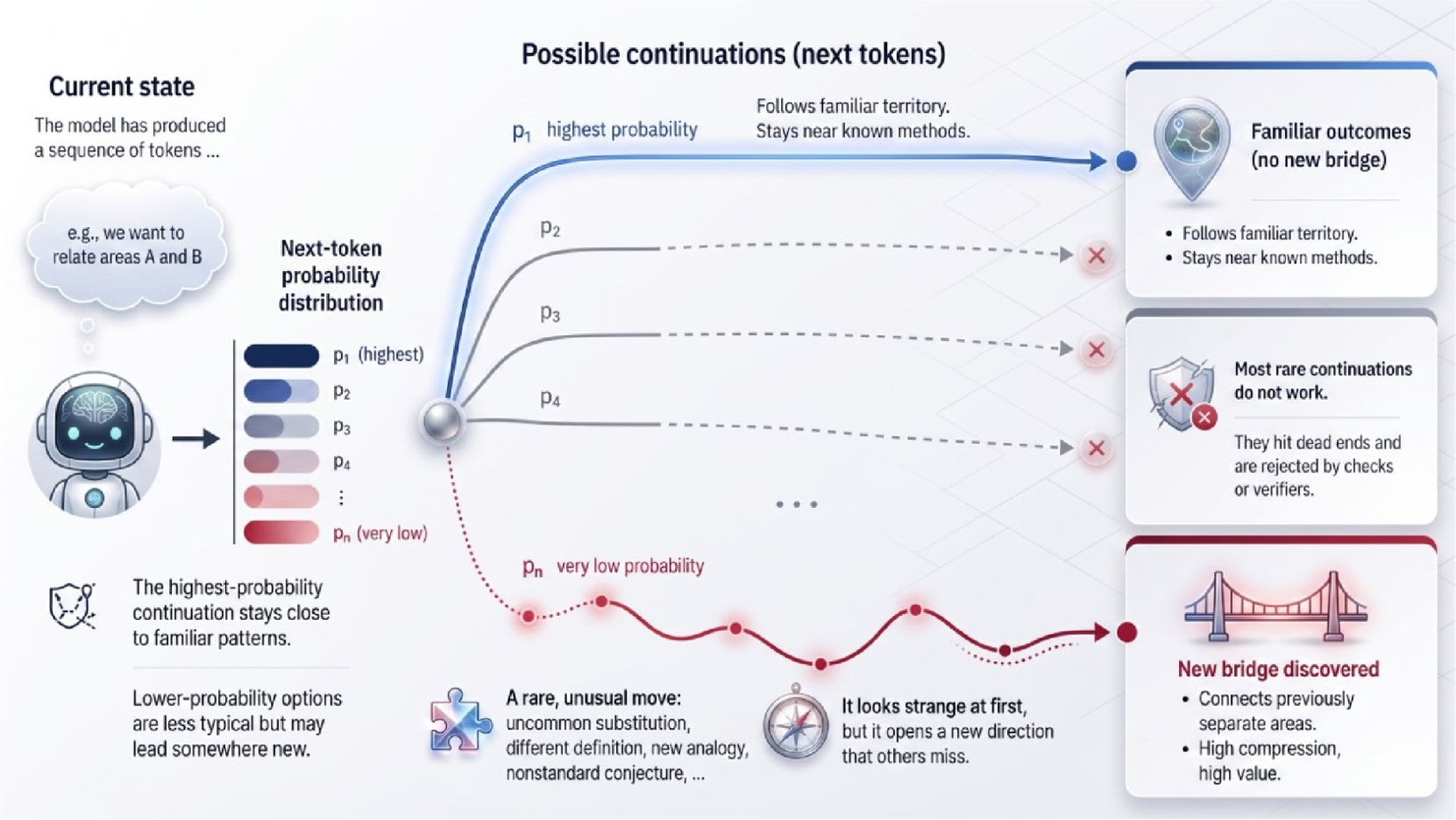
Figure 4: Mathematical discovery may require stepping beyond the highest-probability next token
Verification is crucial here. The more exploratory the search, the more false trails it will produce. A useful discovery system must combine proposal with checking: symbolic verification, theorem proving, or numerical testing. Discovery then becomes a loop of proposing, testing, pruning, and refining.
This also helps explain why general mathematical invention remains so difficult. As the desired importance of the result increases, the search space becomes wider, the promising paths become rarer, and the system must tolerate more exploratory departures from the most probable continuations.
Figure 5: Deeper mathematical invention leads to stronger hypergraph compression, a wider exploratory search space, and hence greater difficulty for LLM-based discovery
Note that in this section, by the “discovery of new mathematics,” I mean the discovery of formal, verifiable mathematics. This is different from the broader machine-learning sense of “discovery,” where an AI system finds approximate relationships in large bodies of input-output data, as in examples such as AlphaFold [18]. Such pattern-finding can be enormously powerful, but it is not the same thing as producing a theorem or proof. Moreover, this approximative power has limits: a finite neural network cannot be expected to compress arbitrarily complex data or bypass processes that are computationally irreducible. In Stephen Wolfram’s terms, AI may help us find “pockets of computational reducibility,” but it cannot eliminate irreducible computation itself [19].
5. Role of a Symbolic Evaluator
5. Role of a Symbolic Evaluator
An efficient LLM for mathematics almost inevitably needs a companion exact system: something like Wolfram Language, SymPy, Lean, or another symbolic and formally checkable environment.
One useful way to think about LLMs is that they behave like statistical approximations to symbolic computation. A symbolic system applies explicit rules to exact mathematical objects; an LLM, by contrast, learns from many examples of such rules being used. It does not usually “know” the rule in the same formal sense, but it develops a highly compressed sense of which transformations, arguments, and intermediate steps are plausible. In this sense, an LLM may be viewed as a kind of first-order or, in more advanced cases, higher-order approximation to symbolic reasoning: it can often imitate the surface and structure of symbolic work, but without the same built-in guarantee of correctness.
Figure 6: LLMs as statistical approximations to symbolic computation
LLM works by predicting plausible next steps, and although this can often look like reasoning, plausibility is not the same as correctness. In mathematics, even a small local error can propagate through a long derivation and produce a result that is polished in appearance but fundamentally wrong. A symbolic evaluator helps prevent this drift by checking local transformations, simplifying expressions exactly, testing identities etc.
Symbolic evaluators are also used in LLMs for local computation: carrying out algebraic manipulations, evaluating special cases, solving sub-problems, expanding expressions, computing examples, or generating exact intermediate results that the model can then build on. In this way, the symbolic system actively helps move the process forward. It serves as a source of exact computational traction inside a broader search carried out by the LLM.
As discussed a while ago, such systems are valuable not only at the inference time, but also during training. They can be used to generate large amounts of synthetic mathematical data: solved examples, verified identities, counterexamples, stepwise derivations etc. This gives the model access to clean mathematical material than would be available from text alone.
Thus, symbolic evaluators do not merely support mathematical competence; they help create it, and form part of the core infrastructure that makes serious mathematical performance by LLMs possible. See [20].
Figure 7: In serious mathematical LLMs, symbolic evaluators are not optional add-ons but core infrastructure for verification, exact computation, and training-data generation
6. Four Levels of Automated Mathematical Discovery
6. Four Levels of Automated Mathematical Discovery
Not all mathematical automation is of the same kind. There is a profound difference between solving a familiar exercise, helping search for an unknown bridge, and independently proposing new directions of exploration. These differences can be organized into four increasingly ambitious levels of automated mathematical discovery.
6.1 Solving a Routine Problem
6.1 Solving a Routine Problem
At the simplest level, an LLM agent is asked to solve a mathematical problem whose method is already well represented in its training. For example, suppose we ask it to solve
Figure 8: ChatGPT solves a quadratic equation
During training, it has absorbed a vast number of examples of equations, transformations, worked solutions, explanations, and symbolic patterns. So when it sees a problem of this kind, it recognizes it as belonging to a familiar class: a quadratic equation. From there it begins generating the next steps token by token, guided by learned regularities such as identifying coefficients, recalling the quadratic formula, computing the discriminant, and simplifying the result.
6.2 Human-Guided Search for a New Bridge
6.2 Human-Guided Search for a New Bridge
At this level, the system is no longer just solving a standard problem by following a known route. Instead a human mathematician begins with a suspicion that some new bridge may exist between two formulas, structures, heuristics, or distant parts of a theory, but does not yet know the path. The human sets the direction of search, the LLM then acts as a large-scale exploratory engine within that human-guided search. This may happen through a carefully designed workflow, or even through a direct open-ended question to an LLM about a previously unsolved research problem.
In either case, the system generates and tests many possible intermediate steps: candidate lemmas, substitutions, auxiliary objects, reformulations, or conjectural links, most of which lead nowhere. But through repeated proposal, checking, and pruning, the search may eventually uncover the missing bridge itself: the key intermediate statement, the right reformulation, or even the full solution path.
The discovery is therefore neither purely human nor fully autonomous. It is a guided search in which the human supplies direction, taste, and judgment, while the machine helps explore the surrounding mathematical space and locate a bridge that was previously unseen. Most AI-assisted mathematical discoveries [3, 4, 14-17] so far belong to this category.
6.3 Autonomous Search for Discovering New Mathematics
6.3 Autonomous Search for Discovering New Mathematics
In the previous section, the human still identifies the frontier to explore. A fully agentic workflow goes one step further: the system begins to propose and rank frontiers of its own. Instead of being given only a fixed problem, the agent is released into a structured mathematical world, the hypergraph, and is asked to search for new mathematics. Its task is not only to continue reasoning, but to decide which possible bridges are worth exploring using the compression index.
That is what makes it agentic in a deeper sense: not merely because it generates unusual continuations, but because it helps decide what is worth exploring, what is worth discarding, and what might truly count as a new bridge.
Early examples of this direction are already visible. AlphaEvolve combines LLM generation with automatic evaluation, allowing AI systems to search through large spaces of possible constructions and algorithms [19, 20]. More recent “AI scientist” and “AI co-scientist” systems go further, trying to generate research ideas, run experiments, evaluate results, and even write papers [23, 24].
6.4 Toward a Synthetic Mathematical Research Community
6.4 Toward a Synthetic Mathematical Research Community
To see how radical such a workflow could become, it helps to think in terms of scale. The exact number of active mathematics researchers in the world is hard to determine sharply, but one published estimate places it on the order of 80,000, while broader definitions can give larger figures. Now imagine not one mathematical agent, but hundreds of thousands of LLM-based agents working in parallel: a synthetic research population comparable in scale to the present human mathematical community.
Each agent could maintain its own evolving local copy of the mathematical hypergraph, continually updated from the research literature. With zbMATH Open reporting around 5 million bibliographic entries [25], such agents could continuously absorb new work, revise their maps of concepts and dependencies, search for new bridges, and turn successful findings into structured reports, formal proofs, or draft papers. Connected to formal systems, exact computation, and mathematical knowledge bases, this would no longer be merely accelerated calculation. It would be an always-active synthetic mathematical community, capable of reproducing, and in some dimensions perhaps surpassing, the present human machinery of mathematical invention.
Figure 9: An imagined population of mathematical agents, continuously reading, updating, exploring, and publishing across the landscape of mathematics.
7. What Still Stands in the Way
7. What Still Stands in the Way
Although the previous section presents an optimistic picture of what full mathematical automation might eventually look like, reaching that stage is far from straightforward. Between today’s AI-assisted mathematics and a mature synthetic research community lie several deep technical, conceptual, and practical challenges. Some of the most important are the following.
7.1 A Fundamental Limitation of AI
7.1 A Fundamental Limitation of AI
As we discussed earlier for LLMs to discover a new bridge typically requires stepping into lower-probability territory: unusual or unfamiliar intermediate constructions. The moment we allow that kind of exploration, the search tree expands enormously. At every stage there are many plausible next tokens, many possible continuations, and therefore many possible branches. In principle this branching process has no natural finite bound.
One may then move to the other extreme and imagine random search. But pure randomness is obviously inefficient, so modern systems instead perform a guided search with some component of randomness or exploration mixed in. That is a sensible strategy, but it does not remove the underlying difficulty. For a given mathematical objective, there is no universal rule that tells us in advance which low-probability branch will later become the fruitful one. A path that looks unlikely at the token level may open the way to a major conceptual bridge, while many seemingly reasonable branches may lead nowhere.
This leads to a fundamental limitation. For a specific mathematical goal, one cannot in general guarantee beforehand that an LLM-driven search will find the right bridge, or find it faster than a human mathematician. The machine may be vastly more systematic, tireless, and scalable. Yet success still depends on how its finite search budget is distributed across an effectively unbounded space of possibilities.
7.2 Formalization and Autoformalization
7.2 Formalization and Autoformalization
A second major challenge is formalization. For mathematics to be checked by symbolic verification systems, informal arguments must be translated into precise formal language. This has already been achieved impressively in certain domains: geometry, olympiad-style problems, algebraic structures, and parts of modern theorem proving, as seen in AlphaGeometry, AlphaProof, and Lean’s mathlib [12, 13, 26]. But general mathematics remains much harder. Research papers often use compressed language, implicit conventions, diagrams, unstated background knowledge, and definitions that depend on the taste and context of a particular field. Turning this into formal code often requires deep mathematical understanding.
There is also no guarantee that formalization is unique [9]. The same mathematical idea can be encoded in many different ways: using different definitions, libraries, abstractions, type structures, or foundational choices. One formalization may be elegant for proving one theorem but awkward for another. This raises a deeper problem: there may not be a universally best formal representation of mathematics that fits all future tasks.
7.3 Limited “Useful” Data and Human Curation
7.3 Limited “Useful” Data and Human Curation
LLMs depend heavily on data. In routine mathematics this is a strength, because the model has seen many examples of standard problems, proofs, explanations, and transformations. But for new mathematical discovery, raw quantity is not enough. The most valuable data is often carefully curated: clean problem sets, verified solutions, formal libraries, annotated derivations, counterexamples, failed attempts, and connections between different fields. Producing such data often requires human judgment.
This makes automation itself dependent on a large amount of non-automated labor. Someone must decide which problems are meaningful, which proofs are correct, which examples are representative, which notations should be standardized, and which failed attempts are instructive rather than noise.
7.4 Development of Symbolic Software Systems
7.4 Development of Symbolic Software Systems
Another challenge is the development of exact symbolic systems (Wolfram Language, SymPy, SageMath, Lean etc.). If LLMs are to participate seriously in mathematical discovery, they need companions that can verify, compute, simplify, search, and formalize with precision. But such systems are themselves extremely difficult to build. A good symbolic system requires years of accumulated mathematical engineering: carefully designed algorithms, decision procedures, libraries, and interfaces. Much of this work is meticulous and intellectually demanding. Ironically, the very systems needed to make LLMs more reliable are among the hardest things to automate.
7.5 Resource Requirements
7.5 Resource Requirements
Finally, there is the question of resources. Large LLMs require enormous computational infrastructure for training, fine-tuning, deployment, and large-scale inference. If we imagine not one mathematical agent but thousands or hundreds of thousands of agents exploring the mathematical hypergraph, the resource demand becomes even more serious. Automated discovery at scale is therefore not only a mathematical problem; it is also an engineering and economic problem.
Figure 10: A synthetic research community still has to pay its electricity bill
8. The Continuing Role of Human Mathematicians
8. The Continuing Role of Human Mathematicians
The challenges just discussed suggest that overcoming the barriers to automation will itself require serious and demanding human involvement. Human mathematicians seem poised to remain central at every plausible level of advanced machine discovery. In fact, the picture seems more encouraging than threatening: as AI grows more capable, human involvement does not vanish, but becomes richer, more ambitious, and more interesting.
8.1 New discovery is hard for LLMs
8.1 New discovery is hard for LLMs
As discussed earlier, the step from solving existing mathematical problems to discovering genuinely new, research-level mathematics is a major conceptual leap for LLMs. Research-level discovery requires opening new paths with higher compression indices within a fully formalized and minutely detailed mathematical hypergraph. Until systems can operate seamlessly and reliably at that level, AI-assisted human discovery is likely to remain the most important and productive mode of progress.
8.2 Mathematics is far from exhausted
8.2 Mathematics is far from exhausted
Even if machines eventually reach autonomous mathematical discovery at Level 3, the sheer combinatorial vastness of mathematics suggests that there will still be ample room for human researchers - for developing specific expertise, taste and sustained attention. The current mathematical universe is not a domain in which we are running out of worthwhile questions. On the contrary, even without advanced machine discovery, human mathematics remains vastly under-explored. There is no sign that the research frontier is approaching saturation, or that the community faces a shortage of deep and interesting problems. If anything, each new conceptual bridge tends to generate further branches of inquiry rather than closing the subject down.
Just as a human researcher today can become deeply learned in a specialized area that has received little attention from others, future mathematicians may still find regions of the mathematical hypergraph that have not been seriously explored by either human or machine agents — and then discover bridges broader automated searches have not yet prioritized.
8.3 Human engineering/research at a higher level
8.3 Human engineering/research at a higher level
This point becomes even stronger if one accepts the eventual arrival of Level 4: a swarm of AI researchers operating continuously, in parallel, across the mathematical landscape. Even then, human researchers are unlikely to become irrelevant. Rather, their role may shift upward. A useful analogy comes from engineering. Before computers, engineers solved simpler design problems largely by hand. With the arrival of computational tools, engineers did not disappear; instead, they began to design and analyze far more complex systems, such as modern bridges, aircraft, communication networks, and control systems. Computation expanded the scale of feasible engineering rather than replacing the engineer. Something similar is likely in mathematics and mathematical science.
In that sense, AI-driven mathematical systems may magnify human research. Human mathematicians, scientists, and engineers may increasingly work with powerful AI partners or even entire swarms of them — to tackle problems whose complexity lies far beyond what either humans or earlier machines could manage alone. Such problems might include planetary-scale climate modeling and control systems, autonomous space habitats, futuristic spacecraft optimized across propulsion, energy, and life-support constraints, or even global biological and ecological models that integrate medicine, agriculture, epidemiology, and environmental science.
8.4 What is Mathematics Ultimately For?
8.4 What is Mathematics Ultimately For?
At one level, mathematics is pursued for the sheer joy of intellectual endeavor: the delight of seeing a hidden pattern, solving a hard problem, or finding that two distant ideas are secretly connected. As we discussed, this joy is not likely to diminish with the progress of automated mathematical discovery. At every new level of automation, new landscapes will open up: more structures to explore, and more ambitious systems to build. Just as computers did not remove the joy of engineering but enabled engineers to design far more complex bridges, aircraft, and simulations, AI-assisted mathematics may allow human beings to participate in deeper and larger forms of discovery.
But the primary purpose of mathematics should be connected to the well-being of human beings and, more broadly, all living beings. Human beings feel suffering, happiness, fear, hope, and aspiration. Because of this, they can sense the need for social, technological, medical, emotional, and ecological progress. They can recognize obstacles in life and ask what kinds of systems, tools, institutions, and technologies might reduce suffering and increase flourishing. This human experience then guides the direction of invention: what technologies should be built, what sciences should be advanced, and therefore what kinds of mathematics are most worth developing.
A good example is the mathematics surrounding Feynman integrals. Much of this deep and highly sophisticated mathematics has grown because Feynman integrals sit at the heart of particle physics. Their study has led to rich developments involving special functions, differential equations, algebraic geometry, periods, polylogarithms, and computational methods. These are beautiful mathematical structures in their own right, but their importance is also tied to physics: to understanding the fundamental constituents of nature and to enabling technologies that may eventually shape human life in practical ways.
9. The Human–LLM–Symbolic Triad of Discovery
9. The Human–LLM–Symbolic Triad of Discovery
At present, one of the most powerful practical architectures for advancing AI-assisted mathematics is not the LLM alone, nor the human mathematician alone, nor the symbolic evaluator alone, but the collaboration of all three. Each component contributes something essential that the others lack.
i. The human mathematician provides direction, judgment, taste, and the ability to recognize which questions are actually meaningful. They also connect mathematics to broader scientific and human goals.
ii. The LLM contributes speed, breadth, and the ability to rapidly explore many candidate paths.
iii. The symbolic evaluator provides exactness. It can verify local steps, test conjectures, carry out difficult computations, and prevent the process from drifting into plausible but false reasoning.
Progress in future mathematics and science may depend precisely on this kind of collaboration: imagination guided by intelligence, accelerated by generation, and stabilized by exactness.
Figure 11: The powerful Human–LLM–Symbolic triad of mathematical discovery
The complementarity involved in this triad is nice. LLMs can help write better code, interfaces, and automation around symbolic systems, making them easier and faster to build and use. In turn, symbolic evaluators can support LLMs by checking steps, generating synthetic training data, supplying exact computations, and serving as a reliable computational backbone during inference. Human mathematicians sit above and within this loop: choosing goals, interpreting outputs, pruning bad directions, and recognizing promising bridges that deserve further development.
For this reason, the most plausible near- and medium-term future is not one in which one component replaces the others, but one in which this combined stack becomes the dominant mode of serious mathematical work. It is hard to see a more effective practical architecture emerging soon, and this triad may well shape the field for a long time. This view is increasingly echoed by several prominent mathematicians and recent discussions on AI and mathematics [5-7, 20, 21, 26, 27].
This may not be just a good architecture for AI-assisted mathematics, but an early glimpse of how Artificial General Intelligence (AGI), may have to function in practice. Mathematics makes the need especially visible because the domain is unforgiving: a single wrong step can collapse an argument, and exact external verification is often possible. But the deeper lesson is broader. Pure generative fluency, by itself, is too unstable a foundation for serious long-horizon intelligence. It becomes far more powerful when embedded in a larger stack that supplies grounding, correction, memory, and control. In that sense, the Human–LLM–Symbolic stack may be one of the clearest early prototypes of a practical AGI architecture. In this connection, Wolfram Language, with its unusually broad symbolic, algorithmic, and computational reach, seems like a particularly strong candidate for the kind of exact symbolic assistance such a stack requires.
10. The Moral Weight of AI
10. The Moral Weight of AI
Although this point is not directly about automated machine discovery, I feel compelled to include it. Any serious discussion about the future of AI and mathematics should also ask what kind of responsibility comes with such power.
Every powerful technology comes with responsibility. A simple knife can illustrate the point. In the hands of a doctor, it can save a life; in the hands of a criminal, it can take one. The same is true of AI, only on a much larger scale. The more powerful a technology becomes, the greater the moral maturity required to handle it well. In the excitement of inventing, improving, and using new technologies, we often forget this dimension. We focus on what can be built, what can be automated, and what can be achieved, but not always on the kind of human beings we must become in order to use these powers responsibly.
A related concern is that AI may make us intellectually lazy and gradually weaken our capacity for deep thinking. But again the problem lies not simply in the tool, but in how we choose to use it. If we hand over our judgment, curiosity, and effort to machines, then we are failing to play our part responsibly. As discussed earlier, AI can open many new avenues for exploration, experimentation, and understanding. Used actively, it can expand the range of questions we are able to pursue rather than replace the human desire to think, discover, and understand.
There is the speculation that, in some future scenario, machines may dominate human beings and reduce us to servants or even slaves. Here I think one fundamental distinction must be kept in view: human beings are conscious, whereas machines are not. Utility, value, and purpose can be properly grounded only when they are connected to the flourishing of conscious beings. A world in which machines dominate human beings without regard for human well-being would not be a higher form of intelligence; it would be a deeply disordered and purposeless situation. The point of technology cannot be the supremacy of the tool over the user, but the wise use of the tool for the genuine good of conscious life.
11. Closing Remarks
11. Closing Remarks
Symbolic systems and LLMs represent two complementary approaches to mathematics. Symbolic systems are built from first principles and offer exactness, but they are difficult to extend across the full range of mathematical thought. LLMs are broad, flexible approximations: easier to train across many domains, but not inherently reliable as exact reasoners. The most exciting future lies in coordinating them: the LLM as explorer, the symbolic system as the exact backbone, and the human mathematician as the source of guidance and purpose. Seen in this way, the coming age of AI-assisted mathematics should not be viewed as a replacement for mathematical thought, but as a way of giving it a larger field of action.
The anxieties surrounding AI are real, but they should be interpreted carefully. Every powerful instrument magnifies intention. In the hands of fear, greed, or narrow ambition, it can magnify confusion and harm. In the hands of wisdom, responsibility, and service, it can magnify understanding, creativity, and human flourishing.
The task before us, therefore, is not to retreat from AI, nor to worship it, but to guide it. We should meet these systems with clarity, humility, and moral seriousness. If our aim is deeper discovery, better education, stronger scientific tools, and the welfare of all living beings, then AI can become not a threat to human intelligence, but one of its most powerful extensions. Mathematics, in such a future, does not become less human; it becomes more collaborative, more adventurous, and more capable of serving the deepest purposes of knowledge.
Further readings: For readers who would like to explore the recent developments in this area more systematically, I have created a curated resource: https://www.wolframcloud.com/obj/jayantap/AIMath2025-26 . It collects selected papers, news articles, and programs related to AI-assisted mathematics. Each entry includes a brief summary, so the resource can be used both as a quick overview and as a pointer for deeper reading.
AI disclaimer: I used AI to generate some images and polish parts of the text. The ideas and overall substance of this article, however, come from my own reading, reflection, and engagement with the topic. I carefully reviewed every AI-assisted change to make sure it preserved my original intent and, where possible, made the expression clearer.
Acknowledgements: I wish to thank my supervisor Devendra Kapadia and Roger Germundsson for our many helpful discussions. I am also very grateful to a few friends for several lengthy and insightful conversations on this topic.
12. References
12. References
1. Luong, Thang, and Edward Lockhart. “Advanced Version of Gemini with Deep Think Officially Achieves Gold-Medal Standard at the International Mathematical Olympiad.” Google DeepMind, 21 July 2025.
2. Castelvecchi, Davide. “AI models solve maths problems at level of top students.” Nature 644.7 (2025): 1.
3. Howlett, Joseph. “An Amateur Just Solved a 60-Year-Old Math Problem—by Asking AI.” Scientific American, edited by Lee Billings, 24 Apr. 2026,
4. Udinmwen, Efosa. “‘Essentially No Human Intervention’: Chinese AI Solves 12-Year-Old Math Problem in Just 80 Hours—and Even Proves It.” TechRadar, 17 Apr. 2026,
5. “Terence Tao: AI Is Ready for Primetime in Math and Theoretical Physics.” OpenAI Academy, 6 Mar. 2026, academy.openai.com/public/blogs/terence-tao-ai-is-ready-for-primetime-in-math-and-theoretical-physics-2026-03-06. Accessed 1 May 2026.
6. Klowden, Tanya, and Terence Tao. “Mathematical methods and human thought in the age of AI.” arXiv preprint arXiv:2603.26524 (2026).
7. Commelin, Johan, et al. “Shaping the Future of Mathematics in the Age of AI.” arXiv preprint arXiv:2603.24914 (2026).
8. “Mathematical Beauty, Truth and Proof in the Age of AI”, Quanta Magazine, https://www.quantamagazine.org/mathematical-beauty-truth-and-proof-in-the-age-of-ai-20250430/
9. Barkeshli, Maissam, Michael R. Douglas, and Michael H. Freedman. “Artificial intelligence and the structure of mathematics.” arXiv preprint arXiv:2604.06107 (2026).
10. Turing, Alan Mathison. “On computable numbers, with an application to the Entscheidungsproblem.” J. of Math 58.345-363 (1936): 5.
11. Wolfram, Stephen. “What Is ChatGPT Doing:... and Why Does It Work?”. Wolfram Media, 2023.
12. Trinh, Trieu, and Thang Luong. “AlphaGeometry: An Olympiad-Level AI System for Geometry.” Google DeepMind, 17 Jan. 2024.
13. AlphaProof and AlphaGeometry teams. “AI Achieves Silver-Medal Standard Solving International Mathematical Olympiad Problems.” Google DeepMind, 25 July 2024.
14. Romera-Paredes, Bernardino, et al. “Mathematical Discoveries from Program Search with Large Language Models.” Nature, vol. 625, 2024, pp. 468–475.
15. Weil, Kevin. “Early Experiments in Accelerating Science with GPT-5.” OpenAI, 20 Nov. 2025.
16. Dobriban, Edgar. “Solving a Research Problem in Mathematical Statistics with AI Assistance.” arXiv, 2025, arXiv:2511.18828.
17. Grebík, Jan, et al. “Bolzano: Case Studies in LLM-Assisted Mathematical Research.” arXiv, 2026, arXiv:2604.16989.
18. Jumper, John, et al. “Highly Accurate Protein Structure Prediction with AlphaFold.” Nature, vol. 596, no. 7873, 2021, pp. 583–589. Nature, https://doi.org/10.1038/s41586-021-03819-2.
19. Wolfram, Stephen. “Can AI Solve Science?” Stephen Wolfram Writings, Mar. 2024, writings.stephenwolfram.com/2024/03/can-ai-solve-science.
20. Wolfram, Stephen. “Making Wolfram Tech Available as a Foundation Tool for LLM Systems,” Stephen Wolfram Writings, 2026. writings.stephenwolfram.com/2026/02/making-wolfram-tech-available-as-a-foundation-tool-for-llm-systems.
21. Georgiev, Bogdan, Javier Gómez-Serrano, Terence Tao, and Adam Zsolt Wagner. “Mathematical Exploration and Discovery at Scale.” arXiv, 2025. arXiv:2511.02864.
22. Novikov, Alexander, et al. “AlphaEvolve: A Coding Agent for Scientific and Algorithmic Discovery.” arXiv, 2025. arXiv:2506.13131.
23. Gottweis, Juraj, et al. “Towards an AI Co-Scientist.” arXiv, 2025. arXiv:2502.18864.
24. Lu, Chris, et al. “Towards End-to-End Automation of AI Research.” Nature, vol. 651, 2026, pp. 914–919. doi:10.1038/s41586-026-10265-5.
25. Schlitzer, Enrico. “zbMATH Open: New Features and Achievements in 2024.” European Mathematical Society, 11 Jan. 2025, euromathsoc.org/news/zbmath-open%3A-new-features-and-achievements-in-2024-138.
26. The mathlib Community. “The Lean Mathematical Library.” Proceedings of the 9th ACM SIGPLAN International Conference on Certified Programs and Proofs, Association for Computing Machinery, 2020, pp. 367–381. https://doi.org/10.1145/3372885.3373824
27. Kakaes, Konstantin. “The AI Revolution in Math Has Arrived.” Quanta Magazine, 13 Apr. 2026, www.quantamagazine.org/the-ai-revolution-in-math-has-arrived-20260413/
CITE THIS NOTEBOOK
CITE THIS NOTEBOOK
LLMs, symbolic computation, and the future of mathematical discovery
by Jayanta Phadikar
Wolfram Community, STAFF PICKS, May 4, 2026
https://community.wolfram.com/groups/-/m/t/3711368
by Jayanta Phadikar
Wolfram Community, STAFF PICKS, May 4, 2026
https://community.wolfram.com/groups/-/m/t/3711368