PhysicsModelLink in action: a Galton board, cascaded by Claude
PhysicsModelLink in action: a Galton board, cascaded by Claude
A propos of Arnoud Buzing's PhysicsModelLink announcement — what happened when I pointed Claude at the paclet
Claude with a bit of help from me — github.com/mthiel74/GaltonBoard
The result
The result
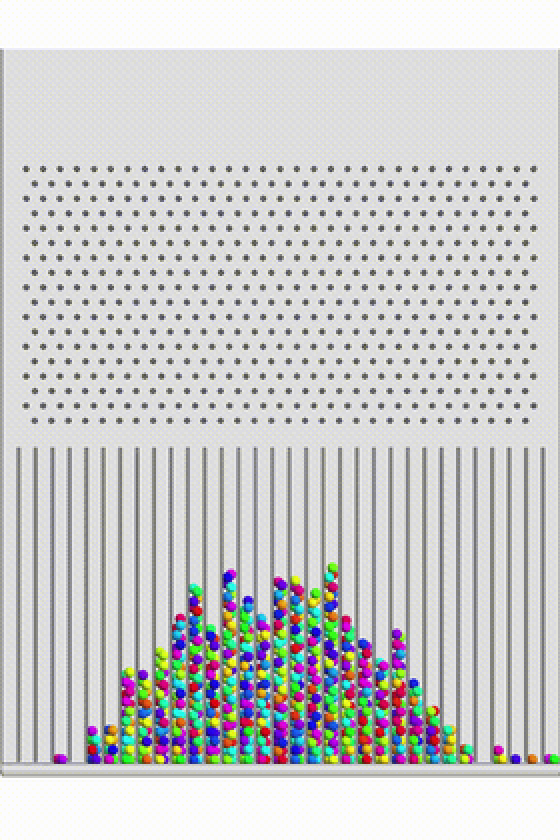
Six hundred balls, dropped one after another into a narrow funnel above a 31×18 alternating-offset peg array. Each ball bounces off real Cylinder pegs (wrapped as FixedBody) under gravity, settles into one of 33 bins, and the pile in those bins forms the expected bell curve:
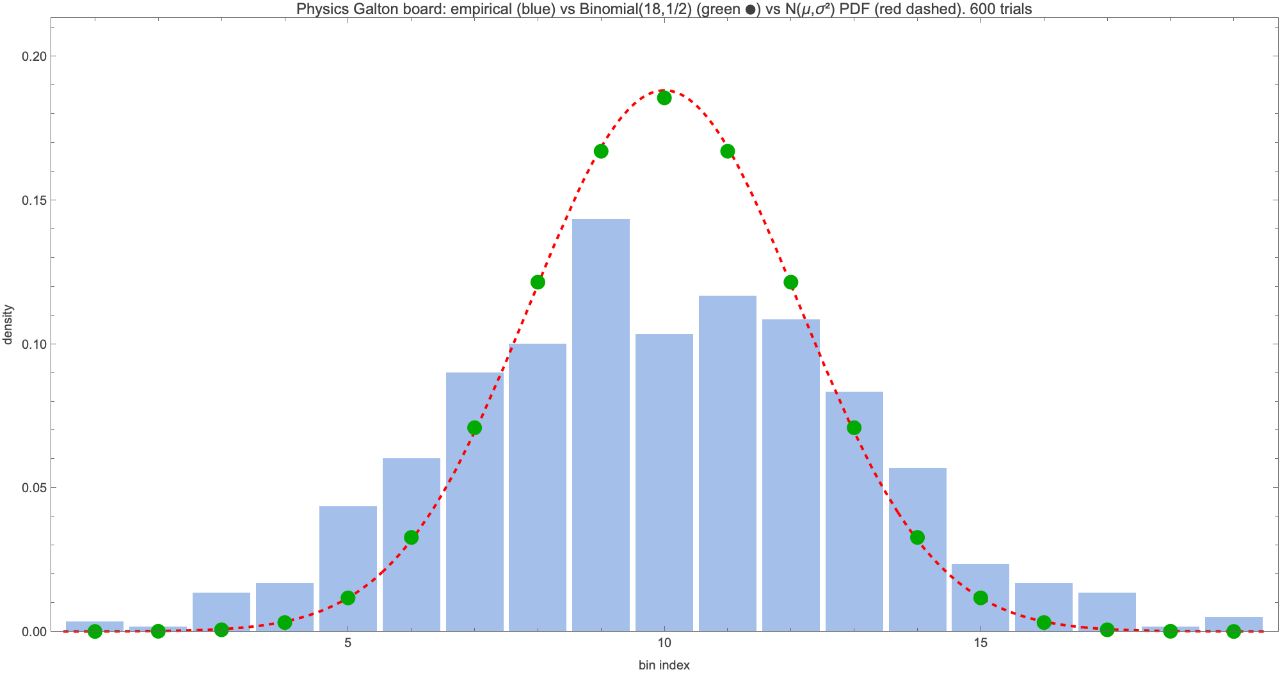
The complementary statistical view — 600 independent single-ball simulations, final bin index compared against Binomial(18, 1/2) and the Normal approximation predicted by the central-limit theorem:
How this came about
How this came about
Arnoud's original post ends with an observation about LLMs lowering the cost of writing boilerplate wrapper code. I wanted to test a closely-related idea: can you point a coding agent at a paclet and have it build a new project on top of that paclet? I opened an empty GitHub folder and typed the following one-liner into Claude Code:
"Hi, this is an empty repo (please make an online one for this). I would like you to use wolframscript to make a Galton Board (i.e. balls 'running over' pegs to give the Normal distribution) based on this paclet https://www.wolframcloud.com/obj/arnoudbuzing/DeployedResources/Paclet/ArnoudBuzing/PhysicsModelLink/. Commit and push regularly."
Claude followed the URL, ran PacletInstall[ResourceObject["..."]], read the PhysicsModelLink.wl source to learn the CreatePhysicsModel / DynamicBody / FixedBody / PhysicsModelEvolve / PhysicsModelVideo API, and pushed a first working single-ball prototype within a few minutes. Between that prototype and the animation above were several iterations — not about writing new code, but about choosing geometry and parameters that actually produce the Binomial distribution:
◼ A "triangular" peg layout was eliminated because balls slid down the outside of the triangle and collected in the edge bins. A rectangular, alternating-offset lattice fixed that.
◼ The same-row peg-edge gap must be greater than the ball diameter (we ended up at 0.17 m vs 0.15 m), otherwise balls wedge.
◼ The outermost peg-to-wall gap has to satisfy the same constraint (fix: fewer pegs per row on the outside, walls further out).
◼ Rapier puts a body to sleep when its motion is very small; a ball that balances exactly on a peg top then sits there forever. A tiny per-step linear-velocity refresh (damping 0.99 every 4 physics steps) keeps the bodies awake and also approximates air drag.
◼ Per-trial peg-x jitter (~0.004 m) is the only non-deterministic ingredient; gravity, collisions and bounces are all real rigid-body physics.
◼ Pegs have to extend beyond the Binomial's 5σ range or residual chaos bunches balls in the extreme bins (we ended up with 31 columns over 25 bins of Binomial width).
Every one of these changes was my physical observation ("some pegs are horizontally closer than others — balls wedge there", "the balls slide along the outer edge of the triangle", "the outermost peg-to-wall gap is too small"...) typed as a short sentence. Claude did the tuning and rebuilt the notebook. The total turn-around from observation to new render was a few minutes each time.
The physics layer
The physics layer
The whole board geometry lives in a tiny shared package, GaltonBoard`, in scripts/board.wl. The parameters that ended up producing the bell curve are:
$PegRows = 18;
$PegCols = 31; (* 31 pegs in even rows, 30 in odd *)
$PegRadius = 0.035;
$BallRadius = 0.075; (* ball diameter 0.15 m *)
$PegDx = 0.24; (* same-row peg-edge gap = 0.17 m > ball dia *)
$PegDz = 0.21;
$NBins = 33; (* > Binomial 5-sigma range *)
$SlabHalfY = 0.13;
$PegCols = 31; (* 31 pegs in even rows, 30 in odd *)
$PegRadius = 0.035;
$BallRadius = 0.075; (* ball diameter 0.15 m *)
$PegDx = 0.24; (* same-row peg-edge gap = 0.17 m > ball dia *)
$PegDz = 0.21;
$NBins = 33; (* > Binomial 5-sigma range *)
$SlabHalfY = 0.13;
Pegs are constructed with FixedBody[{color, Cylinder[...]}, "Restitution" -> 0.5, "Friction" -> 0.0] — zero friction so a ball that happens to balance on a peg top slides off rather than being grabbed by static friction.
to cover >5-sigma of the Binomial(18, 1/2) distribution
so extreme bins are statistically empty. *)
$NBins::usage = "$NBins = number of bins at the bottom. Odd so that bins are symmetric about x=0. Larger than $PegRows+1 and wider than the peg array's x-extent so that no ball is forced into an extreme bin just by falling off the edge of the peg grid.";
$NBins = 33;
PegList::usage = "PegList[] returns the (pristine) rectangular peg grid. PegList[jitter] returns the same grid with each peg's x-coordinate perturbed uniformly in [-jitter, jitter]; call with a fresh RandomReal seed per simulation to generate trial-to-trial variation.";
PegList[] := PegList[0.0];
PegList[jitter_?NumericQ] := Module[{row, j, xj, x, pegs = {}, nPegs, firstX},
Do[
If[OddQ[row],
(* odd row: one FEWER peg, offset so the row is symmetric about 0 *)
nPegs = $PegCols - 1;
firstX = -(($PegCols - 2)/2.0) * $PegDx,
(* even row *)
nPegs = $PegCols;
firstX = -(($PegCols - 1)/2.0) * $PegDx
];
Do[
x = firstX + j * $PegDx;
xj = x + If[jitter > 0, RandomReal[{-jitter, jitter}], 0.];
AppendTo[pegs,
FixedBody[{GrayLevel[0.35],
Cylinder[{{xj, -$SlabHalfY, -row*$PegDz},
{xj, $SlabHalfY, -row*$PegDz}}, $PegRadius]},
"Restitution" -> 0.5, "Friction" -> 0.0]],
Dropping the balls
Dropping the balls
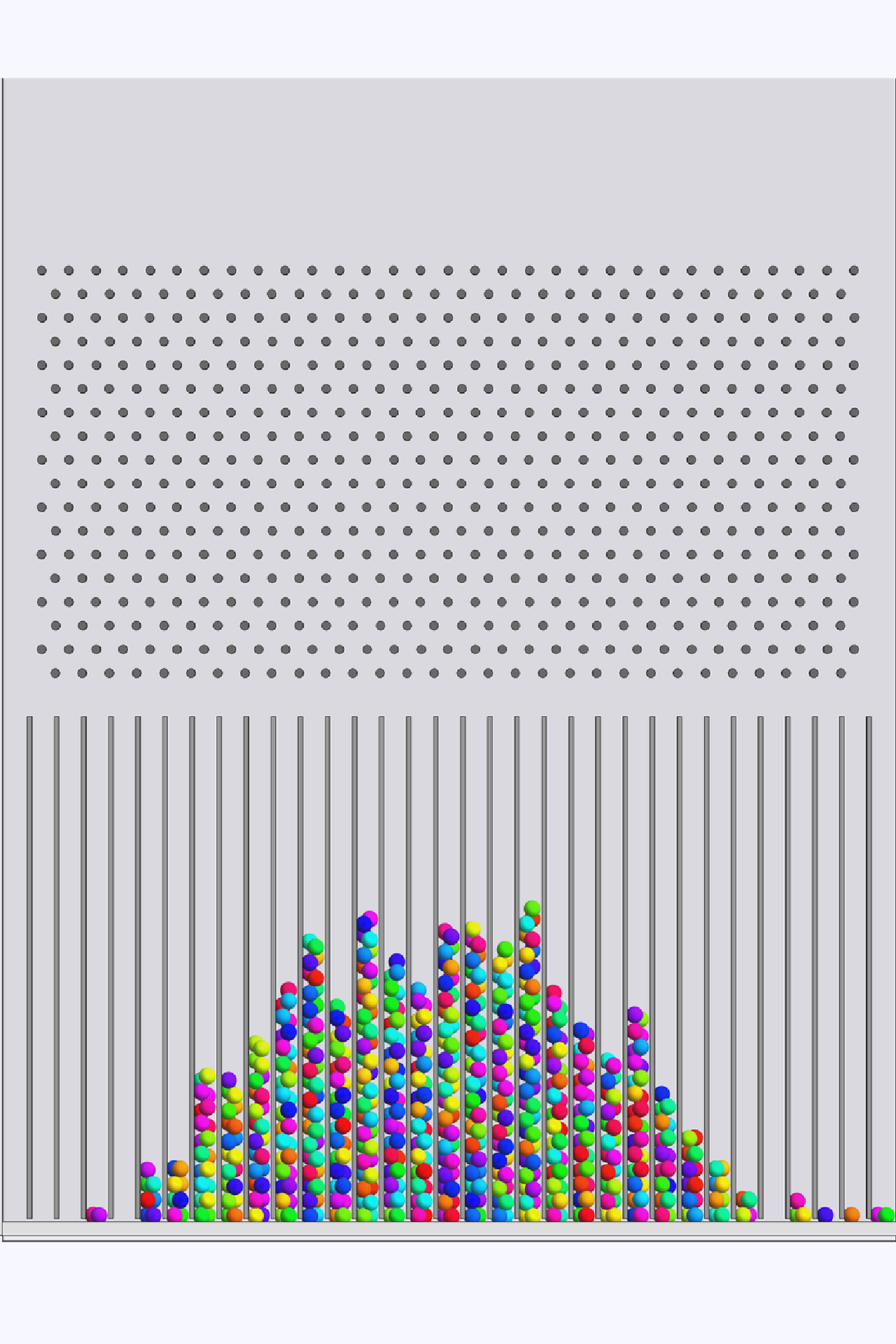
The animation script drops nBalls = 600 balls — stacked vertically above the board with 0.5 m between them so each ball's arrival at the top peg is staggered by ~0.03 s. The only 'non-physical' ingredient is a gentle per-step velocity refresh that prevents Rapier's body-sleep mechanism from freezing balls on peg tops:
current = model;
prevPoss = Table[current[[1]]["Bodies"][[k]]["Position"], {k, 1, nBalls}];
frames = Reap[
Do[
current = PhysicsModelIterate[current, 1, dt];
If[Mod[step, dampEvery] == 0,
Do[Module[{curPos, vel},
curPos = current[[1]]["Bodies"][[b]]["Position"];
vel = (curPos - prevPoss[[b]]) / (dampEvery * dt);
RapierSetBodyVelocity[worldId, ballHandles[[b]], vel * damping];
prevPoss[[b]] = curPos],
{b, 1, nBalls}]];
Sow[current],
{step, 1, nFrames}]][[2, 1]];
Everything else — gravity ({0, 0, -9.81}), ball–peg collisions, ball–ball collisions, ball–wall collisions, energy loss through restitution — is native Rapier.
Independent-trial statistics
Independent-trial statistics
To decouple the distribution from any ball-ball interactions, a second script (scripts/03_histogram.wls) runs N = 600 independent single-ball simulations and records the final bin. The loop is simply CreatePhysicsModel PhysicsModelIterate loop BinIndex[finalX] DestroyPhysicsModel. That yields the blue bars in the overlay figure near the top of this post, tracking Binomial(18, 1/2) and the Normal PDF closely.
What I take from this
What I take from this
1. A paclet is now a pointer. The entire project started from a URL. Claude installed the paclet, read its source, used its high-level CreatePhysicsModel / PhysicsModelEvolve API, and turned out a working simulation without me writing a line of code. That is the same shape of interaction Arnoud describes for LLM-assisted LibraryLink work, but instead of pointing the LLM at a C header, I point it at a whole paclet.
2. The hard part stayed hard — physically correctly parameterising a Galton board. Running the simulation was instant. Getting it to actually produce the Binomial(18, 1/2) took several rounds of iteration, which were driven by physical intuition ("look, balls are wedging between pegs there"). Claude could see the distribution counts and the image but could not, without being told, reason about the 5 mm of peg-edge clearance or the Rapier body-sleep heuristic. Collaborators, not full replacements (yet).
2. The hard part stayed hard — physically correctly parameterising a Galton board. Running the simulation was instant. Getting it to actually produce the Binomial(18, 1/2) took several rounds of iteration, which were driven by physical intuition ("look, balls are wedging between pegs there"). Claude could see the distribution counts and the image but could not, without being told, reason about the 5 mm of peg-edge clearance or the Rapier body-sleep heuristic. Collaborators, not full replacements (yet).
The whole project — seven evolutionary scripts, the Rapier parameterisation, 600 trials of single-ball statistics, the video, the GIF, the histogram — sits at github.com/mthiel74/GaltonBoard. Feedback and further parameter tweaks welcome.
Thanks Arnoud — the paclet is great fun to work with.