Hydrogen Atom: Fine Structure of Energy Levels
Hydrogen Atom: Fine Structure of Energy Levels


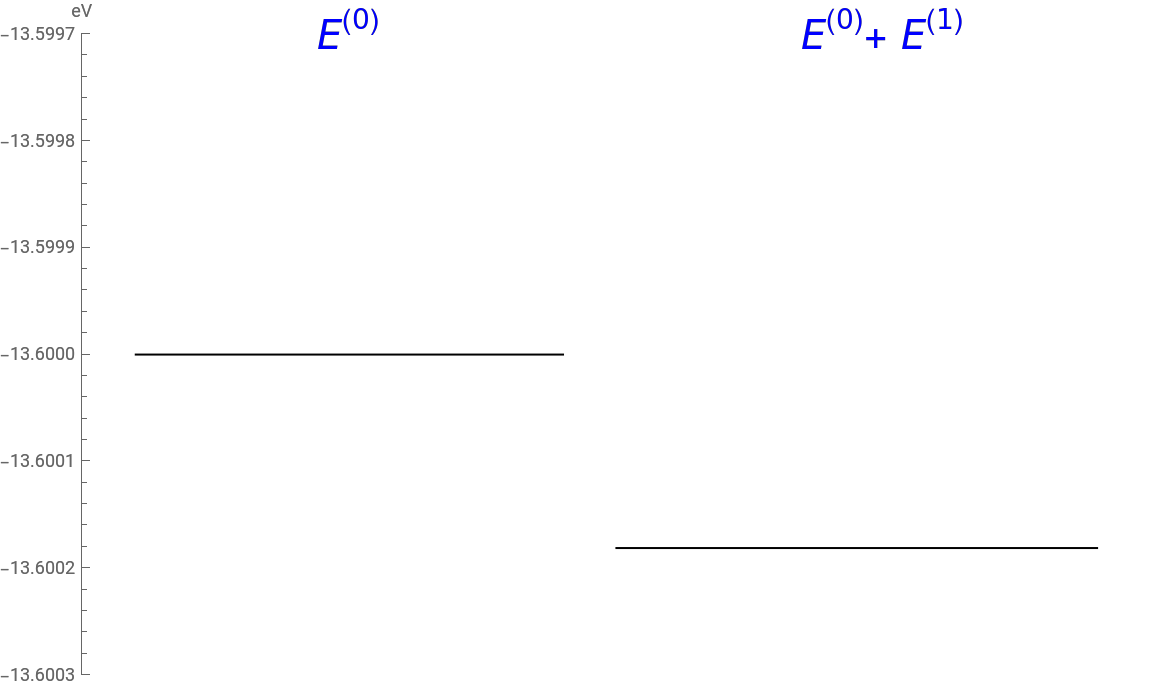
The energy levels of the hydrogen atom , taking account only of the Coulomb interaction between the electron and proton, are shown on the left. Perturbed energy levels +, also including spin-orbit interaction and relativistic corrections, produce the so-called fine structure, as shown on the right.
(0)
E
(0)
E
(1)
E
Details
Details
Atomic structure, specifically for the hydrogen atom, is determined principally by Coulomb interactions among electrons and the nucleus. This leads to the unperturbed energy . There also exist smaller contributions to the energy, most notably from spin-orbit interactions. These are interactions between orbital and spin magnetic moments of the electron, represented by the Hamiltonian
(0)
E
H'
so
2
e
2
2
m
e
2
c
3
r
l
s
where and are the orbital and spin angular momenta, respectively. A secondary perturbation comes from relativistic corrections to electron kinetic energy, represented by a term in the Hamiltonian of the form
l
s
H'
rel
4
p
8
2
m
e
2
c
The total fine structure is then represented by the perturbation
H'
α
H'
so
H'
rel
with a first-order energy correction
(1)
E
This gives the total energy of the state , , to first order in perturbation theory,
n
j
E
nj
(0)
E
n
(1)
E
nj
m
e
4
e
2
ℏ
2
2
n
2
α
n
1
j+1/2
3
4n
where is the principal quantum number, is the total electronic angular momentum quantum number and is the fine-structure constant /ℏc≈1/137.
n
j
α
2
e
External Links
External Links
Permanent Citation
Permanent Citation
Lukás Rafaj
"Hydrogen Atom: Fine Structure of Energy Levels"
http://demonstrations.wolfram.com/HydrogenAtomFineStructureOfEnergyLevels/
Wolfram Demonstrations Project
Published: May 23, 2017