Fractional Ornstein-Uhlenbeck Process
Fractional Ornstein-Uhlenbeck Process


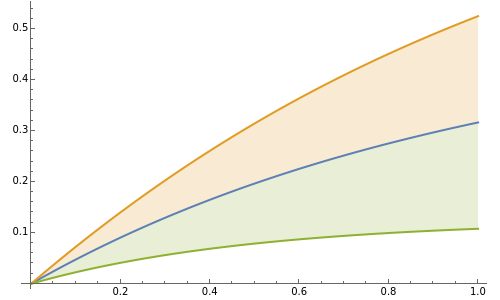
The first two moments (mean and variance) of an Ornstein–Uhlenbeck (OU) process are approximated with stochastic expansions (linear combinations of iterated integrals of the paths). The first three parameters are the usual parameters for an OU process: a high mean reversion makes the convergence to the mean faster and a high volatility increases the variance. The Hurst index controls the roughness of the fractional Brownian motion: the higher the value, the smoother the path. At Hurst index 0.5, this reduces to the usual Brownian motion.
This is a simple application of the theory of rough paths. The same approach can be used for a large class of drivers, not just fractional Brownian motion, and is applicable to more complicated models. Once a stochastic expansion is derived, it can be used for local simulation, moment approximations, or parameter estimation.
References
References
[1] T. J. Lyons, M. J. Caruna, and T. Lévy, "Differential Equations Driven by Rough Paths," in Ecole d'eté de Probabilités de Saint-Flour, XXXIV, (J. Picard, ed.), Berlin: Springer, 2007.
[2] A. Papavasiliou and C. Ladroue, "Parameter Estimation for Rough Differential Equations." (2010) http://arxiv.org/abs/0812.3102.
Permanent Citation
Permanent Citation
Christophe Ladroue, Christophe Ladroue, Anastasia Papavasiliou, Christophe Ladroue
"Fractional Ornstein-Uhlenbeck Process"
http://demonstrations.wolfram.com/FractionalOrnsteinUhlenbeckProcess/
Wolfram Demonstrations Project
Published: October 4, 2010