Background
Background
The World We Can Compute
The World We Can Compute
There is something really interesting about our role and place in the universe. In order for us to survive in a world full of information, we have developed some internal guidance or some sort of translating mechanism in the form of human narratives that are linked not only to our nature, but also to the meanings and concepts we create through these same dynamics. Therefore, in order for us to survive, we may need to remain coherent within this interplay, which may lead us to ask ourselves: What is our role in all these interactions? Do we even have a role, or are we just part of a bigger system, with our behavior and apparent “decisions” being the result of determinism? This is where observer theory comes into play.
We can fairly say that we are observers within this universe, but do not mistake observation for passiveness. The act of observation involves transformation and the active compression of many possibilities. We reflect a lot of ourselves in the reality we make or, in other words, in the way we sample the Ruliad. We do this in such a way because we are the way we are as observers. We do this through equivalencing, which refers to the ability or mechanism we have to take different aspects of the universe and treat them as one. We are constantly engaged in a coarse-graining process that helps us construct this narrative because, otherwise, due to our computational boundedness, meaning that we cannot process all the raw information from the world, we would not be able to maintain it coherently. At the same time, following the Principle of Computational Equivalence, the dynamics happening inside us may not be fundamentally less capable than those occurring outside us, and this provides us with a framework in which one can ask how, in a world whose evolution may be computationally irreducible, computationally bounded observers like us can make sense of anything at all, and yet, somehow still manage to construct coherent descriptions of it.
Knowing the underlying rule does not necessarily mean that we can jump ahead and know what the future state will look like. In a computationally irreducible process, the resulting pattern may be found only by following the computation step by step. The coherent reality accessible to an observer depends on what it samples, where it is situated, and which distinctions it treats as equivalent. Another important property of us as observers is that, even if we and everything around us are constantly changing, we still have this sense of persistence. We can see persistence as an act of equivalencing across time, in which the observer identifies a stable higher-level pattern and ignores changes that do not destroy that pattern. What persists is an organization, relation, or pattern. We preserve some of these distinctions and discard others, while maintaining stable internal descriptions long enough for them to support further computation.
This project aims to tackle one of the main conditions of being an observer and asks: When an observer identifies something as persistent, how much of it can still be recognized after perturbation is added? Once perturbation is introduced, how robust can we be through equivalencing?
Observers in Cellular Automata
Observers in Cellular Automata
A cellular automaton is an array of cells whose states are updated through repeated application of a local rule. The rule is explicit and at every step, the state of each cell is updated according to its own state and the states of nits neighbors. Cellular automata can produce fixed, periodic, apparently random and highly structured behavior. This is why they allow us to study the relation between simple generative rules and complex observable dynamics without the detail of a biological or physical system.
The simplicity of the rules is not a constrain to the richness of the behavior. Some rules produce behavior that is difficult to compress, others generate stable structures or recurring patterns. Periodic and compressible regions are important not because they expose local structures that a bounded observer can describe and compare, so even if an observer is presented only with the resulting pattern it still may not be able to reconstruct the rule without searching through many alternatives first.
The explicit nature of the rules makes it possible to identify exactly how each interaction affects the evolution of the system, we can generate the complete evolution of a cellular automaton and visualize it. Each row represents the state of the system at one moment, and the following row shows the result of applying the rule once more. This makes cellular automata a useful computational laboratory. We can control the initial condition, the rule, the number of steps and the way in which the system is perturbed. We can then inspect how the resulting pattern changes.
Rules as Genotypes and Patterns as Phenotypes
As we mentioned before, cellular automata are well suited to adaptive search because a simple rule can be directly connected to the complete pattern it generates. In our model, the rule is interpreted as a simplified genotype, while the resulting pattern is treated as its phenotype. Mutations act directly on the rule, and each new rule is evaluated through the behavior it produces and the fitness function therefore does not control every cell or prescribe every step of the evolution. Instead, it selects rules according to their ability to reach and maintain periodic behavior within a finite observation window.
The adaptive search can itself be interpreted as a coarse-graining process. Each mutated rule generates a potentially complicated phenotype, but the fitness function retains only the longest period detected within the observation window. In this framework evolution can be seen as filtering a large space of rules through a reduced criterion. In this sense, the search asks whether measurable pockets of computational reducibility can be selected from a broader space of computationally varied behavior.
We run this adaptive search 100 times from the same initial rule, using a different random seed for each evolutionary run. From every run, we extract the final best rule. This gives us 100 independently evolved solutions rather than relying on a single exceptional example, allowing us to compare whether different evolutionary histories produce similar forms of organization.
Periodicity as a Test for Persistence
A cellular automaton does not necessarily become periodic immediately, it first passes through an initial sequence of states that does not repeat, called the transient, and after this transient, the system enters a cycle or the repeating block, and the number of rows it contains is the period length. Once it enters the cycle, its future can be described using a finite repeating structure. Periodicity provides a simple computational model of persistence through change. The rows inside a period do not need to be identical; a period may contain several different states, but rows separated by one complete cycle occupy the same phase of the higher - level pattern. The microscopic configuration continues to change, while the organization defined by the cycle remains recognizable and by treating corresponding phases as equivalent, we can connect periodicity with the Observer’s Theory to the idea of equivalencing.
For each evolved rule, we can extract several properties of this organization. The transient length tells us how long the repeating behavior takes to emerge and it may need to be followed step by step. The period length defines its temporal scale. The diversity within the cycle helps us distinguish a non-trivial patterns from fixed states. We can say that periodicity is used as a measurable pocket of computational reducibility. But persistence in a perfectly undisturbed system is not enough: a pattern may continue indefinitely simply because nothing challenges it. So to distinguish repetition from robust persistence, we perturb the system after it has entered its repeating regime. Noise is introduced immediately after the clean transient and at each subsequent update, cells within the active region of the pattern can be changed with a specified probability, and the cellular automaton continues evolving from the perturbed state. Additional spatial padding is included before the perturbation so that the natural expansion of the pattern is not confused with artificial jumps caused by insufficient array width. The experiment applies nine noise levels, from 0.01 to 0.1, to each of the 100 final best rules. Every rule and noise combination is repeated 10 times.
The third outcome is can be described as reorganization into a new attractor, meaning that the system can preserve some form of organized behavior without returning to its original cycle. The central question is beyond the periodicity of a cellular automaton, why wonder if an evolved regularity remains recognizable when the states that produce it are disturbed.
We separate clean periodicity from persistence under perturbation, to turn abstract concepts into measurable quantities. The length of the period describes the scale of the repeating organization, diversity captures its internal dynamics, and the response to noise measures whether that organization can survive, recover or reorganize when its underlying states are changed.
Model Set Up
Model Set Up
An Inside Look into the Observer’s Cyclic Nature
An Inside Look into the Observer’s Cyclic Nature
Let’s make a complete evolution of a cellular automaton, the periodicity analysis reduces it evolution to a small set of measurable properties, more precisely whether recurrence occurs, when it begins, and how long the cycle lasts.
An evolution may begin with a nonrepeating transient and then enter a recurring cycle. The transient length measures how many states occur before recurrence begins, while the period length measures the number of states in one complete cycle. Period length is used as the evolutionary fitness in the following search.
An evolution may begin with a nonrepeating transient and then enter a recurring cycle. The transient length measures how many states occur before recurrence begins, while the period length measures the number of states in one complete cycle. Period length is used as the evolutionary fitness in the following search.
1
.Generate its complete development.
2
.Separate the initial transient from the recurring repeats.
3
.Measure the transient and period lengths.
4
.Retain a selected number of complete periods for visualization.
5
.Mark the temporal boundaries between the transient and successive cycles.
These operations are combined in the function findCAPeriodicity
To use periodicity as an observable property, the same analysis must be applied consistently to every cellular automaton. For each rule, the procedure must:
Let' s test the periodicity analysis with the example rule and ask it to retain two complete copies of the detected cycle.
For this rule, the evolution has a transient length of 2 and a period length of 50. The first two global states occur before the recurring repeats begins. From the following state onward, the cellular automaton passes through a sequence of 50 states before returning to the same phase of the cycle.
To visualize the organization, we can display the transient followed by two complete periods.
To visualize the organization, we can display the transient followed by two complete periods.
Out[]=
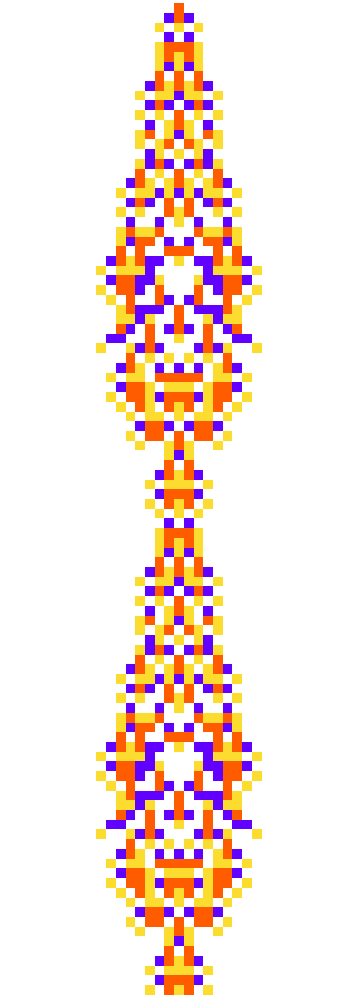
Each row represents the complete state of the cellular automaton at one time step. The visualization contains the two transient states followed by two consecutive copies of the detected 50-step cycle.
The same evolution can be annotated to make the boundary between the transient and the repeats explicit, together with the boundaries between successive periods.
Out[]=
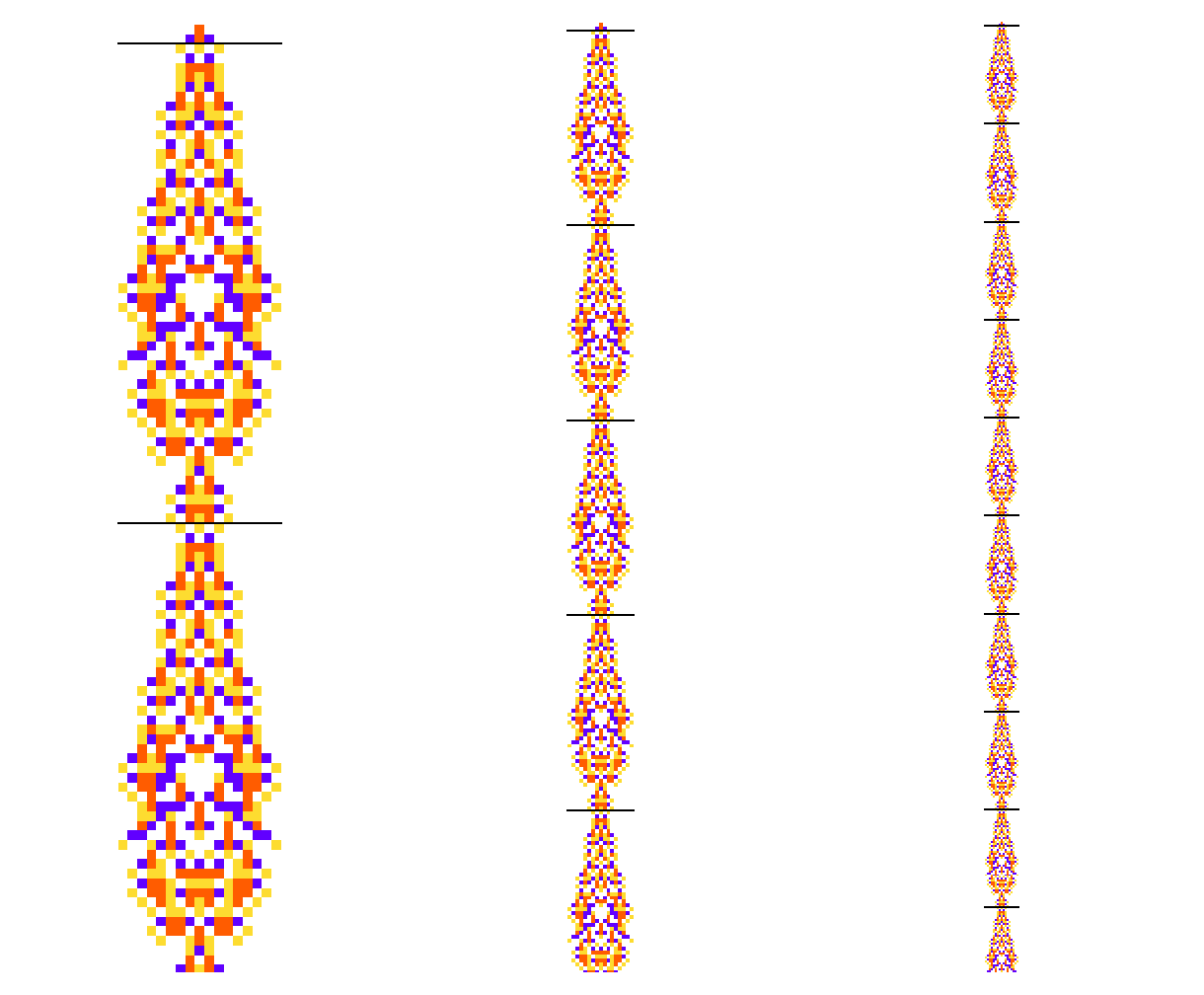
The upper horizontal boundary marks the end of the transient and the beginning of the period. The following boundary separates the first complete period from the second. The configurations within each period are not all identical; rather, the same ordered sequence of 50 configurations appears again in the following period. Once this recurring repetition has been identified, the complete future development no longer needs to be stored independently. The finite sequence contained in one period is sufficient to reconstruct its subsequent evolution.
This constitutes the first explicit coarse-graining operation in the model. A detailed thread of history is compressed into a reduced representation that preserves the temporal properties relevant to the observer.
This example shows how the detailed evolution of a cellular automaton can be reduced to a measurable description of persistent temporal organization. However, this example is not enough to generalize. Next we can explore whether adaptive evolution can discover rules that produce longer repeating cycles. It also raises an important observational question: how long must an evolution be followed before the end of a cycle can be identified? A failure to detect recurrence may reflect the intrinsic behavior of the cellular automaton, but it could also be a result from ours finite computational resources and limited observation window.
This could also makes us wonder: does a longer cycle represent a richer persistent organization, or does its greater extent make it more difficult to identify and maintain under perturbation? To investigate these questions, cellular automaton rules will be treated as simplified genotypes and their complete space-time developments as phenotypes. Mutations will be applied to the rules, while evolutionary fitness will be determined by the period length of the resulting phenotype. The evolved rules will then be exposed to random perturbations to test whether the organization selected through periodicity also remains stable under disturbance.
This could also makes us wonder: does a longer cycle represent a richer persistent organization, or does its greater extent make it more difficult to identify and maintain under perturbation? To investigate these questions, cellular automaton rules will be treated as simplified genotypes and their complete space-time developments as phenotypes. Mutations will be applied to the rules, while evolutionary fitness will be determined by the period length of the resulting phenotype. The evolved rules will then be exposed to random perturbations to test whether the organization selected through periodicity also remains stable under disturbance.
Evolution of observers
Evolution of observers
Cellular automata whose detailed states continue to change while preserving an identifiable recurring organization are treated as observers and the fitness remains observer dependent. Periodicity is measured within the finite observation window defined by the length of the cellular automata; a rule classified as unresolved may genuinely lack recurrence, but its transient or cycle may also extend beyond the observer' s computational horizon. The experiment therefore selects for the longest period detectable under the computational limits of the model, not for an unrestricted property of the rule.
We performed 100 independent adaptive searches from the same initial rule, using a different random seed for each run. Every search used 4000 adaptive iterations and stored only breakthrough states, meaning candidates whose fitness exceeded the best period previously found in that run.
To examine adaptive improvement within a single evolutionary trajectory, each breakthrough is plotted according to the search index at which it appeared and the longest period detected at that point. A selection of the corresponding phenotypes is displayed directly along the trajectory, allowing changes in fitness to be compared with changes in cellular automaton organization.
Out[]=
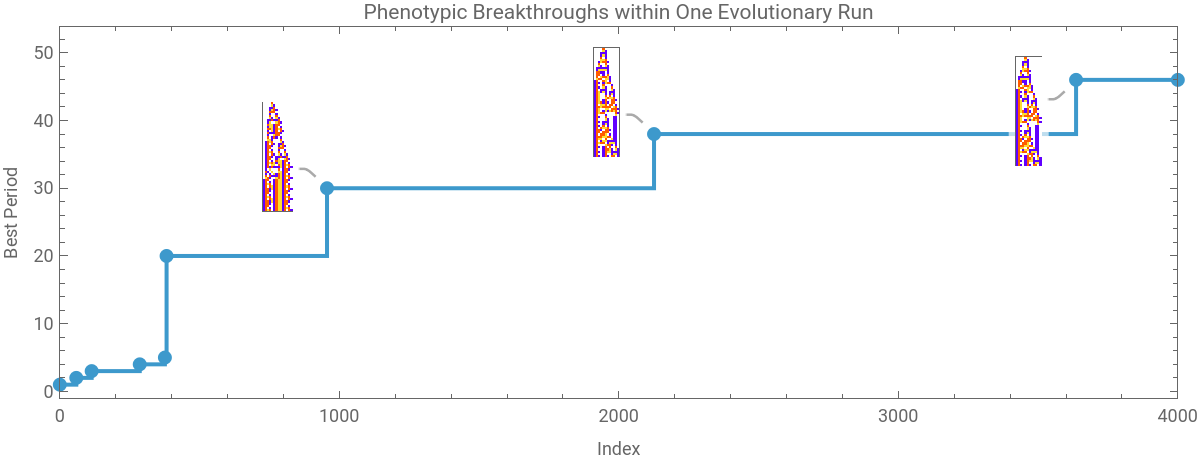
Horizontal segments represent intervals during which no longer period was discovered, while each vertical jump marks the appearance of a new best rule. Individual breakthroughs can substantially reorganize the pattern while generating a longer detectable cycle. Distinct tiny organizations can satisfy the same macroscopic selection criterion.
To compare the selected trajectory with the others, let’s shows how breakthroughs accumulate within one run, comparing the best fitness trajectories of all 100 independent searches:
Out[]=
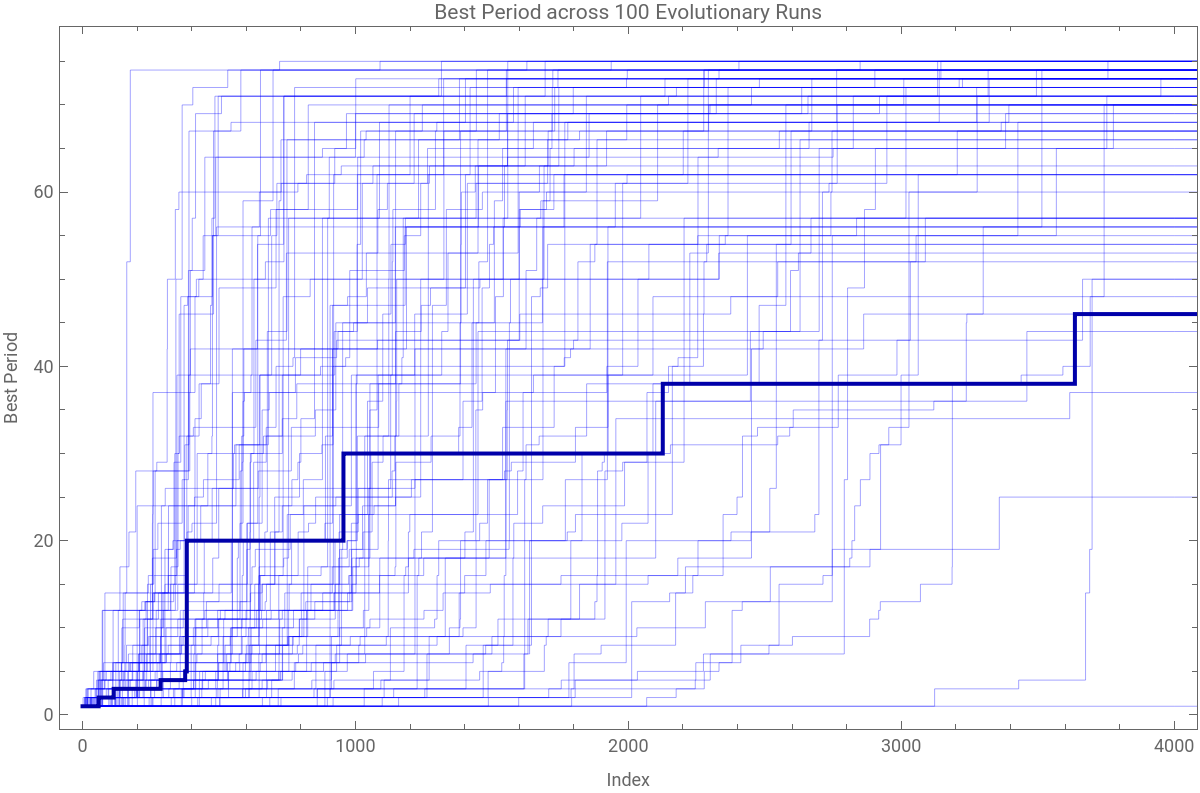
By observing it, is fair to say that the trajectories are highly heterogeneous. Some searches discover long periods relatively early, while others remain at low fitness for extended intervals before undergoing later breakthroughs. Their final periods also vary widely, showing that the runs do not converge to the same result or follow the same evolutionary path. Nevertheless, the repeated upward steps show that the adaptive search repeatedly discovers rules with longer detectable cycles.
The trajectories show how fitness changed during the search, but we can examine next the properties of the final candidate from each run. For this, we can use the transient length distribution to measure how long each system requires to enter recurrence, and the period length to show the range of recurring temporal organizations discovered by evolution.
Out[]=
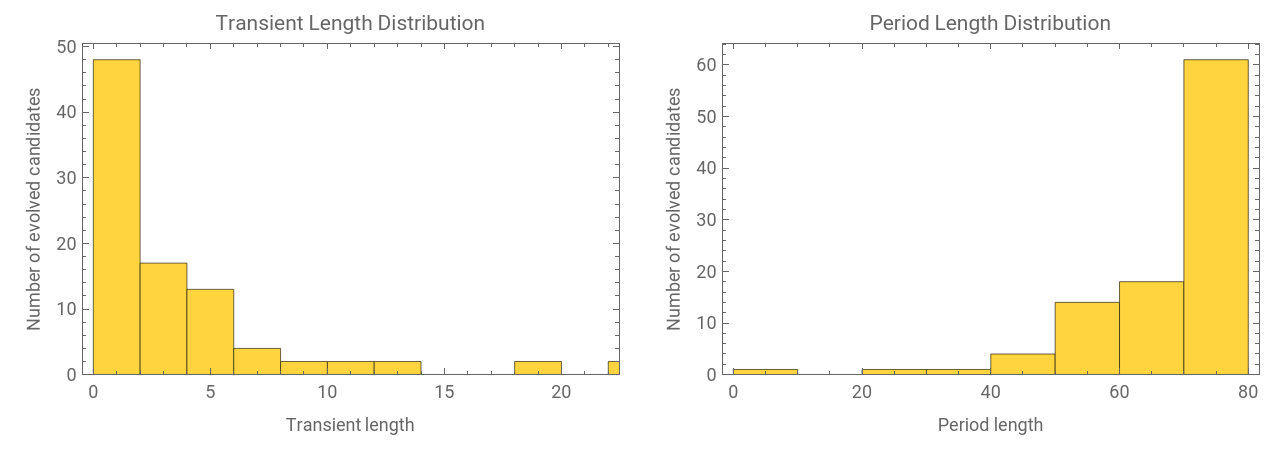
All 100 final candidates were resolved as periodic within the observation window. Most enter their recurring regime after relatively short transients, and only a smaller group requires longer initial developments. Their periods vary widely instead of converging on a single result and the evolutionary search produces a diverse population of recurring structures.
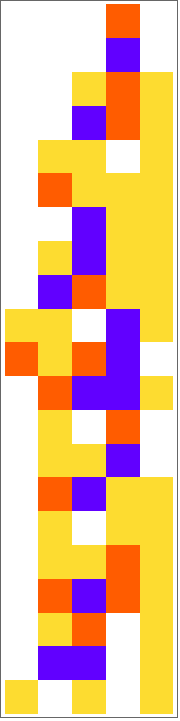
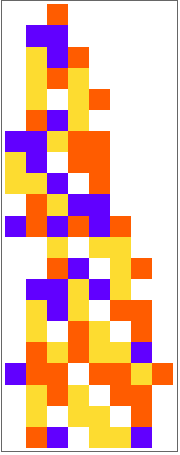
To show the organizations producing those values, we select three final candidates from different parts of the period distribution: one near the lower quartile, one near the median, and one near the upper quartile. Their first 100 steps are displayed using the same scale to support visual comparison.
Out[]=
Observer with a relatively shorter period |
Run: 73 |
Detected period: 62 |

Observer near the middle of the period distribution |
Run: 26 |
Detected period: 71 |
Observer with a relatively longer period |
Run: 8 |
Detected period: 74 |
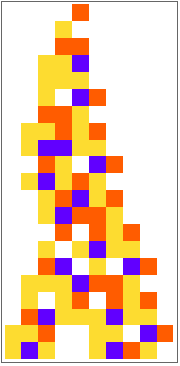
All three candidates were selected using the same fitness criterion, but as shown above, their phenotypes remain visibly different. The length of the periods do not correspond to a single morphology or increase in size. Distinct local rules can produce different organizations while satisfying the same coarse-grained objective.
The evolutionary experiment establishes that extended recurring organization can arise through adaptive search, but periodicity alone does not determine whether these structures remain identifiable when their development is disturbed.
Robustness of observers
Robustness of observers
Robustness requires different interventions than the ones we have done so far. The rule must remain fixed while disturbances are introduced into the states produced during its execution. Noise changes the developing phenotype (behavior) rather than the genotype. Now we move towards studying if organization remains identifiable after the detailed trajectory has been disturbed. To make this question computationally testable, we need a perturbation mechanism, a representation of the observer's body, and a method for comparing clean and perturbed runs.
At each update, the successor row is generated first. Noise is then applied probabilistically only within the active spatial span, meaning between its first and last nonzero cells. A selected cell is replaced by one of the other available states. We must also define which positions belong to the coherent body being observed.
Running Paired Evolutions
Running Paired Evolutions
A complete experiment must ensure that the clean and perturbed developments use the same rule, begin from the same recurring state, occupy the same position between the first non-zero position and the last one, and continue for the same number of time steps. With the function perturbedCARun w first detect the transient and period of the clean cellular automaton. If a period is done, it takes the first state of the recurring cycle and generates two aligned trajectories from it: a deterministic clean development and a noisy development produced with perturbedCAStepUpdate. The comparison begins from the first state of the detected cycle, testing the stability of an established recurring cycle.
The function then applies interiorMaskCA internally and separates the comparison into three categories. Shadow represents body positions found only in the clean development, New represents positions found only in the perturbed development, and Recolor represents positions that remain in both bodies but change internal state. Their union is stored as Difference.
The function then applies interiorMaskCA internally and separates the comparison into three categories. Shadow represents body positions found only in the clean development, New represents positions found only in the perturbed development, and Recolor represents positions that remain in both bodies but change internal state. Their union is stored as Difference.
perturbedCARunPlot converts one stored association into three aligned visualizations: the clean phenotype, the perturbed phenotype, and a categorical difference plot.
Clean vs Perturbed Evolution for a Single Run
Clean vs Perturbed Evolution for a Single Run
Let us first examine one stored run in detail. The selected example is the first replicate of the first observer at a noise probability of 0.01. Its purpose is to define and visually validate the measurements before applying them to the complete dataset.
The categorical difference plot combines the three possible forms of change. Light gray identifies clean body positions that were lost, light magenta identifies new body positions created under perturbation, and dark gray positions that remain within the body but change state. Original colors indicate positions preserved with the same state.
The full-state plots preserve the cellular states, but size is measured from a coarser body-level representation. The two stored phenotypes are therefore transformed into aligned binary masks using the same interiorMaskCA function employed inside perturbedCARun.
The clean mask is shown on the left and the perturbed mask on the right. Because the masks are aligned, corresponding rows and columns can be compared directly.
From Complete Body Volume to Structural Divergence
From Complete Body Volume to Structural Divergence
Complete body size could tell us if perturbation produces net expansion or contraction, but not much about the structural changes produced that difference or when they occurred. To solve this, the normalized profile at each time step divides the union of the clean and perturbed bodies into three forms: “Shadow” represents positions present only in the clean development, “New” represents positions present only in the perturbed development, and “Recolor” represents positions occupied in both developments but with different states. “Total” is the sum of these three fractions.
The profiles remain at zero during the initial time steps, indicating that there is no change between the clean and perturbed developments over that interval. Once divergence begins, recoloring is initially the largest component, suggesting that perturbation first changes internal states at positions that remain occupied in both of the runs. Later, newly generated structure becomes the main contribution, while shadow remains comparatively smaller. The total divergence rises rapidly and then remains high, but it continues to fluctuate rather than converging to a fixed value. Because total divergence remains below 1, a nonzero fraction of the clean - perturbed body union remains unchanged. In this example, survival is better understood as partial preservation of organization through transformation.
The clean and perturbed masks contain only 0’s and 1’s, by summing their entries gives the complete body size of each development. The size change is defined as the perturbed total minus the clean total. Its sign indicates whether the development expands or contracts, while its absolute value records only the magnitude of that change.
The left panel shows that the clean development occupies 979 positions, the perturbed development occupies 1, 240. The resulting signed change is 1240 − 979 = 261, so net expansion is under perturbation. The perturbed development occupies 261 more positions across its complete stored evolution.
The right panel distinguishes the direction of the change from its magnitude. Because the signed difference is positive in this run, the signed and absolute changes are both 261 and the two bars have the same height. The signed change would appear below zero, while the absolute change would preserve the same magnitude above zero. The observed expansion is consistent with the difference visualization, which shows substantial newly generated structure in the perturbed development. However, the increase in total volume does not reveal how much of the clean organization remains. New positions may emerge while parts of the original body are simultaneously lost or recolored. Complete body can be understood as a coarse measure of net expansion or contraction rather than a direct measure of persistence. A larger perturbed body is not necessarily a surviving body, because survival requires the preservation of recognizable organization rather than volume alone.
Body Change across Evolved Populations
Body Change across Evolved Populations
The selected example showed how complete clean and perturbed bodies can be compared for one run. Let’s now apply the same measurement to every other candidate under the same perturbation condition used in the individual example.
For each candidate, the size change is defined as the perturbed volume minus the clean volume. Positive values indicate net expansion, while negative values indicate net contraction. The paired scatter plot compares clean and perturbed size body volumes directly, while the histogram summarizes the distribution of signed changes across the population.
The scatter plot places the clean body volume of each candidate on the horizontal axis and its perturbed body volume on the vertical axis. The diagonal represents no net volumetric change. Points above it indicate expansion and the points below it indicate contraction. As shown above, more candidates lie above than below the diagonal. The broad dispersion and the presence of several extreme values show that the size change is highly heterogeneous across the population.
By looking at the histogram seems reasonable to conclude that perturbation can produce both contraction and expansion. Most changes are concentrated relatively close to zero compared with the full observed range, but the distribution extends much farther in the positive direction. Expansion is more common than contraction, but it is not a uniform response.
A perturbed development may occupy substantially more volume while simultaneously losing much of the clean structure. Therefore, survival is not linked to the size of the body mainly, it seems like the preservation of organization may be a main factor as well.
Spatial Robustness across Noise Levels
Spatial Robustness across Noise Levels
A box-and-whisker chart is used to summarize the full distribution at each noise, allowing the central tendency and variability across observers and replicates to be compared.
The box plot shows how compression changes across noise levels. Most perturbed developments become slightly less compressible, but this does not increase steadily with noise. Some runs become simpler, while others become much harder to compress, showing a wide range of responses. Compression together with structural robustness can be more informative about changes in regularity rather than the survival of the original structure.
Compression and Description length
Compression and Description length
Structural robustness shows how much of the original body remains. In the selected run, the perturbed development is much less compressible than the clean one, suggesting that perturbation introduced more irregularity. Because observers may have different array sizes, the change is normalized by the number of positions. Positive values mean the perturbed development became less compressible, negative values mean it became more compressible, and the box plot shows how this varies across noise levels.
Across noise levels, the typical change remains slightly positive, but it does not increase steadily with stronger noise. The distributions become somewhat more variable, with some developments becoming easier to compress and others much harder. Overall, noise affects the range of outcomes more clearly than the average direction of change.
Because positive and negative compression changes can cancel each other, the signed change can’t capture how strongly perturbation alters descriptive length. We compare structural robustness with the absolute magnitude of compression change:
Signed compression change shows essentially no monotonic association with structural robustness, indicating that greater preservation does not consistently make a development either more or less compressible. In contrast, the absolute compression change has a moderate negative association with robustness. Developments that preserve more of their original spatial body therefore tend to retain a compressed description length closer to that of their clean evolution, while less robust developments can undergo much larger changes in either direction. Structural robustness is with greater stability of compressibility under perturbation. Compression and robustness capture complementary aspects of persistence: one measures changes in descriptive regularity, while the other measures preservation of the original spatial organization.
Conclusions and Discussion
Conclusions and Discussion
Our results distinguish four related properties of observers persistence. Periodicity can be use as a tool to identify cyclic temporal organization under deterministic evolution. The body size provides information about the net expansion or contraction under perturbation. The structural robustness is useful to know how much of the original space remains preserved, while compression change measures how the descriptive regularity of the development changes. These measures help us to approach persistence in a more operational way, without reducing it to only repetition, size, preservation, or compressibility alone.
For our 100 periodic candidates, many entered recurrence after short or negligible transients, but their periods and organizations varied considerably. Both the evolutionary trajectories and the representative final phenotypes show that selection for longer cycles do not converge on a single morphology. One of the main things we were able to study is that apparent simple rules can produce different organizations while satisfying the same fitness criterion.
The most interesting thing for me is that these results suggest a more precise interpretation of the idea that evolution extracts coherence of regularities in phenotypes from the underlying computational irreducibility. Adaptive processes do not eliminate irreducibility or force every solution into simplicity. Instead, they select phenotypes that expose one measurable regularity while preserving diversity in their organization. The fitness function discards most details of the development and retains only the property relevant to the selected objective.
By perturbing the automata, we noticed that recurrence and robustness are distinct. In the examples, they initially agree, but after recoloring becomes the first major source of change. Newly generated structure later becomes dominant and loss remains comparatively smaller. Across the population, perturbation produces heterogeneous volumetric responses. Under the selected condition, expansion occurs more often than contraction, but several candidates contract and a smaller number undergo exceptionally large expansions. Another main point is that a larger perturbed body is therefore not necessarily a surviving body, since new structure can grow while parts of the original organization are simultaneously lost.
The structural robustness decreases as noise probability increases, even if the distributions may have things in common and the decline is not perfectly uniform. Noise changes the probability of preservation at the population level and at every noise level, the population contains both relatively robust and highly fragile outcomes. Therefore, robustness is distributed unevenly across the evolved population. Also, perturbation can produce either a less compressible development or a collapse into a simpler one, so compression alone cannot distinguish preservation from simplification or irregular growth.
An observer does not survive merely by repeating an unchanged microscopic pattern, nor by occupying the same or a larger volume. It survives to the extent that enough of its organization and descriptive regularity remain stable for it to continue being recognized as the same higher-level object while its detailed trajectory changes. In other words, persistence is an act of equivalencing across time.
It is important to notice that the conclusions are tightly linked on the particular computational observer used in this experiment. Repetition is detected only within a finite observation window, so a rule classified as unresolved in a different experiment might simply have a transient or cycle beyond that horizon. Exact repetition within the transient provides a tractable measure of temporal organization.
Finally, the observed relationship between robustness and compression stability is descriptive rather than causal, and should be tested under additional rules, initial conditions, perturbation models, and evolutionary objectives to explore further and different possibilities that this framework can give us.
Finally, the observed relationship between robustness and compression stability is descriptive rather than causal, and should be tested under additional rules, initial conditions, perturbation models, and evolutionary objectives to explore further and different possibilities that this framework can give us.
Future Development
Future Development
A extension of this work could be to investigate persistence under broader evolutionary objectives, future searches could combine recurrence with internal diversity and the capacity or nature of reorganization of the system after perturbation. The analysis could distinguish among temporary disruption, return to the original cycle, transition to a new attractor, and irreversible collapse. These outcomes would make it possible to study not only whether organization survives, but also how it recovers, transforms, or establishes a new form of persistence. This could provide a richer view of the dynamics among an observers structure, its environment, and its own internal organization.
A further extension would allow observers to influence where and when they receive input, move between environments, or modify the conditions under which they are perturbed. to test whether systems tend to place themselves in environments whose regularities they can compress and anticipate, and how or when they preserve the conditions under which their internal descriptions remain useful. Such a process could become self-reinforcing, the observer survives partly by selecting environments in which its way of observing continues to work. The present project cannot address this possibility because perturbations are externally imposed and the candidates cannot select or modify their environments.
Also by varying where, when, and how noise is introduced could help distinguish robustness intrinsic to a rule from robustness produced by the chosen experimental boundary. Increasing the number of probabilistic replicates would also allow the response distribution of each individual candidate to be studied more closely. More broadly, the intention is to extend this framework beyond cellular automata to dynamic hypergraphs and multiway models, where richer forms of behavior may emerge. These systems could help investigate the nature of the regularities identified by observers, the relationship between an observer and those regularities, and how much of the observer’s own structure is reflected in what it is able to recognize. This introduces a potentially self-referential perspective where the regularities through which an observer constructs coherence may themselves depend on its locality, history, internal dynamics, and previous interactions with its environment. A central question is therefore whether persistent organization is intrinsic to the underlying dynamics, produced through the observer’s equivalencing, or by both.
A more ambitious extension could be studying systems that would require collective recovery. This could help connect minimal observers persistence with richer forms of organization. This broader direction may provide computational frameworks relevant to biology and neuroscience, but it is not limited to living systems. It may also help investigate how finite observers embedded within the Ruliad sample, integrate, and preserve coherent threads of organization from a much larger computational structure. The aim is not to claim that the present cellular automata are complete observers, but to isolate minimal ingredients that may contribute to their persistence across different scales and domains.
There is a certain contingency in our character as observers. What we perceive, describe, and understand depends partly on our computational limitations, histories, biases, and positions within the universe. I find it especially meaningful to continue exploring this theory because understanding those limitations does not only constrain scientific inquiry, but also gives us a clearer place from which to begin. Once we identify the boundaries of an observer, brighter and more innovative questions can emerge about what lies beyond them and about which aspects of those boundaries may be extended. Perhaps the most fascinating question for me is how a subsystem embedded within the Ruliad can become capable of asking about its own role and position within it. This apparent circularity may not be a problem to eliminate, but a fundamental feature of observers. Exploring the observer is therefore also an exploration of the larger structure that makes observation possible. Rather than belonging to a single scientific field, this kind of questions may require ideas from computation, physics, biology, neuroscience, philosophy, and any other area in which finite systems help us understand nature.
Acknowledgments
Acknowledgments
First, I would like to express my deepest gratitude to my mentor Pedro Márquez Zacarías, his guidance went far beyond helping me on this project. He encouraged me to move beyond my comfort zone, sharpen my questions, and grow intellectually and academically. Working with him during these three weeks profoundly enriched my understanding of scientific research and made this one of the most formative academic experiences I have had.
I am also sincerely grateful to Júlia Campolim for her patience, generosity, and genuine willingness to help. I thank Xerxes D. Arsiwalla and Carlos Zapata Carratalá for conversations that repeatedly challenged my assumptions, helped me view the project from new perspectives, and encouraged me to search for principles extending beyond cellular automata and any single field. I am grateful to Stephanie Bowyer for always keeping an eye on everything and making sure everything stayed under control. I also thank Stephen Wolfram for helping me turn my ideas into a form that could be investigated computationally, while preserving their potential to grow into broader questions and future directions. Finally, I am immensely grateful to the Wolfram Summer Research Program 2026 and to everyone who made it possible. The program created a community in which there was always someone with whom to exchange ideas, ask questions, and receive genuine support. It has been one of the most intellectually enriching experiences of my academic journey, and I am deeply thankful for every part of it.
I am also sincerely grateful to Júlia Campolim for her patience, generosity, and genuine willingness to help. I thank Xerxes D. Arsiwalla and Carlos Zapata Carratalá for conversations that repeatedly challenged my assumptions, helped me view the project from new perspectives, and encouraged me to search for principles extending beyond cellular automata and any single field. I am grateful to Stephanie Bowyer for always keeping an eye on everything and making sure everything stayed under control. I also thank Stephen Wolfram for helping me turn my ideas into a form that could be investigated computationally, while preserving their potential to grow into broader questions and future directions. Finally, I am immensely grateful to the Wolfram Summer Research Program 2026 and to everyone who made it possible. The program created a community in which there was always someone with whom to exchange ideas, ask questions, and receive genuine support. It has been one of the most intellectually enriching experiences of my academic journey, and I am deeply thankful for every part of it.
References
References
1
.S. Wolfram (1984), “Computation Theory of Cellular Automata,” Communications in Mathematical Physics, 96, 15–57
2
.S. Wolfram (1984), “Universality and Complexity in Cellular Automata,” Physica D: Nonlinear Phenomena, 10(1–2), 1–35
3
.S. Wolfram (2002), A New Kind of Science. Wolfram Media
4
.S. Wolfram (2023), “Observer Theory,” Stephen Wolfram Writings
5
.S. Wolfram (2024), “Why Does Biological Evolution Work? A Minimal Model for Biological Evolution and Other Adaptive Processes,” Stephen Wolfram Writings
6
.S. Wolfram (2025), “What’s Special about Life? Bulk Orchestration and the Rulial Ensemble in Biology and Beyond,” Stephen Wolfram Writings
7
.S. Wolfram (2026), “What Ultimately Is There? Metaphysics and the Ruliad,” Stephen Wolfram Writings
AI Disclosure
AI Disclosure
The following generative AI tools were used in this project:Gemini, ChatGPT. They were used for brainstorming, generating implementation ideas, and checking spelling. editing prose. All was reviewed, understood and approved by the author.
CITE THIS NOTEBOOK
CITE THIS NOTEBOOK
Observer Theory in Cellular Automata
by Maria Renza
Wolfram Community, STAFF PICKS, July 16, 2026
https://community.wolfram.com/groups/-/m/t/3763308
by Maria Renza
Wolfram Community, STAFF PICKS, July 16, 2026
https://community.wolfram.com/groups/-/m/t/3763308