CITE THIS NOTEBOOK: Idealized conventional and pressure-assisted thermal preservation processes by Micha Peleg. Wolfram Community NOV 22 2022.
ORIGINAL ARTICLE: Peleg, M. Assessing the Pressure’s Direct Contribution to the Efficacy of Pressure-Assisted Thermal Sterilization. Food Engineering Reviews 14, 201–211 (2022). https://doi.org/10.1007/s12393-021-09303-x
Wolfram Demonstrations Project: Mark D. Normand, Micha Peleg, and Murray Eisenberg, http://demonstrations.wolfram.com/IdealizedConventionalAndPressureAssistedThermalPreservationP/
Article Abstract: In pressure-assisted thermal sterilization process (PATS), most of the microbial inactivation occurs under a combination of high temperature and pressure conditions for which meaningful experimental isothermal/isobaric (static) survival data are rarely if ever available. Therefore, a kinetic survival model for the targeted microbe, the magnitudes of its parameters, and the pressure’s direct contribution to the process lethality, i.e., besides the processing temperature elevation, must be determined mathematically from experimental survival ratios obtained after the food cooling at the end of dynamic treatments. At least in principle, this can be achieved with the endpoints method, explained and demonstrated with the aid of simulated realistic dynamic temperature and pressure profiles. The pressure’s net (unmediated) contribution to the process lethality can be expressed as equivalent time at the processing temperature, or as the added number of decades’ reduction to the treatment’s final survival ratio had it been reached in a purely thermal process having the same temperature profile. The pressure’s role is also manifested in the coefficients of a special pressure dependency term incorporated into the dynamic inactivation kinetics model. This term indicates whether the process lethality rises monotonically with temperature and pressure or there exists an optimal combination of the two. The expanded rate model can be used to simulate and examine the efficacy of existing or contemplated PATS processes by varying the temperature and pressure profiles, and/or by modifying the targeted microbe’s survival parameters.
Introduction
Introduction
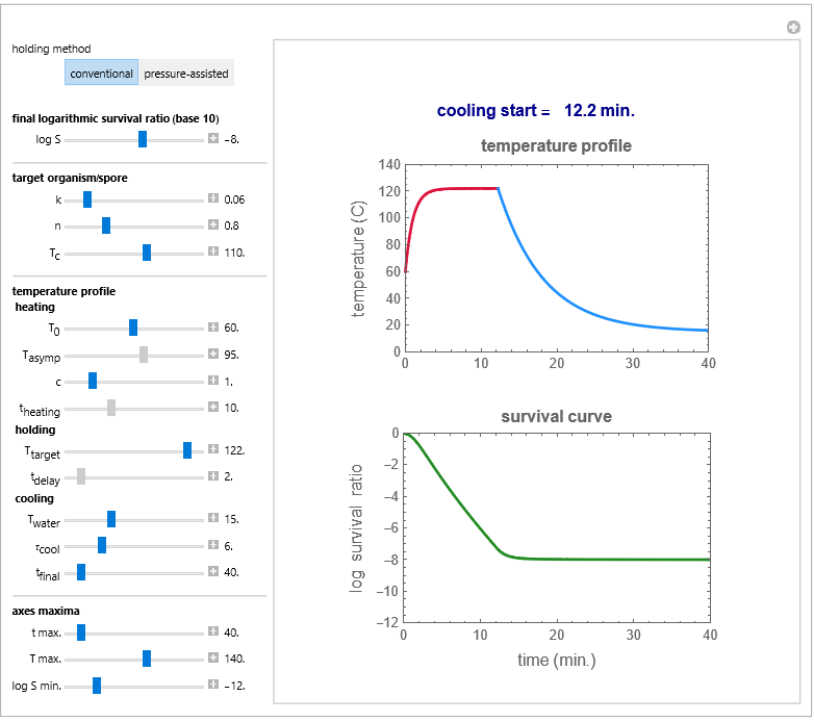
This app generates idealized temperature profiles of the kind encountered in conventional and pressure-assisted thermal preservation of food and pharmaceuticals.
The targeted organism or spore’s heat resistance is specified by the WeLL (Weibullian Log Logistic) model parameters, , and entered with sliders, where represents the concavity of the isothermal semi-logarithmic survival curves in the pertinent temperature range, represents a marker of the beginning of the lethal temperature range, and represents the slope of the Weibullian rate parameter,, at .
The targeted organism or spore’s heat resistance is specified by the WeLL (Weibullian Log Logistic) model parameters
k
n
T
c
n
T
c
k
b(T)
T≫
T
c
The conventional heating stage is approximated by the equation , where is the initial temperature, is the process temperature, and is a rate constant. The cooling stage is approximated by the equation , where is the temperature of the cooling water, is the highest temperature reached in the process, and is a time characteristic of the cooling. (All temperatures are in degrees C and all times are in minutes.) The final logarithmic survival ratio, , to be accomplished by the process is entered by the user with a slider. The time, , needed to achieve this survival ratio is calculated by numerically solving the particular organism or spore's rate equation for the chosen heating and cooling curves. The numeric value of is displayed above the plots of the temperature profile and the corresponding survival curve of the process.
T(t)=+(-)(1-)
T
0
T
target
T
0
-ct
e
T
0
T
target
c
T(t)=+(-)
T
water
T
final
T
water
-(t-)
t
cool
τ
cool
e
T
water
T
final
τ
cool
logS
t
cool
t
cool
In the pressure-assisted method, chosen by clicking the "pressure-assisted" button, the conventional heating stage is approximated by the equation . In this process, is the temperature reached almost instantaneously by adiabatic heating due to pressurization. Cooling can start immediately after depressurization or after additional holding for time set with a slider. The cooling stage is approximated by the same equation, , where =++.
T(t)=+(-)(1-)
T
0
T
asymp
T
0
-ct
e
T
target
t
delay
T(t)=+(-)
T
water
T
final
T
water
-(t-)
t
cool
τ
cool
e
t
cool
t
heating
t
holding
t
delay
The time is the time at the target temperature needed to achieve the final logarithmic survival ratio, , is calculated by numerically solving the rate equation of the particular organism or spore for the chosen pressure-assisted heating and cooling regimes. The numeric values of and are displayed above the plots of the temperature profile and the corresponding survival curve of the pressure-assisted process.
t
holding
logS
t
holding
t
cool
The generated survival curve and holding-time calculations are based on the assumptions that the inactivation pattern follows the WeLL model and that the inactivation during holding under pressure is primarily thermal. In cases where nonthermal effects of the pressure do play a significant role, comparison of the simulations with experimental results can be used to identify and quantify their contribution to the overall process lethality.
Not all possible control combinations necessarily correspond to realistic processes or can achieve the chosen final logarithmic survival ratio. If such a control combination is chosen, no curves are drawn and a message alerting the user to the situation appears in bold red text.
Interactive App
Interactive App
Out[]=