Each year, we try to list properties for the number of the given year. For 2025, we start by squaring the ninth triangular number, 45. By slicing the cubes into height 1 squares, we get a tiled solution.
In[]:=
bc={{{4,30}},{{18,28},{21,21}},{{5,33},{5,30},{25,13}},{{0,23},{0,27},{21,13},{21,17}},{{16,6},{16,11},{25,16},{0,31},{18,23}},{{16,0},{22,0},{30,16},{30,22},{8,30},{14,30}},{{21,6},{0,16},{7,16},{14,16},{4,23},{11,23},{23,21}},{{0,0},{0,8},{8,0},{8,8},{28,0},{28,8},{20,28},{28,28}},{{0,36},{9,36},{18,36},{27,36},{36,36},{36,27},{36,18},{36,9},{36,0}}};ColumnRowText@Style["2025 = ",18],ColumnText@Style["++++++++",12],Text@Style["(1+2+3+4+5+6+7+8+9",12]},Alignment->Center,Graphics[{EdgeForm[Black],White,Table[{Hue[Mod[k+5,9]/9],Rectangle[#,#+k]&/@bc[[k]],Black,Style[Text[k,#+k/2],6k]&/@bc[[k]]},{k,1,9}]},ImageSize->300],Alignment->Center
3
1
3
2
3
3
3
4
3
5
3
6
3
7
3
8
3
9
2
)
Out[]=
2025 =
| ||
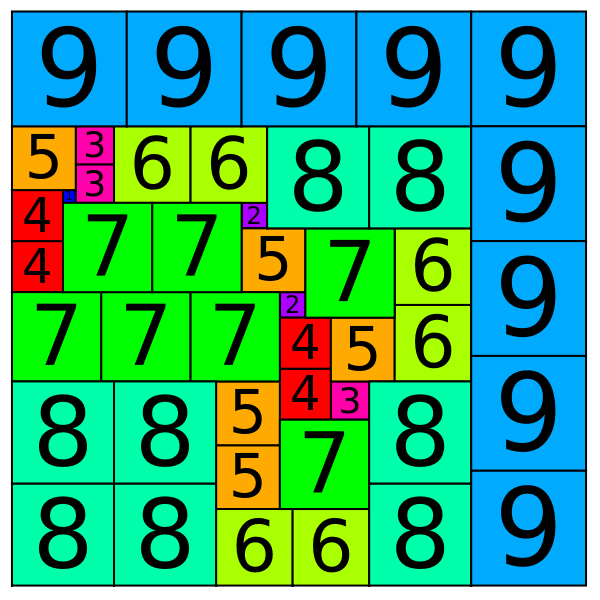
This comes from the following identify, often referred to as Faulhaber’s Formula or Nicomachus’s Theorem:
Out[]//TraditionalForm=
n
∑
k=1
3
k
2
k
n
∑
k=1
It’s the product of the proper divisors of 45:
In[]:=
proper=Drop[Divisors[45],-1]
Out[]=
{1,3,5,9,15}
In[]:=
Times@@proper
Out[]=
2025
The radius of the circumcircle for 8 different integer triangles is sqrt(2025/11):
Out[]=
σ
1
3
2025
ϕ(())
σ
1
3
2025
In[]:=
DivisorSigma[1,EulerPhi[2025^3]]==EulerPhi[DivisorSigma[1,2025^3]]
Out[]=
True
An odd property of the square root, 45, is that it’s the smallest integer where the periodic part of the reciprocal is 2:
In[]:=
N[1/45]
Out[]=
0.0222222
It’s the denominator for this sum of squares:
In[]:=
-2
9
-2
5
Out[]=
106
2025
We can also represent 2025 with ϕ, the golden ratio:
In[]:=
phi=ResourceFunction["PhiNumberSystem"][2025]
Out[]=
{15,13,10,5,3,1,-6,-11,-16}
In[]:=
RootReduce[Total[GoldenRatio^phi]]
Out[]=
2025
There are also 2025 “good” permutations (A006717), where all rotations have a single number in the correct place.
In[]:=
goodpermutations=Select[Permutations[Range[9]],Union[Table[Count[RotateRight[#,k]-Range[9],0],{k,0,8}]]=={1}&];
In[]:=
Length[goodpermutations]
Out[]=
2025
Here’s the first of the “good” permutations:
In[]:=
Grid[Table[RotateRight[goodpermutations[[1]],k-1],{k,1,9}][[{1,9,2,7,6,8,4,3,5}]]]
Out[]=
1 | 3 | 2 | 7 | 9 | 8 | 4 | 6 | 5 |
3 | 2 | 7 | 9 | 8 | 4 | 6 | 5 | 1 |
5 | 1 | 3 | 2 | 7 | 9 | 8 | 4 | 6 |
7 | 9 | 8 | 4 | 6 | 5 | 1 | 3 | 2 |
9 | 8 | 4 | 6 | 5 | 1 | 3 | 2 | 7 |
2 | 7 | 9 | 8 | 4 | 6 | 5 | 1 | 3 |
4 | 6 | 5 | 1 | 3 | 2 | 7 | 9 | 8 |
6 | 5 | 1 | 3 | 2 | 7 | 9 | 8 | 4 |
8 | 4 | 6 | 5 | 1 | 3 | 2 | 7 | 9 |
It’s the product of greatest common divisors of 15 for numbers less than 15:
In[]:=
Times@@(GCD[15,#]&/@Range[14])
Out[]=
2025
CITE THIS NOTEBOOK
CITE THIS NOTEBOOK
Happy 2025 = = 1³+2³+3³+4³+5³+6³+7³+8³+9³!by Ed PeggWolfram Community, STAFF PICKS, December 30, 2024https://community.wolfram.com/groups/-/m/t/3347182