This work studies how consensus forms in a one-dimensional cellular automaton when random noise is present. By varying the initial density and noise strength, I identify regimes of global consensus, local consensus, and no consensus, and summarize them in phase diagrams. We then focus on how consensus evolves over time and show that it is not permanently stable. Although the system may appear converged for long periods, random noise can eventually trigger rare transitions to a different macroscopic state. To isolate the role of timing, I apply the same noise pattern at different starting times. I find that small delays can strongly affect transient behavior and convergence time. However, under continued noise, these differences disappear and the system ultimately converges to the same state.
History and Motivation
History and Motivation
History and Motivation
Cellular automata (CA) were first introduced by John von Neumann in the 1940s as a framework for studying self-replicating systems. Since then, CA have become a powerful class of discrete computational models, known for their ability to generate complex and often unexpected behavior from simple, local rules. A cellular automaton consists of a grid of cells, each of which can take on a finite number of states and evolve in discrete time steps according to deterministic or probabilistic rules that depend only on neighboring cells.
One of the most influential developments in the field is Stephen Wolfram’s classification of elementary cellular automata, which demonstrated that even extremely simple rule sets—such as Rule 30 or Rule 110—can produce dynamics resembling randomness, self-organization, and, in some cases, universal computation [1]. This discovery fundamentally challenged the intuition that complex behavior requires complex underlying rules.
One of the most influential developments in the field is Stephen Wolfram’s classification of elementary cellular automata, which demonstrated that even extremely simple rule sets—such as Rule 30 or Rule 110—can produce dynamics resembling randomness, self-organization, and, in some cases, universal computation [1]. This discovery fundamentally challenged the intuition that complex behavior requires complex underlying rules.
Out[]=
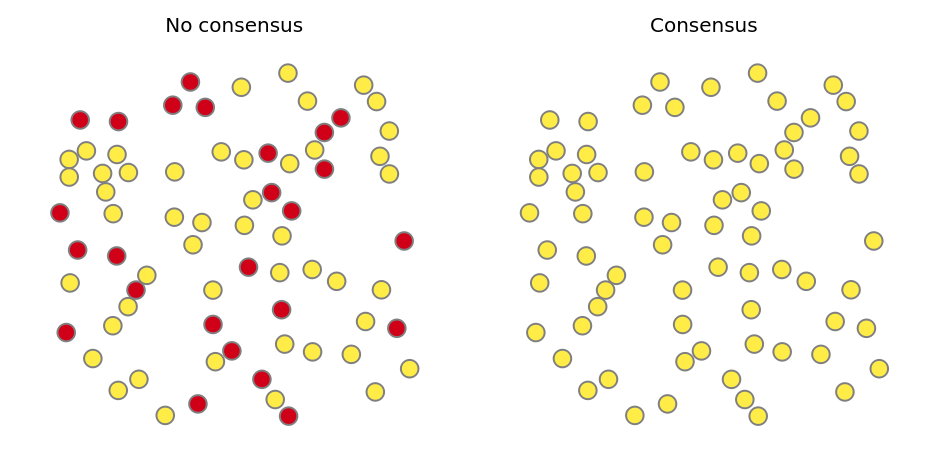
In CA, Consensus refers to a situation where local interactions cause the system to align, so that nearly all cells share the same value. Recent work has shown that consensus in noisy cellular automata can exhibit surprisingly rich and nontrivial behavior. In particular, Lucas Squillante and collaborators demonstrated that even when a system appears to have reached consensus, stochastic perturbations can induce rare but dramatic transitions at long time scales, leading to sudden flips between macroscopic states [2]. These results highlight that consensus in cellular automata is not always permanently stable, but can instead be metastable, with long-lived transients that depend sensitively on noise strength, system size, and update rules.
Out[]=
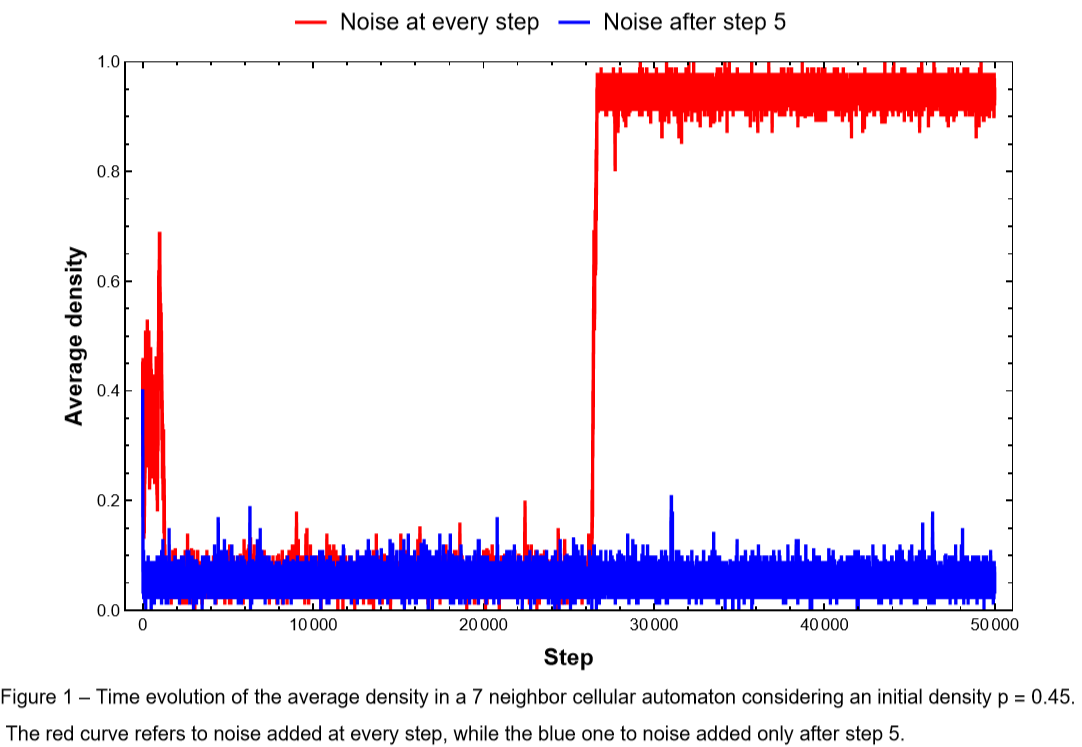
“The results shown in Fig. 1 demonstrate that the initial condition is key for determining how fast consensus is achieved. For the case with noise at every step, consensus is achieved later than the one with noise added after step 5, both CAs achieving an average density close to zero after a few steps. However, for the case of noise every step, a remarkable situation was found. After a high number of steps, the systems flipped to an average density 0 to 1. Such a behavior is, however, suppressed upon increasing the system’s length. This is an interesting situation because it seems consensus is step-dependent and even though the CA seem to be converged, it might suddenly flip its consensus considering long time (step) scales.” [3]
In the figure above the red and blue curves show two runs of the system where noise is introduced at different moments. Although both runs use the same type of noise, the actual noise patterns are different in each case. As a result, the figure shows that sudden flips can happen at long times, but it does not clearly explain why they happen. In particular, it is hard to tell whether the flip is caused by the timing of the noise or simply by randomness.
To clarify this, in this work I use a different approach. Instead of generating two independent noise patterns, I apply the same noise realization to the system and only change the step at which the noise begins. This makes the comparison much cleaner: the two runs differ only in when the system is exposed to noise, not in how it is perturbed.
Cellular Automaton Evolution Without Noise
Cellular Automaton Evolution Without Noise
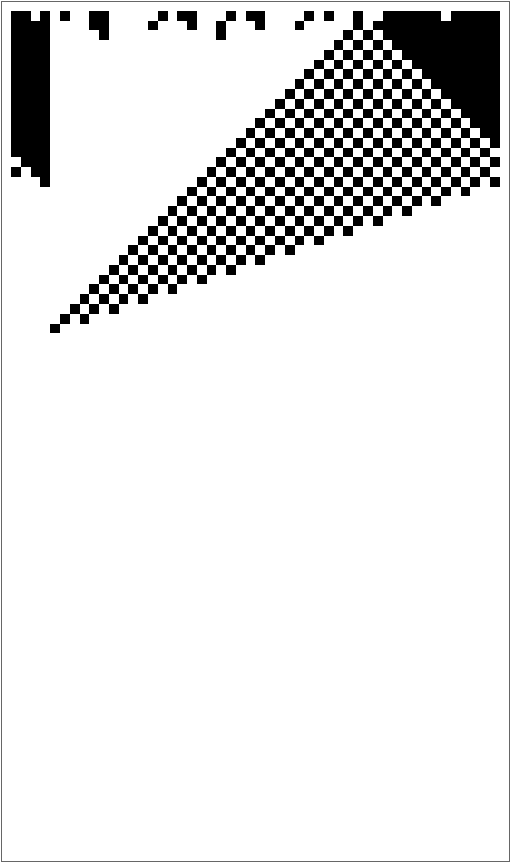
In the absence of noise, the cellular automaton quickly leaves the transient regime and converges to a stable macroscopic state, as reflected both in the spacetime diagram and in the rapid decay of the average density.
p=0.45;length=50;steps=85;stateList=CellularAutomaton[{339789091192587366278221041213531750560,2,3},RandomChoice[{p,1-p}->{1,0},length],steps];stateList//ArrayPlotstateList//Map[Mean]//ListLinePlot[#,PlotRange->{0,1}]&
Out[]=
Out[]=
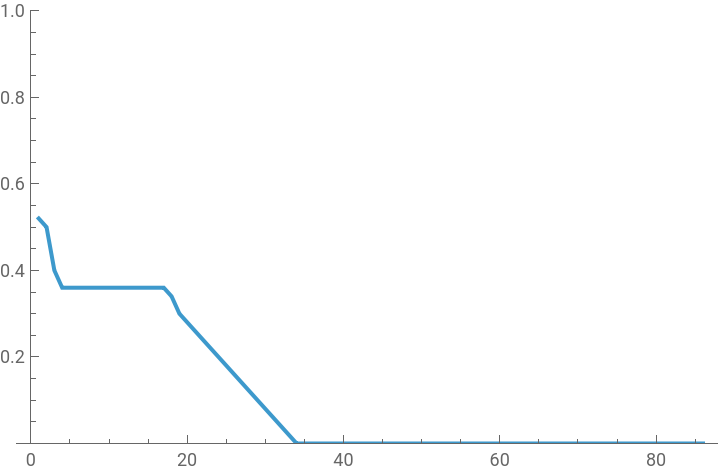
Figure2–CellularAutomatonEvolutionWithoutNoise
Here is the visual representation of the rule using #339789091192587366278221041213531750560:
Out[]=
Cellular Automaton and Consensus Evolving With Noise
Cellular Automaton and Consensus Evolving With Noise
In this work, I modify the method used by Lucas Squillante by applying the same noise realization to both runs. The only difference between the trajectories is the step at which the noise is turned on. This paired-noise approach removes randomness as a confounding factor and allows the effect of lateness alone to be tested.
Because of this change, the results presented here isolate a phenomenon that is not clearly visible in the original study: small delays in the introduction of identical noise can lead to different long-lived transient states, even though the system eventually converges under sustained noise. The difference is therefore not in the cellular automaton itself, but in how the noise is controlled and compared across runs.
The dynamics separate into three stages: an early commitment phase where noise timing selects the basin, a long metastable regime with persistent macroscopic differences, and a late-time noise-driven escape leading to eventual convergence.
Out[]=
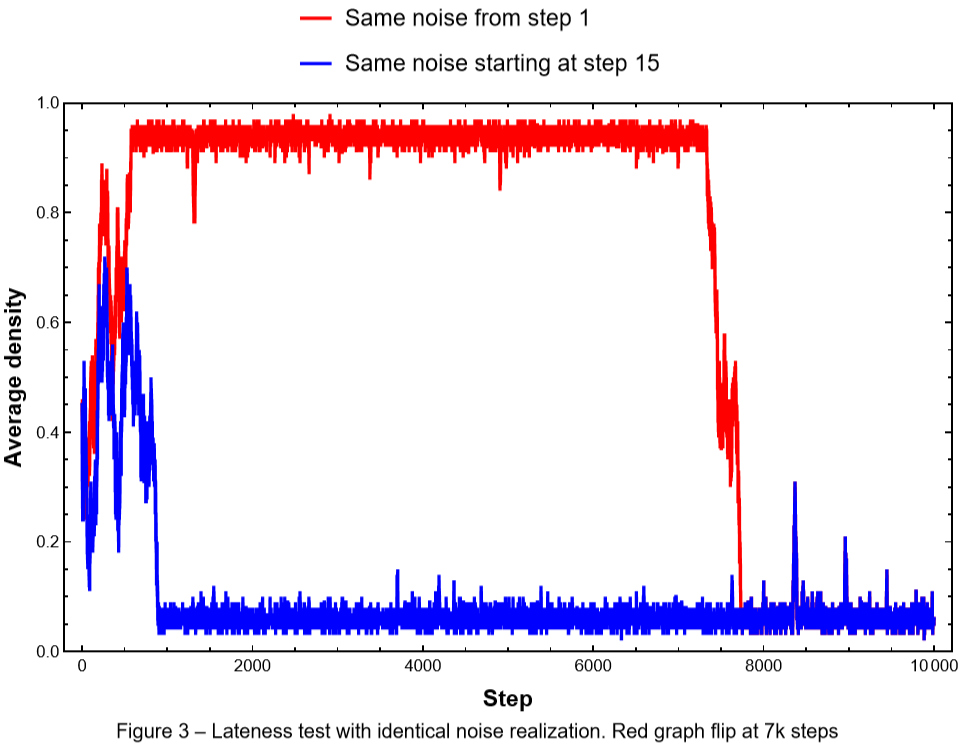
In Fig. 2 and Fig. 3, the initial conditions are different, but in both cases the same noise pattern is used. The only difference is when that noise is turned on.
What stands out is that convergence happens from both sides. In the left panel, the delayed run (blue) is trapped in a low-density state for a long time before eventually escaping and joining the high-density state reached by the red curve. In the right panel, the situation is reversed: the delayed run quickly settles into the low-density state, while the red curve remains in the high-density state for thousands of steps before flipping and converging with the blue one.
Despite starting from different initial conditions and favoring opposite states early on, both systems eventually reach the same behavior under continued exposure to the same noise realization. The direction of convergence is not fixed: sometimes the delayed run moves toward the early-noise trajectory, and sometimes the early-noise trajectory moves toward the delayed one. This shows that convergence in the system is not tied to a particular basin, but rather to the long-term action of the noise itself.
In addition, this behavior is not limited to large systems. By reducing the system size and increasing the noise strength, I found that the same effect persists even in very small lattices. For seed 625, the preference for different basins under delayed noise and the subsequent late convergence remain visible down to a system length of 27 with noise strength ε = 0.12. Below this scale, the dynamics becomes strongly mixed and the distinction between basins is no longer clearly observable.
This shows that the observed behavior does not depend on having a large system. Instead, it comes from how the system evolves in its early stages. Even in small systems, introducing noise at different moments can briefly push the system along different paths, although continued noise eventually leads the dynamics to settle back into similar long-term behavior.
Concluding Remarks
Concluding Remarks
The apparent late-time flip observed in the original figure is a finite-time stochastic effect that depends on the total number of steps simulated, rather than a genuine consequence of delaying the introduction of noise. More generally, these results suggest that in stochastic cellular automata, early transient dynamics can act as a form of commitment phase, after which the system becomes increasingly insensitive to later perturbations, even when those perturbations follow the same underlying realization. From a multicomputational perspective, this behavior can be interpreted as different coarse-grained histories becoming effectively inaccessible once a particular branch has formed. Further work could explore how robust this phenomenon is across different rules, noise strengths, system sizes, as well as observation timescales.
Acknowledgments
Acknowledgments
I would like to thank Stephen Wolfram for his foundational ideas and enduring inspiration. I am especially grateful to my primary mentor, Nik Murzin, as well as my support mentors, Lucas Squillante - whose research inspired this post - and Zsombor Meder, for their guidance, insights, and continued support throughout this work. I also thank Dugan Hammock and Xerxes Arsiwalla for inspiring discussions and their assistance with the code. I am grateful to Stephanie Bowyer for an opportunity to participate in the program, for coordinating the program and fostering a productive research environment. Finally, I sincerely appreciate the opportunity to attend the Wolfram Winter School, and I will carry this spirit forward in my future academic and research aspirations.
References
References
1
.S. Wolfram, A new kind of Science (Wolfram Media Inc., 2002).
2
.G.B. Ermentrout, L. Edelstein-Keshet, Journal of Theoretical Biology 160, 97 (1993).
3
.Squillante, L. (2025, July). [WSS25] Critical Behavior and Noise Threshold in Consensus-Based Cellular Automata - Online Technical Discussion Groups—Wolfram Community. Wolfram.com. https://community.wolfram.com/groups/-/m/t/3497150
4
.Wolfram, S. (2021, May 17). The Problem of Distributed Consensus—Stephen Wolfram Writings. Writings.stephenwolfram.com. https://writings.stephenwolfram.com/2021/05/the-problem-of-distributed-consensus/
CITE THIS NOTEBOOK
CITE THIS NOTEBOOK
Noise-induced metastability and consensus in a cellular automaton
by Roman Segov
Wolfram Community, STAFF PICKS, January 15, 2026
https://community.wolfram.com/groups/-/m/t/3607929
by Roman Segov
Wolfram Community, STAFF PICKS, January 15, 2026
https://community.wolfram.com/groups/-/m/t/3607929