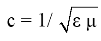
Example30ElectromagneticImagingwthinaLaser-Beampropagatingwiththespeedoflight:c=
1
ϵ0μ0
In[]:=
Out[]=
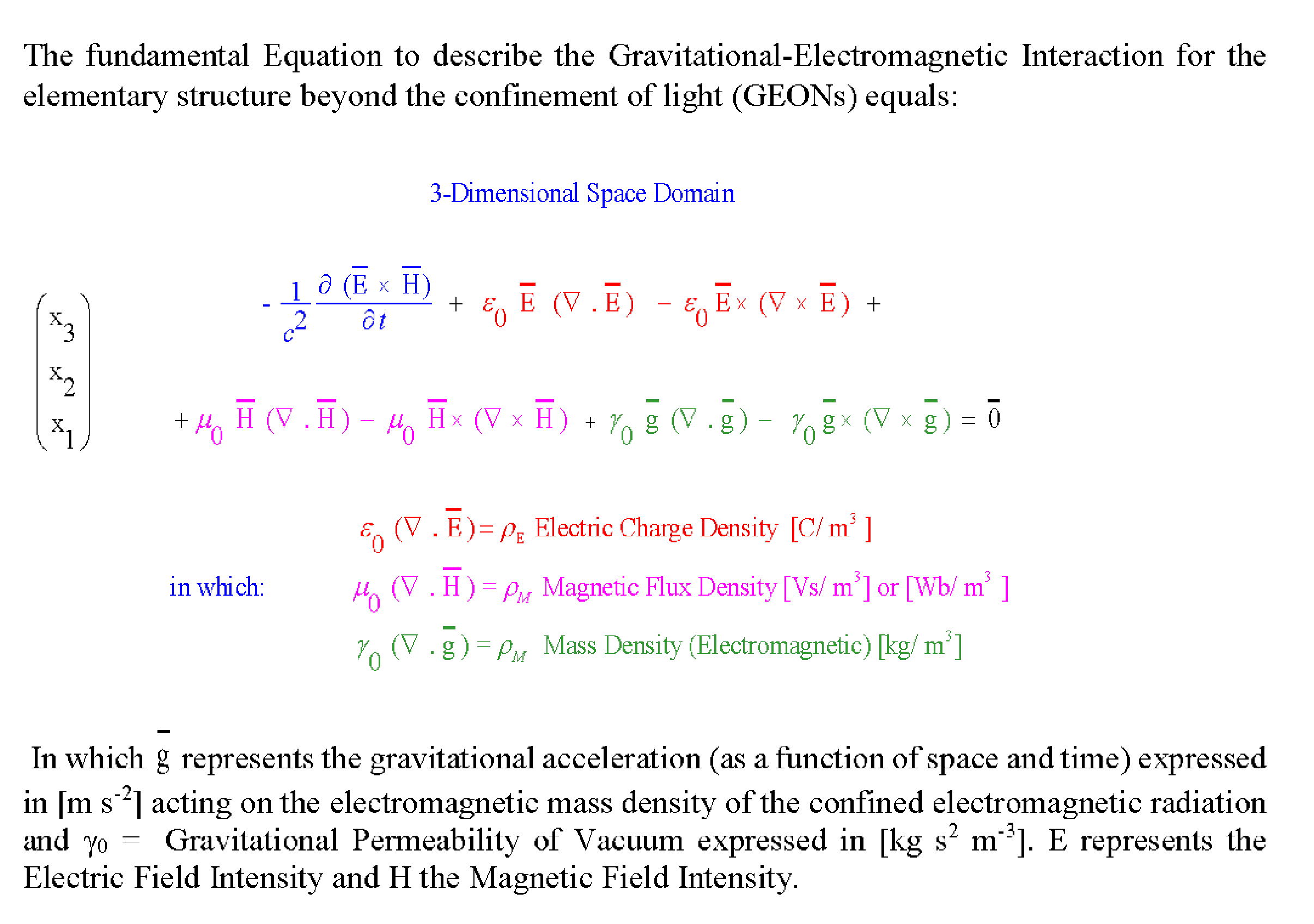
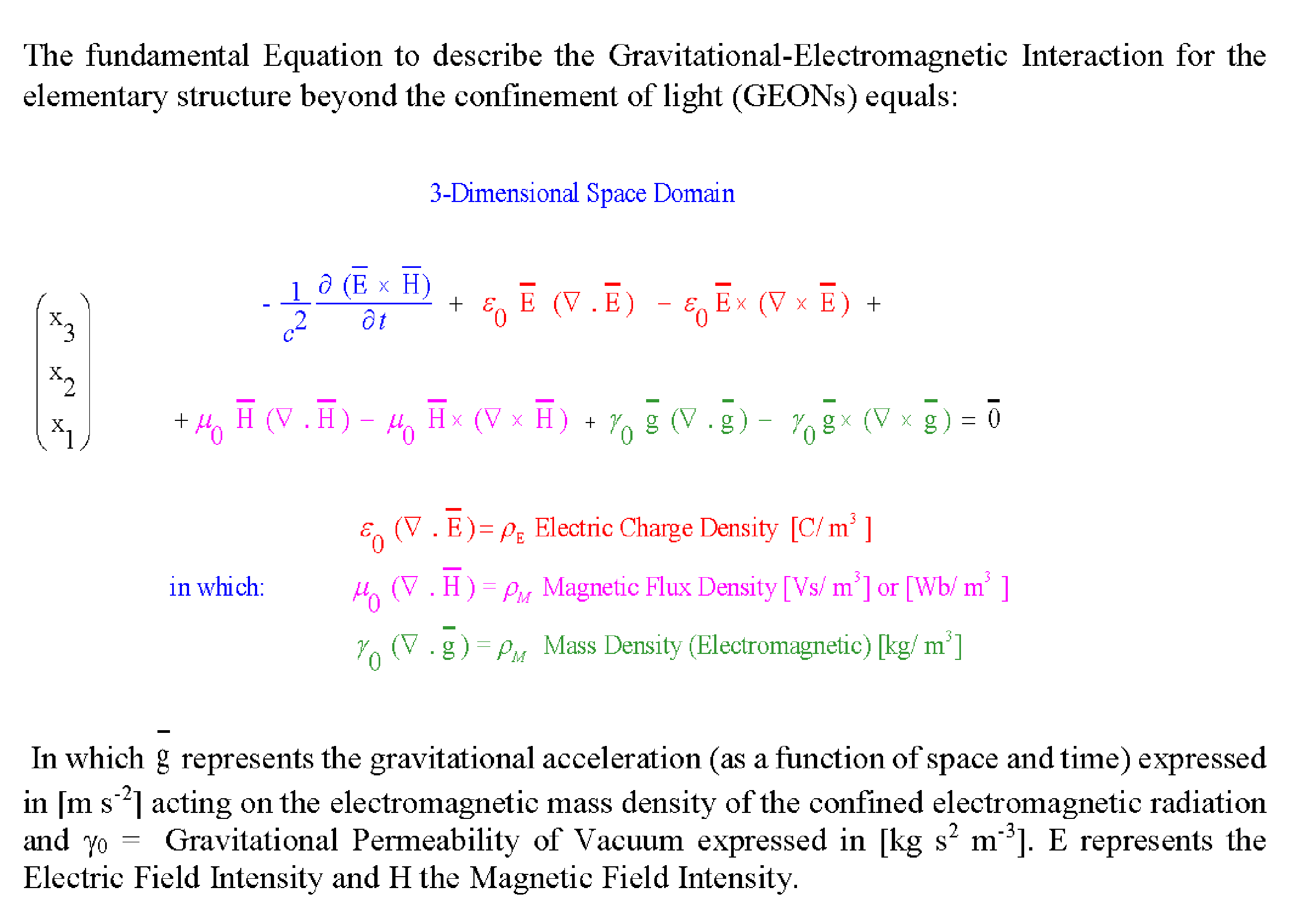
Book:+∇. −×∇×+∇. −×∇× (19)ExampleofaLASER-BEAMwithaGaussianIntensitydivison,combinedwithanarbitrarydivisiong[x,y]inthe(x,y)plane,propagatinginthez-directionwiththespeedoflightc=.
RisingoftheJamesWebbSpaceTelescope
anditsFundamentalBlindness
Page15,Equation(19)-
1
2
c
∂×
¯
E
¯
Η
∂t
ε
0
¯
E
¯
E
ε
0
¯
E
¯
E
μ
0
¯
Η
¯
Η
μ
0
¯
Η
¯
Η
= 0
-K2+
2
x
2
y
1
ϵ0μ0
In[]:=
Needs["DifferentialEquations`NDSolveProblems`"]
In[]:=
Needs["DifferentialEquations`NDSolveUtilities`"]
In[]:=
Needs["DifferentialEquations`InterpolatingFunctionAnatomy`"]
In[]:=
ϵ0=.
In[]:=
μ0=.
In[]:=
x=.
In[]:=
y=.
In[]:=
z=.
In[]:=
t=.
In[]:=
Get["VectorAnalysis`"]

In[]:=
InverseFunctions->True
Out[]=
InverseFunctionsTrue
In[]:=
Needs["DifferentialEquations`NDSolveProblems`"]
In[]:=
Needs["DifferentialEquations`NDSolveUtilities`"]
In[]:=
Needs["DifferentialEquations`InterpolatingFunctionAnatomy`"]
In[]:=
SetCoordinates[Cartesian[x,y,z]]
Out[]=
Cartesian[x,y,z]
In[]:=
{Coordinates[Cartesian],CoordinateRanges[Cartesian]}
Out[]=
{{x,y,z},{-∞<x<∞,-∞<y<∞,-∞<z<∞}}
In[]:=
K2=.
Research Proposal:The fundamental foundation for Einstein's Theory of General Relativity is the "Curvature of Space and Time" due to a Gravitational Field. In the "Theory of General Relativity" Gravitational RedShift has been explained by a change in time and space resulting is a change in the observed frequency shift in the spectrum of the light being emitted by far away Galaxies. The foundation for Einstein's theory of General Relativity is a constant value for the speed of light in the absence of a gravitational field.In the "New Theory" the fundamental foundation is "Equilibrium". Equilibrium for the "5 fundamental force densities in light" in any direction at any time and at any location. The 5 fundamental forces in light are:1) "Inertia Force" (Energy has always inertia according Einstein's E = m c2)2) "Electric Force"3) "Magnetic Force" 4) "Electric Force" due to the "Lorentz Transformation" of the "Magnetic Force"5) "Magnetic Force" due to the "Lorentz Transformation" of the "Electric Force"The speed of light has been fully controlled by the perfect equilibrium between the 5 fundamental force densities in any direction at any time and at any location. For a single beam of light the perfect equilibrium between the 5 fundamental forces always results in the speed of light: However in this experiment 3 beams of light with the same frequency and the same phase and 3 controllable (LPA) different intensities K1, K2 and K3 will cross each other in 3 orthogonal directions. This will result in different boundary conditions for the total electromagnetic radiation and will be measurable by a changing in the speed of light. In this experiment by a changing of the speed of light in the chosen z-direction. The changing of the speed of light will become visible by a change in the interference patterns of the 2 LASER beams. The original beam and the manipulated beam.The solution for equation (8) has been calculated in Mathematica when 3 laser beams cross each other perpendicular and will cause a change in the speed of light within the intersection of the 3 crossing Laser Beams due to Electromagnetic Interaction. According the calculations in Mathematica 11.3 at the exact "location dependent speed of light c[x,y,z]" there will be a perfect equilibrium between all the electromagnetic- inertia- and radiation pressure force densities at any time in any direction:One polarized (Electric Field in the x-direction) Laser Beam f1[x,y,z,] is propagating in the z-direction. The second polarized (Electric Field in the y-direction) Laser Beam f2[x,y,z] is propagating in the x-direction. In the cross section of both Laser Beams due to "Electromagnetic Interaction" deformation takes place and deforms both different images projected by both Laser Beams in two different and perpendicular directions. This has been called "Electromagnetic Interaction Lensing".