This is part of live presentation series called Mathematical Games in which we explore a variety of games and puzzles using Wolfram Language. In this episode, we feature games and puzzles focusing on tetrahedral centers.
Wolfram Demonstrations Project
Wolfram Demonstrations Project
More than a thousand demonstrations involve triangles. https://demonstrations.wolfram.com/
Initialization
Initialization
1. Incenter (I)
1. Incenter (I)
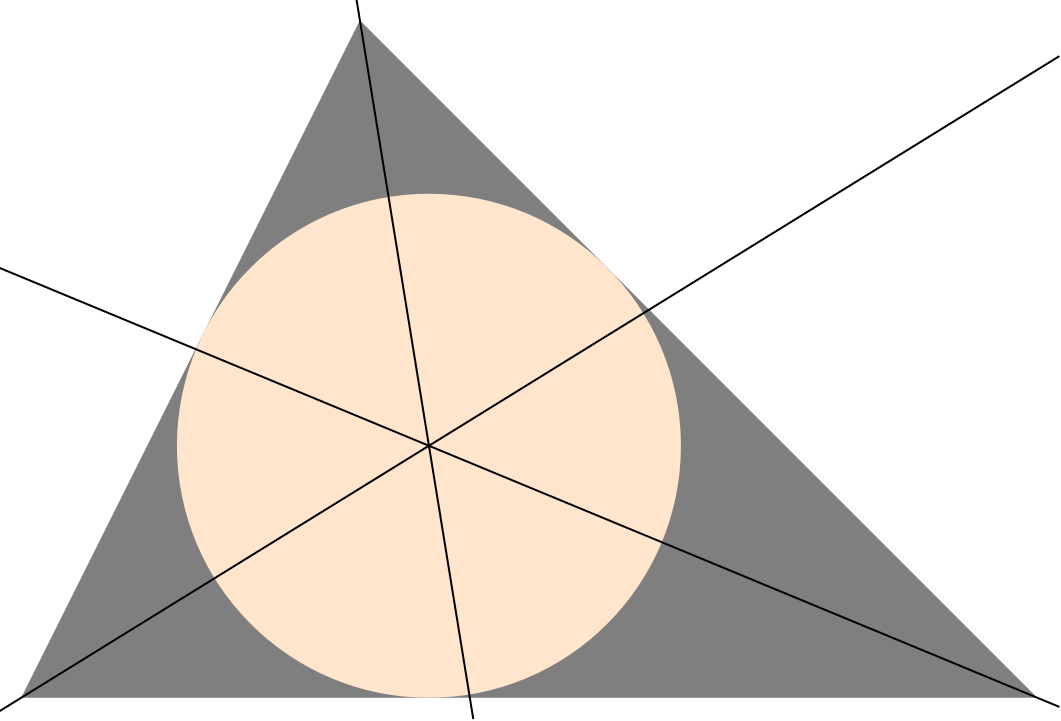
Incenter , where the angle bisectors intersect. the center of the incircle.
I
In[]:=
initial={{0,0},{1,2},{3,0}};ii=Insphere[initial];Graphics[{Gray,Triangle[initial],LightOrange,Disk@@ii,Black,InfiniteLine[{ii[[1]],#}]&/@initial}]
Out[]=
Center of the insphere, which is tangent to the four faces.
Center of the insphere, which is tangent to the four faces.
Intersection point of the dihedral angle bisectors.
In[]:=
initial={{0,0,0},{1,2,0},{3,0,0},{1,1,2}};ii=Insphere[initial];Graphics3D[{Opacity[.5],Tetrahedron[initial],Opacity[.8],Sphere@@ii,Black,Thick,InfiniteLine[{ii[[1]],#}]&/@initial},Boxed->False,SphericalRegion->True]
Out[]=

The reflection of I in the dihedral angle bisectors is thus the same point
In[]:=
RootReduce[ii[[1]]]
Out[]=
,,

In[]:=
RootReduce[ResourceFunction["IsogonalConjugate"][initial,ii[[1]]]]
Out[]=
,,
2. Centroid (G)
2. Centroid ()
G
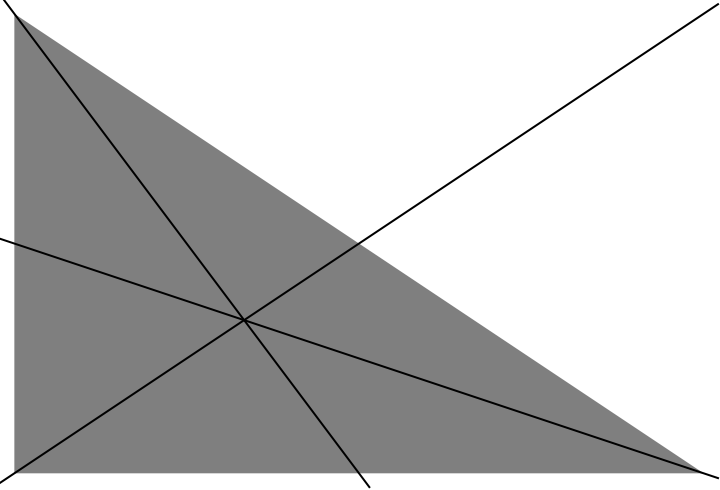
Centroid , where the medians intersect.
G
In[]:=
initial={{0,0},{0,2},{3,0}};gg=Mean[initial];Graphics[{Gray,Triangle[initial],Black,InfiniteLine[{gg,#}]&/@initial}]
Out[]=
Center of mass, the mean of the four vertices.
Center of mass, the mean of the four vertices.
Instead of the concurrence of the midpoints, it’s the concurrence of the centroids.
In[]:=
initial={{0,0,0},{0,2,0},{3,0,0},{1,1,2}};gg=Mean[initial];Graphics3D[{Opacity[.5],Tetrahedron[initial],Opacity[1],{Black,Thick,InfiniteLine[{gg,#}]&/@initial},Sphere[Mean[#],.05]&/@Subsets[initial,{3}]},Boxed->False,SphericalRegion->True]
Out[]=

Center of the circumsphere, which goes through the four vertices. Intersection of the midplanes
No corresponding center. When altitudes are concurrent, same as Monge point.
No corresponding center. When altitudes are concurrent, same as Monge point.
Most of the time, the altitudes do not intersect.
4 Alternate: The Monge Point (M)
4 Alternate: The Monge Point (M)
In a tetrahedron, a midplane is perpendicular to one edge and concurrent with the midpoint of the opposing edge. Each tetrahedron has six midplanes, which intersect at the Monge point.
Center of the 12-point sphere.
Center of the 12-point sphere.
Goes through these twelve points:
1. medial points of each triangle. (Red)
2. 1/3rd distance points between Monge and vertices, the Euler points. (Blue)
3. The feet of the Euler points. (Green)
1. medial points of each triangle. (Red)
2. 1/3rd distance points between Monge and vertices, the Euler points. (Blue)
3. The feet of the Euler points. (Green)
The exsphere tangency is lost.
6. Symmedian Point (K)
6. Symmedian Point (K)
The symmedian point minimizes the sum of the distances squared.
Reflections of the median planes in the dihedral angle bisectors.
Reflections of the median planes in the dihedral angle bisectors.
Also the least-squares point, which is the point with minimal total distance squared to the four faces.
Kimberling Centers (Currently 53769 centers)
Kimberling Centers (Currently 53769 centers)
Here are the first six:
Here’s an animation of a few hundred of the triangle centers.
Euler Line
Euler Line
The Euler line goes through O G T and H. The incenter and symmedian are off the Euler line. The isogonal conjugate of the Euler line is the Jerabek hyperbola.
Positions of O G T H on the Euler Line:
The Euler Line for Tetrahedra
The Euler Line for Tetrahedra
The Euler line goes through O G T and H.
The incenter and symmedian are off the Euler line.
The incenter and symmedian are off the Euler line.
Positions of O G T M on the Euler Line:
Cevians
Cevians
Go from a vertex to the opposite edge.
Cevians for Tetrahedra
Cevians for Tetrahedra
Go from a vertex to the opposite face.
Excircles
Excircles
A triangle:
And the excircles
Exspheres
Exspheres
Isogonal Conjugate
Isogonal Conjugate
Given a triangle ΔABC, the isogonal conjugate of P is constructed by reflecting the lines PA, PB and PC about the angle bisectors and taking the intersection.
The centers of the incircle and excircles are the only four self-conjugate points:
In a tetrahedron
In a tetrahedron
Given a tetrahedron ABCD, the isogonal conjugate of P is constructed by reflecting the lines PA, PB, PC and PD about the angle bisectors of the dihedral edges and taking the intersection.
These incenter and excenters are all equal to their own isogonal conjugates:
Three other points are their own isogonal conjugate in a tetrahedron:
Show the 16 collinear sets of three points formed by four tetrahedral points and eight self-conjugates:
Triangles angles: Twice Sum of angles is 2π
Triangles angles: Twice Sum of angles is 2π
Based on given sides of a triangle, find the opposite angles
Trilinear Coordinates
Trilinear Coordinates
The trilinear coordinates are the relative distances to the sides.
TC can be used with areal coordinates to generate that center; here is a calculation of the orthocenter, where the altitudes of the triangle intersect:
The relative distances are the following:
In a Tetrahedron
In a Tetrahedron
In a tetrahedron, the relative distances to the faces provide the trilinear coordinates:
We can get coordinates of the insphere and exspheres:
They have particular trilinear coordinates:
Areal or Barycentric coordinates -- Triangle Functions
Areal or Barycentric coordinates -- Triangle Functions
In a triangle with sides (a,b,c) and opposite angles (A, B, C)
In a tetrahedron with face areas (a,b,c,d) and opposite angles (A, B, C, D)
The Spieker Point is the incenter of the medial tetrahedron (ie, the tetrahedron whose vertices are the centroids of the faces) of PABC.
Trilinear coordinates -- Triangle Functions
Trilinear coordinates -- Triangle Functions
In a triangle with sides (a,b,c) and opposite angles (A, B, C), the trilinear coordinates are
Tetraplanar Coordinates
Tetraplanar Coordinates
In a tetrahedron with face areas (a,b,c,d), opposite angles (A, B, C, D) and edge lengths
KimberlingCenters
KimberlingCenters
Show the first 29 triangle centers:
Lots of centers
Lots of centers
Start with an asymmetric tetrahedron. For 11,000 triangle centers, calculate that triangle center for each face to generate a new tetrahedron. Calculate tetrahedra centers for that new set of points.
For the first time, here’s a tetrahedron shown with thousands of generated centers. There are 46869 centers in this picture.
Getting a point from Tetraplanar coordinates
Getting a point from Tetraplanar coordinates
In a triangle with sides (a,b,c) and opposite angles (A, B, C) the areal coordinates are as follows:
In a triangle with sides (a,b,c) and opposite angles (A, B, C), the trilinear coordinates are as follows:
To go from trilinear to areal, multiply by the side lengths then normalize. For Cartesian, areal dot original vertices.
To go from tetraplanar to areal, multiply by the face areas then normalize. For Cartesian, areal dot original vertices.
Isogonal Conjugates
Isogonal Conjugates
Isotopic Conjugates
Isotopic Conjugates
140618 Tetrahedron Centers
140618 Tetrahedron Centers
Dihedral Constant Center of a Tetrahedron
Dihedral Constant Center of a Tetrahedron
For opposing edges in a tetrahedron, define p⊗q=p^2+q^2+ 2 p q cot(∠p)cot(∠q), where ∠p is the inner dihedral angle of edge p. In tetrahedron ABCD, AB⊗CD=AC⊗BD=AD⊗BC, a property of dihedral angles in a tetrahedron. Call this the dihedral constant of a tetrahedron. Given tetrahedron ABCD, does there exist a point E such that the dihedral constants of ABCE, ABDE, ACDE, and BCDE are identical? It turns out the point does exist.
A Theorem on the Dihedral Angles of a Tetrahedron
Equal-Area Parallelians Point
Equal-Area Parallelians Point
Definition and Theorem. A parallelian of tetrahedron PABC with respect to vertex P is a triangle, with vertices on the edge-lines through P, in a plane parallel to that of △ABC. Any non-degenerate tetrahedron admits a unique point common to the planes of four equal-area parallelians (one for each vertex); this is the Equal-Area Parallelians Point (EAPP).
Lets see if we can get that working.
The coordinates of the point don’t look too horrible in exact form.
Now we have to calculate the triangles through the point. Being lazy, I’ll shift the tetrahedron to place the EAPP at the origin.
It works! The areas of the four triangles are the same. So lets make a picture of it.
Tetrahedron Centers
Tetrahedron Centers
Unsolved Questions
Unsolved Questions
1. Virtually everything! For example, what is the Tetrahedral Formula for the Fermat Point?
2. For this talk, I generated hundreds of thousands of points. Which ones have easy formulas?
3. We can use simple formulas to generate points. For example, for solid angles A B C D, cos(A):cos(B):cos(C):cos(D). Which of these correspond to useful points?
4. (BIG) What Tetrahedron Centers deserve LETTERS? I = Incenter, G = Centroid, O = Circumcenter, M=Monge
5. What triangles centers have tetrahedral equivalents, and which do not?
6. What are the equivalent SubTetrahedra corresponding to SubTriangles?
CITE THIS NOTEBOOK
CITE THIS NOTEBOOK
Mathematical Games: Tetrahedral Centers
by Ed Pegg
Wolfram Community, STAFF PICKS, May 19 2023
https://community.wolfram.com/groups/-/m/t/2922218
by Ed Pegg
Wolfram Community, STAFF PICKS, May 19 2023
https://community.wolfram.com/groups/-/m/t/2922218