Cycloidal Pendulum
Cycloidal Pendulum


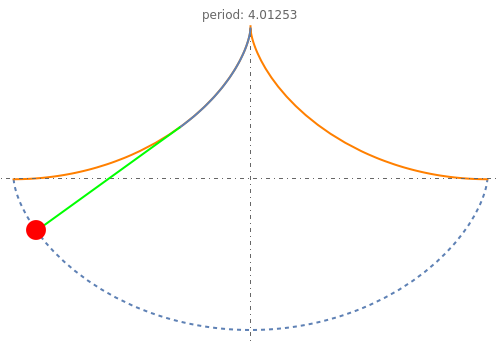
This Demonstration illustrates the isochronous movement of the cycloidal (tautochrone) pendulum.
In 1656, Dutch mathematician and scientist Christiaan Huygens discovered that the simple pendulum is not isochronous, that is, its period depends on the amplitude of the swing.
He realized that the pendulum would be isochronous if the bob of a pendulum swung along a cycloidal arc rather than the circular arc of the classical pendulum. He proved that the cycloid is a tautochrone curve.
To construct this cycloidal pendulum, he used a bob attached to a flexible rod. The movement of the pendulum was restricted on both sides by plates forming a cycloidal arc. When the rod unwraps from these plates, the bob will follow a path that is the involute of the shape of the plates. Since the cycloid is its own evolute, this is a congruent cycloid.
Details
Details
Considered here is a simple pendulum consisting of a bob, idealized as a point mass, attached to a pivot point by a massless string having fixed length . The pendulum is assumed to be subject only to gravity.
L=2
The path of the bob is the cycloid formed by a circle of radius 1 running from to , passing through the point . With as the angle through which the circle has rolled by time , this cycloid is given by the parametric equation
(-π,0)
(π,0)
(0,-2)
s(t)
t
{x,y)=[s(t)-sins(t)-π,-1+coss(t))]
Using Lagrangian dynamics, we have
ℒ=t(t)+
1
2m
2
sin
2
′
s
2
[(t)-cost(t)]
′
s
′
s
and the resulting equation of motion is .
sins(t)g-(t)+2[-1+coss(t)](t)=0
2
′
s
′′
s
The period of a cycloidal pendulum is for any amplitude. With , the period is 4.01213. In this Demonstration, the function period[amplitude] verifies this fact by escaping NDSolve with the "EventLocator" method at the point where the pendulum passes the vertical.
2π
2L/g
L=2
Much more information about the Huygens clock can be found in the following reference.
References
References
[1] A. Emmerson. "Things Are Seldom What They Seem — Christiaan Huygens, the Pendulum and the Cycloid." The Horological Foundation. (2010) www.antique-horology.org/Piggott/RH/Images/81V_Cycloid.pdf.
External Links
External Links
Permanent Citation
Permanent Citation
Erik Mahieu
"Cycloidal Pendulum"
http://demonstrations.wolfram.com/CycloidalPendulum/
Wolfram Demonstrations Project
Published: November 30, 2011