We discuss some connections between the Wolfram Physics Project and Noncommutative Geometry. These ideas are part of our proposal to build a bridge between these two areas, which might enrich our understanding of the questions addressed by both.
Two perspectives
Two perspectives
Building a bridge between the Wolfram Physics Project and noncommutative geometry has the potential to lead to new insights that may inform our understanding of physics.
Noncommutative geometry extends the tools of differential geometry and differential topology to situations where these cannot be applied directly. Although the perspectives are quite different, many ideas in the Wolfram Physics Project are reminiscent of ideas in noncommutative geometry. The success of noncommutative geometry comes largely from its effectiveness as a tool for uncovering structures that are invisible or out of reach when using more traditional methods. This begs the question: what can the tools of noncommutative geometry tell us about the structures relevant to the Wolfram Physics Project?
Computational primitives in the Wolfram Physics Project
Computational primitives in the Wolfram Physics Project
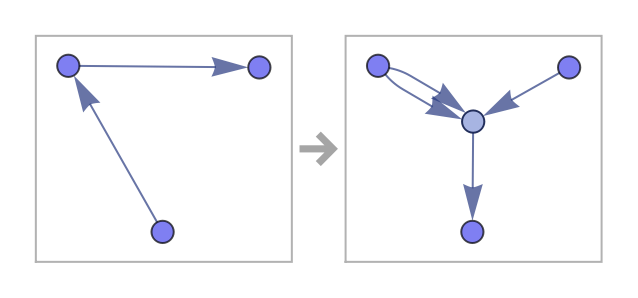
The Wolfram Physics Project approaches the study of the fundamental laws of physics using a multicomputational paradigm. In this approach, the main computational primitives are given by hypergraph rewriting systems. These systems serve as the basis for multicomputational models with extremely rich expressive capabilities, resulting in models versatile enough to represent phenomena ranging from general relativity to quantum mechanics and beyond.
As grounding examples, we consider some of the systems in the registry of notable universes:
In[]:=
WolframModel=ResourceFunction["WolframModel"];
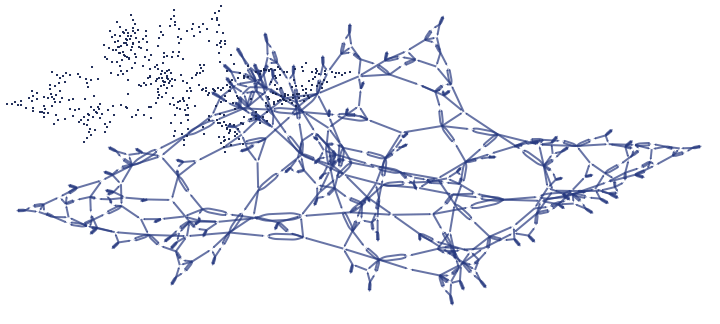
eo1=WolframModel["wm1433"],Automatic,10;RulePlot[eo1]eo1["FinalStatePlot"]
Out[]=

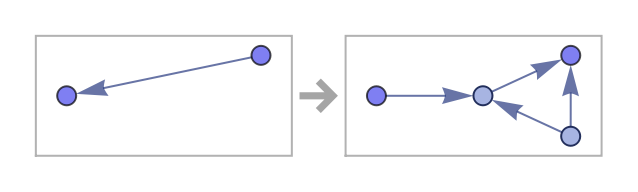
eo2=WolframModel["wm2277"],Automatic,5;RulePlot[eo2]eo2["FinalStatePlot"]
Out[]=
Out[]=
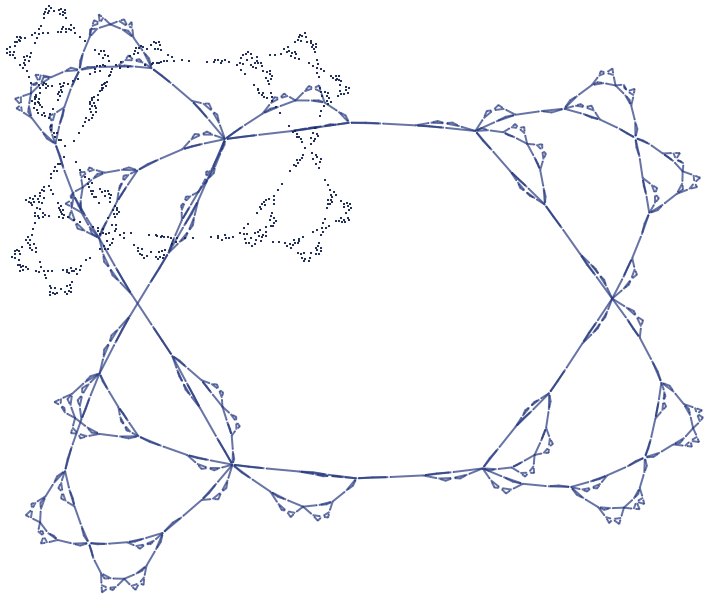
eo3=WolframModel["wm1879"],Automatic,10;RulePlot[eo3]eo3["FinalStatePlot"]
Out[]=

Out[]=
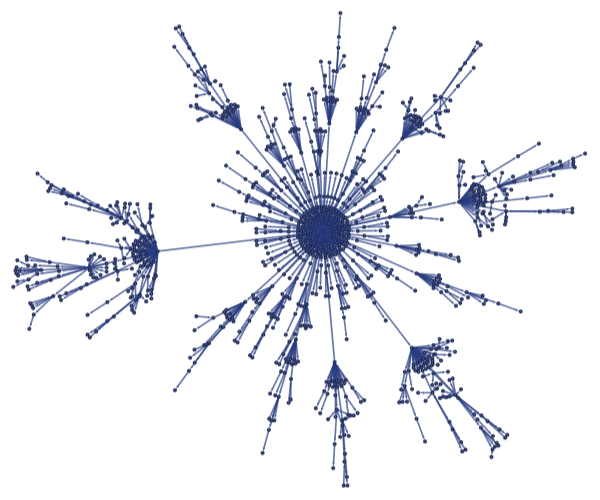
eo4=WolframModel["wm1543"],Automatic,10;RulePlot[eo4]eo4["FinalStatePlot"]
Out[]=

Out[]=
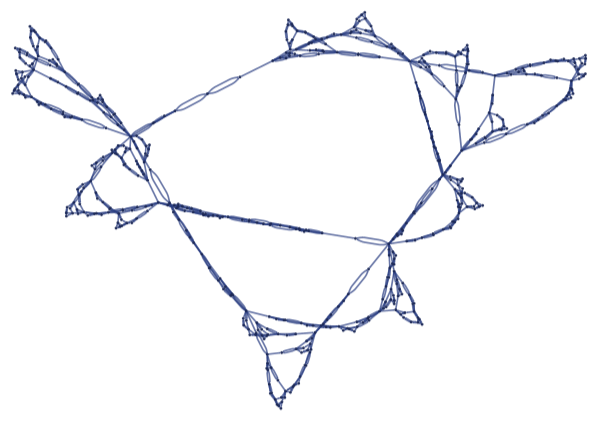
eo5=WolframModel["wm1686"],Automatic,5;RulePlot[eo5]eo5["FinalStatePlot"]

Out[]=
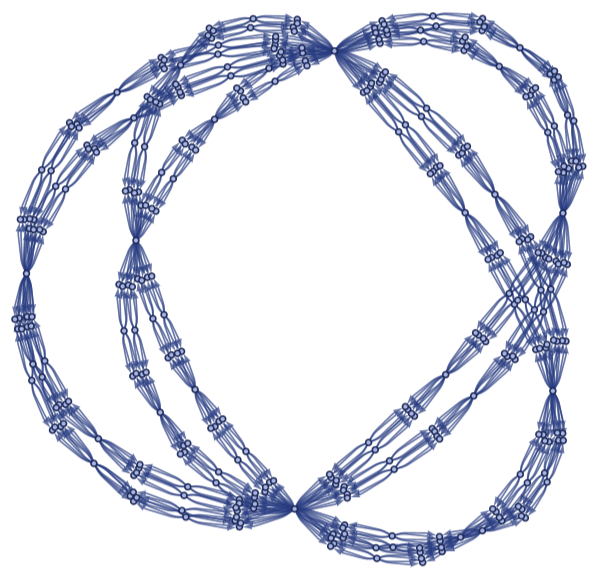
eo6=WolframModel["wm1526"],Automatic,5;RulePlot[eo6]eo6["FinalStatePlot"]
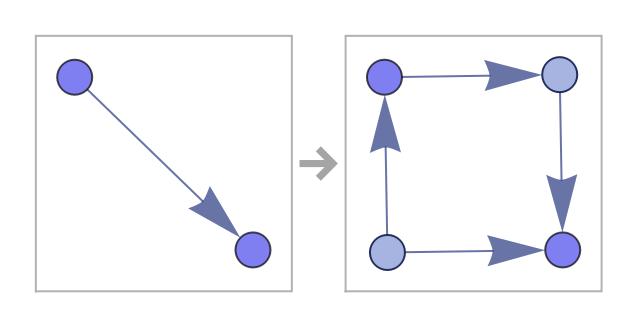
Out[]=
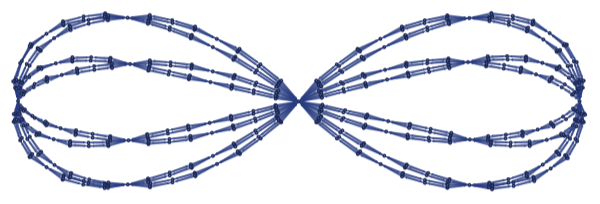
eo7=WolframModel["wm1218"],Automatic,10;RulePlot[eo7]eo7["FinalStatePlot"]
Operator algebras, aka noncommutative spaces
Operator algebras, aka noncommutative spaces
Noncommutative geometry extends the tools of differential geometry and differential topology to situations where these cannot be applied directly.
The main paradigm of noncommutative geometry is that of an operator algebra, which is understood as an algebra of functions on an underlying noncommutative space. This operator-theoretic viewpoint is familiar from quantum mechanics, where unitary operators define the time evolution of a system, Hermitian operators correspond to observables, and projection operators to measurements. As an important remark, all of these are normal operators, so we can understand them in terms of their spectra via the spectral theorem. It is no coincidence that the development of Heisenberg’s matrix mechanics arose from his study of the hydrogen spectrum and the subsequent realization of the uncertainty principle as a consequence of the presence of noncommutative observables. Lets look at this spectra:
The main paradigm of noncommutative geometry is that of an operator algebra, which is understood as an algebra of functions on an underlying noncommutative space. This operator-theoretic viewpoint is familiar from quantum mechanics, where unitary operators define the time evolution of a system, Hermitian operators correspond to observables, and projection operators to measurements. As an important remark, all of these are normal operators, so we can understand them in terms of their spectra via the spectral theorem. It is no coincidence that the development of Heisenberg’s matrix mechanics arose from his study of the hydrogen spectrum and the subsequent realization of the uncertainty principle as a consequence of the presence of noncommutative observables. Lets look at this spectra:
Some sketches
Some sketches
Graph Laplacian eigenvalues
Graph Laplacian eigenvalues
We start by looking at the graph Laplacian of the middle states in some of the above models.
Heat Kernels
Heat Kernels
We can use these to study the heat kernel of the states in a model.
The work of Bérard, Besson, and Gallot, ‘Embedding Riemannian manifolds by their heat kernel’, later extended by Connes to provide a unitary invariant of Riemannian manifolds, could be used to identify limiting geometries. The question would then be: does the heat kernel of a graph rewriting system coincide, in the limit, with that of a Riemannian manifold? If so, can we identify the appropriate data for Connes’ unitary invariant arising from the system in such a way as to single out the Riemannian geometry associated with the limiting system?
Betti number profiles
Betti number profiles
Concluding Remarks
Concluding Remarks
The last example suggests the use of Betti number profiles for the classification of multiway rewriting systems. Understanding the functions underlying these profiles could lead to useful invariants, close in spirit to those of a K-theoretic nature in noncommutative geometry.
Can noncommutative geometry inform the study of multiway rewriting systems? Can we extend the scope of noncommutative geometry by understanding some of its constructions within the multicomputational perspective furnished by hypergraph rewriting systems? We believe that pursuing a serious study of these questions could be a very fruitful endeavor.
Can noncommutative geometry inform the study of multiway rewriting systems? Can we extend the scope of noncommutative geometry by understanding some of its constructions within the multicomputational perspective furnished by hypergraph rewriting systems? We believe that pursuing a serious study of these questions could be a very fruitful endeavor.
Acknowledgments
Acknowledgments
I am very happy to thank the members of the Wolfram Winter School 2026 for their amazing work in putting together such an inspiring event. I am especially indebted to Xerxes D. Arsiwalla for many useful conversations. I would also like to thank J. Arturo Silva-Ordaz for introducing me to the Wolfram Physics Project.
References
References
1
.Alain Connes (1994), Noncommutative Geometry. Academic Press.
2
.Stephen Wolfram (2020), "Finally We May Have a Path to the Fundamental Theory of Physics… and It's Beautiful," Stephen Wolfram Writings. writings.stephenwolfram.com/2020/04/finally-we-may-have-a-path-to-the-fundamental-theory-of-physics-and-its-beautiful.
CITE THIS NOTEBOOK
CITE THIS NOTEBOOK
Noncommutative geometry and graph rewriting systems
by Jorge Plazas
Wolfram Community, STAFF PICKS, January 15, 2026
https://community.wolfram.com/groups/-/m/t/3607969
by Jorge Plazas
Wolfram Community, STAFF PICKS, January 15, 2026
https://community.wolfram.com/groups/-/m/t/3607969