The Gompertz Sigmoid Function and Its Derivative
The Gompertz Sigmoid Function and Its Derivative


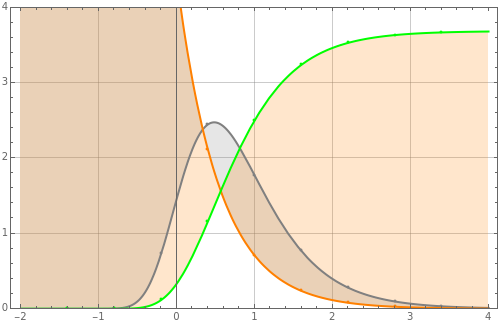
This Gompertz function is defined by or , where is the upper asymptote and and are the negative growth rates. The Gompertz function is a sigmoid function. It is a type of mathematical model for a time series, where growth is slowest at the start and end of a time period. This Demonstration plots the Gompertz function , its derivative, , and the ratio ln(f(t))= .
f(t)=a
b
ct
e
e
f(t)=aexp(bexp(ct))
a
b
c
f(t)
f'(t)=abc
b
ct
e
e
ct
e
d
dt
f'(t)/f(t)
Details
Details
For more information, see the Wikipedia entry for Gompertz–Makeham Law of Mortality, as well as B. Gompertz, "On the Nature of the Function Expressive of the Law of Human Mortality, and on a New Mode of Determining the Value of Life Contingencies," Philosophical Transactions of the Royal Society of London, 115, 1825 pp. 513–585.
External Links
External Links
Permanent Citation
Permanent Citation
Olexandr Eugene Prokopchenko
"The Gompertz Sigmoid Function and Its Derivative"
http://demonstrations.wolfram.com/TheGompertzSigmoidFunctionAndItsDerivative/
Wolfram Demonstrations Project
Published: March 7, 2011