A challenging Chinese college entrance examination adapted from 1988 Soviet Union Math competition. The new built-in DataStructrue features (HashTable and LinkedList) help to create very efficient implementation with compact code to simulate the proof with random inputs.
Problem
Problem
Given two lists of same finite length , and . For each element and , ∈{1,2,3,...,m} and ∈{1,2,3,...,m}. Notice that the elements do NOT have to be distinct. Also define:==0, =+++...+=+++...+ =max{i|<=} with .Show that there exist and s.t. +++...+=+++...+.
m
{}={,,...,,}
a
n
a
1
a
2
a
3
a
m-1
a
m
{}={,,...,,}
b
n
b
1
b
2
b
3
b
m-1
b
m
a
i
b
i
a
i
b
i
A
0
B
0
A
n
a
1
a
2
a
3
a
n
B
n
b
1
b
2
b
3
b
n
r
k
B
i
A
k
i∈{0,1,2,...,m}
1<=p<=q<=m
1<=s<=t<=m
a
p
a
p+1
a
p+2
a
q
b
s
b
s+1
b
s+2
b
t
Simple example with m = 5
Simple example with m = 5
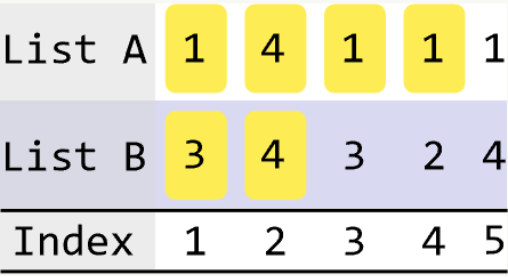
{}={1,4,1,1,1}
a
n
{}={3,4,3,2,4}
b
n
{}={0,0,1,1,2,2}
r
k
a
1
a
2
a
3
a
4
b
1
b
2
Simulation
Simulation
The implementation is the word-by-word translation from the mathematical proof based on pigeonhole principle. Therefore it will always stop and return the earliest pair of subsequences with the same sum.
In[]:=
pigeonhole principle
Initialization
Initialization
Using proper data structure greatly improves performance:
Clear[ht,lnklst]
ht=CreateDataStructure["HashTable"];lnklst=CreateDataStructure["LinkedList"];
Core of the algorithm
Core of the algorithm
Set the length of the random input less than 300 so that we can have good visualization in the tabulated result.
In[]:=
m=256;
solAsso=Module{a,b,r,twoLists,count,pos,key},ht["KeyDropAll"];lnklst["DropAll"];(*randomlygenerateinputs.MakesureAm<Bm.Otherwisejustswitchtheorder*)twoLists=SortBy[RandomInteger[{1,m},{2,m}],Total];(*worstcaseonlyonedupe*)(*twoLists={ConstantArray[1,m],ConstantArray[m,m]};*)a=Accumulate[{0}~Join~(twoLists[[1]])];b=Accumulate[{0}~Join~(twoLists[[2]])];pos=Dor=[b,a[[k]]];(*onlycomputenecessaryterms*)lnklst["Append",r];key=a[[k]]-b[[r]];If[!ht["KeyExistsQ",key],ht["Insert",key->k],Return[k]],{k,1,m+1};<|"TwoLists"->twoLists,"RangeA"->{ht["Lookup",key],pos-1},"RangeB"->{lnklst["Part",ht["Lookup",key]],lnklst["Part",pos]-1}|>;
Here are some tips to understand the algorithm:
◼
Accumulate[{0}~Join~listA]
A
n
B
n
◼
a
p
a
p+1
a
p+2
a
q
A
q
A
p-1
b
i
◼
The objects of pigeon-hole principle is - with >= and <<=+m. We can show that there are in total objects and only possible boxes with . Therefore we must have at least one pair of duplication.
A
k
B
r(k)
A
k
B
r(k)
A
k
B
r(k)+1
B
r(k)
-,-,-,...,-
A
0
B
r(0)
A
1
B
r(1)
A
2
B
r(2)
A
m
B
r(m)
m+1
m
0<=-<m
A
k
B
r(k)
◼
r
k
A
k
B
r=[b,a[[k]]]
◼
r
k
◼
Record each occurrence of new element and its location in a hash table;
Terminate the loop if some element found again
Terminate the loop if some element found again
◼
Use the current value of iteration counter and hash table to extract the subsequences with same sum
Visualization
Visualization
The visualization code creates human-readable tabulated result and highlight which items are the earliest findings in each list with equal sum. The code is written to give you some flexibility to handle large inputs by dropping the unwanted parts:
In[]:=
Module{list1=solAsso["TwoLists"][[1]],list2=solAsso["TwoLists"][[2]],lb,ub,pre,suf},Scan[(list1[[#]]=Highlighted[list1[[#]]])&,Range@@solAsso["RangeA"]];Scan[(list2[[#]]=Highlighted[list2[[#]]])&,Range@@solAsso["RangeB"]];lb=Max[1,Min[solAsso["RangeA"][[1]]-2,solAsso["RangeB"][[1]]-2]];ub=Min[m,Max[solAsso["RangeA"][[2]]+2,solAsso["RangeB"][[2]]+2]];pre=If[lb==1,{},{"..."}];suf=If[ub==m,{},{"..."}];[{pre~Join~list1[[lb;;ub]]~Join~suf,pre~Join~list2[[lb;;ub]]~Join~suf,pre~Join~(Range[lb,ub])~Join~suf},{},{"List A","List B","Index"},Dividers->{False,{False,False,True}}]
Out[]=

Verify the sum of two subsequence are the same
◼
The subsequence highlighted in the first list
In[]:=
Take[solAsso["TwoLists"][[1]],solAsso["RangeA"]]
Out[]=
{158,102,21,143,63,6,75,229,229}
In[]:=
Total[%]
Out[]=
1026
◼
The subsequence highlighted in the second list
In[]:=
Take[solAsso["TwoLists"][[2]],solAsso["RangeB"]]
Out[]=
{84,154,142,112,11,243,77,203}
In[]:=
Total[%]
Out[]=
1026
The corresponding hash table
Partial list for :
R
n
In[]:=
lnklst["Visualization"]
Out[]=

Updated items in the hash table
Construction of the worst case
Construction of the worst case
Release memory
Summary
Summary
◼
Use hash table to store visited items in accumulated sum
◼
Pay attention to the indices of zero based and 1 based array
◼
The algorithm is probabilistically efficient for large input because the first pair of equal sum is very early even for really large input
Utility
Utility
CITE THIS NOTEBOOK
CITE THIS NOTEBOOK
Find a pair of subsequences of equal sum from two lists
by Shenghui Yang
Wolfram Community, STAFF PICKS, June 22, 2023
https://community.wolfram.com/groups/-/m/t/2940997
by Shenghui Yang
Wolfram Community, STAFF PICKS, June 22, 2023
https://community.wolfram.com/groups/-/m/t/2940997