Pacioli’s (incorrect) assertion in the Summa de Arithmetica 1494 that there was no general solution to cubic equations helped to popularize the problem among contemporary mathematicians, contributing to its subsequent solution by Nicolo Tartaglia. https://en.wikipedia.org/wiki/Summa_de_arithmetica
[and remember the general quintic can not be solved by reducing to a lower degree equation https://en.wikipedia.org/wiki/Abel%E2%80%93Ruffini_theorem ]
[and remember the general quintic can not be solved by reducing to a lower degree equation https://en.wikipedia.org/wiki/Abel%E2%80%93Ruffini_theorem ]
Luca Pacioli (1445-1517) had conjectured in his Summa de Arithmetica published 1494, that cubics of this type +px=q and +p=q can not be solved in closed form. This was a motivation for the mathematicians of the time to refute this conjecture. It was first solved by Scipione del Ferro (1465-1527) and later also by Nicolo Tartaglia (1499/1500-1567), who already had a deeper understanding of the matter and revealed the secret to Cardano (1501-1576), who published it in the Ars magna 1545 together with the solution of the quartic found by Ludovici Ferrari (1522-1565).
3
x
3
x
2
x
Michael Stifel dealt with negative numbers in his 1544 Arithmetica Integra, where he also called them numeri absurdi (absurd numbers).
https://en.wikipedia.org/wiki/Negative_number
https://en.wikipedia.org/wiki/Negative_number
The purpose of this notebook is to show, how this depressed cubic +px=q ( positive) can be solved by decomposing a cube. Formally the depressed cubic is reduced to a quadratic equation.
3
x
p,q
To keep things very short, the following points are excluded:
(0) How to convert a general cubic into a depressed cubic.
(i) Solving the depressed cubic for all real values of. This is harder then one might expect. The solutions involve all three third roots of 1.
(ii) Cardano’s solution from his Ars Magna 1545 could solve all cases, but only by introducing complex numbers. The first who could solve the CASUS IRREDUCIBILIS with only using real numbers was Vieta with trigonometric functions involved around 1593. https://en.wikipedia.org/wiki/Casus_irreducibilis
(iii) The solution of a quartic with the method of Ludovici Ferrari. The quartic is reduced to a depressed cubic.
(0) How to convert a general cubic into a depressed cubic.
(i) Solving the depressed cubic for all real values of
p,q
(ii) Cardano’s solution from his Ars Magna 1545 could solve all cases, but only by introducing complex numbers. The first who could solve the CASUS IRREDUCIBILIS with only using real numbers was Vieta with trigonometric functions involved around 1593. https://en.wikipedia.org/wiki/Casus_irreducibilis
(iii) The solution of a quartic with the method of Ludovici Ferrari. The quartic is reduced to a depressed cubic.
To be honest nobody knows how Del Ferro came up with a solution to the depressed cubic. But it could have been like this (and it’s very plausible to me).
Definition: The Scipione del Ferro depressed cubic is for positive numbers : +px=q
p,q
3
x
Out[]=

Let be the solution of the depressed cubic +px=q and the sidelength of the red cube. The big cube (the hole) has sidelength and the small blue cube has sidelength . So we have , and .The hole cube has volume and del Ferro’s decomposition shows that this is equal to the volume of the red cube plus 3 times the volume of the white cuboids and the volume of the blue cube, i.e. +3uv(u-v)+=which is the same as +3uv(u-v)=-
x
3
x
u
v
u>v>0
x=u-v>0
3
u
3
(u-v)
3
v
3
u
3
(u-v)
3
u
3
v
Check this claim:
In[]:=
Reduce[+3uv(u-v)==-]
3
(u-v)
3
u
3
v
Out[]=
True
Now let , and then
+px=q
q=->0
3
u
3
v
p=3uv>0
x=u-v>0
3
x
Check:
In[]:=
3
(u-v)
3
u
3
v
3
u
3
v
Out[]=
px+q
3
x
And this system has to be solved: -=q =which is a quadratic equation in disguise.
3
u
3
v
3
(uv)
3
p
3
Check:
In[]:=
eqns={Equal@@rule3,ApplySides[&,Equal@@rule2]}
3
#
Out[]=
-q,
3
u
3
v
3
u
3
v
3
p
27
Now let , , then this system has to be solved: which is just a quadratic equation =qU+Pwhich must be solved for .And is then as well as .
U=>0
3
u
V=>0
3
v
P=>0
3
(p/3)
U-V=q
UV=P
2
U
U
V
U-q
P
U
Check:
In[]:=
eqns2=eqns/.->U/.->V/.->27P
3
u
3
v
3
p
Out[]=
{U-Vq,UVP}
In[]:=
quadratic=Eliminate[eqns2,V]
Out[]=
P+qU-0
2
U
In[]:=
Solve[quadratic/.q->2Q,U]/.Q->q/2
Out[]=
U-+
q
2
P+
,U2
q
4
q
2
P+
2
q
4
Pick the positive solution (negative numbers where numeri absurdi): , and therefore , (also )Then
U=++P
q
2
2
q
2
V=U-q>0
u=++
3
U
=3
q
2
2
q
2
3
p
3
v=
3
U-q
v=
p
3u
x=u-v
https://mathshistory.st-andrews.ac.uk/Biographies/Tartaglia/quotations/The poem in which Tartaglia revealed the secret of solving the cubic to Cardan:+px=q
When the cube and the things together
Are equal to some discrete number
, 3
x
Find two other numbers differing in this one.
U-V=q
Then you will keep this as a habit
That their product shall always be equal
Exactly to the cube of a third of the things.
UV=
3
(p/3)
The remainder then as a general rule
Of their cube roots subtracted
Will be equal to your principal thing.
x=
3
U
-3
V
Remark: can be computed by or . I choose here the first method in the tradition of del Ferro and Tartaglia.
V
V=U-q
V=
3
(p/3)
U
All intermediate values stay positive as well as the result:
In[]:=
DelFerroDepressedCubic[+p_.x_==q_.,x_]/;q>0&&p>0:=WithU=++,Withu=
3
x_
q
2
2
(q/2)
3
(p/3)
3
U
,v=3
U-q
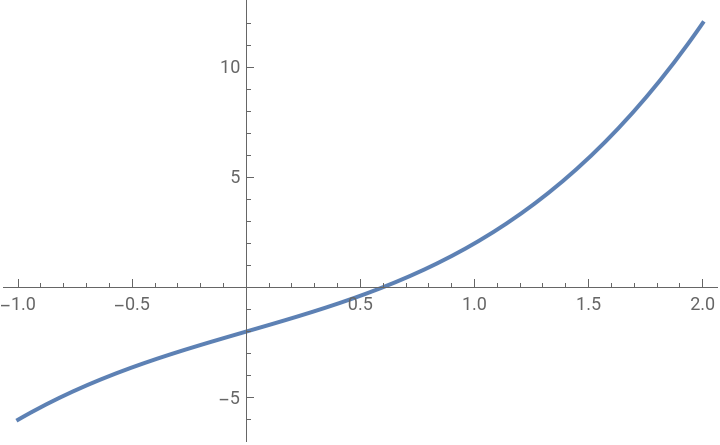
,u-vExample: +3x=2 (it has an irrational real solution)
3
x
In[]:=
DelFerroDepressedCubic[eqn=+3x==2,x]
3
x
Out[]=
-+
1/3
(-1+
2
)1/3
(1+
2
)In[]:=
N[%]
Out[]=
0.596072
How does this depressed cubic look like?
In[]:=
Plot[eqn,{x,-1,2}]
Out[]=
And how does it look in the complex plane?
So there is a positive real solution and two conjugate complex solutions.
CITE THIS NOTEBOOK
CITE THIS NOTEBOOK
Solving a depressed cubic with Scipione del Ferro's idea
by Oliver Seipel
Wolfram Community, STAFF PICKS, October 14, 2023
https://community.wolfram.com/groups/-/m/t/3036063
by Oliver Seipel
Wolfram Community, STAFF PICKS, October 14, 2023
https://community.wolfram.com/groups/-/m/t/3036063