Rolling Ball inside a Cylinder
Rolling Ball inside a Cylinder


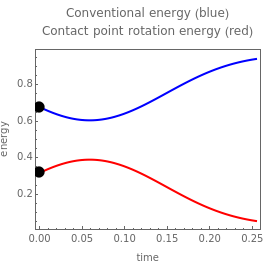
A ball rolling along the inside of a cylinder without slipping performs a surprising return to the starting height. This is related to the phenomenon of a golf ball rising out of the cup after it starts to fall in. This Demonstration uses the equations of motion to show the rolling ball together with the axis of rotation and an energy plot. A key point is the proper coordinate system for studying the axis of rotation. The rotation axis is given by , where refers to the vertical axis through the center of the ball, refers to the horizontal axis through the point of contact and normal to the cylinder, and refers to the horizontal axis perpendicular to that of . The third component of the angular velocity, , turns out to remain constant. The graph on the right shows the breakdown of two types of energy. Total energy is constant, but the energy can be divided into a conventional part (kinetic energy plus angular energy due to rotation of and plus potential energy) and a surprising part, the spinning around the axis, . The -spinning is due to a coriolis torque and it is this that causes the sign of to reverse; because =r, the reversal of -spin causes the reversal of the -motion.
(,,)
ω
ρ
ω
ϕ
ω
z
z
ρ
ϕ
ρ
ω
z
ω
z
ω
ϕ
ρ
ω
ρ
ρ
ω
ϕ
′
z
ω
ϕ
ϕ
z
The controls:
The ratio control gives where is the ball radius and the cylinder radius. is always set to the golf ball cup radius of 5.4 cm. The golf ball setting for is 2.1 cm.
r/R
r
R
R
r
g
cm/
2
sec
α
V
0
ω
ρ0
ρ
V
0
ω
ρ0
V
0
The number of revolutions sets the number of horizontal revolutions of the ball around the cylinder.
Time is given in seconds.
Details
Details
The physics of a ball rolling inside a cylinder is worked out in the paper by Gualtieri et al; they analyze the various forces involved, notably a Coriolis torque that acts around the -axis. A physical demonstration of the process is described in the paper by Matsuura. We enhanced the work of Gualtieri et al by allowing an initial spinning around the -axis. This matches the behavior of a golf ball, which would be spinning at a rate proportional to its speed as it falls into the cup (see second snapshot). Solving the differential equations yields a formula of the form . But in order to learn where points are at time requires the numerical solution of a differential equation so that the angular velocity at each instant is as it should be. The angular velocity is computed from by the following equation, where is the radius of the ball, is the radius of the cylinder, and is a constant that represents the (negative of) the angular speed of the ball around the central axis of the cylinder: . Note that is a linear function of . The program for the soccer ball was taken from a Demonstration by Greg Wilhelm.
ρ
ω
ρ0
ρ
z=+sin(λt)+cos(λt)
c
1
c
2
c
3
t
z(t)
r
R
Ω
(,,)=-z+,,
ω
ρ
ω
ϕ
ω
z
Ω
r
ω
ρ0
1
r
′
z
ΩR
r
ω
ρ
z
References
References
M. Gualtieri, T. Tokieda, L. Advis-Gaete, B. Carry, E. Reffet, and C. Guthman, "Golfer's Dilemma," American Journal of Physics, 74(6), 2006 pp. 497–501.
A. Matsuura, "Strange Physical Motion of Balls in a Cylinder," Proc. of Bridges Conference, Banff, 2005.
External Links
External Links
Permanent Citation
Permanent Citation
Dan Curtis, Alexi Radovinsky, Stan Wagon
"Rolling Ball inside a Cylinder"
http://demonstrations.wolfram.com/RollingBallInsideACylinder/
Wolfram Demonstrations Project
Published: September 1, 2009