This is part of live presentation series called Mathematical Games in which we explore a variety of games and puzzles using Wolfram Language. In this episode, we explore the mathematical games and puzzles involving Icosahedra and other polyforms.
demonstrations.wolfram.com
demonstrations.wolfram.com
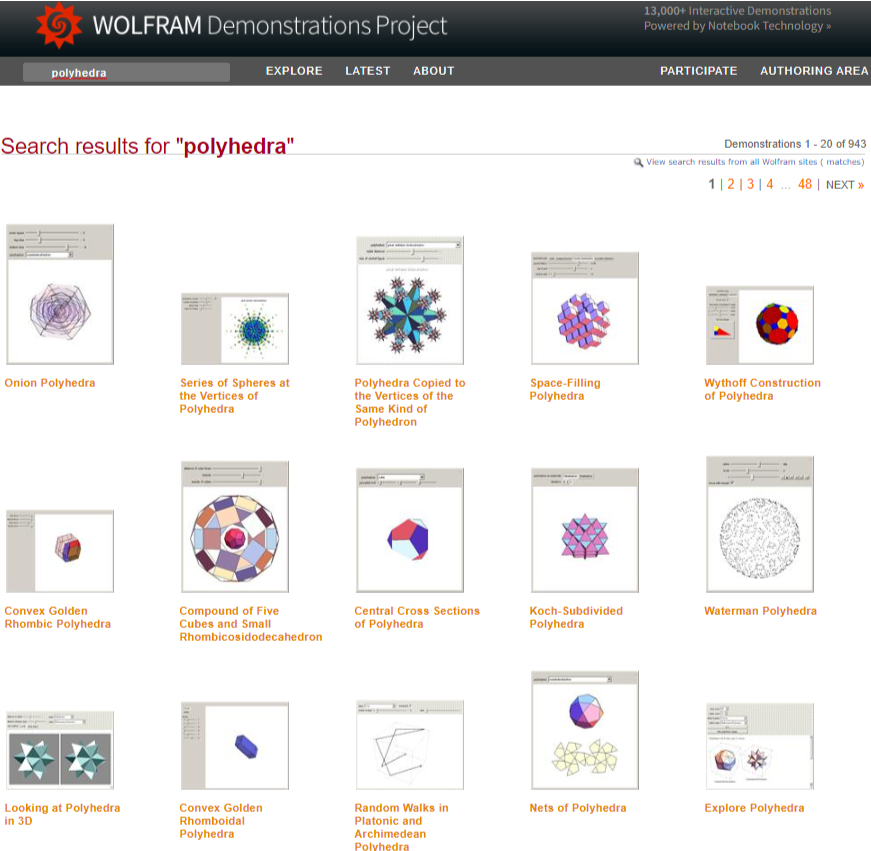
Many Demonstrations involve polyhedra.
The Five Platonic Solids (Martin Gardner)
The Five Platonic Solids (Martin Gardner)
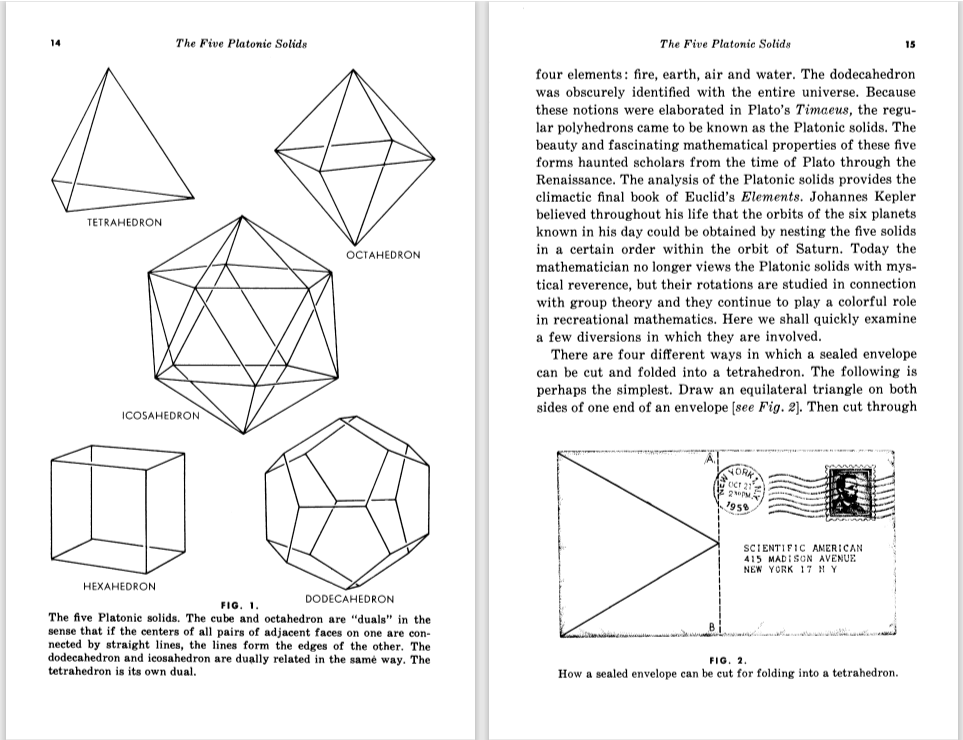
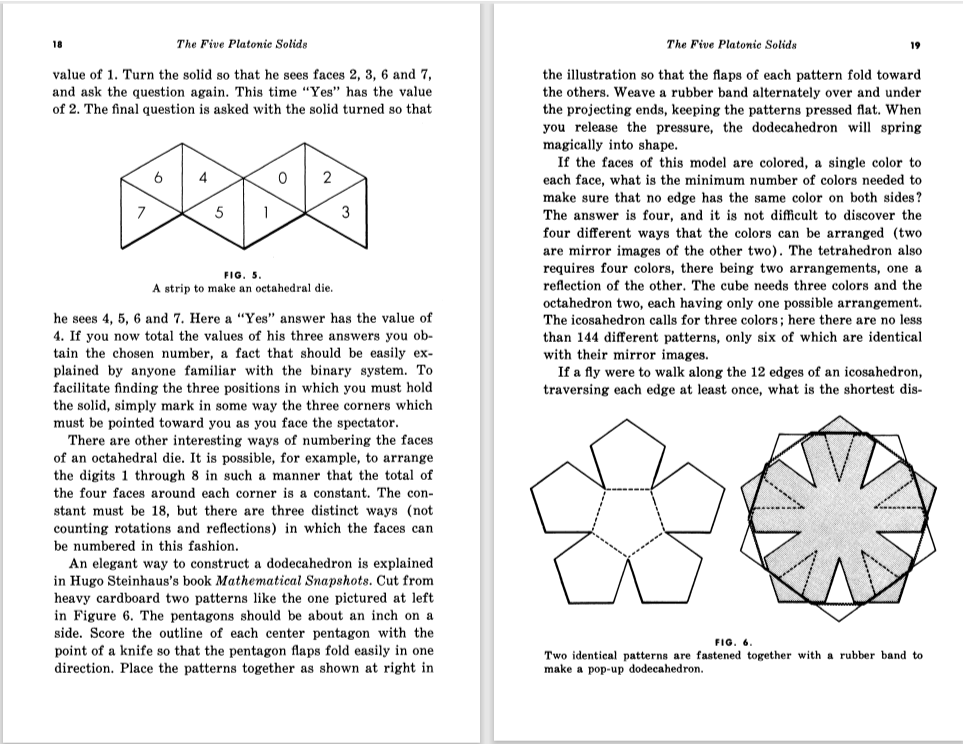
The Five Platonic Solids
The Five Platonic Solids
In[]:=
PolyhedronData["Platonic"]
Out[]=
{Tetrahedron,Cube,Octahedron,Dodecahedron,Icosahedron}
In[]:=
PolyhedronData/@%
Out[]=
 ,
, ,
, ,
, ,
,
The Icosian Game (Martin Gardner)
The Icosian Game (Martin Gardner)
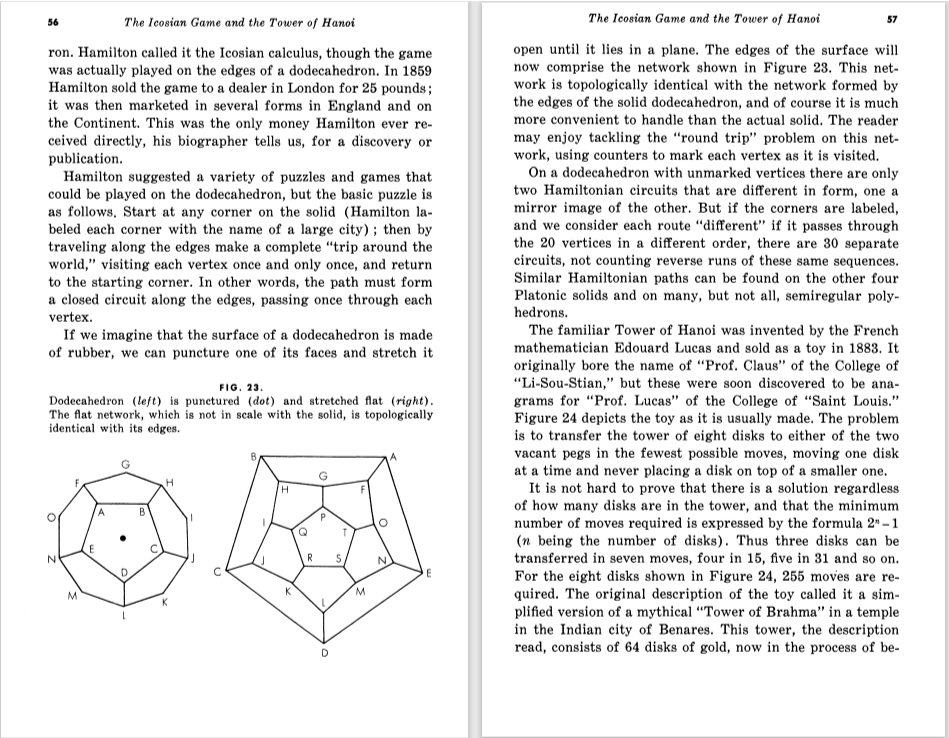
The Icosian Game (James Dalgety)
The Icosian Game (James Dalgety)
An original copy of Sir William Rowan Hamilton’s famous “Icosian Game”.
by: Sophia Chen
A Hamiltonian cycle is a cycle in a graph that visits every vertex exactly once. This Demonstration challenges you to find a Hamiltonian cycle through graphs of various polyhedral skeletons. If the “drag locators” checkbox is checked, each vertex has a locator that you can drag from one point to another in order to help you find a Hamiltonian cycle. (It is helpful to drag a vertex close to the next vertex but not covering the its locator). Check the box “show possible answer” to view one possible answer.
by: Ed Pegg Jr
This Demonstration shows Hamiltonian tours on various polyhedra.
by: Eric Weisstein
Display the set of polygons obtained by extending polyhedron edges perpendicularly inward by a given distance
TwistyPuzzles.com
TwistyPuzzles.com
All of the classic polyhedra have been turned into twisty puzzles.
Preston Alden’s 49×49×49 cube
Preston Alden’s 49×49×49 cube
Announced Saturday, Aug 10, 2024: a new world record in twisty puzzles. It’s 30 kg, 34 cm tall, consists of 13,827 pieces, 14406 stickers and needed four years to construct.
So ... how many positions does this have? First, a few numbers:
This is a very fast growing number:
The numbers are more manageable when expressed with exponents:
by: Ed Pegg Jr and Jan Mangaldan
Get all signed permutations of a list
The vertices of an icosahedron:
All the Platonic and Archimedean solids are easy to represent:
Let’s get the mesh regions back into polyhedra:
by: Ed Pegg Jr
Get the faces corresponding to a polyhedral graph
Find the faces corresponding to a set of polyhedral graph edges:
Show the faces:
All polyhedral graphs with 1 to 10 vertices, grouped by number of vertices, in “g6” format:
by George W. Hart
Show
Show
Generate the canonical form of a convex polyhedron. The center of each edge is tangent to the unit sphere:
We can look at the canonical forms for the seven polyhedral graphs with six vertices:
The volume of the second is curiously close to Pi:
The polylist earlier was all the polyhedral graphs with a given number of vertices.
The dual graphs give all the polyhedral graphs with a given number of faces:
The dual graphs give all the polyhedral graphs with a given number of faces:
Canonical forms of the seven hexahedra:
Canonical forms of the 34 heptahedra:
One tetrahedron, two pentahedra, seven hexahedra, 34 heptahedra, 257 octahedra, 2606 nonahedra, and 32300 decahedra.
A Schlegel diagram is a planar 2D representation of a polyhedron with the following properties:
1. One outer face is taken as a regular polygon.
2. The inner faces are convex polygons.
1. One outer face is taken as a regular polygon.
2. The inner faces are convex polygons.
EulerCharacteristic (F+V-E = 2)
EulerCharacteristic (F+V-E = 2)
The Euler Characteristic of a polyhedron is 2
by: Izidor Hafner
The smallest known single-hole toroidal polyhedron made up of only equilateral triangles was found by Conway and consists of 36 triangles. Some adjacent triangles are coplanar.
Reflect a polyhedron over a given face
A sample toroid:
by: Sándor Kabai
Tetrahedra are arranged in triples along a straight line. The edges of the tetrahedra trace three helices. The vertices of the tetrahedra lie on a cylinder, as well as on two helices, one that turns left and one that turns right.
Box Packing (Hoffman’s Packing Puzzle)
Box Packing (Hoffman’s Packing Puzzle)
by: Ed Pegg Jr
by: Izidor Hafner
This Demonstration shows a colored Szilassi polyhedron and its net.
by: Stephen Wolfram
Generate nets of polyhedra, suitable for constructing the polyhedra out of paper.
by: Izidor Hafner
Create an unfolding net for a given polyhedron
Icosians
Icosians
The icosians are a set of Hamiltonian quaternions based on the 120 vertices of the 600-cell.
With them, we can make the Hexakis Icosahedron:
The above can be used as an equivalent of the Icosahedral group.
by: Izidor Hafner
by: Sándor Kabai
Cut out all but an S-shaped piece from each of the 30 faces of a great rhombic triacontahedron (GRT) to produce this geometrical sculpture.
by: Ed Pegg Jr
by: Ed Pegg Jr
Play with the facets and cells of stellations of the icosahedron. Cut off a segment (along an axis through a vertex, edge, or face) and see inside. Different color schemes help identify the symmetry, facets, and cells of icosahedral stellations.
by: Ed Pegg Jr
by: Izidor Hafner
This Demonstration shows op art graphics on a sphere. You can choose patterns with underlying tetrahedral, octahedral or icosahedral symmetry.
by: Izidor Hafner
by: Sándor Kabai
The bricks are fit tightly together as a Borromean ring. When they are compressed, the vertices of the resulting golden rectangles coincide with the vertices of an icosahedron. When the golden rectangles are extended until equal to the square of the golden ratio, the edges coincide with the edges of a dodecahedron.
by: Izidor Hafner
A face of a polyhedron is stable if and only if the orthogonal projection of the center of mass of the polyhedron onto the plane of the face lies inside the face or on an edge. In other words, when the polyhedron is placed on that face, the center of mass is over the face. This tetrahedron has two unstable faces. If you place it on one of the unstable faces, it will topple to the other unstable face and then topple to one of the stable faces.
by: Izidor Hafner
This illustrates four of the various polyhedra that can fill space. Drag the graphic to see the resulting polyhedra from different vantage points.
by: Ed Pegg Jr
If you want a statue to look as big as possible, where should you stand? If you are too close, the statue will be foreshortened. If far away, the statue will appear small. In the fifteenth century, Johannes Regiomontanus solved this question. The statue appears largest when an imaginary circle that passes through the top and bottom of the statue also passes horizontally through the viewer’s eyes.
What major error did Regiomontanus find?
by: Izidor Hafner
This Demonstration shows a loop of a billiard ball in a regular tetrahedron discovered by J. H. Conway. Each vertex is a vertex of a triangle on a face with side length one-tenth the length of an edge of the tetrahedron. There are three such loops.
by: Izidor Hafner
by: Ian Calvert
by: Ed Pegg Jr
Both the circle and the Reuleaux triangle are examples of curves of constant width. Such curves, if fitted into a square, can rotate in constant contact with all four sides. Any triangle can serve as a template for a curve of constant width by putting three pairs of arcs of circles around it, centered at each of the three vertices, as shown by this Demonstration.
Barbier’s theorem proves that a curve with constant width 1 has a perimeter of π.
by: Izidor Hafner
Peabodies of Constant Width
Peabodies of Constant Width
Here’s one example of recent papers on new surfaces of constant width. But with the new methods are needed polyhedra that will work well with the methods.
by: Ed Pegg Jr
by: Ed Pegg Jr
by: Ed Pegg Jr
Cluster of 30 Tetrahedra
Cluster of 30 Tetrahedra
by: Sándor Kabai
Thirty tetrahedra are arranged in a cluster such that one edge of each tetrahedron coincides with the diagonal of the square face of a small rhombicosidodecahedron. Two vertices of each tetrahedron meet vertices of an icosahedron embedded in the tetrahedron. The vertices of the icosahedron are defined by the intersecting points of golden lines within the regular triangles of the tetrahedron.
Cayley Graphs
Cayley Graphs
by: Ed Pegg Jr
A Cayley graph is a pictorial representation of the structure of a group G with respect to a generating subset S. The vertices of the graph are the elements of G. (Mouse over a vertex to see the permutation.) Two vertices g and h are connected by an edge if there is a generator in S that multiplies g into h or vice versa. Here pairs of permutations {p, q} are used for S to construct polyhedra, symmetric graphs, and so on.
Engel 38
Engel 38
Image
Image
With all that, we can completely surround Engel-38 with copies of itself, with red spheres at reflected generator points.
Unsolved Questions
Unsolved Questions
1. Solids of Constant Width.
2. Space-filling polyhedra. Get Engel-38. The plesiohedra are indexed, but not in a convenient form.
3. What are the bounce loops in arbitrary polyhedra.
4. What are the largest small polyhedra?
5. Can a mechanism be made for big chop?
6. What polyhedra divide into similar copies of themselves?
7. Do all polyhedra have nets that don’t self-overlap?
8. Can Thomson minima be proven?
9. Heesch3D. What shapes can completely surround themselves, but not tile the plane?
10. Hat3D. Is there a 3D equivalent of the Hat monotile?
2. Space-filling polyhedra. Get Engel-38. The plesiohedra are indexed, but not in a convenient form.
3. What are the bounce loops in arbitrary polyhedra.
4. What are the largest small polyhedra?
5. Can a mechanism be made for big chop?
6. What polyhedra divide into similar copies of themselves?
7. Do all polyhedra have nets that don’t self-overlap?
8. Can Thomson minima be proven?
9. Heesch3D. What shapes can completely surround themselves, but not tile the plane?
10. Hat3D. Is there a 3D equivalent of the Hat monotile?
CITE THIS NOTEBOOK
CITE THIS NOTEBOOK
Mathematical Games: Icosahedra and other polyforms
by Ed Pegg
Wolfram Community, STAFF PICKS, August 15, 2024
https://community.wolfram.com/groups/-/m/t/3249245
by Ed Pegg
Wolfram Community, STAFF PICKS, August 15, 2024
https://community.wolfram.com/groups/-/m/t/3249245