Towards a Spin-Statistics Theorem for a Wolfram Model Multiway System
Simone Caletti
Università degli Studi di Genova and INFN Sezione di Genova
Simone Caletti
Università degli Studi di Genova and INFN Sezione di Genova
"Why is it that particles with half-integral spin are Fermi particles whose amplitudes add with the minus sign, whereas particles with integral spin are Bose particles whose amplitudes add with the positive sign? We apologize for the fact that we cannot give you an elementary explanation. An explanation has been worked out by Pauli from complicated arguments of quantum field theory and relativity. He has shown that the two must necessarily go together, but we have not been able to find a way of reproducing his arguments on an elementary level [...] . This probably means that we do not have a complete understanding of the fundamental principle involved."
Richard Feynman, Feynman Lectures on Physics
Code
Code
Motivations
Motivations
Pauli gave us the first proof of the Spin-Statistics theorem in 1940. He established a connection between the spin and statistics regarding the consistency of the underlying relativistic quantum field theories [1]. Despite this, in the following decades, a considerable effort was made to bring out the underlying physical rules in the simplest possible way. Schwinger, Hall, Wightman and Sudarshan have made the most significant contribution. There is anything else to say about it? Due to this theorem’s role as a meeting point between SR and QM, I think yes. Can the Wolfram Model help us to do the next step towards its understanding?
Developments
Developments
The idea is to characterize some properties of the states of our multiway graph as the ‘spin’ and the ‘statistics’ of whatever we will consider a ‘particle.’ After that, the plan is to see if there is a correlation between them.
In this notebook, we will do only one step towards our goal of studying our two-indistinguishable-particles states’ behavior under the swapping of the two particles.
In this notebook, we will do only one step towards our goal of studying our two-indistinguishable-particles states’ behavior under the swapping of the two particles.
1. String Substitution system with indistinguishable particles
1. String Substitution system with indistinguishable particles
Consider the evolution of the following string substitution system.
In[]:=
rule={"A""AB","B""CA","C""AB"};init="A";steps=5;
Out[]=
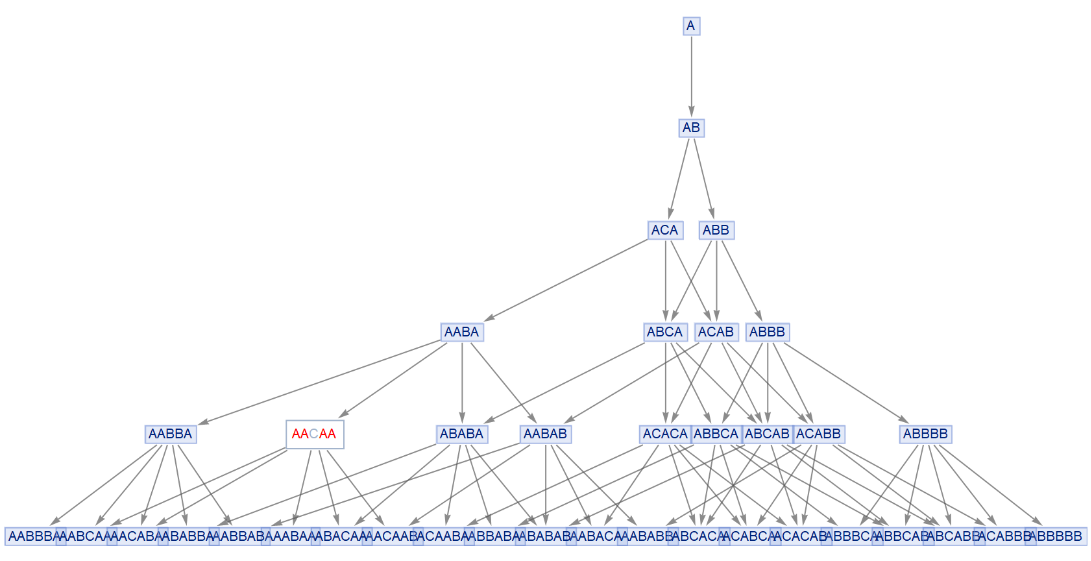
Consider as our particles two AA substrings in the state AACAA as we have colored in red. If we exchange any two As (what we will call the swap operation), nothing changes in the graph above, also after time evolution.
This obvious conclusion might have been the end of our investigation into the behavior of multiway graphs under such particle permutation. However, a crucial observation will allow us to investigate a little bit deeper.
This obvious conclusion might have been the end of our investigation into the behavior of multiway graphs under such particle permutation. However, a crucial observation will allow us to investigate a little bit deeper.
2. String Substitution with rulialy-indistinguishable particles
2. String Substitution with rulialy-indistinguishable particles
The notion of rulialy-indistinguishability
The notion of rulialy-indistinguishability
Consider the same setup we used before. The rule does not distinguish between the As and the Cs, i.e. it acts on them in the same way. We will say they are rulial-indistinguishable. This is a crucial observation because now if we consider our new particles, two substrings like AA and AC, they are still indistinguishable from the update rule (which represents the time evolution of our system), but their structure is different.
As a demonstration that the two strings are rulialy indistinguishable, let us consider them as separate initial conditions for the multiway system. The two graphs should be isomorphic:
{"A""AB","B""CA","C""AB"}
As a demonstration that the two strings are rulialy indistinguishable, let us consider them as separate initial conditions for the multiway system. The two graphs should be isomorphic:
Out[]=
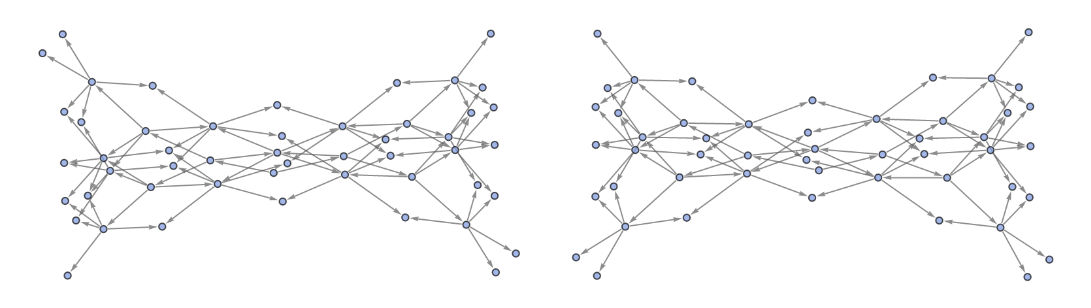
And indeed they are:
In[]:=
IsomorphicGraphQ[g1,g2]
Out[]=
True
Hence, consider out initial setup but take the state ACACA. Consider as our particles the two substrings in red i.e. AC and CA. They are rulial-indistinguishable with respect to our rule.
Out[]=
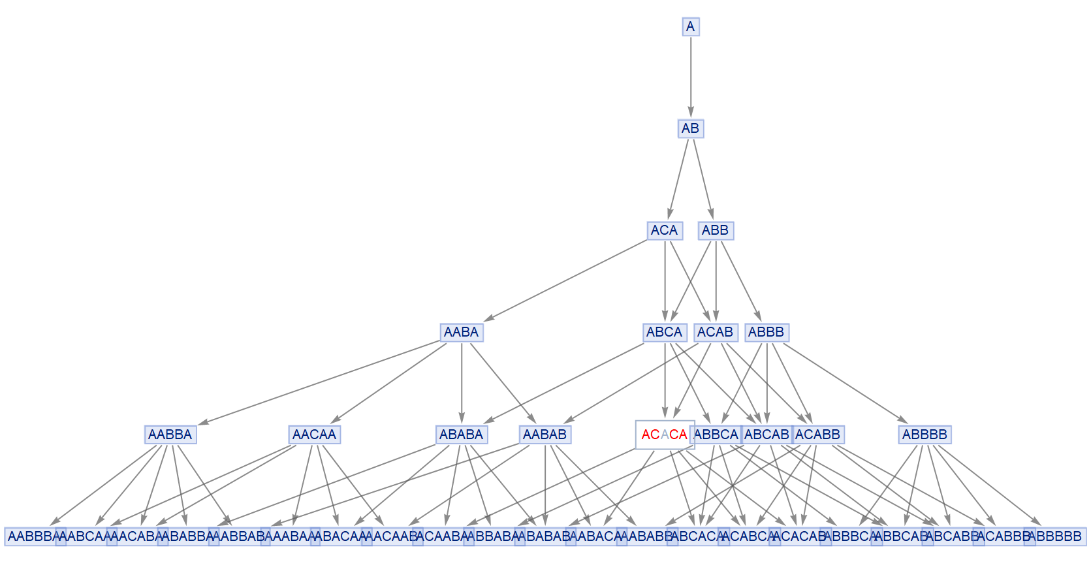
At this point, we want to swap the two substrings above and answer the counterfactual question: what would have happened if those characters at their respective coordinates have been different, starting all the way from their creation there? And what happens if we time evolve the system after the swap? (This is the reason why we consider a state in second-last branchial hypersurface, and in the following, we evolve the system next step further)
In order to do this, we have to somehow put a set of sensible “coordinates” on each character of every state in the multiway graph. Character position of a string seems like an obvious first choice, but after each string replacement, it can shift all surrounding characters to the left and the right so that positions of old characters change, which is rather undesirable behavior.
What follows is rather an obnoxious coordinatization method for string substitution multiway systems, which avoid that particular issue but has some other downsides of its own.
In[]:=
Short[coords=multiwayStringCoordinates[rule,init,steps]]
Out[]//Short=
A{1},AB,,ABB,,,33,AABCAA,,,,,,AAABAA,,,,,
5
6
7
6
11
18
8
9
7
6
5
6
230
243
515
486
565
486
310
243
25
18
5
6
55
54
535
486
575
486
205
162
25
18
The algorithm subdivides an interval of previously surrounding character’s coordinates to produces new coordinates after each rewriting.
The replacement we decided to do is described by the following rule:
"ACACA"{143/216,187/216,115/108,275/216,55/36}
particle1={{"A",143/216},{"C",187/216}};particle2={{"C",275/216},{"A",55/36}};swap=Join[Thread[particle1particle2],Thread[particle2particle1]]
Out[]=
A,C,,C,A,,C,A,,A,C,
143
216
275
216
187
216
55
36
275
216
143
216
55
36
187
216
Thus we can apply the above replacements. New state with the same coordinates now has different characters:
Out[]=
ACACA,,,,,CAAAC,,,,
143
216
187
216
115
108
275
216
55
36
143
216
187
216
115
108
275
216
55
36
The overall operation corresponds to swapping these multiway states:
Out[]=
{ACACACAAAC,CAAACACACA}
In[]:=
oldBranchialHypersurfaces=Reap[Nest[With[{hypersurface=#},Sow[ResourceFunction["MultiwaySystem"][rule,hypersurface,1,"StatesGraphStructure"]];ResourceFunction["MultiwaySystem"][rule,hypersurface,1][[-1]]]&,init,steps]][[2,1]];newBranchialHypersurfaces=Reap[Nest[With[{hypersurface=#/.multiwaySwap},Sow[ResourceFunction["MultiwaySystem"][rule,hypersurface,1,"StatesGraphStructure"]];ResourceFunction["MultiwaySystem"][rule,hypersurface,1][[-1]]]&,init,steps]][[2,1]];oldMultiway=Graph[stitchBranchialHypersurfaces[oldBranchialHypersurfaces],VertexShapeFunctionAnnotationValue[g,VertexShapeFunction],AspectRatio1/2];newMultiway=Annotate[{Graph[stitchBranchialHypersurfaces[newBranchialHypersurfaces,multiwaySwap],VertexShapeFunctionAnnotationValue[g,VertexShapeFunction],AspectRatio1/2],"ACACA"},VertexShapeFunction(Text[Framed@Row[{Style["CA",Red],"A",Style["AC",Red]}],#1]&)];clickToCopy@GraphicsColumn[{oldMultiway,newMultiway},ImageSizeFull]
Out[]=
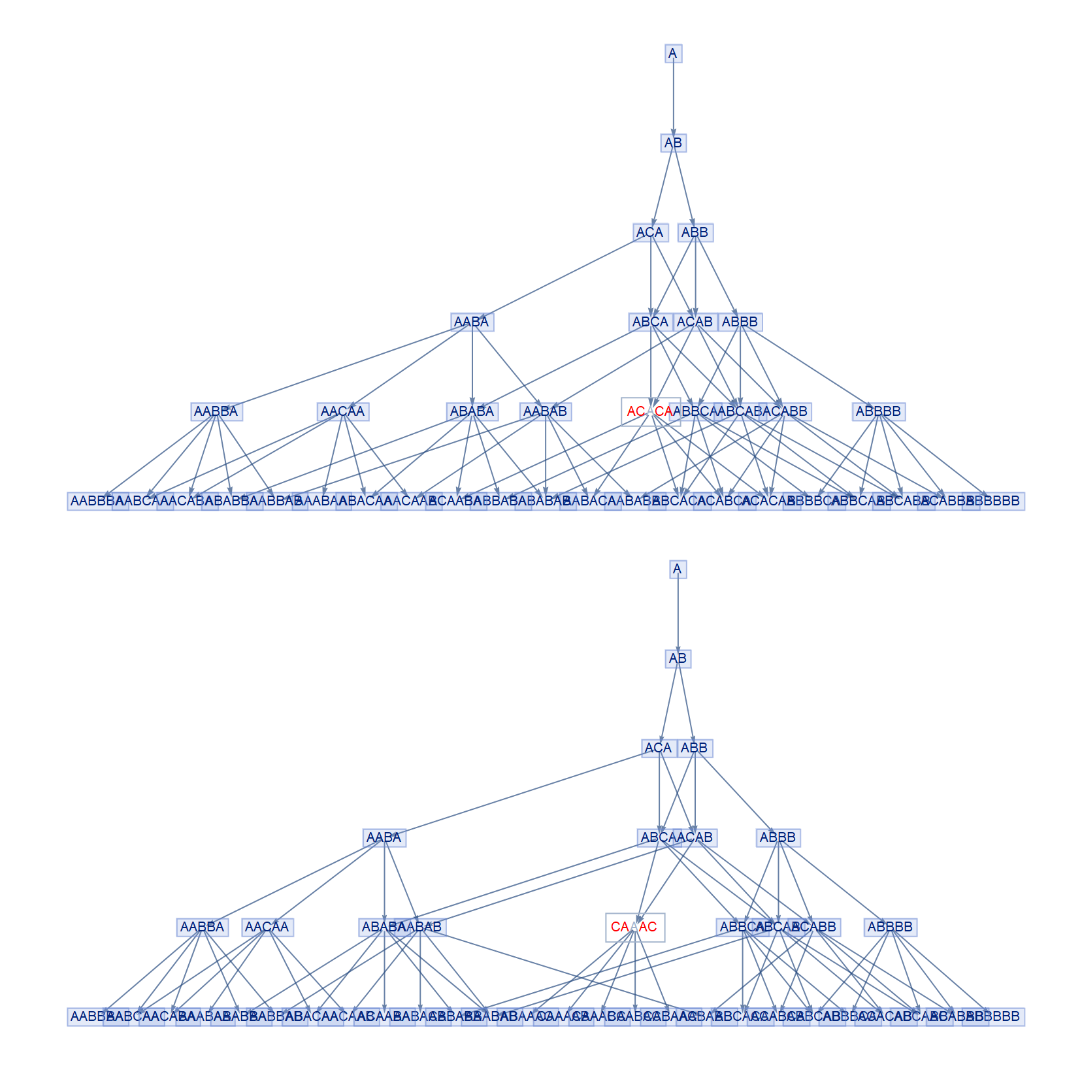
Notice that the state we considered before now is CAAAC and every character has been swapped following the swap rules also the state causally connected with the one we chose.
Now we can compare the two multiway graphs: with (on the left, named oldMultiway) and without (on the right, named newMultiway) the swap operation.
Now we can compare the two multiway graphs: with (on the left, named oldMultiway) and without (on the right, named newMultiway) the swap operation.
It is easy to see that the multiway graph in the swapped case is no longer the same. In particular, it is not isomorphic to its non-swapped counterpart.
This are branchial graphs of the corresponding multiway evolutions before and after the swap operation:
3. Wolfram Model system with indistinguishable particles
3. Wolfram Model system with indistinguishable particles
If there is any deeper reason behind this phenomenon it should be independent from the model we use to represents our particles. In order to investigate in this direction we want to reproduce these results also using the Wolfram Model.
Consider now the following setup.
Consider now the following setup.
Here we will consider as our particles the subgraphs {{3, 8, 28}, {8, 15, 29}} and {{4, 7, 24}, {7, 13, 25}} which have the same T-structure and thus they are identical. Now we have to implement again the swap operation on these two subgraph. Rather than the set coordinate we used the last time for strings now we will use the 'atom structure' on which the Wolfram Model is based.
The hypergraph atom structure is much more natural in a way that it provides a way to encode coordinates by just considering relations between them, instead of making up some coordinate scheme.
The swap operation is represented by the following set of rules in which we use the atoms as coordinates for our vertices.
Now we are able to create the swapped object. Here below we can see that the non-swapped case (on the left) and the swapped one (on the right) are quite similar.
Despite the fact that the two hypergraph above are quite similar is not so easy too see if they are isomorphic or not at first glance. Instead, in the version below it is clear that they are isomorphic as expected by analogy with the String Substitution model studied before.
4. Wolfram Model system with rulialy-isomorphic particles
4. Wolfram Model system with rulialy-isomorphic particles
Stressing this analogy with the String Substitution systems now we want also to study what happens if we consider two particle which are different but that seem to behave the same under updating rule.
To do this, we will call two subgraph rulialy isomorphic if the updating rule acts the same on both the subgraph, thus they are indistinguishable in a universe build with this updating rule.
An explicit example:
To do this, we will call two subgraph rulialy isomorphic if the updating rule acts the same on both the subgraph, thus they are indistinguishable in a universe build with this updating rule.
An explicit example:
Let us consider the following setup.
As for the string substitution system we are interested in the multiway graph of this system. Thus the multiway graph of our system looks like
Notice that each vertex in the multiway graph above corresponds to a hypergraph. This will be important in what comes next.
Now consider the hyperedges in the last branch-like hypersurface {3, 3, 3} and {4, 4, 2}. They are rulialy isomorphic to our updating rule. We will consider them as our indistinguishable particles, and therefore now we have to perform the swap of their atoms. The replacement rules for the swap are {{2->3},{4->3}}, where we have already removed the replacements which interchange different atoms leaving the evolution invariant.
Now consider the hyperedges in the last branch-like hypersurface {3, 3, 3} and {4, 4, 2}. They are rulialy isomorphic to our updating rule. We will consider them as our indistinguishable particles, and therefore now we have to perform the swap of their atoms. The replacement rules for the swap are {{2->3},{4->3}}, where we have already removed the replacements which interchange different atoms leaving the evolution invariant.
In general, each replacement happens only once after some event has created a particular atom specified by LHS of any replacement. Evolution itself takes care of the rest.
Because there are multiple possible swaps, this operation adds additional branches at the creation of an ambiguous atom. The multiway after the swap procedure looks like
Because there are multiple possible swaps, this operation adds additional branches at the creation of an ambiguous atom. The multiway after the swap procedure looks like
Because we have manually messed up the evolution now, we should also manually recover the branchial graph. For this reason, now we have to stitch back all the branchial hypersurfaces of the swapped multiway graph. The criterion used to stitch one edge with another is that their common vertices have to be isomorphic (not rulialy). Remember that each vertex represents a hypergraph. Hence this procedure is well defined.
To test our functions first, let us apply them to the non-swapped multiway graph. This should result in the original graph trivially.
The following non-swapped multiway graph divided for each step of time evolution.
The following non-swapped multiway graph divided for each step of time evolution.
And thus it is.
Now we apply the same procedure on the swapped case.
Now we apply the same procedure on the swapped case.
Fortunately for the swapped case is not easy as for the previous subsection. Now the two branchial graphs are not isomorphic.
This is the same result we obtained for the string substitution systems. This fact should be reflected in the branchial graph like in the string substitution system. In fact the branchial graph of the last branchial hypersurfaces looks like the one on the left for the non-swapped case and like the one on the right for the swapped case and they are very different.
After that we will talk about some possible interpretation of this phenomenon. We can conclude that the swap operation produces additional branches/entanglement. The action of the swap operation create some additional (potentially disconnected) entangled states due to its ‘what if’ nature.
It is possible that, for a more complicated rule, branches related to disconnected pieces would converge somewhere in the evolution process?
It is possible to quantify the effect of the swapping procedure? Maybe in the phases between states. Could this be related to the spin of our particles?
It is possible that, for a more complicated rule, branches related to disconnected pieces would converge somewhere in the evolution process?
It is possible to quantify the effect of the swapping procedure? Maybe in the phases between states. Could this be related to the spin of our particles?
Future work
The Spin-Statistics Theorem has not yet been proven within this formalism. As I suggest in the conclusions, there are some directions to investigate how this project’s results could be useful. The idea is still to find some Multiway Systems property to interpret as the ‘spin’ and another one to interpret as the ‘statistics’ of our ‘particles’. An idea could be to identify bosonic (fermionic) behavior in resolving (non-resolving) multiway system branches and use the results in this work to find the spin.
It could also be interesting to investigate different statistics, for example, finding multiway systems that could describe parastatistics or anyon-like behavior.
It could also be interesting to investigate different statistics, for example, finding multiway systems that could describe parastatistics or anyon-like behavior.
Keywords
Keywords
◼
Wolfram Model
◼
String Substitution
◼
Multiway Graph
◼
Spin Statistics Theorem
◼
Spin
◼
Quantum Mechanics
◼
Quantum Field Theory
Acknowledgment
Acknowledgment
Mentor: Nikolay Murzin
I am deeply grateful for all the support I received from my project mentor Nikolay Murzin. Most of the functions I used in this project were practically done by him with me playing the role of the debugger and giving suggestions. I learnt a lot from him about the Wolfram Language.
I am deeply grateful for all the support I received from my project mentor Nikolay Murzin. Most of the functions I used in this project were practically done by him with me playing the role of the debugger and giving suggestions. I learnt a lot from him about the Wolfram Language.
I would also like to thank Stephen Wolfram for the inspiring tips he gave to us during the school.
References
References
◼
[1] W. Pauli, The Connection Between Spin and Statistics, Phys. Rev. 58, 716-722 (1940).
◼
[2] I. Duck and E. C. G. Sudarshan, Pauli and the Spin-Statistics Theorem, Singapore: World Scientific, 1998.
◼
[3] S. Weinberg (1995). The Quantum Theory of Fields (Vol. 1). Cambridge: Cambridge University Press.
◼
[4] S. Wolfram, A Project to Find the Fundamental Theory of Physics (2020)
◼
[5] J. Gorard, Some Relativistic and Gravitational Properties of the Wolfram Model, arXiv:2004.14810
◼
[6] J. Gorard, Some Quantum Mechanical Properties of the Wolfram Model