Introduction
This post is a simple expression of my recreational exploration of the Collatz conjecture.
It doesn't carry an intellectually high burden and I hope it will be of interest to a wide spread of the Wolfram community.
I would appreciate any feedback, good or bad.
Introduction
This post is a simple expression of my recreational exploration of the Collatz conjecture.
It doesn't carry an intellectually high burden and I hope it will be of interest to a wide spread of the Wolfram community.
I would appreciate any feedback, good or bad.
Abstract
The Collatz conjecture is an unsolved problem in mathematics. It is very simply stated.
Take any positive integer and generate a sequence as follows:
If the initial term is even divide it by 2, if it is odd multiply it by 3 and add 1.
Repeat the process with the resulting integers until the sequence returns to 1.
The Collatz conjecture predicts that all positive integers will generate a Collatz sequence that eventually ends in 1.
A more detailed explanation of the background to the Collatz conjecture can be found in Wolfram Mathworld.
My main purpose in publishing this article is not to show how to prove or disprove the Collatz conjecture but to share my recreational interest in the problem.
I cannot claim that any of the ideas put forward in this article are original.
I shall demonstrate an approach for a proof to the Collatz conjecture that makes use of cumulative infinite sequences of integers.
There has been so much work carried out on this problem over the last 80 years or so that it is almost certain that equivalent ideas have been aired before.
My hope is that it will interest some members of the Wolfram community by illustrating the use of some of the rich tools available within the Wolfram language.
General approach
Let's just try out a few Collatz sequences to get a feel for how they look.
We can manipulate the controls below to get a feel for the type of sequences that are generated for the first 50 positive integers.
In[]:=
Manipulate[ResourceFunction["Collatz"][c],{c,1,50,1}]
Out[]=


We can think about proving or disproving the Collatz conjecture by adopting a very simple method.
Start at the integer 1, generate the Collatz sequence and if it eventually returns to the integer 1 it can be said to be "Collatz true".
Let's use C true to mean "Collatz true" and C false to mean "Collatz false".
Think about getting into an elevator on floor 1. Before you press the button you calculate where to go using the Collatz formula.
1 is odd so we need to go to level 4.
4 is even so we go to level 2.
2 is even so we go back to level 1 and the Collatz sequence for 1 is true.
Move on to incrementally higher starting levels one by one as each new integer evaluated becomes C true but stop if one of the integers is shown to be C false.
So we start at level 1, prove it is C true.
We then move up to level 2, prove it is C true.
We continue in this way one level at a time until we find a level that is C false.
It is very easy to write a computer program that follows this process.
This has been done many times over the last 20 or more years and so far all the integers from 1 to an extremely high number ( in 2020) have been shown to be C true.
This does not mean that the Collatz conjecture is true, it has just never been shown to be false.
It's never going to be possible to prove that the Collatz conjecture is true by evaluating all integers from 1 upwards in a step by step approach. We can only find an integer that proves it is false.
In order to prove that the Collatz conjecture is true we would need a different approach.
If we are evaluating Collatz sequences from 1 upwards incrementally, every time we reach a sequence value that is less than the starting value (or we reach 1) we know that the initial value is C true because we have reached a value that is known to be C true.
Let's call this value the "stopping point".
This gives us our first easy win, since all even numbers are divided by 2 and must give us an integer that is less than the starting integer.
So, as we start to ascend the elevator at a level that is an even integer we know that it is C true since we know that all the numbers below it have been shown to be C true.
The even integers represent 50 percent of all positive integers.
That leaves us with all the odd integers to investigate.
Let's split the odd integers into two sequences:
(1 + 4x) where x=1,2,3, . . .,∞
and
(3 + 4x) where x=0,1,2,3, . . .,∞
Let's evaluate the general term (1 + 4x) first:
(1 + 4x) is always odd so the second term of the Collatz sequence will be (4 + 12x).
This is always even so the third term will be (2 + 6x).
This is always even so the fourth term will be (1 + 3x).
Since (1 + 3x) < (1 + 4x) for x=1,2,3, . . .,∞ we have reached the stopping point.
So, as we start to ascend the elevator at a level that is a member of the sequence (1 + 4x) where x=1,2,3, . . .,∞ we know it is C true since all the integers below it are C true.
That represents another 25 percent of all positive integer values.
Now let's evaluate the general term (3 + 4x):
(3 + 4x) is always odd so the second term will be (10 + 4x).
This is always even so the third term will be (5 + 2x).
This is always odd so the fourth term will be (16 + 6x).
This is always even so the fifth term will be (8 + 3x).
This is either odd or even, depending on the value of x and we cannot determine whether we have reached the stopping point.
Start at the integer 1, generate the Collatz sequence and if it eventually returns to the integer 1 it can be said to be "Collatz true".
Let's use C true to mean "Collatz true" and C false to mean "Collatz false".
Think about getting into an elevator on floor 1. Before you press the button you calculate where to go using the Collatz formula.
1 is odd so we need to go to level 4.
4 is even so we go to level 2.
2 is even so we go back to level 1 and the Collatz sequence for 1 is true.
Move on to incrementally higher starting levels one by one as each new integer evaluated becomes C true but stop if one of the integers is shown to be C false.
So we start at level 1, prove it is C true.
We then move up to level 2, prove it is C true.
We continue in this way one level at a time until we find a level that is C false.
It is very easy to write a computer program that follows this process.
This has been done many times over the last 20 or more years and so far all the integers from 1 to an extremely high number (
(68)
2
This does not mean that the Collatz conjecture is true, it has just never been shown to be false.
It's never going to be possible to prove that the Collatz conjecture is true by evaluating all integers from 1 upwards in a step by step approach. We can only find an integer that proves it is false.
In order to prove that the Collatz conjecture is true we would need a different approach.
If we are evaluating Collatz sequences from 1 upwards incrementally, every time we reach a sequence value that is less than the starting value (or we reach 1) we know that the initial value is C true because we have reached a value that is known to be C true.
Let's call this value the "stopping point".
This gives us our first easy win, since all even numbers are divided by 2 and must give us an integer that is less than the starting integer.
So, as we start to ascend the elevator at a level that is an even integer we know that it is C true since we know that all the numbers below it have been shown to be C true.
The even integers represent 50 percent of all positive integers.
That leaves us with all the odd integers to investigate.
Let's split the odd integers into two sequences:
(1 + 4x) where x=1,2,3, . . .,∞
and
(3 + 4x) where x=0,1,2,3, . . .,∞
Let's evaluate the general term (1 + 4x) first:
(1 + 4x) is always odd so the second term of the Collatz sequence will be (4 + 12x).
This is always even so the third term will be (2 + 6x).
This is always even so the fourth term will be (1 + 3x).
Since (1 + 3x) < (1 + 4x) for x=1,2,3, . . .,∞ we have reached the stopping point.
So, as we start to ascend the elevator at a level that is a member of the sequence (1 + 4x) where x=1,2,3, . . .,∞ we know it is C true since all the integers below it are C true.
That represents another 25 percent of all positive integer values.
Now let's evaluate the general term (3 + 4x):
(3 + 4x) is always odd so the second term will be (10 + 4x).
This is always even so the third term will be (5 + 2x).
This is always odd so the fourth term will be (16 + 6x).
This is always even so the fifth term will be (8 + 3x).
This is either odd or even, depending on the value of x and we cannot determine whether we have reached the stopping point.
We need to take a different approach now to find additional integer sequences that are C true.
Let's call this "The modified elevator approach".
For each of the unevaluated odd integers 3,7,11,15,19, . . . let's add an arbitrary value ofx before we evaluate the Collatz sequence. Where d is an arbitrarily high positive integer and x=0,1,2, . . . ∞.
So, for integer 3 we have:
(3 +x) is odd when d>0
(10 +) is even when d>0
(5 +) is odd when d > 1
(16 +(x)) is even when d > 1
(8 +(x)) is even when d > 2
(4 +(x)) is even when d > 3
(2 +(x)) = (2 + x) when d=4
Since (2 +x) < (3 + x) for x = 0,1,2,3, . . . ,∞ we have reached the stopping point.
So, as we start to ascend the elevator at a level that is a member of the sequence (3 +x) where x = 0,1,2,3, . . .,∞ we know it is C true since all the integers below it are C true.
That represents another 6.25 percent of all positive integer values.
Let's call this "The modified elevator approach".
For each of the unevaluated odd integers 3,7,11,15,19, . . . let's add an arbitrary value of
d
2
So, for integer 3 we have:
(3 +
d
2
(10 +
3(x)
d
2
(5 +
3(x)
(d-1)
2
(16 +
2
3
(d-1)
2
(8 +
2
3
(d-2)
2
(4 +
2
3
(d-3)
2
(2 +
2
3
(d-4)
2
2
3
Since (2 +
2
3
4
2
So, as we start to ascend the elevator at a level that is a member of the sequence (3 +
4
2
That represents another 6.25 percent of all positive integer values.
For the next integer 7 we have:
(7 +x) is odd when d>0
(22 +) is even when d>0
(11 +) is odd when d > 1
(34 +(x)) is even when d > 1
(17 +(x)) is odd when d > 2
(52 +(x)) is even when d > 2
(26 +(x)) is even when d > 3
(13 +(x)) is odd when d > 4
(40 +(x)) is even when d > 4
(20 +(x)) is even when d > 5
(10 +(x)) is even when d > 6
(5 +(x)) = (5 + x) when d = 7
Since (5 +x) < (7 + x) for x = 0,1,2,3, . . . ,∞ we have reached the stopping point.
So, as we start to ascend the elevator at a level that is a member of the sequence (7 +x) where x=0,1,2,3, . . .,∞ we know it is C true since all the integers below it are C true.
That represents almost 1 percent of all positive integer values.
(7 +
d
2
(22 +
3(x)
d
2
(11 +
3(x)
(d-1)
2
(34 +
2
3
(d-1)
2
(17 +
2
3
(d-2)
2
(52 +
3
3
(d-2)
2
(26 +
3
3
(d-3)
2
(13 +
3
3
(d-4)
2
(40 +
4
3
(d-4)
2
(20 +
4
3
(d-5)
2
(10 +
4
3
(d-6)
2
(5 +
4
3
(d-7)
2
4
3
Since (5 +
4
3
7
2
So, as we start to ascend the elevator at a level that is a member of the sequence (7 +
7
2
That represents almost 1 percent of all positive integer values.
Using the same approach for the next integer 11 we arrive at:
= when d=5
Since < for x=0,1,2,3, . . . ,∞ we have reached the stopping point.
So, as we start to ascend the elevator at a level that is a member of the sequence where x=0,1,2,3, . . . ,∞ we know it is C true since all the integers below it are C true.
That represents another 3.125 percent of all positive integer values.
By now you may have noticed a pattern.
The value of the variable d equates to the number of even terms in the sequence before the stopping point.
The power of 3 that is reached at the stopping point value equates to the number of odd terms in the sequence before the stopping point.
In fact, we could have used this "modified elevator approach" to derive the (1+4x) sequence and the 2x sequence.
So now let's look at the Collatz sequence for 23, highlighting all the even terms in red.
(10+(x))
3
3
(d-5)
2
(10+x)
3
3
Since
(10+x)
3
3
(11+x)
5
2
So, as we start to ascend the elevator at a level that is a member of the sequence
(11+x)
5
2
That represents another 3.125 percent of all positive integer values.
By now you may have noticed a pattern.
The value of the variable d equates to the number of even terms in the sequence before the stopping point.
The power of 3 that is reached at the stopping point value equates to the number of odd terms in the sequence before the stopping point.
In fact, we could have used this "modified elevator approach" to derive the (1+4x) sequence and the 2x sequence.
So now let's look at the Collatz sequence for 23, highlighting all the even terms in red.
In[]:=
Manipulate[If[EvenQ[#],Style[#,Red],#]&/@ResourceFunction["Collatz"][c],{c,3,403,4}]
Out[]=
The stopping point has a value of 20.
There are 5 even terms and 3 odd terms before the stopping point.
So should be C true for x=0,1,2,3, . . . ,∞ since < for x=0,1,2,3, . . . ,∞
So, as we start to ascend the elevator at a level that is a member of the sequence where x=0,1,2,3, . . .,∞ we know it is C true since all the integers below it are C true.
That represents another 3.125 percent of all positive integer values.
Let's look at one more sequence for integer 27, highlighting all the even terms in red.
There are 5 even terms and 3 odd terms before the stopping point.
So
(23+x)
5
2
(20+x)
3
3
(23+x)
5
2
So, as we start to ascend the elevator at a level that is a member of the sequence
(23+x)
5
2
That represents another 3.125 percent of all positive integer values.
Let's look at one more sequence for integer 27, highlighting all the even terms in red.
In[]:=
Manipulate[If[EvenQ[#],Style[#,Red],#]&/@ResourceFunction["Collatz"][c],{c,3,403,4}]
Out[]=
Let's run the sequence for 27 again, this time highlighting in blue all values that are less than the starting value of 27.
In[]:=
Manipulate[If[#<c,Style[#,Blue],#]&/@ResourceFunction["Collatz"][c],{c,3,403,4}]
Out[]=
We can see that the stopping point has a value of 23.
Now let's count the number of even and odd terms in the sequence prior to the stopping point.
Now let's count the number of even and odd terms in the sequence prior to the stopping point.
Generate a list c containing the terms of the Collatz sequence; calculate the length clen of the list up to but not including the stopping point; remove the stopping point value and all following values from the list; count the number of even values and odd values remaining in the list
In[]:=
c=ResourceFunction["Collatz"][27];clen=LengthWhile[c,#≠First[Select[#<c[[1]]&][c]]&];c=Take[c,clen];"There are "<>ToString[Count[c,_?EvenQ]]<>" even terms and "<>ToString[Count[c,_?OddQ]]<>" odd terms in the Collatz sequence prior to the stopping point"
Out[]=
There are 59 even terms and 37 odd terms in the Collatz sequence prior to the stopping point
So (27 + x) should be C true for x = 0,1,2,3, . . ,∞ since (23 +x) < (27 + x) for x = 0,1,2,3, . . .,∞
So, as we start to ascend the elevator at a level that is a member of the sequence (27 +x) where x=0,1,2,3, . . .,∞ we know it is C true since all the integers below it are C true.
That represents a very, very small percentage of all positive integer values.
Note that we don't always get a new sequence as we move up in the elevator.
For example, integer 19 generates a sequence (19 +x) that is part of the sequence (3 + x) we evaluated earlier.
Here is a table that lists the 20 unique C true sequences up to and including integer 123:
(59)
2
(37)
3
(59)
2
So, as we start to ascend the elevator at a level that is a member of the sequence (27 +
(59)
2
That represents a very, very small percentage of all positive integer values.
Note that we don't always get a new sequence as we move up in the elevator.
For example, integer 19 generates a sequence (19 +
4
2
4
2
Here is a table that lists the 20 unique C true sequences up to and including integer 123:
In[]:=
Grid[{{"Sequence number","'C true' sequences for integers x>0","Cumulative % of all positive integers"},{1,2x,50},{2,"1+2^2x",75},{3,"3+2^4x",81.25},{4,"7+2^7x",82.0313},{5,"11+2^5x",85.1563},{6,"15+2^7x",85.9376},{7,"23+2^5x",89.0626},{8,"27+2^59x",89.0626},{9,"31+2^56x",89.0626},{10,"39+2^8x",89.4532},{11,"47+2^54x",89.4532},{12,"59+2^7x",90.2345},{13,"63+2^54x",90.2345},{14,"71+2^51x",90.2345},{15,"79+2^8x",90.6251},{16,"91+2^45x",90.6251},{17,"95+2^8x",91.0157},{18,"103+2^42x",91.0157},{19,"111+2^31x",91.0157},{20,"123+2^8x",91.4063}},FrameAll]
Out[]=
Sequence number | 'C true' sequences for integers x>0 | Cumulative % of all positive integers |
1 | 2x | 50 |
2 | 1+2^2x | 75 |
3 | 3+2^4x | 81.25 |
4 | 7+2^7x | 82.0313 |
5 | 11+2^5x | 85.1563 |
6 | 15+2^7x | 85.9376 |
7 | 23+2^5x | 89.0626 |
8 | 27+2^59x | 89.0626 |
9 | 31+2^56x | 89.0626 |
10 | 39+2^8x | 89.4532 |
11 | 47+2^54x | 89.4532 |
12 | 59+2^7x | 90.2345 |
13 | 63+2^54x | 90.2345 |
14 | 71+2^51x | 90.2345 |
15 | 79+2^8x | 90.6251 |
16 | 91+2^45x | 90.6251 |
17 | 95+2^8x | 91.0157 |
18 | 103+2^42x | 91.0157 |
19 | 111+2^31x | 91.0157 |
20 | 123+2^8x | 91.4063 |
The sequences which are part of other sequences have been omitted from the table as they do not contribute towards the cumulative percentage.
For example, sequence () is part of the sequence () and sequence is part of sequence .
Even so, after identifying the sequences 2x and (1+4x), by ascending the elevator for integers of the form (3+4x) from 3 to 123 we have already shown that over 91 percent of all integers above 123 are C true and don't need to be checked.
As we ascend the elevator we will generate more sequences that gradually grow the cumulative percentage towards 100 percent coverage of all integers.
Let's plot this growth:
For example, sequence (
19+x
4
2
3+x
4
2
(43+x)
5
2
(11+x)
5
2
Even so, after identifying the sequences 2x and (1+4x), by ascending the elevator for integers of the form (3+4x) from 3 to 123 we have already shown that over 91 percent of all integers above 123 are C true and don't need to be checked.
As we ascend the elevator we will generate more sequences that gradually grow the cumulative percentage towards 100 percent coverage of all integers.
Let's plot this growth:
In[]:=
points={{0,0},{1,50},{2,75},{3,81.25},{4,82.0313},{5,85.1563},{6,85.9376},{7,89.0626},{8,89.0626},{9,89.0626},{10,89.4532},{11,89.4532},{12,90.2345},{13,90.2345},{14,90.2345},{15,90.6251},{16,90.6251},{17,91.0157},{18,91.0157},{19,91.0157},{20,91.4093}}
Out[]=
{{0,0},{1,50},{2,75},{3,81.25},{4,82.0313},{5,85.1563},{6,85.9376},{7,89.0626},{8,89.0626},{9,89.0626},{10,89.4532},{11,89.4532},{12,90.2345},{13,90.2345},{14,90.2345},{15,90.6251},{16,90.6251},{17,91.0157},{18,91.0157},{19,91.0157},{20,91.4093}}
In[]:=
ListPlot[points,{JoinedTrue,AxesOrigin{0,0},AxesLabel{"Sequences","Cumulative % of all positive integers"},PlotMarkers{Automatic,Small}}]
Out[]=
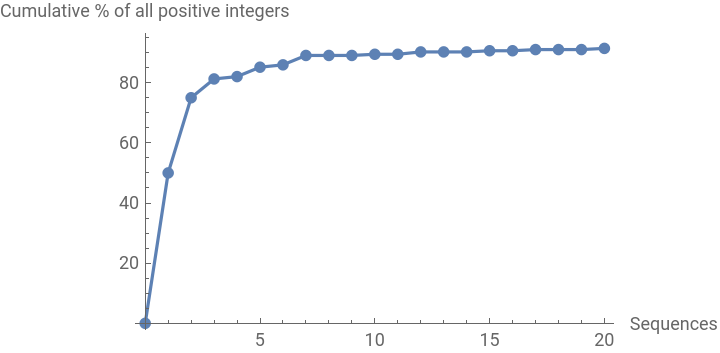
Let's check that none of the C true sequences have duplicate values contained in the other sequences. The True result proves that there is no duplication of integers up to 400 in the first twenty integer sequences.
In[]:=
DuplicateFreeQ[{Table[x,{x,2,400,2}],Table[1+x,{x,0,400,4}],Table[3+x,{x,0,400,2^4}],Table[7+x,{x,0,400,2^7}],Table[11+x,{x,0,400,2^5}],Table[15+x,{x,0,400,2^7}],Table[23+x,{x,0,400,2^5}],Table[27+x,{x,0,400,2^59}],Table[31+x,{x,0,400,2^56}],Table[39+x,{x,0,400,2^8}],Table[47+x,{x,0,400,2^54}],Table[59+x,{x,0,400,2^7}],Table[63+x,{x,0,400,2^54}],Table[71+x,{x,0,400,2^51}],Table[79+x,{x,0,400,2^8}],Table[91+x,{x,0,400,2^45}],Table[95+x,{x,0,400,2^8}],Table[103+x,{x,0,400,2^42}],Table[111+x,{x,0,400,2^31}],Table[123+x,{x,0,400,2^8}]}]
Out[]=
True
Let's evaluate the collective impact of the first twenty C true integer sequences over the range 1 to 400. The following integer values are generated:
In[]:=
clist=Select[Sort[Catenate[{Table[x,{x,2,400,2}],Table[1+x,{x,0,400,4}],Table[3+x,{x,0,400,2^4}],Table[7+x,{x,0,400,2^7}],Table[11+x,{x,0,400,2^5}],Table[15+x,{x,0,400,2^7}],Table[23+x,{x,0,400,2^5}],Table[27+x,{x,0,400,2^59}],Table[31+x,{x,0,400,2^56}],Table[39+x,{x,0,400,2^8}],Table[47+x,{x,0,400,2^54}],Table[59+x,{x,0,400,2^7}],Table[63+x,{x,0,400,2^54}],Table[71+x,{x,0,400,2^51}],Table[79+x,{x,0,400,2^8}],Table[91+x,{x,0,400,2^45}],Table[95+x,{x,0,400,2^8}],Table[103+x,{x,0,400,2^42}],Table[111+x,{x,0,400,2^31}],Table[123+x,{x,0,400,2^8}]}]],#<401&]
Out[]=
{1,2,3,4,5,6,7,8,9,10,11,12,13,14,15,16,17,18,19,20,21,22,23,24,25,26,27,28,29,30,31,32,33,34,35,36,37,38,39,40,41,42,43,44,45,46,47,48,49,50,51,52,53,54,55,56,57,58,59,60,61,62,63,64,65,66,67,68,69,70,71,72,73,74,75,76,77,78,79,80,81,82,83,84,85,86,87,88,89,90,91,92,93,94,95,96,97,98,99,100,101,102,103,104,105,106,107,108,109,110,111,112,113,114,115,116,117,118,119,120,121,122,123,124,125,126,128,129,130,131,132,133,134,135,136,137,138,139,140,141,142,143,144,145,146,147,148,149,150,151,152,153,154,156,157,158,160,161,162,163,164,165,166,168,169,170,171,172,173,174,176,177,178,179,180,181,182,183,184,185,186,187,188,189,190,192,193,194,195,196,197,198,200,201,202,203,204,205,206,208,209,210,211,212,213,214,215,216,217,218,220,221,222,224,225,226,227,228,229,230,232,233,234,235,236,237,238,240,241,242,243,244,245,246,247,248,249,250,252,253,254,256,257,258,259,260,261,262,263,264,265,266,267,268,269,270,271,272,273,274,275,276,277,278,279,280,281,282,284,285,286,288,289,290,291,292,293,294,295,296,297,298,299,300,301,302,304,305,306,307,308,309,310,311,312,313,314,315,316,317,318,320,321,322,323,324,325,326,328,329,330,331,332,333,334,335,336,337,338,339,340,341,342,343,344,345,346,348,349,350,351,352,353,354,355,356,357,358,360,361,362,363,364,365,366,368,369,370,371,372,373,374,375,376,377,378,379,380,381,382,384,385,386,387,388,389,390,391,392,393,394,395,396,397,398,399,400}
So, after the first twenty C true sequences, the only integers in the range 1 to 400 that have not been generated by these sequences are:
Complement[Range[400],clist]
Out[]=
{127,155,159,167,175,191,199,207,219,223,231,239,251,255,283,287,303,319,327,347,359,367,383}
Conclusions
If we define the "stopping point" of a Collatz sequence as the first term in the sequence whose value t is less than the value of the initial term t or equals 1 then:
In general, if s is the number of the term of the stopping point and d is the number of even values in the Collatz sequence prior to the stopping point then the number of odd values prior to the stopping point will be (s-d-1)
So, if there is a stopping point value t in the Collatz sequence starting with integer t then:
(t+ 3 x)<(t+ x) for x=0,1,2, . . .∞
and the sequence (t+x)will be C true for x =0,1,2, . . .∞
Of course, this doesn't prove that the Collatz conjecture is true.
A proof would require that all Collatz sequences could be shown to have a stopping point or alternatively, that a specific Collatz sequence does not have a stopping point.
If we define the "stopping point" of a Collatz sequence as the first term in the sequence whose value t
s
1
In general, if s is the number of the term of the stopping point and d is the number of even values in the Collatz sequence prior to the stopping point then the number of odd values prior to the stopping point will be (s-d-1)
So, if there is a stopping point value t
s
1
(t
s
(s-d-1)
1
d
2
and the sequence (t
1
d
2
Of course, this doesn't prove that the Collatz conjecture is true.
A proof would require that all Collatz sequences could be shown to have a stopping point or alternatively, that a specific Collatz sequence does not have a stopping point.