ABSTRACT (original article): We present LieART 2.0 which contains substantial extensions to the Mathematica application LieART (Lie Algebras and Representation Theory) for computations frequently encountered in Lie algebras and representation theory, such as tensor product decomposition and subalgebra branching of irreducible representations. The basic procedure is unchanged—it computes root systems of Lie algebras, weight systems and several other properties of irreducible representations, but new features and procedures have been included to allow the extensions to be seamless. The new version of LieART continues to be user friendly. New extended tables of properties, tensor products and branching rules of irreducible representations are included in the supplementary material for use without Mathematica software. LieART 2.0 now includes the branching rules to special subalgebras for all classical and exceptional Lie algebras up to and including rank 15. CITATION (original article): Robert Feger, Thomas W. Kephart, Robert J. Saskowski, LieART 2.0 – A Mathematica application for Lie Algebras and Representation Theory, Computer Physics Communications, Comput. Phys. Commun. 257 (2020) 107490. https://doi.org/10.1016/j.cpc.2020.107490
arXiv Repository: https://arxiv.org/abs/1912.10969
arXiv Repository: https://arxiv.org/abs/1912.10969
Introduction
Introduction
LieART (Lie Algebras and Representation Theory) is a Mathematica application for computations frequently encountered in Lie algebras and representation theory, such as tensor product decomposition and subalgebra branching of irreducible representations. LieART can handle all classical and exceptional Lie algebras. It computes root systems of Lie algebras, weight systems and several other properties of irreducible representations. LieART's user interface has been created with a strong focus on usability and thus allows the input of irreducible representations via their dimensional name, while the output is in the textbook style used in most particle-physics publications. The unique Dynkin labels of irreducible representations are used internally and can also be used for input and output. LieART exploits the Weyl reflection group for most of the calculations, resulting in fast computations and a low memory consumption.
LieART is associated with
◼
Robert Feger and Thomas W. Kephart.
LieART—A Mathematica application for Lie algebras and representation theory.
Comput.Phys.Commun. 192 (2015), 166-195
DOI: 10.1016/j.cpc.2014.12.023
e-Print: 1206.6379 [math-ph]
LieART—A Mathematica application for Lie algebras and representation theory.
Comput.Phys.Commun. 192 (2015), 166-195
DOI: 10.1016/j.cpc.2014.12.023
e-Print: 1206.6379 [math-ph]
◼
Robert Feger, Thomas W. Kephart and Robert J. Saskowski.
LieART 2.0 – A Mathematica application for Lie Algebras and Representation Theory.
Comput.Phys.Commun. 257 (2020), 107490
DOI: 10.1016/j.cpc.2020.107490
e-Print: 1912.10969 [hep-th]
LieART 2.0 – A Mathematica application for Lie Algebras and Representation Theory.
Comput.Phys.Commun. 257 (2020), 107490
DOI: 10.1016/j.cpc.2020.107490
e-Print: 1912.10969 [hep-th]
Installation
Installation
Please download the latest version of the package from here: https://lieart.hepforge.org/downloads/
and follow the installation instructions stated here: https://lieart.hepforge.org/
and follow the installation instructions stated here: https://lieart.hepforge.org/
This loads the package:
In[]:=
<<LieART`
LieART 2.1.0
last revised 31 March 2022
Lie Algebras
Lie Algebras
Entering Lie Algebras
Entering Lie Algebras
The classical Lie algebras are internally described by the algebra class A, B, C, D and its rank while exceptional algebras are described by E6, E7, E8, F4 and G2.
In the algebra is displayed by its Cartan classification:
In[]:=
Algebra[A][4]//StandardForm
Out[]//StandardForm=
A
4
In (default) the algebra is displayed by its conventional name:
In[]:=
Algebra[A][4]
Out[]=
SU(5)
The default output format type of LieART is . The associated user setting is overwritten for the front-end session LieART that is loaded in. For as default output format type make the following cell evaluatable:
CurrentValue[$FrontEndSession,{CommonDefaultFormatTypes,"Output"}]=StandardForm
Short forms of the classical algebras are defined up to rank 30 for the Cartan classification, i.e., A1, . . . , A30, B3, . . . , B30, C2, . . . , C30, D4, . . . , D30:
In[]:=
A4
Out[]=
SU(5)
and up to dimension 30 for the conventional name, i.e., SU2, . . . ,SU30, SO7, . . . ,SO30 and Sp4, Sp6, . . . ,Sp30:
In[]:=
SU5
Out[]=
SU(5)
Dynkin Diagrams
Dynkin Diagrams
Dynkin diagrams depict lengths and angles of simple roots of a Lie algebra.
DynkinDiagram[algebra]displaystheDynkindiagramassociatedwithalgebra.
Dynkin Diagram.
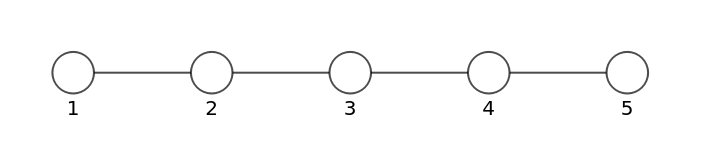
Dynkin diagram of (SU(6)):
A
5
In[]:=
DynkinDiagram[A5]
Dynkin diagram of (SO(11)):
B
5
In[]:=
DynkinDiagram[B5]

Dynkin diagram of (Sp(10)):
C
5
In[]:=
DynkinDiagram[C5]

Dynkin diagram of (SO(10)):
D
5
In[]:=
DynkinDiagram[D5]
Out[]=
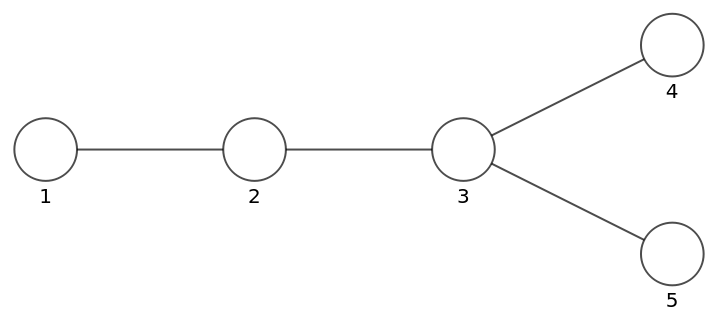
Dynkin diagram of :
E
6
In[]:=
DynkinDiagram[E6]
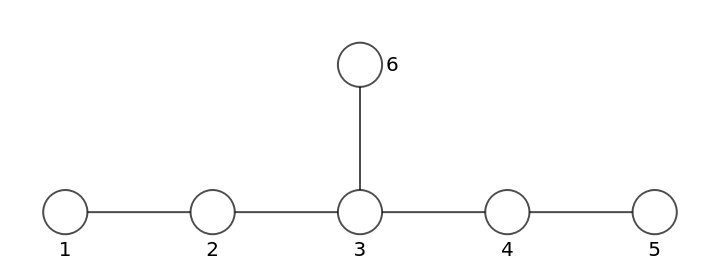
Dynkin diagram of :
E
7
In[]:=
DynkinDiagram[E7]
Out[]=
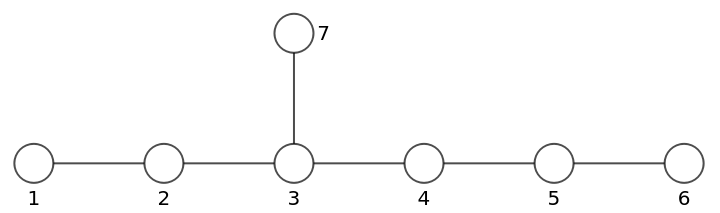
Dynkin diagram of :
E
8
In[]:=
DynkinDiagram[E8]
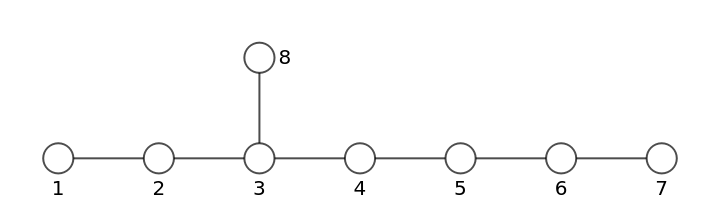
Dynkin diagram of :
F
4
In[]:=
DynkinDiagram[F4]
Out[]=

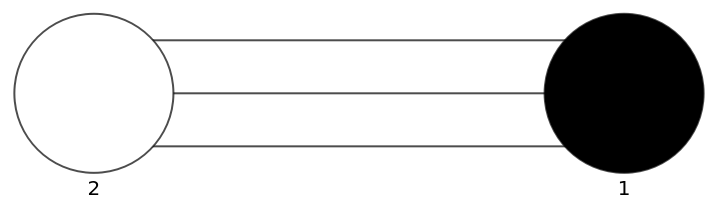
Dynkin diagram of :
G
2
In[]:=
DynkinDiagram[G2]
Out[]=
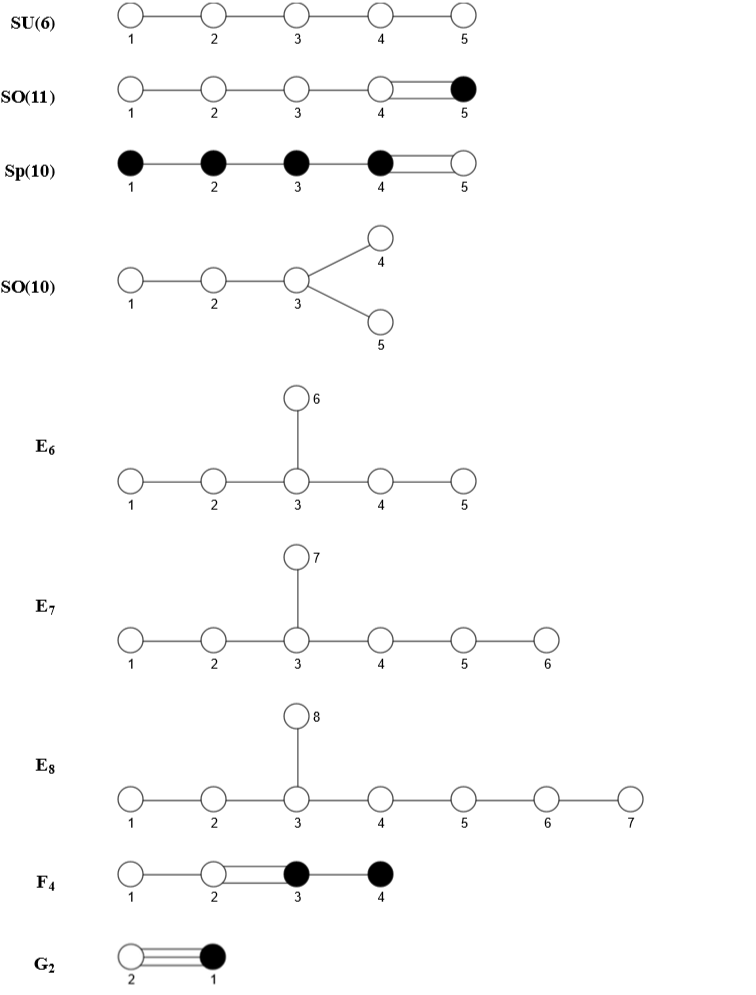
Representative Dynkin diagrams for all classical and exceptional Lie algebras :
In[]:=
allAlgebras={A5,B5,C5,D5,E6,E7,E8,F4,G2};TableForm[{#,DynkinDiagram[#,PlotRange{{0.5,8.5},Full},ImageSize{500,Automatic}]}&/@allAlgebras,TableSpacing{4,2},TableAlignments{Right,Left}]
Extended Dynkin Diagrams
Extended Dynkin Diagrams
Extended Dynkin diagrams are needed for the decomposition into semisimple subalgebras.
Extended Dynkin Diagram.
Representative extended Dynkin diagrams for all classical and exceptional Lie algebras :
Roots
Roots
Simple roots define a Lie algebra and are explicitly specified in LieART using orthogonal coordinates.
The simple roots of SU(5) in the orthogonal basis:
Dynkin diagrams are usually translated to the corresponding Cartan matrix::
The rows of the Cartan matrix are the simple roots in the so-called omega or Dynkin basis :
The root system of an algebra is constructed by generating the Weyl group orbits of each simple root and adding the degenerated zero roots:
Representations
Representations
Entering Irreducible Representations
Entering Irreducible Representations
Irreducible representations (irreps) are internally described by their Dynkin label with a combined head of Irrep and the Lie algebra.
Entering irreps by Dynkin label.
The algebraClass follows the Dynkin classification of simple Lie algebras and can only be A, B, C, D for the classical algebras and E6, E7, E8, F4 and G2 for the exceptional algebras. The precise classical algebra is determined by the length of the Dynkin label.
Irreps may also be entered by their dimensional name. The package transforms the irrep into its Dynkin label. Since the algebra of an irrep of a classical Lie algebra can become ambiguous with only the dimensional name, it has to be further specified.
Entering irreps by dimensional name.
Out[]//InputForm=
Irrep[A][0, 0, 1, 0]
The traditional name of the algebra SU(5) may also be used:
Out[]//InputForm=
Irrep[A][0, 0, 1, 0]
Product irreps.
Out[]//InputForm=
ProductIrrep[Irrep[A][1, 0], Irrep[A][0, 1]]
In[]:=
ProductIrrep[Irrep[A][1, 0], Irrep[A][0, 1]]
Take for example the left-handed quark doublet in the Standard-Model gauge group SU(3)⊗SU(2)⊗U(1) (The U(1) charge is not typeset in bold face):
Out[]//InputForm=
ProductIrrep[Irrep[A][1, 0], Irrep[A][1], Irrep[U][1/3]]
Young Tableaux
Young Tableaux
Young tableaux.
Young tableau of the 720 of SU(5):
Display Young tableaux of SU(4) irreps with a maximum of one column per box count:
WeightSystem
WeightSystem
The weight system in LieART is a collection of Weyl-group orbits generated from the unique dominant weights of an irrep.
Weight system of the 8 of SU(3):
Weight system of SU(5) irrep 40 in spindle shape with weights of the same level in one row:
Weight Diagrams for SU(3)
Weight Diagrams for SU(3)
The weights of SU(3) in terms of the eigenvalues of the Cartan generators H1 and H2 can be displayed in a two-dimensional plot, with multiplicities larger one by circles around the points in the weight lattice.
Weight Diagram.
Weight diagram of SU(3) irrep 3:
Weight diagram of SU(3) irrep 8:
Weight diagram of SU(3) irrep 10:
Weight diagram of SU(3) irrep 27:
Weight diagram of SU(3) irrep 64, i.e., (1, 1) in Dynkin labels:
Tensor Product Decomposition
Tensor Product Decomposition
Tensor product decomposition.
Out[]//InputForm=
IrrepPlus[Irrep[A][0, 0], IrrepTimes[2, Irrep[A][1, 1]], Irrep[A][3, 0], Irrep[A][0, 3], Irrep[A][2, 2]]
Subalgebra Decomposition
Subalgebra Decomposition
Decompose irreps and product irreps.
Decompose the 16 of SO(10) to SU(5)⊗U(1):
Decompose the SU(3) irrep 3 in (24,3)(-3) of SU(5)⊗SU(3)⊗U(1) to SU(2)⊗U'(1), i.e., SU(5)⊗SU(3)⊗U(1)SU(5)⊗SU(2)⊗U'(1)⊗U(1):
The same decomposition as above displayed as branching rule:
Branching rules for all totally antisymmetric irreps, so-called basic irreps, of SU(6) to SU(3)⊗SU(3)⊗U(1):
CITE THIS NOTEBOOK
CITE THIS NOTEBOOK
LieART: Lie Algebras and Representation Theory
by Robert Feger, Thomas W. Kephart & Robert J. Saskowski
Wolfram Community, STAFF PICKS, November 29, 2022
https://community.wolfram.com/groups/-/m/t/2711991
by Robert Feger, Thomas W. Kephart & Robert J. Saskowski
Wolfram Community, STAFF PICKS, November 29, 2022
https://community.wolfram.com/groups/-/m/t/2711991