The 4-peg tower is significantly more difficult than the original version with 3 pegs. I use Jaime Rangel-Mondragon’s code for computation and add simple rules for geometric transformation to create the animation for moves.
Notation
Notation
Run the code in the “Jaime Rangel-Mondragon’s code” section below to load the definition for the function HanoiMoves. In my example, I put 10 plates in the game with 4 pegs or needles.
In[]:=
allConfigs=HanoiMoves[10,4];
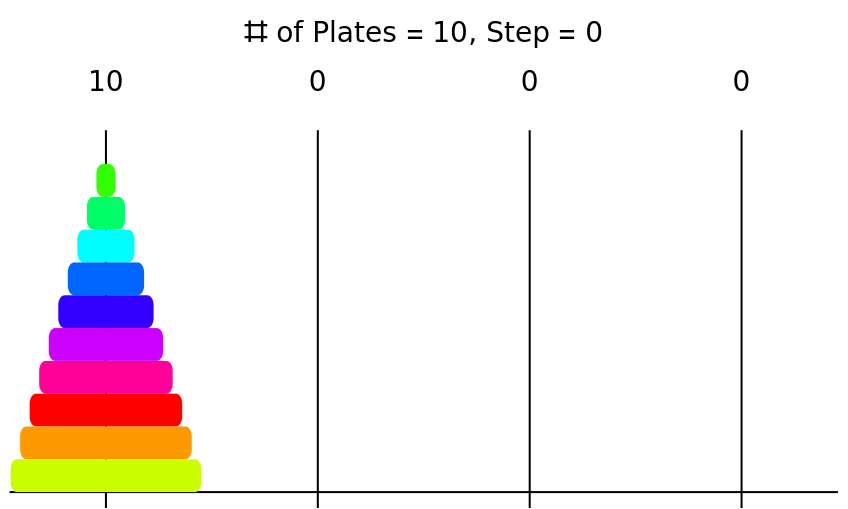
Say we extract the first 5 steps. The columns in the matrix stands for needle or peg:
In[]:=
allConfigs[[;;5]]//MatrixForm
Out[]//MatrixForm=
{1,2,3,4,5,6,7,8,9,10} | {} | {} | {} |
{2,3,4,5,6,7,8,9,10} | {1} | {} | {} |
{3,4,5,6,7,8,9,10} | {1} | {2} | {} |
{4,5,6,7,8,9,10} | {1} | {2} | {3} |
{4,5,6,7,8,9,10} | {1} | {} | {2,3} |
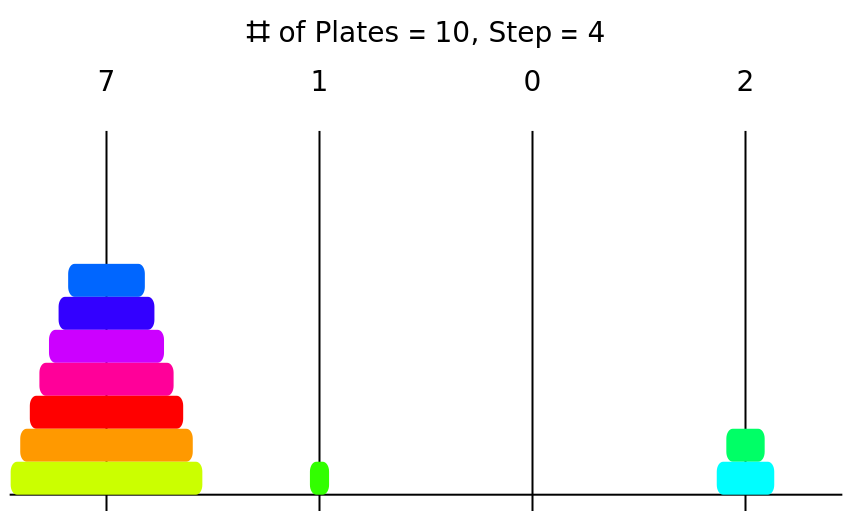
The list of number in each column stands for the pile of numbered plated sitting at the current location. For instance the last row in the above matrix has , I can illustrate it as the following diagram:
{{4,5,6,7,8,9,10},{1},{},{2,3}}
Use GeometricTransformation for animation
Use GeometricTransformation for animation
Define two association to record the initial location and position of the center for each plate at the left most pile with plates:
n
In[]:=
plates[n_Integer]:=AssociationThread[Range[n]->Array[Style[Rectangle[{-.45#/n,1/n*(n-#)},{.45#/n,1/n*(n-#+1)},RoundingRadius->.3/n],Hue[#/n+0.2]]&,n]]
In[]:=
platesCenterInit[n_]:=AssociationThread[Range[n]->Array[{0,1./n*(n-#)+1/(2n)}&,n]]
For 10 plates:
In[]:=
data1=plates[10];data2=platesCenterInit[10];Graphics[{Line[{{0,-0.05},{0,1.1}}],Values@data1,Point[Values[data2]]},AspectRatio->1.2]
Out[]=
Given any entry of the move set from Jaime’s function, the new target location for each plate is computed with following rule:
pos[plts_List,needleId_List,n_Integer]:=Module[{len=Length[plts],id=needleId[[1]]},If[plts!={},AssociationThread[plts->Array[{id-1,(len-#)/n+1/(2n)}&,len]],<||>]]
targetAssoc[config_List,n_Integer]:=Join@@MapIndexed[pos[#1,#2,n]&,config]
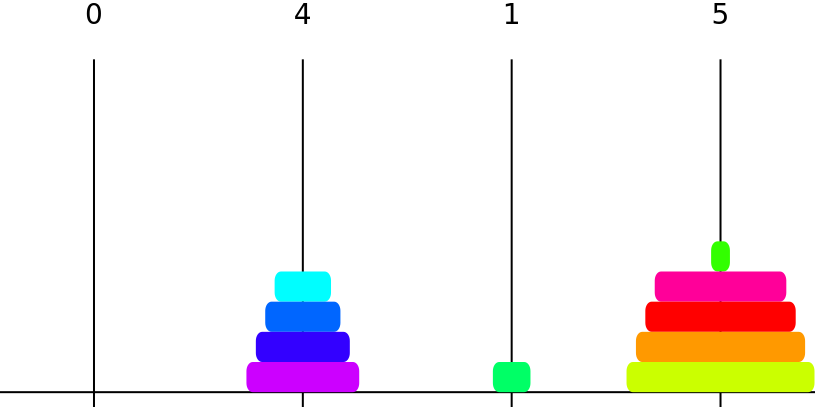
For instance at Step=35
In[]:=
allConfigs[[35]]
Out[]=
{{},{3,4,5,6},{2},{1,7,8,9,10}}
The new location for each center of the plates become:
In[]:=
target=targetAssoc[%,10]
Out[]=
31,,41,,51,,61,,22,,13,,73,,83,,93,,103,
7
20
1
4
3
20
1
20
1
20
9
20
7
20
1
4
3
20
1
20
In[]:=
gConfig2=Table[GeometricTransformation[data1[i],TranslationTransform[target[i]-data2[i]]],{i,10}];
In[]:=
move=allConfigs[[35]];pegs=Array[Line[{{#,-0.2},{#,1.1}}]&,4,0];ground=Line[{{-.45,0},{3.45,0}}];Graphics[Table[Inset[Style[Length[move[[i]]],14],{i-1,1.25}],{i,4}]~Join~{pegs,ground,gConfig2},AspectRatio->.5,PlotRange->{{-0.45,3.45},{-.05,1.3}}]
Out[]=
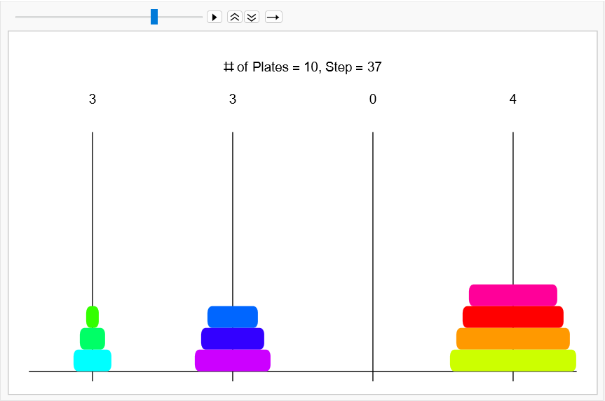
I compile all animation code in one place in the “Utility- Animation code” section below. Just run that part you should be fine to create the animation for all moves.
OEIS A007664
OEIS A007664
You can compute the steps directly with this WL function used on the OEIS page:
In[]:=
a[n_]:=a[n]=Min[Table[2*a[k]+2^(n-k)-1,{k,0,n-1}]];a[0]=0;Table[a[n],{n,0,48}](*Jean-FrançoisAlcover,Dec06×2011,afterM.F.Hasler*)
Out[]=
{0,1,3,5,9,13,17,25,33,41,49,65,81,97,113,129,161,193,225,257,289,321,385,449,513,577,641,705,769,897,1025,1153,1281,1409,1537,1665,1793,2049,2305,2561,2817,3073,3329,3585,3841,4097,4609,5121,5633}
Utility- Jaime Rangel-Mondragon’s code
Utility- Jaime Rangel-Mondragon’s code
In[]:=
sums[s_,i_]:={}/;(s<i)||(i==0)sums[s_,s_]:={Table[1,{s}]}sums[s_,1]:={{s}}sums[s_,i_]:=Module[{d},Flatten[Table[Map[Join[{d},#]&,sums[s-d,i-1]],{d,s-i+1}],1]]
In[]:=
hanoiP[n_,p_]:=Join[Table[1,{n-1}],Table[0,{p-n-1}],{2n-1}]/;n<p-1hanoiP[n_,p_]:=hanoiP[n,p]=Module[{v,t},t=sums[n-1,p-2];v=Map[Join[#,{2Plus@@Table[Last[hanoiP[,p-i+1]],{i,p-2}]+1}]&,t];First[Sort[v,Last[#2]>Last[#1]&]]]
#
〚i〛
In[]:=
superHanoi[{{d_},{a_,___,b_}}]:={d,a,b}superHanoi[{tower_,pegs_}]:=Module{a,pat,lp=Length[pegs],n,ans={},i,p,spread,back},a=Drop[hanoiP[Length[tower],lp],-1];pat=TableTaketower,1+,,{n,lp-2};spread=Table[p=Drop[pegs,{2,n}];i=Last[p];=;=i;{,p},{n,lp-2}];spread=Cases[spread,{{__},_}];back=Map[{First[#],Join[{Last[Last[#]]},Complement[Last[#],{Last[Last[#]],Last[pegs]}],{Last[pegs]}]}&,Reverse[spread]];Map[AppendTo[ans,superHanoi[#]]&,spread];AppendTo[ans,{Last[tower],First[pegs],Last[pegs]}];Map[AppendTo[ans,superHanoi[#]]&,back];Partition[Flatten[ans],3]
n-1
∑
i=1
a
〚i〛
n
∑
i=1
a
〚i〛
p
〚-1〛
p
〚2〛
p
〚2〛
pat
〚n〛
Utility- Animation code
Utility- Animation code
Just put everything about the animation code altogether:
CITE THIS NOTEBOOK
CITE THIS NOTEBOOK
Animate the optimal set of moves for 4-peg tower of Hanoi
by Shenghui Yang
Wolfram Community, STAFF PICKS, October 31, 2024
https://community.wolfram.com/groups/-/m/t/3312046
by Shenghui Yang
Wolfram Community, STAFF PICKS, October 31, 2024
https://community.wolfram.com/groups/-/m/t/3312046