Inverse Transformation of s-Reflection Coefficient between Oblique and Normal Incidence
Inverse Transformation of s-Reflection Coefficient between Oblique and Normal Incidence


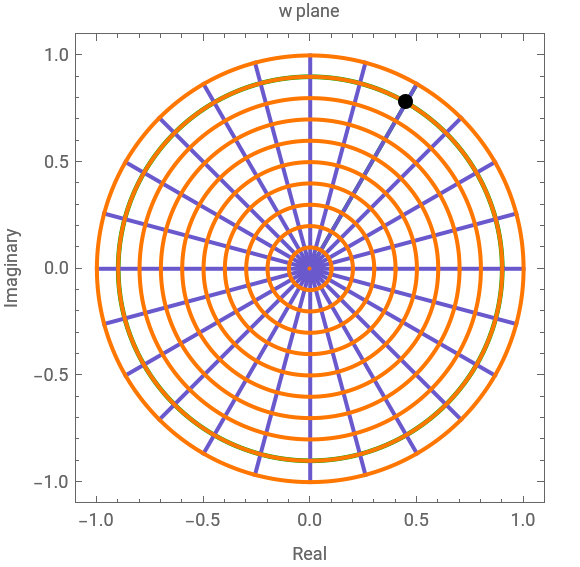
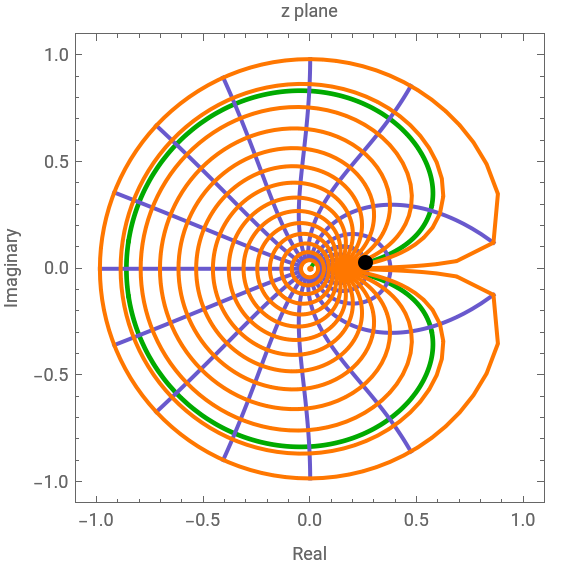
If denotes an interface Fresnel reflection or transmission coefficient for - or -polarized light at an oblique angle of incidence , and z denotes the same coefficient at normal incidence, then it can be shown that w is an analytic function of , that depends parametrically on the angle of incidence . The inverse mapping between the complex and planes is illustrated here by one of the Fresnel coefficients (for s reflection) at one oblique angle of incidence (45°) and normal incidence. Here , where and are the oblique-incidence amplitude reflectance and phase shift.
w
s
p
ϕ
z
w=f(z)
ϕ
z=(w)
-1
f
w
z
w=|r|exp(jδ)
|r|
δ
This figure shows that the orthogonal (polar) set of straight lines and circles through and around the origin in the plane is mapped onto orthogonal sets of curves in the plane.
w
z
Details
Details
R. M. A. Azzam, "Transformation of Fresnel's interface reflection and transmission coefficients between normal and oblique incidence," Journal of Optical Society of America, 69(4), 1979 pp. 590-596.
External Links
External Links
Permanent Citation
Permanent Citation