TXM797: RATIONAL CYCLIC-POLYGON
TXM797: RATIONAL CYCLIC-POLYGON
In[]:=
Manipulate[Module[{AA,BB,CC,MM},AA={y(x^2+1),0};BB={(x(x+y)^2-x(xy-1)^2)/(x^2+1),(2x(x+y)(xy-1))/(x^2+1)};CC={0,0};MM={((y+z)(yz-1)(x^2+1)(z^2-1))/(z^2+1)^2,(2z(y+z)(yz-1)(x^2+1))/(z^2+1)^2};Graphics[{Point/@{AA,BB,CC,MM},Text["A",AA],Text["B",BB],Text["C",CC],Text["M",MM],Circumsphere[{AA,BB,CC}]}]],{x,-10,10},{y,-10,10},{z,-10,10},SaveDefinitionsTrue]
Out[]=


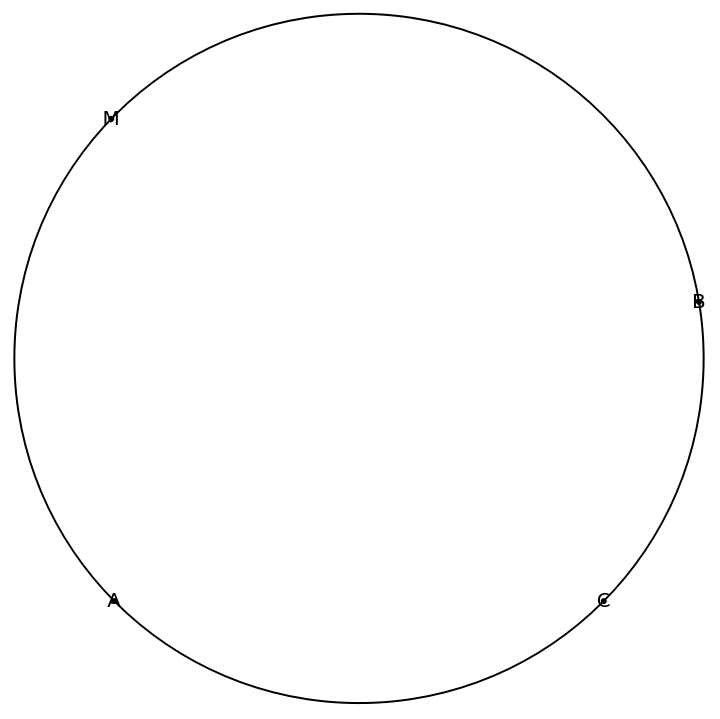
CaptionAn cyclic polygon is called rational if it has a rational area and the distance between any two of its vertices is also rational. In the general case, suppose we have Cartesian coordinates of 3 vertices A=(y(2x+1),0) , B=2x(x+y)-2x(xy-1)2x+1,2x(x+y)(xy-1)2x+1, C=(0,0). Then the coordinates of all remaining vertices of the rational polygon are determined through a parameter zn as Mn=(y+zn)(yzn-1)(2x+1)(2zn-1)2(2zn+1),2zn(y+zn)(yzn-1)(2x+1)2(2zn+1). For all x,y,zn∈Q.
CaptionAn cyclic polygon is called rational if it has a rational area and the distance between any two of its vertices is also rational. In the general case, suppose we have Cartesian coordinates of 3 vertices , , . Then the coordinates of all remaining vertices of the rational polygon are determined through a parameter as =,. For all .
A=(y(+1),0)
2
x
B=-+1,+1
2
x(x+y)
2
x(xy-1)
2
x
2x(x+y)(xy-1)
2
x
C=(0,0)
z
n
M
n
(y+)(-1)(+1)(-1)
z
n
yz
n
2
x
2
z
n
2
(+1)
2
z
n
2(y+)(-1)(+1)
z
n
z
n
yz
n
2
x
2
(+1)
2
z
n
x,y,∈Q
z
n