MinimalCurvatureRadius::usage="At what points does the radius of curvature of the curve:x = a (1 - Sin[t]), y = a (1 - Cos[t]), z = 4a Cos reach the local minimum?References: Fedenko, A.S. Problemas de Geometría Diferencial. Moscú: Edditorial Mir, p.68, 1981; Personal.";
t
2
Development:
The radius of curvature is the reciprocal of the curvature:
In[]:=
r[t_]:=a(t-Sin[t]),a(1-Cos[t]),4aCos;rc=
t
2
3
(Norm[r'[t]])
Norm[r'[t]r''[t]]
In[]:=
Simplify+4+++
3/2
2
Abs[a(1-Cos[t])]
2
AbsaSin
t
2
2
Abs[aSin[t]]
2
Abs2Cos[t]Sin-CosSin[t]
2
a
t
2
2
a
t
2
2
AbsCos-CosCos[t]-2SinSin[t]
2
a
t
2
2
a
t
2
2
a
t
2
2
Abs[Cos[t]--]
2
a
2
a
2
Cos[t]
2
a
2
Sin[t]
Out[]=
3/2
+4+
2
Abs[a-aCos[t]]
2
AbsaSin
t
2
2
Abs[aSin[t]]
2
Abs[(-1+Cos[t])]
2
a
2
Abs
2
a
3
Sin
t
2
2
AbsSinSin[t]
2
a
t
2
In[]:=
Simplify+4++4+
3/2
2
(a-aCos[t])
2
aSin
t
2
2
(aSin[t])
2
((-1+Cos[t]))
2
a
2
2
a
3
Sin
t
2
2
SinSin[t]
2
a
t
2
Out[]=
2
2
3/2
(-(-1+Cos[t]))
2
a
4
a
4
Sin
t
2
2
2
3/2
(-(-1+Cos[t]))
2
a
4
a
4
Sin
t
2
2
2
3
a
3
2
(1-Cos[t])
2
a
2
Sin
t
2
2
2
a3
2
(1-Cos[t])
2
Sin
t
2
Let a = 1 (The value of a only affects the amplitude, that is, the maximums, does not affect the values of the minumums of 0.)
In[]:=
Minimize,t
2
2
3
2
(1-Cos[t])
2
Sin
t
2
Out[]=
{0,{t0}}
In[]:=
Plot,{t,-4π,4π}
2
2
3
2
(1-Cos[t])
2
Sin
t
2
Out[]=
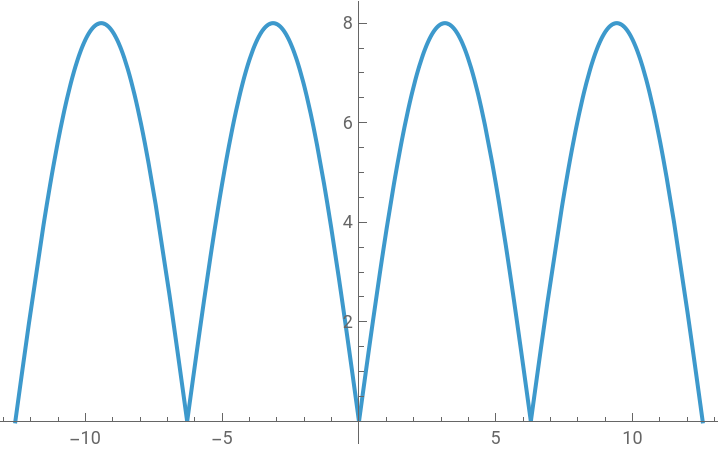
It is observed that the function reaches a minimum value of 0, in the following values:
t=2kπ,{k=0,±1,±2,±3,...}
Let’s look at the graph of the curve:
In[]:=
ζ[t_]:=t-Sin[t],1-Cos[t],4Cos;Show[{ParametricPlot3D[ζ[t],{t,-8π,8π},PlotStyle{Thick,Blue}],Table[Graphics3D[{Red,Ball[ζ[2kπ],0.44]}],{k,-4,4,1}]},AxesLabel->(Style[#,15,Blue]&/@{"X","Y","Z"}),AxesOrigin{0,0,0},AxesTrue,BoxedFalse,BoxRatiosAutomatic,PlotRangeAll,ViewPoint{1.3,-2.4,2.},ImageSize500,PerformanceGoal"Quality"]
t
2
Out[]=

The points that appear in red are those in which the radius of curvature is minimal.