A circle has no end. - Isaac Asimov.
Skilling, John (1975), “The complete set of uniform polyhedra”, Philosophical Transactions of the Royal Society A, 278 (1278): 111–135.
A definitive enumeration of all uniform polyhedra is presented (a uniform polyhedron has all vertices equivalent and all its faces regular polygons). It is shown that the set of uniform polyhedra presented by Coxeter, Longuet-Higgins & Miller (1953) is essentially complete. However, after a natural extension of their definition of a polyhedron to allow the coincidence of two or more edges, one extra polyhedron is found, namely the great disnub dirhombidodecahedron.
A definitive enumeration of all uniform polyhedra is presented (a uniform polyhedron has all vertices equivalent and all its faces regular polygons). It is shown that the set of uniform polyhedra presented by Coxeter, Longuet-Higgins & Miller (1953) is essentially complete. However, after a natural extension of their definition of a polyhedron to allow the coincidence of two or more edges, one extra polyhedron is found, namely the great disnub dirhombidodecahedron.
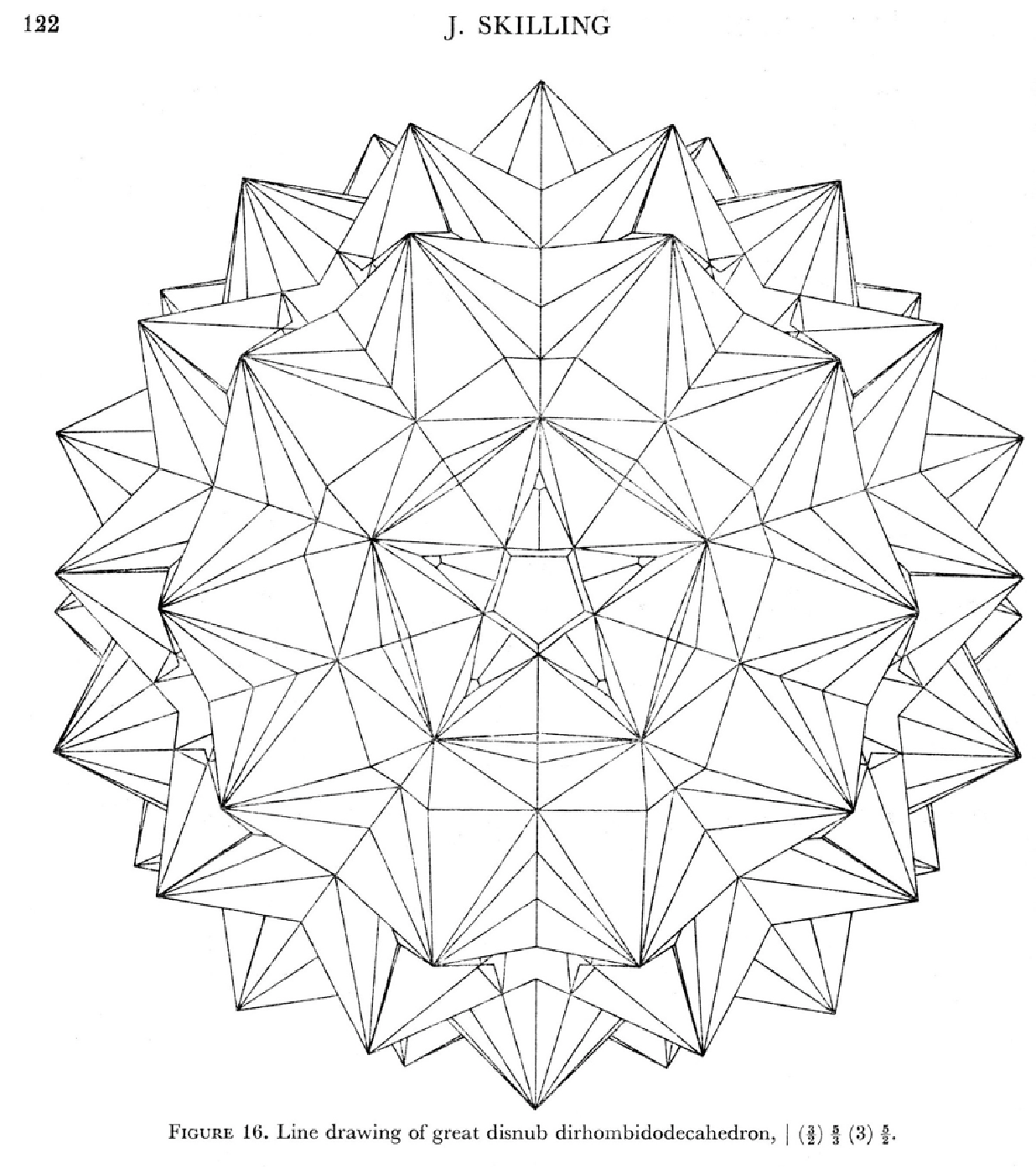
The goal of this notebook is to perform the construction of Skilling’s figure from scratch and to do the line drawing as well.
https://en.wikipedia.org/wiki/Great_disnub_dirhombidodecahedron
In geometry, the great disnub dirhombidodecahedron, also called Skilling’s figure, is a degenerate uniform star polyhedron. Due to its geometric realization having some double edges where 4 faces meet, it is considered a degenerate uniform polyhedron but not strictly a uniform polyhedron. It shares the same edge arrangement as the great dirhombicosidodecahedron, but has a different set of triangular faces.
In geometry, the great disnub dirhombidodecahedron, also called Skilling’s figure, is a degenerate uniform star polyhedron. Due to its geometric realization having some double edges where 4 faces meet, it is considered a degenerate uniform polyhedron but not strictly a uniform polyhedron. It shares the same edge arrangement as the great dirhombicosidodecahedron, but has a different set of triangular faces.
https://en.wikipedia.org/wiki/Great_dirhombicosidodecahedronCartesian coordinates for the vertices of a great dirhombicosidodecahedron are all the even permutations of, , where is the golden ratio. These vertices result in an edge length of . These are also the vertices for the great disnub dirhombidodecahedron
0,±,±
2
τ
2
τ
±-1+,±-,±+
1
3
τ
1
2
τ
1
τ
1
τ
τ
±-+,±+
1
τ
τ
,±-1-1
3
τ
1
2
τ
1
τ
τ=(1+
5
)22
2
First we construct all even permutations from above:
In[]:=
Withτ=(1+,&,Map[Join[{1},#]&,Tuples[{1,-1},2]],Map#-1+,-,++,+&,Tuples[{1,-1},3],1,2,1;
5
)2,vertices=FlattenNestListMap[RotateRight,#]&,FlattenMap#0,2
τ
2
τ
1
3
τ
1
2
τ
1
τ
1
τ
τ
&,Tuples[{1,-1},3],Map#-1
τ
τ
,-1-1
3
τ
1
2
τ
1
τ
There are 60 vertices:
In[]:=
Length[vertices]
Out[]=
60
In[]:=
pentagons={{3,17,50,52,13},{46,18,4,14,48},{56,42,60,25,27},{9,39,21,35,11},{31,29,59,41,55},{1,15,51,49,19},{5,7,36,22,40},{53,43,57,30,32},{54,28,26,58,44},{47,16,2,20,45},{23,37,10,12,33},{6,38,24,34,8}};
The hull of Skilling’s figure is an exploded Dodecahedron:
In[]:=
Graphics3DPoint[vertices],Opacity[0.5],FaceForm[Cyan,Blue],Map[Polygon[vertices[[#]]]&,pentagons],Opacity[1],LightBlue,MapTranslatePolygon[vertices[[#]]],N-5(3+
1
4
5
)+290+130
Mean[vertices[[#]]]&,pentagons,Lighting"Neutral",BoxedTrue5
Out[]=

Here are the visible card boards in 2D:
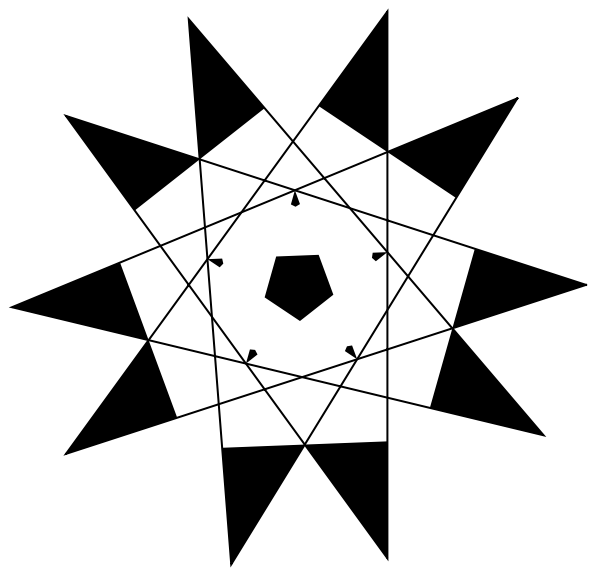
The double pentagrams:
In[]:=
Withcp=RiffleN@CirclePoints[{1,0},5],N@CirclePoints1,ArcCos1-(-1+,5,indices=Table[Mod[1+4k,10],{k,0,5}],Graphics[{{LightGray,Line[cp[[indices]]],Line[cp[[indices+1]]]},EdgeForm[Black],White,doublePentagram[cp]},ImageSize->300]
5
2+5
8
5
)Out[]=
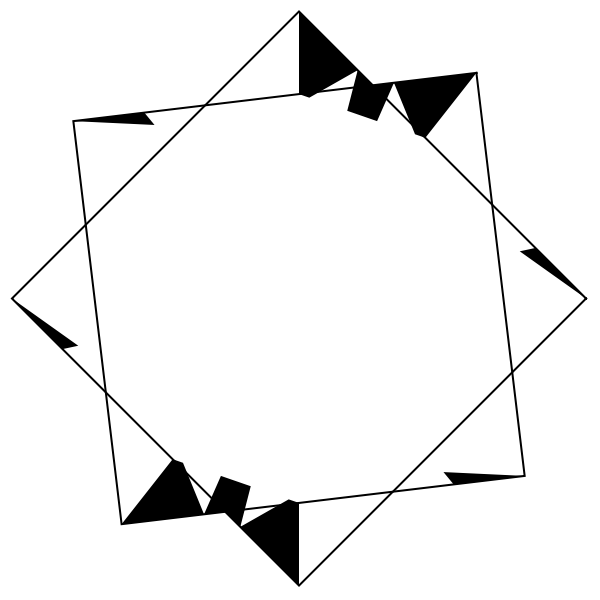
The double squares:
In[]:=
With[{cp=Riffle[N@CirclePoints[{1,0},4],N@CirclePoints[{1,ArcCos[1/GoldenRatio]},4]],indices=Table[Mod[1+2k,8],{k,0,4}]},Graphics[{{LightGray,Line[cp[[indices]]],Line[cp[[indices+1]]]},EdgeForm[Black],White,doubleSquare[cp]},ImageSize->300]]
Out[]=
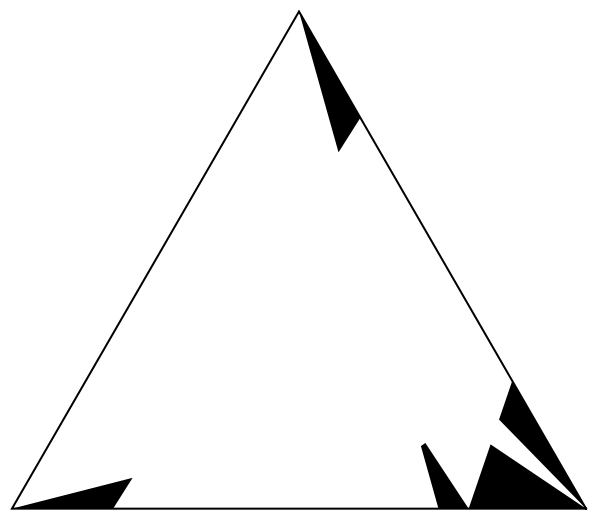
The triangles:
In[]:=
With[{cp=N@CirclePoints[3]},Graphics[{{LightGray,Line[cp[[{1,2,3,1}]]]},EdgeForm[Black],White,triangle[cp]},ImageSize->300]]
Out[]=
Skilling’s Great Disnub Dirhombidodecahedron:
Skilling’s Great Disnub Dirhombidodecahedron:
The double pentagrams are white, the double squares are red and orange, the triangles are blue and cyan:
In[]:=
Graphics3D[{{FaceForm[White,Gray],Map[doublePentagram[vertices[[#]]]&,s10]},{FaceForm[Blue,Cyan],Map[triangle[vertices[[#]]]&,s31],Map[triangle[vertices[[#]]]&,s32]},{FaceForm[Orange,Red],Map[doubleSquare[vertices[[#]]]&,s8]}},Lighting"Neutral",BoxedFalse,ViewPoint2.5Mean[vertices[[{39,9,11,35,21}]]],ViewProjection"Orthographic",ViewVertical->2.5Mean[vertices[[{48,52,42}]]]]
With removed colors:
With removed shading (this is like Skilling’s original line drawing):
CITE THIS NOTEBOOK
CITE THIS NOTEBOOK
Skilling's 1975 Great Disnub Dirhombidodecahedron
by Oliver Seipel
Wolfram Community, STAFF PICKS, February 12, 2024
https://community.wolfram.com/groups/-/m/t/3121152
by Oliver Seipel
Wolfram Community, STAFF PICKS, February 12, 2024
https://community.wolfram.com/groups/-/m/t/3121152