In this project, we aim to understand what happens to gravitation in accelerated frames undergoing a Thomas Precession. We first construct causal graphs in flat spacetimes then in asymptotically flat spacetime, while investigating their foliations. Once a relationship is established between Gyrogeometry and Gyrovector spaces with the Equivalence Principle in this discrete framework, it will have far-reaching consequences in our understanding of concepts such as spacetime heat.
Introduction to Causal Graphs and Foliations
Introduction to Causal Graphs and Foliations
This preliminary work is intended to set the foundations for upcoming research. The utility of causal graphs lies in their capability to construct coherent structures of complex mechanisms.In the context of causal graphs, a common approach involves conceptualizing them as representations of partial orderings of events within a system. Essentially, they serve as a depiction of a poset, where events can be viewed as partially ordered sets. Consequently, any specific sequence of updating events can be regarded as a distinct total ordering of such events. Take for example the following grid [1]:
In[]:=
CloudGet["https://wolfr.am/LcADnk1u"];upTriangleGraph=diamondCausalGraphPlot[9,{0,0},{},#&,"Up",VertexLabels->Placed[Automatic,Above],ImageSize->450]
Out[]=
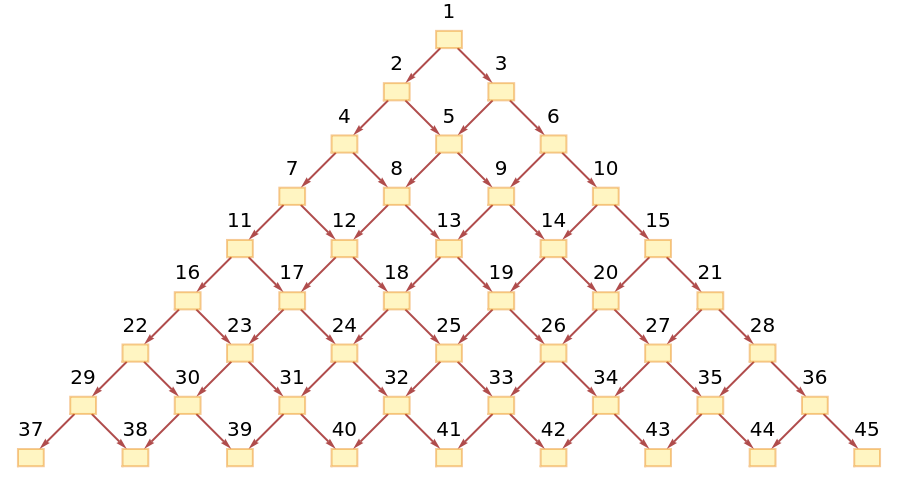
There are multiple way these events can be ordered, such as the “breadth-first scan” [1]:
In[]:=
CloudGet["https://wolfr.am/LcADnk1u"]upTriangleGraph=diamondCausalGraphPlot[9,{0,0},{},#&,"Up",VertexLabels->Placed[Automatic,Above],ImageSize->450];vertexToDiagram=Association[Thread[VertexList[upTriangleGraph]->Take[Catenate[Table[{m,n},{m,1,20},{n,m,1,-1}]],VertexCount[upTriangleGraph]]]];Show[upTriangleGraph,skewPosetDiagram[vertexToDiagram/@Reap[BreadthFirstScan[upTriangleGraph,1,"PrevisitVertex"->(Sow[#]&)]][[2,1]]]]
Out[]=
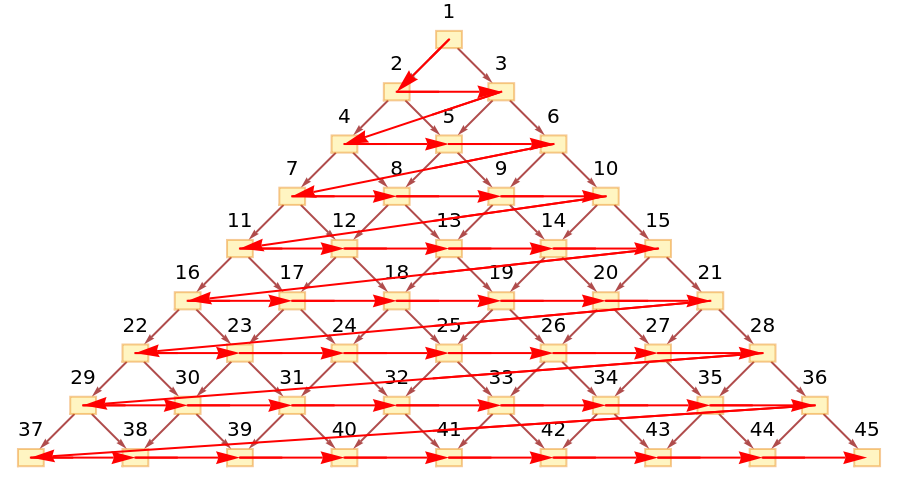
In considering total orderings, it is important to acknowledge the numerous possibilities available, particularly when contemplating large-scale limits. When seeking to address such scenarios, it is customary to confine the focus to orderings that can be delineated by “reasonable” foliations. The concept of a foliation involves establishing a series of slices characterized by the condition that events occurring on consecutive slices must adhere to the sequencing of the slices, while events within a slice are permitted to occur in any order. Foliations are also intended to denote simultaneity within the framework of a physical system. For instance, a readily conceivable foliation of the above-mentioned causal graph could be:
In[]:=
CloudGet["https://wolfr.am/LcADnk1u"];diamondCausalGraphPlot[10,{1,0},{0.0,0.0},lorentz[0],"Up",VertexLabels->Placed[Automatic,Center],VertexLabelStyle->Directive[8,Bold],VertexSize->.45,ImageSize->550]
Out[]=
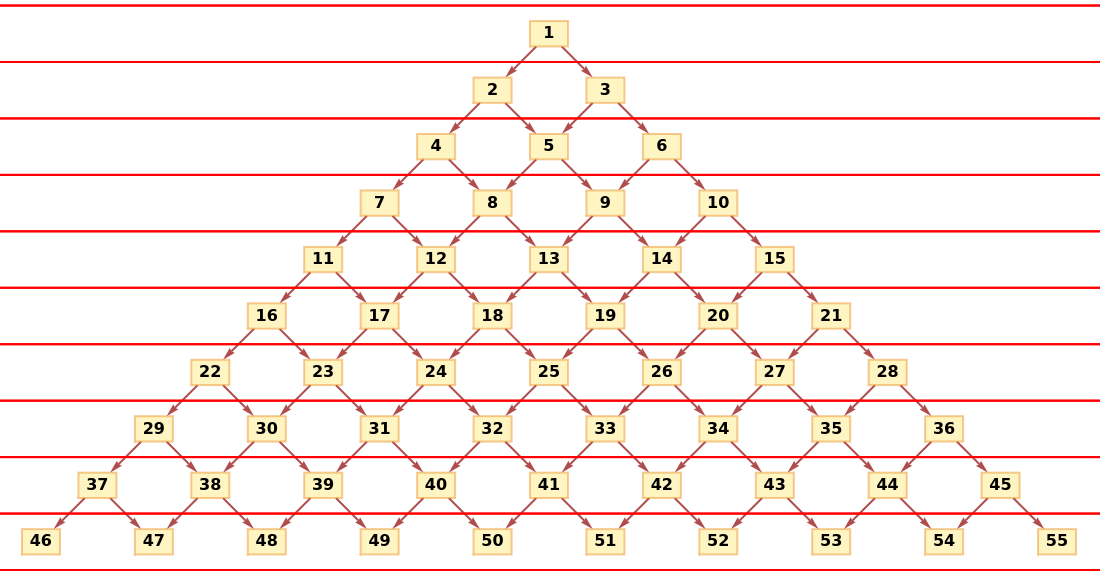
The established foliation dictates the sequential occurrence of event 1 prior to events 2 and 3, which can then proceed in any order, followed by events 4, 5, and 6 in any permutation, and so forth. The foliation slices can become steeper, but there is a limit as to how steep it can get due to the orderings of a causal graph [1].
The mathematical concepts of gyrogroups, gyrovector spaces, and gyrogeometry have been developed to encompass the algebraic and geometric properties derived from Einstein’s non-commutative and non-associative Addition Law and Thomas Precession [2]. In the context of relativistic velocities, it became necessary to establish a structure capable of accommodating these properties, leading to the formation of gyrogroups with their gyroassociative and gyrocommutative laws. Additionally, the effect of Thomas Precession, observed in relativistic systems, is characterized by the gyroautomorphisms that define the gyrogroup structure [2]. These concepts give rise to gyrovector spaces, which extend the concept of vector spaces into hyperbolic geometry, and gyrogeometry, which generalizes classical geometric relationships to reflect the curvature and dynamics of relativistic spacetime. This comprehensive framework provides a rigorous mathematical foundation for describing the geometry of special relativity. Furthermore, within this formalism of gyrogroups and gyrovector spaces, space and time are distinct entities rather than primitive concepts [2]. This aligns with the perspective in the Wolfram Physics Project, where continuous updating of the hypergraph signifies time, implying that space and time are separate constructs emerging from more fundamental structures. Ungar’s use of gyrovector spaces and gyrogroups, rooted in the hyperbolic nature of relativistic velocities, naturally extends to Thomas precession, providing an algebraic structure that mirrors Lorentz transformations. Meanwhile, the causal graphs used in the Wolfram Physics Project model the universe’s evolution through discrete elements, with time as a parameter tracking the hypergraph’s updates, and foliations representing different ways of slicing spacetime, analogous to various coordinate systems in general relativity.
The mathematical concepts of gyrogroups, gyrovector spaces, and gyrogeometry have been developed to encompass the algebraic and geometric properties derived from Einstein’s non-commutative and non-associative Addition Law and Thomas Precession [2]. In the context of relativistic velocities, it became necessary to establish a structure capable of accommodating these properties, leading to the formation of gyrogroups with their gyroassociative and gyrocommutative laws. Additionally, the effect of Thomas Precession, observed in relativistic systems, is characterized by the gyroautomorphisms that define the gyrogroup structure [2]. These concepts give rise to gyrovector spaces, which extend the concept of vector spaces into hyperbolic geometry, and gyrogeometry, which generalizes classical geometric relationships to reflect the curvature and dynamics of relativistic spacetime. This comprehensive framework provides a rigorous mathematical foundation for describing the geometry of special relativity. Furthermore, within this formalism of gyrogroups and gyrovector spaces, space and time are distinct entities rather than primitive concepts [2]. This aligns with the perspective in the Wolfram Physics Project, where continuous updating of the hypergraph signifies time, implying that space and time are separate constructs emerging from more fundamental structures. Ungar’s use of gyrovector spaces and gyrogroups, rooted in the hyperbolic nature of relativistic velocities, naturally extends to Thomas precession, providing an algebraic structure that mirrors Lorentz transformations. Meanwhile, the causal graphs used in the Wolfram Physics Project model the universe’s evolution through discrete elements, with time as a parameter tracking the hypergraph’s updates, and foliations representing different ways of slicing spacetime, analogous to various coordinate systems in general relativity.
Flat Spacetime Causal Graphs with Foliations
Flat Spacetime Causal Graphs with Foliations
Hypergraph Evolution with Lorentz and Rindler Coordinates
Hypergraph Evolution with Lorentz and Rindler Coordinates
We will first examine flat Minkowski spacetimes and their foliations within a causal graph because of their structural simplicity. Another motivation behind this decision is that a standard Minkowski spacetime does not invoke the Equivalence Principle, which would enable us to understand the difference in foliations between those two different classes of spacetimes. We must first begin by describing the spacetime continuum in a discrete framework, and that can be done in the following manner:
In[]:=
sprinkling=ResourceFunction["FlatSpacetimeSprinkling"][2,20]
Out[]=
SpacetimeSprinkling


In[]:=
causalGraph=sprinkling["CausalGraphFull"]
Out[]=
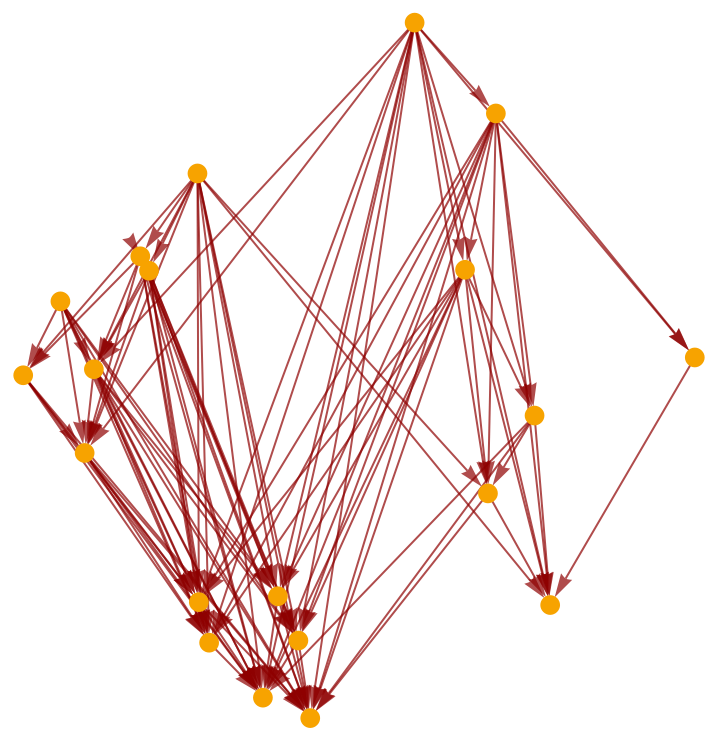
The choice of nodes is arbitrary, and has been reduced in order to avoid unnecessary complications. From which we have obtained the following foliations:
In[]:=
foliations7=ResourceFunction["GraphFoliations"][causalGraph7];
In[]:=
vertexPositions7=Flatten[foliations7,2];vertexList=VertexList[causalGraph7];
In[]:=
If[Length[vertexPositions7]>=Length[vertexList],positionMap=AssociationThread[vertexList,Take[vertexPositions7,Length[vertexList]]]];
In[]:=
foliationLines=Table[Line[foliations7[[i]]],{i,Length[foliations7]}];
In[]:=
Show[Graph[VertexList[causalGraph7],EdgeList[causalGraph7],VertexCoordinates->Normal[positionMap],VertexLabels->"Name",EdgeStyle->Arrowheads[0.03],GraphStyle->"Causal"],Graphics[{Red,foliationLines}]]
Out[]=
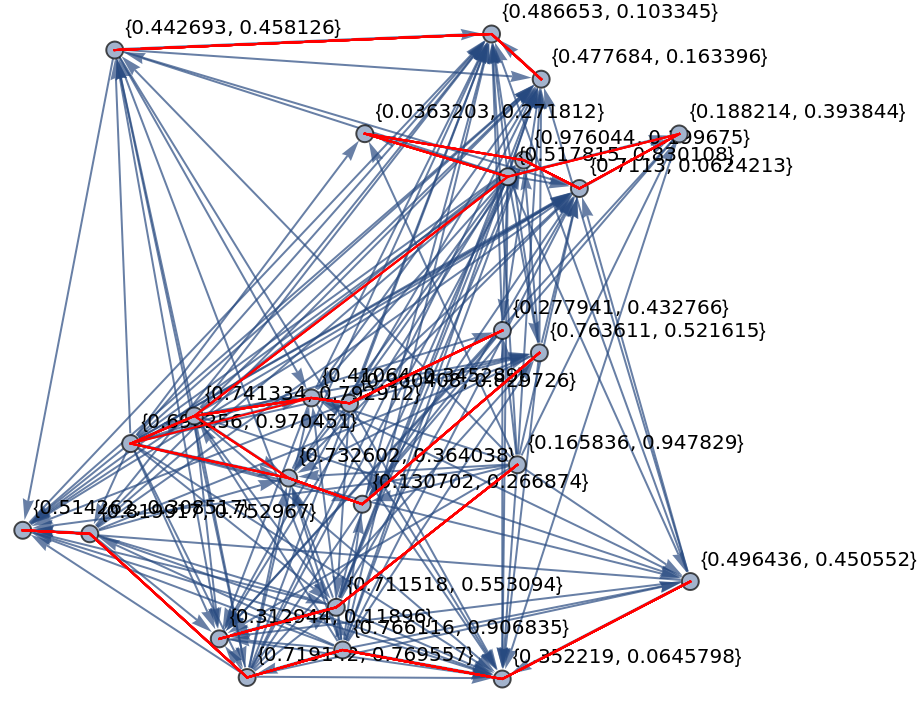
In a given causal graph, different observers may perceive events unfolding in varying sequences due to the relativity of simultaneity in Minkowski spacetime. This is attributed to the unique foliation or slicing of spacetime dictated by each observer’s frame of reference, defining the perception of simultaneous events. The depicted red lines in the graph represent these foliations, illustrating that events on the same red line are deemed simultaneous for a particular observer, while events on different lines occur sequentially. As observers move relative to each other, their perception of simultaneity undergoes alterations, thereby causing different event sequences, while maintaining the consistency of the causal structure. Moreover, we are interested in examining what happens to the structure of a causal graph when one uses two separate sets of coordinates: Lorentz and Rindler. Lorentz coordinates are associated with inertial reference frames, wherein observers maintain constant velocities with respect to each other. These coordinates are fundamental to special relativity and are employed to characterize events in a flat spacetime without acceleration. The transitions between different Lorentz frames are governed by the Lorentz transformations, which ensure the constancy of the speed of light in all inertial frames and the uniformity of the laws of physics for all inertial observers. Conversely, Rindler coordinates are utilized to delineate uniformly accelerated reference frames in flat spacetime. These coordinates are particularly valuable for understanding the repercussions of acceleration in special relativity. The Rindler transformation offers a method for transitioning between an inertial frame and a frame undergoing constant proper acceleration. In the context of a Rindler observer, experiencing constant acceleration, the spacetime metric appears altered, and phenomena such as the Unruh effect, wherein an accelerating observer discerns thermal radiation in a vacuum, can be expounded upon. The crucial distinction lies in the fact that Lorentz coordinates are suited for portraying scenarios with constant relative velocity (inertial frames), while Rindler coordinates are imperative for analyzing situations involving persistent acceleration (non-inertial frames). The difference can also be observed in the subsequent causal ring structures with and without the Lorentz boost, alongside with the causal ring structures one can obtain through Rindler transformations. In order to do this, we will utilize new functions [3] “simplecausaldata[size_]” and “Foliationclass[data_]” with Lorentz coordinates:
In[]:=
simplecausaldata[size_]:=Module[{n=size},data={};i=0;For[k=n,0<=k,k--,Do[i++;If[i!=0,data=Join[data,{{i,2(n-k),2(k-1)-4j}}],data=data],{j,0,k-1,1}]];data];Lorentzcoord[data_,beta_]:=Module[{d=data,b=beta},For[i=1,i<=Dimensions[d][[1]],i++,d[[i,2]]=(d[[i,2]]-b*d[[i,3]])/Sqrt[1-b^2];d[[i,3]]=(d[[i,3]]-b*d[[i,2]])/Sqrt[1-b^2]];d=d[[Ordering[d[[All,2]]]]];d];Foliationclass[data_]:=Module[{d=data,max,min,foliation,count},n=Dimensions[d][[1]];max=2*Ceiling[(d[[n,2]]-1)/2]+1;min=2*Floor[(d[[1,2]]-1)/2]+1;count=(max-min)/2;foliation={};Do[tmp={};Do[If[min+2(j-1)<=d[[i,2]]<min+2j,tmp=Join[tmp,{d[[i,1]]}],tmp=tmp],{i,1,n,1}];foliation=Join[foliation,{tmp}],{j,1,count,1}];foliation];data1=simplecausaldata[10];data2=Lorentzcoord[data1,0.3];
While without the Lorentz boost one would obtain:
The application of a Lorentz boost involves a transformation of coordinates in Minkowski spacetime to account for a change in velocity along a specific axis. Introducing a Lorentz boost of 0.3 results in the application of a velocity factor to the coordinates. Notably, with a Lorentz boost of 0.3, the observation of hypergraph evolution updates amounted to 14, compared to 11 updates in the absence of a Lorentz boost. The Lorentz boost has the effect of stretching and skewing spacetime intervals due to relative motion, thereby influencing the number of interactions or updates observed by the observer.
Rindler coordinates, on the other hand, describe a uniformly accelerating reference frame within flat spacetime. A proper time interval of 0.3 corresponds to a specific time interval experienced by an observer undergoing constant acceleration. In the context of Rindler coordinates, only 2 hypergraph evolution updates were observed. This reduction in updates reflects the significant impact of constant acceleration on the causal structure of events. The decrease in updates in Rindler coordinates can be attributed to various factors. Uniform acceleration results in a non-linear transformation of time and space, causing events that appear distinct in a Lorentz-boosted frame to be perceived as simultaneous or less interactive in Rindler coordinates. Furthermore, Rindler coordinates incorporate an event horizon beyond which events cannot influence the observer, consequently limiting the number of updates observable by the observer. The proper time interval of 0.3, being much smaller than the corresponding Lorentz-boosted time interval, leads to fewer observable events in the accelerated frame. The observation of loops in the hypergraph under Rindler transformation may be attributed to the nature of uniformly accelerating frames, where paths that were linear in Minkowski space become curved or looping due to the non-linear transformation. These loops signify repeated interactions or causal dependencies arising from the manner in which events are mapped in accelerating frames and reflect the non-trivial causal structure of Rindler spacetime.
Grid-like Simple Causal Graph with Lorentz and Rindler Coordinates
Grid-like Simple Causal Graph with Lorentz and Rindler Coordinates
The process of rewriting remains consistent with the case of a simple casual graph for the sake of simplicity. In addition, the initial condition is localized and represented as a ring. Subsequently, in the absence of the Lorentz boost, there are four hypergraph evolutions (specified by update number, without periodicity) [3].
The figure presented depicts the causal graph structure of the hypergraph evolution, showcasing a grid-like pattern as opposed to a triangular shape. Consequently, a similar analogy can be applied for Lorentz boost foliation following proper coordination.
The function “simplegriddata[size_]” has been newly introduced as a specialized coordinating function for grid-like causal graphs. In this context, [size_] represents the initial number of nodes [3]. Following the same procedure for Lorentz coordinates, we can generate Figure #.
When β=0.3, there are 9 updates in the hypergraph evolution. In the examination of Rindler coordinates, we will introduce a function called “simplerigidddata[size_].”
The results indicate 10 distinct hypergraph updates for Rindler coordinates, in contrast to 9 updates for Lorentz coordinates with β=0.3. This disparity suggests that the Rindler coordinates’ description of the uniformly accelerated frame introduces additional causal layers, leading to an extra step in the hypergraph evolution. This outcome is a natural consequence of the non-linear transformation in Rindler coordinates, highlighting the differences in causal structures between the accelerated and inertial frames.
Gyrogroups
Gyrogroups
Hitherto we have witnessed the differences between Lorentz and Rindler coordinates, but it would be instrumental to investigate mathematical intricacies of gyrogroups. These groups are algebraic structures that expand upon the concept of groups by introducing a non-associative binary operation known as the Möbius addition. This operation is governed by an associated gyration, which ensures the preservation of the gyrocommutative and gyroassociative properties. Within the realm of gyrogroups, the binary operation a⊕b represents the Möbius addition, while the gyration function gyr[a,b] accommodates the non-associative nature of the operation by providing the required adjustment to maintain the structure. Gyrogroups present an extension of the traditional notion of groups, proving particularly valuable in hyperbolic geometry and other fields where conventional group properties fall short. The algebraic framework of Lorentz transformations finds an elegant description through gyrogroups. Within this framework, the Lorentz boosts are depicted as transformations in a gyrovector space, where the non-Euclidean addition of velocities is naturally addressed through Möbius addition and gyration operations [2].
Curved Spacetime Causal Graphs with Foliations
Curved Spacetime Causal Graphs with Foliations
Perturbations
Perturbations
Understanding the emergent characteristics of the Equivalence Principle entails considering perturbations to our discretized Minkowski spacetime. According to the equivalence principle the emergence of gravitational curvature necessitates accelerated reference frames. It is important to note that locality plays a significant role in this principle indicating that isolated celestial bodies would not endure the effects of a strong gravitational field. This underscores the significance of integrating such perturbations into our model as the gravitational field becomes weak for an isolated system allowing us to treat that region as approximately flat. Prior to delving into the analysis of asymptotically flat spacetime it is crucial to address the emergent structure of a weakly curved field:
Based on these minor perturbations to the curvature there appears to be a causally disconnected region. Now, as it will be demonstrated in the upcoming figures this disconnection disappears as the curvature decreases. This can be observed once we introduce asymptotically flat spacetime.
The distribution of scattered points and their interconnected causal relationships constitute a fundamental representation of the structure of spacetime. The asymptotically flat characteristic guarantees that at significant distances from the point of origin, the impact of curvature diminishes, closely resembling the flat spacetime delineated by special relativity. The causal graph unveils potential pathways for causal interactions, elucidating how occurrences at one spacetime coordinate can affect events at other coordinates. By segmenting the causal graph into distinct layers, we obtain insight into the sequence and progression of events within spacetime. Each foliation can be construed as a moment in time, with the connectivity within and between these moments demonstrating the progression and interconnection of events. It would be fruitless to further scrutinize the dynamics of these computational structures under different coordinates until an appropriate gyrogroup is formed, which would shift its focus toward accelerated frames.
New Gyrogroup Function in Curved Background
New Gyrogroup Function in Curved Background
The development of a new sprinkling function for curved backgrounds is based on the surface length contraction theorem from Ungar’s work. Gyrogroups have been utilized to describe inertial reference frames with constant velocity, grounded in the core principles of the Einstein Addition Law and Thomas Precession.
Then this frame can be deconstructed in a discrete form
The sprinkling function would then be updated in the following manner
The next area of focus pertains to accelerated reference frames. Various methods exist for deriving these frames; however, an intriguing approach involves modifying the curved sprinkling function. By employing gyrogroup techniques in accelerated frames, such as those represented by Rindler coordinates, we are able to incorporate the equivalence principle into our framework. This method enables us to simulate relativistic effects in non-inertial reference frames within curved spacetime. It provides valuable insights into the discrete mechanisms of gravitation and enhances our comprehension of gravitational phenomena at small scales.
Conclusion
Conclusion
This thorough study examines the complex interplay between the Equivalence Principle, hyperbolic geometry, and gyrogeometry within the context of causal graphs and foliations. Our investigation has yielded valuable insights into the temporal evolution of events in accelerated frames and the influence of different coordinate systems on the perception of simultaneity and causal structure. Our inquiry commenced with an analysis of the construction and interpretation of causal graphs, highlighting the significance of total orderings in elucidating event sequences. This foundational approach enabled us to outline the diverse means by which events can be sequenced and the ramifications of such sequences on the perception of event order in a given frame of reference. Through the introduction of the concept of foliation, we illustrated how events at the same level are deemed simultaneous for a particular observer while differing foliations can engender distinct perceptions of event sequences. This differentiation is pivotal in the realm of relativity, as it underscores the relativity of simultaneity predicated on the observer’s frame of reference.
Our examination of flat spacetime causal graphs featuring foliations has introduced the utilization of both Lorentz and Rindler coordinates. Lorentz coordinates are linked to inertial frames, maintaining constant velocities, while Rindler coordinates pertain to uniformly accelerated frames. The transition between these coordinates, governed by Lorentz transformations, has provided a more profound understanding of how acceleration impacts the perception of time and space. Through the application of Rindler coordinates, we have gained deeper insights into the nature of spacetime heat, particularly in the context of the thermal bath that arises with Unruh radiation in curved spacetime. This phenomenon, originating from the acceleration of an observer, materializes as a thermal bath, unveiling fundamental aspects of spacetime structure and thermodynamics in relativistic physics. Furthermore, the study delved into hypergraph evolution under Lorentz and Rindler coordinates, revealing the effects of a Lorentz boost on causal structure. The transformation demonstrated the stretching and skewing of spacetime intervals due to relative motion, influencing the number of hypergraph updates and their distribution. Additionally, we explored simple causal graphs represented as grid-like structures, accentuating the differences in causal dependencies stemming from non-linear structures in accelerating frames. The comparison between Lorentz-boosted and non-boosted frames illustrated the variations in causal graph structures and their evolution.
The outline for the development of a new gyrogroup function for curved backgrounds could potentially represent a significant advancement in modeling non-inertial reference frames. This innovative approach has enabled the simulation of relativistic effects in such frames, thereby enhancing our comprehension of gravitational phenomena at small scales. The mathematical frameworks of gyrogeometry, gyrovectors, and gyrogroup theory, integrated with causal graphs and foliations, offer a robust foundation for understanding the dynamics of events in various spacetime geometries. This study emphasizes the importance of these concepts in advancing our knowledge of relativistic physics and provides promising avenues for future research. By refining our understanding of accelerated frames and their causal structures, we can better simulate and interpret the complex interactions that govern our universe.
Acknowledgments
Acknowledgments
Mentors: Jon Lederman and Xerxes D. Arsiwalla
I am grateful to Stephan Wolfram, Jon Lederman, and Xerxes D. Arsiwalla for their suggestions, which have been a source of great inspiration.
I am grateful to Stephan Wolfram, Jon Lederman, and Xerxes D. Arsiwalla for their suggestions, which have been a source of great inspiration.
References
References
1
.Stephen Wolfram: “A Class of Models with the Potential to Represent Fundamental Physics”, Ch. 5, Ch. 6, Ch.7, Ch. 8
2
.Abraham Ungar: “Beyond the Einstein Addition Law and its Gyroscopic Thomas Precession; The Theory of Gyrogroups and Gyrovector Spaces”.
3
.Tom Lee: “Relativistic Mass Transformations from Simple Causal Graph”, Wolfram Community, [WWS21]. University of Bonn.
4
.Wolfram Physics Project: Function Repository Guide Page
5
. Wolfram Physics Project: Technical Documents
Cite This Notebook
Cite This Notebook