Michaelis-Menten Kinetics for Hydrogen Peroxide-Catalase Reaction
Michaelis-Menten Kinetics for Hydrogen Peroxide-Catalase Reaction


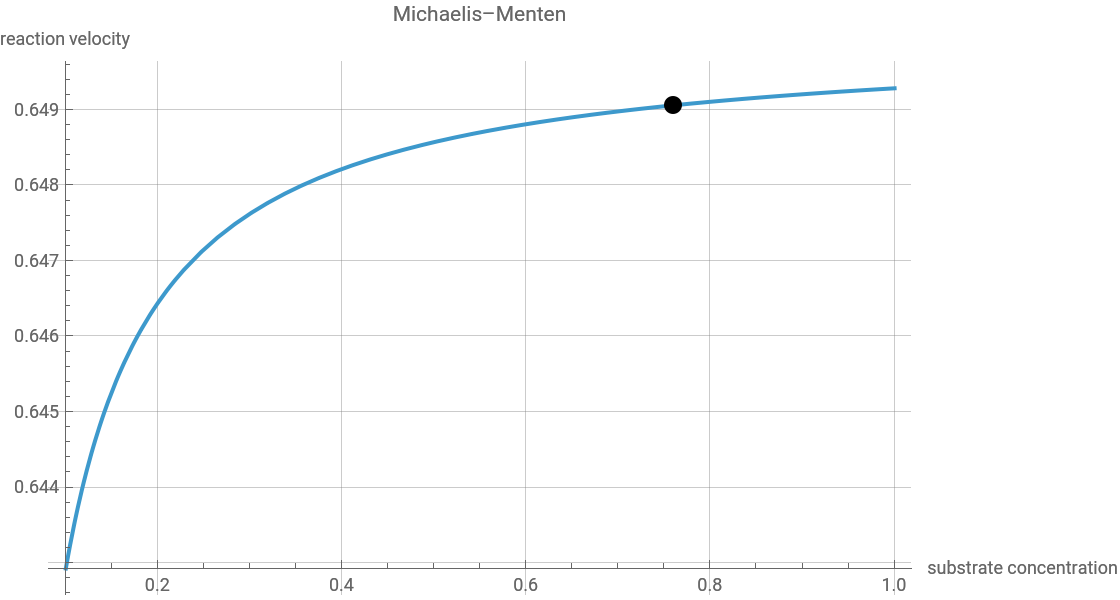
Catalase is an important enzyme found in the human liver. The Michaelis–Menten equation is one of the best-known models for representing enzyme kinetics. Using this chart, you can see how a change in concentration for a particular substrate (in this case, hydrogen peroxide) affects the reaction rate.
Select "image" to see a representative enzymatic reaction of catalase. This Demonstration shows an expanded pH range, beyond that existing in the human body, to show the point at which catalase denatures.
Select "image" to see the oxygen production, a measure of the progress of the redox reaction. Oxygen production is at a maximum for a pH between 8.5 and 10.5.
References
References
[1] P. Jones and A. Suggett, "The Catalase–Hydrogen Peroxide System. Kinetics of Catalatic Action at High Substrate Concentrations," Biochemical Journal, 110(4), 1968 pp. 617–620. doi:10.1042/bj1100617.
External Links
External Links
Permanent Citation
Permanent Citation
Charlotte Geoghegan, Shantellie Hickinson, Joseph Keating, Dalia Hassan, Yifan Lai, Kristina M. Lenn
"Michaelis-Menten Kinetics for Hydrogen Peroxide-Catalase Reaction"
http://demonstrations.wolfram.com/MichaelisMentenKineticsForHydrogenPeroxideCatalaseReaction/
Wolfram Demonstrations Project
Published: November 18, 2021