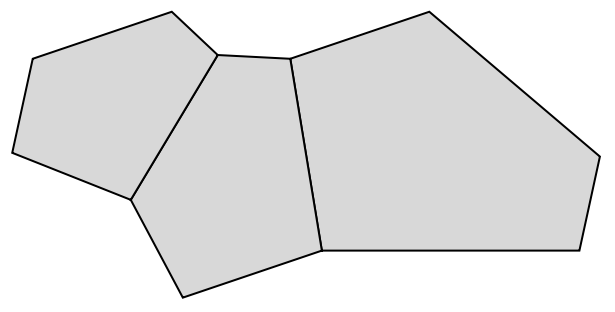
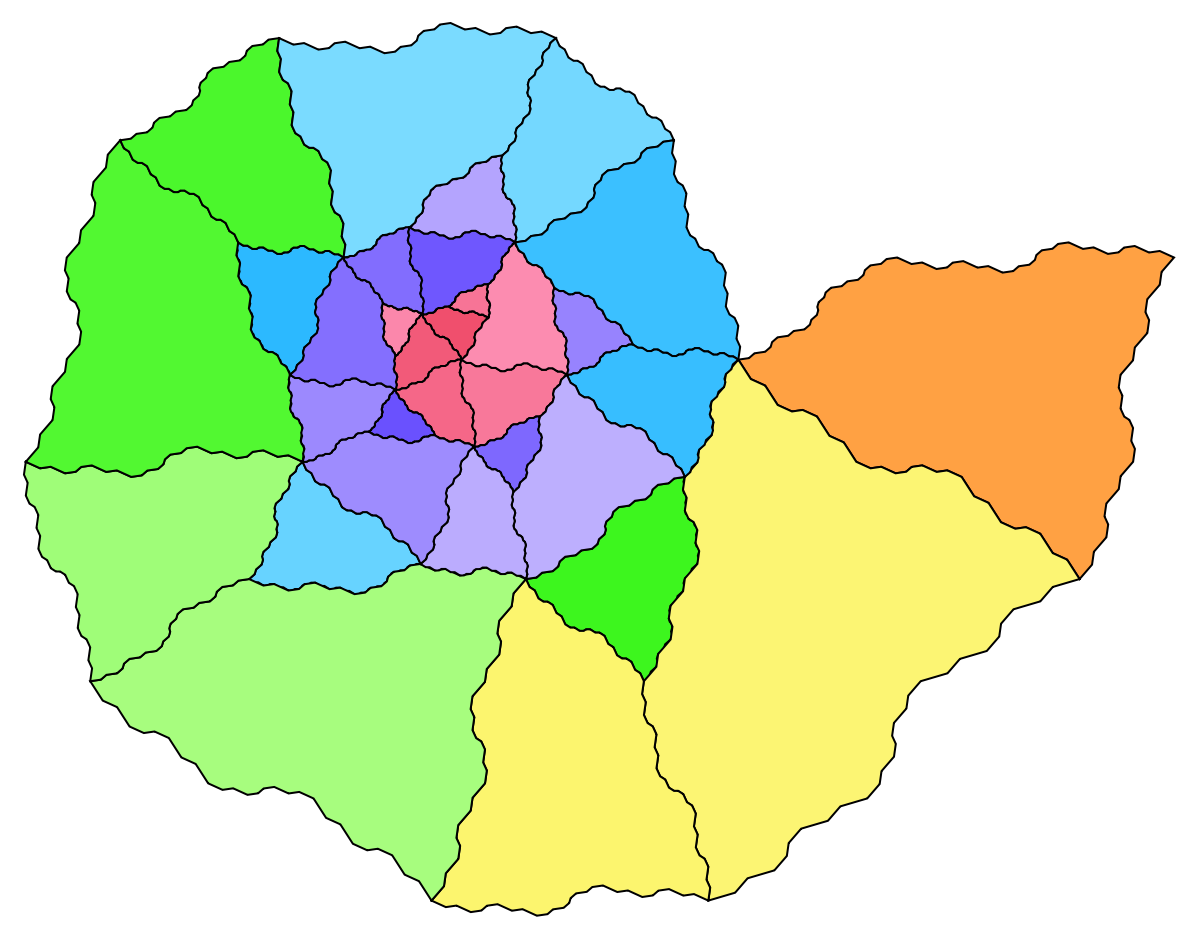
In the above approximation of Australia, all the pentagons have the same shape in three different sizes.
All the points of the base pentagon are simple powers of r (sometimes with a minus sign), which is a complex root of the Plastic constant.
This pentagon is new! Until now, we didn’t know about this pentagon or what it could do.
In[]:=
r=Root[#^3-#-1&,3];v=Join[r^{-1,2},-r^{6,5,0}];Graphics[{EdgeForm[Black],FaceForm[LightGray],Polygon[ReIm[#]]&/@{v,-r^2v+r^2+r-1,r^3v+2r^2+3r}}]
Out[]=
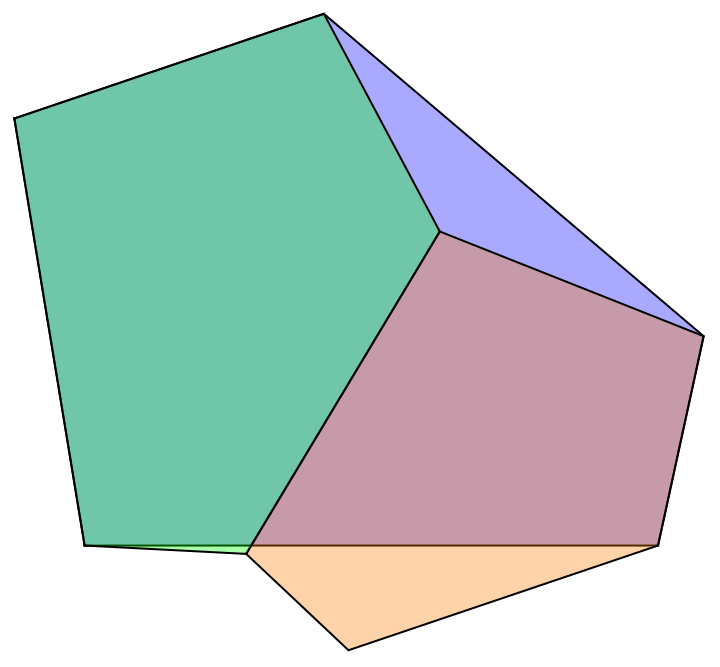
Here’s an overlay to show the substitution system.
In[]:=
Graphics[{EdgeForm[Black],Opacity[1/3],MapThread[{#1,Polygon[ReIm[#2]]}&,{{Blue,Orange,Green},{v,-r^3v-r^2-3r-2,r^2v-r^3}}]}]
Out[]=
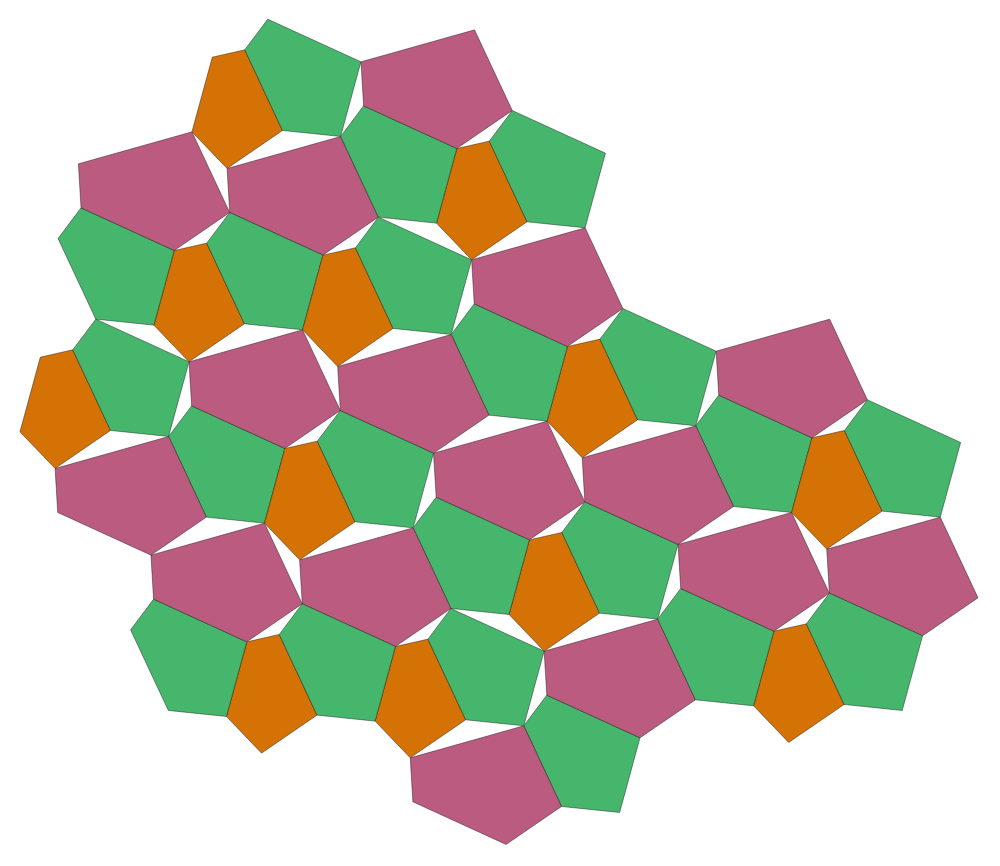
Here’s code for the iterative substitution:
In[]:=
Manipulate[Module[{r=Root[#^3-#-1&,3],v,tiles={{1,0,0}},lo},v=Join[r^{-1,2},-r^{6,5,0}];Do[lo=Min[tiles[[All,3]]];tiles=N[Flatten[(If[Last[#]==lo,{{-r^3#[[1]],#[[2]]-(r^2+3r+2)#[[1]],lo+3},{r^2#[[1]],#[[2]]-r^3#[[1]],lo+2}},{#}]&)/@tiles,1]],{iterations}];Graphics[{EdgeForm[{Black,Thin}],{ColorData[97][Last[#]+1],Polygon[ReIm[#[[1]]v+#[[2]]]]}&/@tiles},ImageSize->500]],{{iterations,7},1,20,1}]
Out[]=


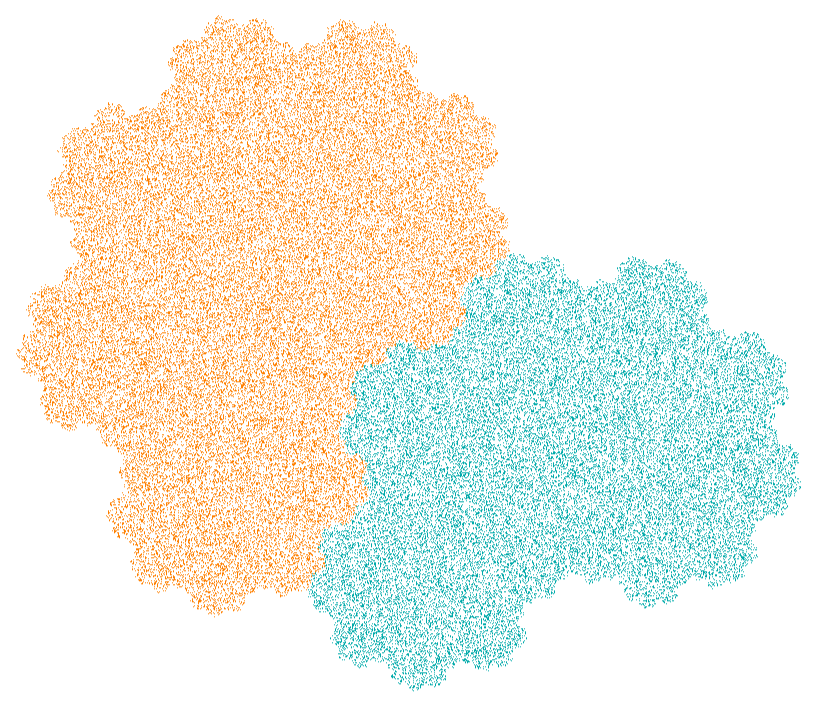
With the Chaos Game, we can get what Hinsley called the Ammonite tile, though I think it looks more like a kidney bean or Australia. Other items related to the Rauzy fractal can be found in Kenyon's paper, or in Rauzy’s original paper.
In[]:=
Module[{r=N[Root[#^3-#-1&,3]],pts},pts=Drop[NestList[If[RandomReal[]<Abs[r]^6,{-r^3First[#]-r^2-3r-2,1},{r^2First[#]-r^3,2}]&,{0.,1},100100],100];Graphics[{PointSize[.001],Table[{{Darker[Cyan],Orange}[[jj]],Point[ReIm[Pick[pts[[All,1]],pts[[All,2]],jj]]]},{jj,2}]},AspectRatio->Automatic,ImageSize->400]]
Out[]=
Myself, I think the supergolden ratio makes a much more convincing ammonite, but I can’t fight the laws of eponymy. But I digress.
In[]:=
r=Root[-1-#1^2+#1^3&,3];iterate=3;cowed[comp_]:=First/@Split[Flatten[RootReduce[#[[1]]+(#[[2]]-#[[1]]){0,-r^5,r^5+1,1}]&/@Partition[comp,2,1,1],1]];base={{r^10,r^7,-r^9,r^11},{-r^12,-r^9,r^11,-r^13},{r^8,r^5,-r^7,r^9},{-r^7,-r^4,r^6,-r^8}}+{-r^10,r^11,-r^6,r^4+r^8};naut=RootReduce[Join[Table[base[[1]](-r)^n,{n,0,-4,-1}],Flatten[Table[Drop[base,1](-r)^n,{n,-8,0}],1]]];poly=ReIm[Nest[cowed[#]&,#,iterate]]&/@N[naut,50];Graphics[{EdgeForm[{Black}],MapIndexed[{ColorData["BrightBands"][N[Norm[Mean[#1]]/2]],Polygon[#1]}&,poly]},ImageSize->600]
Out[]=
Here’s a Rauzy-type construction of the Ammonite tile fractal.
In[]:=
Module[{r=N[Root[#^3-#-1&,3]],pts,cc,dd},cc=r^2+r;dd=-4r^2-6r-3;pts=Nest[Join[r^2#,1-r^3#]&,{0.},16];Graphics[{PointSize[.001],{Darker[Cyan],Point[ReIm[cc+dd(1-r^3pts)]]},{Orange,Point[ReIm[cc+ddr^2pts]]}},AspectRatio->Automatic,ImageSize->500]]
Out[]=
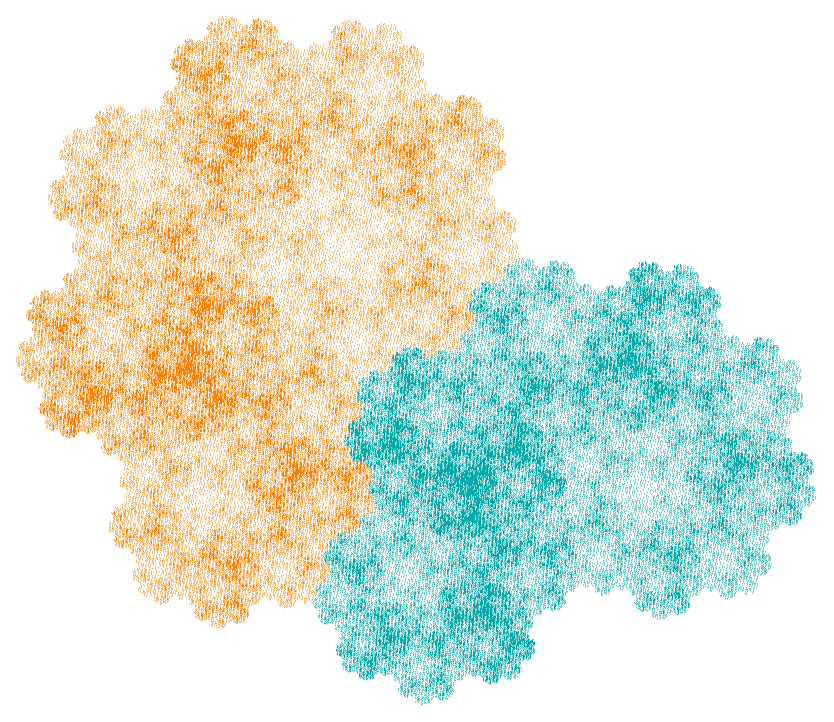
The Rauzy construction is partially based on the following matrix generating the plastic constant.
Choose the upper complex eigenvalue r = −0.662359 + 0.562280 i.
Multiplication by r contracts and rotates the plane.
For the ammonite construction, we use q = −r, so that q² = r² and q³ = −r³.
The matrix describes three interacting sets, A, B, and C.
Its first row connects A to B and C; its second connects B to A; and its third connects C to B.
Adding the contraction q and a translation gives:
A = q B ∪ (1 + q C)
B = q A
C = q B
Substituting the last two equations into the first gives:
A = q² A ∪ (1 + q³ A)
Thus A consists of two smaller copies of itself: one multiplied by r², and the other multiplied by −r³ and translated by 1.
This is the normalized two-piece ammonite construction.
What's new in all this? Before now, no-one knew that a simple pentagon could produce the tiling. There are also triangle gaps.
We can find the lengths of the sides:
Or, all in a labeled diagram.
This pentagon is not one of the fifteen pentagon tilings. The first display of all fifteen was this picture.
It does have interesting angle relations:
A = E
C + 2D = 360°
3(A + B) = 5D
Video Overview
Code for the lead image
CITE THIS NOTEBOOK
CITE THIS NOTEBOOK
The Plastic Pentagon - A new tile system
by Ed Pegg
Wolfram Community, STAFF PICKS, October 30, 2026
https://community.wolfram.com/t/28451