CITE THIS NOTEBOOK: Dividing a square into similar but unequal pieces by Ed Pegg. Wolfram Community DEC 28 2022.
Divide a square into 4 similar but unequal pieces. At an Alex Bellos column, he posted what he called a “rubbish sketch”.
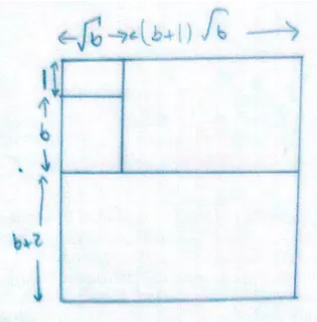
So, what’s b in this? Turns out its the real root of =8x+9.
3
x
In[]:=
RootReduce[Solve[2b+3==Sqrt[b](b+2)][[1]]]
Out[]=
b

We can make a map of this and pick out the points we need:
In[]:=
b=x/.Solve[x^3==8x+9][[1]];yy={0,1,1+b,2b+3};xx=0,
b
,2b+3;all=RootReduce[Tuples[{xx,yy}]];Graphics[{Table[Text[n,all[[n]]],{n,1,12}]},ImageSize->Small]Out[]=
With points {{1,6},{2,7},{5,11},{3,12}} we can render the dissection perfectly:
In[]:=
b=x/.Solve[x^3==8x+9][[1]];pp={0,0},
b
,1,{0,1},b
,1+b,b
,0,{2b+3,1+b},{0,1+b},{2b+3,2b+3};Graphics[{EdgeForm[{Black,Thick}],Cyan,Rectangle[pp[[#[[1]]]],pp[[#[[2]]]]]&/@Partition[Range[8],2]}]Out[]=
As shown in Shattering the Plane, once you’ve got a constrained geometric image in a particular algebraic space, everything is in that algebraic space. This construction is entirely in the space of =8x+9.
3
x
In[]:=
ResourceFunction["SqrtSpace"],pp
Out[]=
{{{0,0,0},{0,0,0}},{{0,1,0},{1,0,0}},{{0,0,0},{1,0,0}},{{0,1,0},{1,2,1}},{{0,1,0},{0,0,0}},{{9,12,4},{1,2,1}},{{0,0,0},{1,2,1}},{{9,12,4},{9,12,4}}}
We can thus draw the dissection with algebraic coordinates:
In[]:=
root=x/.Solve[x^3==8x+9][[1]];rootcoord={{{0,0,0},{0,0,0}},{{0,1,0},{1,0,0}},{{0,0,0},{1,0,0}},{{0,1,0},{1,2,1}},{{0,1,0},{0,0,0}},{{9,12,4},{1,2,1}},{{0,0,0},{1,2,1}},{{9,12,4},{9,12,4}}};pp=ResourceFunction["SqrtSpace"][root,rootcoord];Graphics[{EdgeForm[{Black,Thick}],Cyan,Rectangle[pp[[#[[1]]]],pp[[#[[2]]]]]&/@Partition[Range[8],2]}]
Out[]=
George Sicherman also pointed out this dissection:
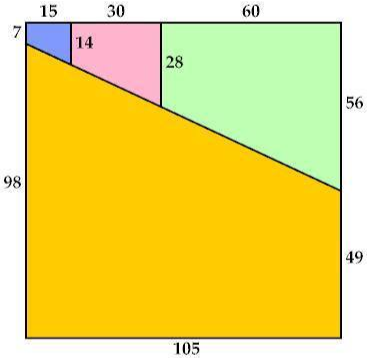
Are there other solutions for dividing a square into similar but unequal pieces? For 3 pieces, we can use the plastic constant ρ:
In[]:=
ρ=x/.Solve[x^3==x+1][[1]];rr={{0,0},{,1},{,0},{1,},{,},{1,1}};Graphics[{EdgeForm[{Black,Thick}],Green,Rectangle[rr[[#[[1]]]],rr[[#[[2]]]]]&/@Partition[Range[6],2]}]
-2
ρ
-2
ρ
-5
ρ
-2
ρ
-5
ρ
Out[]=
How many ways can a square be divided into 3 similar but unequal pieces?
How many ways can a square be divided into 4 similar but unequal pieces?
How many ways can a square be divided into 5 similar but unequal pieces?
I’m not sure this is a well explored question, so I though I’d ask it.
How many ways can a square be divided into 4 similar but unequal pieces?
How many ways can a square be divided into 5 similar but unequal pieces?
I’m not sure this is a well explored question, so I though I’d ask it.