ORIGINAL ARTICLE: J. G. Moxness (2023), The Isomorphism of and , arXiv:2311.01486.
DOI: https://doi.org/10.48550/arXiv.2311.01486
H
4
E
8
DOI: https://doi.org/10.48550/arXiv.2311.01486
Article Abstract: This paper gives an explicit isomorphic mapping from the 240 real roots of the Gosset 8-polytope to two golden ratio scaled copies of the 120 root 600-cell quaternion 4-polytope using a traceless 8×8 rotation matrix with palindromic characteristic polynomial coefficients and a unitary form . It also shows the inverse map from a single 600-cell to using a 4D↔8D chiral left↔right mapping function, φ -scaling, and . This approach shows that there are actually four copies of each 600-cell living within in the form of chiral φ φ roots. In addition, it demonstrates a quaternion Weyl orbit construction of -based 4-polytopes that provides an explicit mapping between and four copies of the tri-rectified Coxeter-Dynkin diagram of , namely the 120-cell of order 600. Taking advantage of this property promises to open the door to as yet unexplored -based Grand Unified Theories or GUTs.
8
E
8
4
21
H
4
ℯ
H
4
E
8
-1
E
8
H
4L
H
4L
H
4R
H
4R
H
4
E
8
H
4
E
8
Initializations (snippets)
Initializations (snippets)
Demonstration CodeBase (snippets)
Demonstration CodeBase (snippets)
Section I: Introduction
Section I: Introduction
As an early fan of the Computable Document Format (CDF) that Wolfram pioneered, I have always been motivated to use Mathematica to document my research and validate the content of my papers. This notebook replicates the arXiv paper https://arxiv.org/abs/2311.01486 content and replaces static images with code snippets and interactive output directly from my research material. The codebase I have developed over 25 years is too much for this post, but I maintain publicly shared Wolfram cloud demonstrations of user interactive content related to my areas of research interest. Several of those related to this paper are available here and here.
This paper grew out of a line of research I had begun around 1996 related to finding and visualizing the physics of grand unified theories (GUTs). My thought was if I could code it and visualize it, then I would better understand it. I also wanted to add some interactive color and shape to the black and white blackboard content of most all math/physics papers. Mathematica was my tool of choice for that.
Around 2007, I was intrigued by the symmetries of E8 and its relationship to H4. After spending some time adding content to the group theory and geometry pages of Wikipedia, in 2010 I was asked if I could visualize the Rhombic Triacontahedron with its suggested E8 connection to H3 and H4. I did that by using the icosahedron vertices as a basis. In 2012 I revisited this with a short effort to find the 4th basis vector to produce H4 (the 600-cell) directly projected from E8. With that discovery in hand, I documented the symmetric 8x8 form of what I called the E8 to H4 folding matrix. This was referenced in an AMS paper by John Baez in 2014. The current traceless form of that is referenced in this paper as (U).
This paper adds to that my early work the last 3 years trying to understand and integrate E8 folding into the Lie group theoretic analysis tools, the related quaternion-based Weyl orbit geometries of A4, BC4, D4/F4, and E8 polytopes, as well as regular, split and complexified octonion forms of geometry - all suggested to be possible paths to GUTs in physics.
I hope you enjoy the current and anticipated future results of these efforts.
Introduction
Introduction
Fig. 1 is the Petrie projection of the Gosset 8-polytope derived from the Split Real Even (SRE) form of the Lie group with unimodular lattice in It has 240 vertices and 6,720 edges of 8-dimensional (8D) length . is the largest of the exceptional simple Lie algebras, groups, lattices, and polytopes related to octonions ( ), (8,4) Hamming codes, and 3-qubit (8 basis state) Hadamard matrix gates. An important and related higher dimensional structure is the () Leech lattice (⊃ ) with its binary (ternary) Golay code construction.
4
21
E
8
8
2
E
8
24
24
Λ
24
E
8
E
8
E
8
In[]:=
showEdges=True;doImage
Out[]=
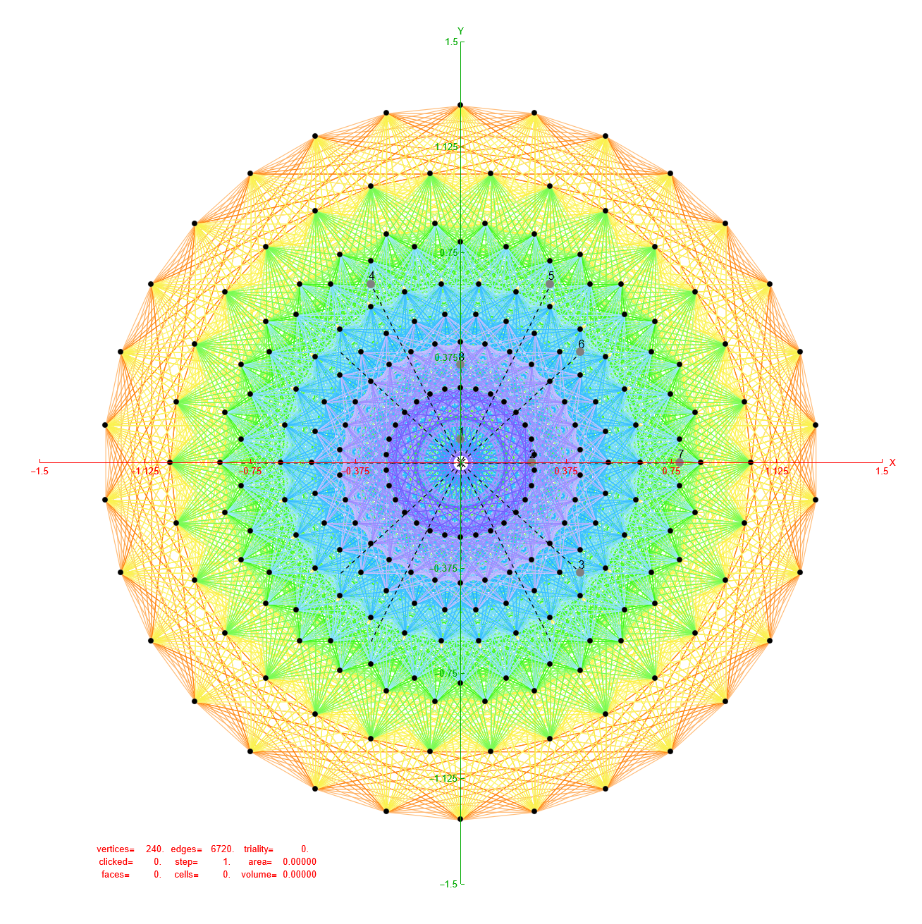
Fig.1Petrieprojection
E
8
4
21
It is widely known [1]-[14] that the can be projected, mapped, or "folded" (as shown in Fig. 2) to two golden ratio φ=≈1.618 scaled copies of the 4 dimensional 120 vertex 720 edge 600-cell. Folding an 8D object into a 4D one can be done by projecting each vertex using its dot product with a 4×8 matrix\cite{Moxness2014-006}. This produces φ , where is the binary icosahedral group 2I of order 120, a subgroup of Spin(3). It covers as the full icosahedral group of order 120, a subgroup of SO(3). The binary icosahedral group is the double cover of the alternating group .
E
8
1
2
(1+
5
)H
4
H
4
H
4
H
4
H
3
I
h
A
5
Defining φ:
(*ThesymbolφisthemainreferenceforresolvingtheGoldenRatios.ItisonlyevaluatedtoasymbolicornumericvalueusingφRepreplacementrules*)Clear[ϕ,σ,Φ,τ,φ];(*Upper(andlower)casePhiΦ=1+
5
2andphiϕ=1-5
2representlarge(andsmall)GoldenRatio(respectively)*)ϕ=1/φ;(*σ&τareGaloisconjugates*)σ=-1/φ/.slRep;τ=Φ=φ;(*Det1fisascalefactortomakeDet@=1*)Det1f=2ϕ
/.slRep;(*φReparereplacementrulesusedwhenneedingtoevaluateφandω*)?φRep
(*Note:slRepisarereplacementruleswhenusingtheSuperLie'package,whichredifinesoperatorssuchasPlus,Times,...*)
In[]:=
?slRep
Despite others'[2][9] recent attempts, the inverse morphism or "unfolding” from to is less trivial given that the matrix is not square and lacks an inverse. Yet, a real () symmetric volume preserving Det()=1 rotation matrix(\ref{eqn:H4foldUnitary}) was derived in 2012 and documented [11][12][13]. The quadrant structure of rotates into four 4D copies of 600-cells, with the original two (L)eft and (R)ight side unit scaled 4D copies related to the two L/R φ scaled copies which we now identify as (LR1φ). This traceless form of has palindromic characteristic coefficients and provides for an explicit isomorphic mapping of ↔(LR1φ). This involves using a bidirectional L↔R mapping function (mapLR) and (2). The process is described and visualized in Section II. It is interesting to note the exchange of 1↔φ in ↔ , excluding .
H
4
E
8
E
8
H
4
H
4
E
8
H
4
-1
-1
-
2
φ
Constructing the E8 to H4 Folding Matrix from Quantum Computing (QC) CNOT (eqn. (3) and SWAP (eqn. (4) gates
Define CNOT and SWAP as Hermitian Matrices
In[]:=
CNOT:=
;CNOTCNOT.==IM@4
1 | 0 | 0 | 0 |
0 | 1 | 0 | 0 |
0 | 0 | 0 | 1 |
0 | 0 | 1 | 0 |
CNOT
CNOT
In[]:=
SWAP:=
;SWAPSWAP.==IM@4
1 | 0 | 0 | 0 |
0 | 0 | 1 | 0 |
0 | 1 | 0 | 0 |
0 | 0 | 0 | 1 |
SWAP
SWAP
This is the non - Det = 1 palindromic form of (curr = 11)
In[]:=
Transpose@Join[SWAP-ϕCNOT,Reverse[SWAP+ϕCNOT]]/.slRep;Base=Join[%,Reverse[Reverse/@%]];%//MatrixForm
Out[]//MatrixForm=
1- 1 φ | 0 | 0 | 0 | 0 | 0 | 0 | 1+ 1 φ |
0 | - 1 φ | 1 | 0 | 0 | 1 | 1 φ | 0 |
0 | 1 | 0 | - 1 φ | 1 φ | 0 | 1 | 0 |
0 | 0 | - 1 φ | 1 | 1 | 1 φ | 0 | 0 |
0 | 0 | 1 φ | 1 | 1 | - 1 φ | 0 | 0 |
0 | 1 | 0 | 1 φ | - 1 φ | 0 | 1 | 0 |
0 | 1 φ | 1 | 0 | 0 | 1 | - 1 φ | 0 |
1+ 1 φ | 0 | 0 | 0 | 0 | 0 | 0 | 1- 1 φ |
In[]:=
N[%/.φRep]//MatrixForm
Out[]//MatrixForm=
0.381966 | 0. | 0. | 0. | 0. | 0. | 0. | 1.61803 |
0. | -0.618034 | 1. | 0. | 0. | 1. | 0.618034 | 0. |
0. | 1. | 0. | -0.618034 | 0.618034 | 0. | 1. | 0. |
0. | 0. | -0.618034 | 1. | 1. | 0.618034 | 0. | 0. |
0. | 0. | 0.618034 | 1. | 1. | -0.618034 | 0. | 0. |
0. | 1. | 0. | 0.618034 | -0.618034 | 0. | 1. | 0. |
0. | 0.618034 | 1. | 0. | 0. | 1. | -0.618034 | 0. |
1.61803 | 0. | 0. | 0. | 0. | 0. | 0. | 0.381966 |
In[]:=
Det@%
Out[]=
37.3499
This is scaled to Det = 1 (curr = 9)
In[]:=
E82H4=Base/Det1f/.slRep;%//MatrixForm
Out[]//MatrixForm=
1- 1 φ 2 1 φ | 0 | 0 | 0 | 0 | 0 | 0 | 1+ 1 φ 2 1 φ |
0 | - 1 φ 2 | 1 2 1 φ | 0 | 0 | 1 2 1 φ | 1 φ 2 | 0 |
0 | 1 2 1 φ | 0 | - 1 φ 2 | 1 φ 2 | 0 | 1 2 1 φ | 0 |
0 | 0 | - 1 φ 2 | 1 2 1 φ | 1 2 1 φ | 1 φ 2 | 0 | 0 |
0 | 0 | 1 φ 2 | 1 2 1 φ | 1 2 1 φ | - 1 φ 2 | 0 | 0 |
0 | 1 2 1 φ | 0 | 1 φ 2 | - 1 φ 2 | 0 | 1 2 1 φ | 0 |
0 | 1 φ 2 | 1 2 1 φ | 0 | 0 | 1 2 1 φ | - 1 φ 2 | 0 |
1+ 1 φ 2 1 φ | 0 | 0 | 0 | 0 | 0 | 0 | 1- 1 φ 2 1 φ |
Redefining from the Localized Manipulate (above)
Here are a few different forms for using the E8 ↔ H4 (un) folding matrix , which is now selectable and set from curr
Here are a few different forms for using the E8 ↔ H4 (un) folding matrix , which is now selectable and set from curr
Equations (1) and (2):
Note : octSym performs a symbolic simplification related to φ ratios
Generating Polytopes
Generating Polytopes
Also shown are the Cartan and simple root matrices which correspond to the common Coxeter-Dynkin representation of the diagrams
8D Platonic Rotation
8D Platonic Rotation
from recursively applied Fibonacci numbers &
Quantum Computing Logic Gates
Quantum Computing Logic Gates
2D and 3D Projection
2D and 3D Projection
Equation (5):
Equation (6):
3D Platonic Solid Projection
3D Platonic Solid Projection
Section II: The palindromic unitary matrix
Section II: The palindromic unitary matrix
Fig. 7 The trace, determinant, Eigenvalues, Eigenvector matrix, and characteristic polynomial coefficients of
Show it is traceless
Get the Characteristic coefficients
The palindrome of coefficients in the characteristic matrix of
Show the Trace of = 0
The palindrome of coefficients in the characteristic matrix of
Section III: Quaternionic Weyl orbit construction
Section III: Quaternionic Weyl orbit construction
Fig. 9 The selected octonion Fano plane mnemonic and multiplication table based on its 7 structure constant triads .
The first triad (123) defines standard convention for quaternions..
The first triad (123) defines standard convention for quaternions..
This sets the type of octonion split for negative split numbers (where Abs@split selects a triad):
False implies the first of 4 non - triad imaginary dimensions becomes real (or + 1), giving a 1 + 3 + 1 + 3 octonion
True implies the first 3 become real, giving a 1 + 3 + 3 + 1 octonion
False implies the first of 4 non - triad imaginary dimensions becomes real (or + 1), giving a 1 + 3 + 1 + 3 octonion
True implies the first 3 become real, giving a 1 + 3 + 3 + 1 octonion
Fig. 10 An alternative set of structure constant triads, octonion Fano plane mnemonic, and multiplication table, with decorations showing the palindromic multiplication.
This sets the type of octonion split for negative split numbers (where Abs@split selects a triad):
False implies the first of 4 non - triad imaginary dimensions becomes real (or + 1), giving a 1 + 3 + 1 + 3 octonion
True implies the first 3 become real, giving a 1 + 3 + 3 + 1 octonion
False implies the first of 4 non - triad imaginary dimensions becomes real (or + 1), giving a 1 + 3 + 1 + 3 octonion
True implies the first 3 become real, giving a 1 + 3 + 3 + 1 octonion
From the original study I did
Define c, α, & β (L only )
This gives S = I - T (See SLΦ defined below), with 4 D odd position permutations with odd ± Sign permutations where τ = φ and σ = -1/φ .
Convert to an 8 D octonion list, with only the quaternion part being non - zero
Convert symbols to rounded integer rationals
Visualize 5 - cell in 3 D using the 4 orthogonal projections wxy, wxz, wyz, xyz
Set some short variable names for Mamone paper analysis LieART steps on T
Generate the A’ parent Weyl orbit
Put it into symbolic octonion form
Display vertex valuse
The Alternate generation of A4
Simplify quaternion multiplication using p∘r∘q which also handles lists,
We scale up/down by 4 for symbolic clarity .
Please note the double struck A to avoid stepping on LieArt
We scale up/down by 4 for symbolic clarity .
Please note the double struck A to avoid stepping on LieArt
Equation (7):
Equation (8):
Fig. 13 Visualization of the 144 root vertices of S’+T+T’ now identified as the dual snub 24-cell
The 3D hulls for one copy of I (or φI) are represented in Fig. 14 hulls {2,3,5} (or {6,7,8}) respectively plus 1/2 of the vertices in hull 4. The vertex values of I are listed in either of the center columns of Appendix D Fig. 22 or Fig. 23.
Koca[3] has also identified the dual to the snub 24-cell as being made up of the 144 root vertices of S'+T+T'. This 4-polytope is visualized in Fig. 13.
Equation (9):
Equation (10):
See Appendix A Figs. 16-17 for the 120-cell (J) and its alternate (J') as generated by J=prq[A',1,I] and J'=prq[A',1,I'] respectively.
Section IV: Conclusion
Section IV: Conclusion
Bibliography
Bibliography
[1] M . Koca, E8 Lattice with Octonions and Icosians, CERN, 1211 Geneva 23, Switzerland (1989).
[2] M . Koca and N . Koca, Quaternionic Roots of E8 Related Coxeter Graphs and Quasicrystals, Turkish Journal of Physics 22, 421 (1998) .
[3] M . Koca, M . Al - Ajmi, and N . O . Koca, Quaternionic representation of snub 24 - cell and its dual polytope derived from e8 root system, Linear Algebra and its Applications 434, 977 (2011).
[4] M . Koca, N . O . Koca, and M . Al - Shueili, Chiral Polyhedra Derived From Coxeter Diagrams and Quaternions, ArXiv e - prints math . ph (2011), arXiv : 1006.3149[mathph].
[5] M . Koca, N . O . Koca, and M . Al - Ajmi, 4 d - polytopes and their dual polytopes of the coxeter group a4 represented by quaternions, International Journal of Geometric Methods in Modern Physics 09, 1250035 (2012).
[6] S . Mamone, G . Pileio, and M . H . Levitt, Orientational sampling schemes based on four dimensional polytopes, Symmetry 2, 1423 (2010).
[7] J . H . Conway, R . H . Hardin, and N . J . A . Sloane, Packing Lines, Planes, etc . : Packings in Grassmannian Space, ArXiv e-prints math.CO (2002), arXiv : math/0208004 [math . CO].
[8] D . A . Richter, Triacontagonal coordinates for the E8 root system, ArXiv e - prints math . GM (2007), arXiv : 0704.3091[math . GM].
[9] P . P . Dechant, The birth of E8 out of the spinors of the icosahedron, Proceedings of the Royal Society of London Series A 472, 20150504 (2016), arXiv : 1602.05985[mathph] .
[10] J . C . Baez, From the Icosahedron to E8, ArXiv e - prints math . HO (2017), arXiv : 1712.06436[math . HO].
[11] J . G . Moxness, The 3 D Visualization of E8 using an H4 Folding Matrix, www.vixra.org/abs/1411.0130 (2014).
[12] J . G . Moxness, Mapping the fourfold H4 600 - cells emerging from E8, www.vixra.org/abs/1808.0107 (2018).
[13] J . G . Moxness, Unimodular rotation of E8 to H4 600 - cells, www.vixra.org/abs/1910.0345 (2019).
[14] J . G . Moxness, 3 D Polytope Hulls of E8 4 - 21, 2 - 41, and 1 - 42, www.vixra.org/abs/2005.0200 (2020).
[15] G . Dixon, Integral octonions, octonion xy - product, and the leech lattice, ArXiv e-prints math.th (2010), arXiv : 1011.2541[hep - th].
[16] Pushpa, P . S . Bisht, T . Li, and O . P . S . Negi, Quaternion octonion reformulation of grand unified theories, International Journal of Theoretical Physics 51, 3228 (2012).
[17] R . A . Wilson, T . Dray, and C . A . Manogue, An octonionic construction of e8 and the lie algebra magic square, Innovations in Incidence Geometry : Algebraic, Topological and Combinatorial 20, 611 (2023).
[18] M . Güunaydin and F . GüNursey, Quark structure and octonions, Journal of Mathematical Physics 14, 1651 (2003), https://pubs.aip.org/aip/jmp/articlepdf/14/11/1651/8805448/16511online.pdf.
[19] C . Furey, Su (3) c*su (2) l*u (1) y (*u (1) x) as a symmetry of division algebraic ladder operators, The European Physical Journal C 78, 10.1140/epjc/s10052 - 018 - 5844 - 7 (2018).
[20] J . G . Moxness, The Comprehensive Split Octonions and their Fano Planes, https://vixra.org/abs/1503.0228 (2013).
[21] R . M . Fonseca, GroupMath : A mathematica package for group theory calculations, Computer Physics Communications 267, 108085 (2021).
[22] P . Grozman and D . Leites, Lie superalgebra structures, Czechoslovak Journal of Physics 54, 1313 (2004).
Appendices are attached below
Appendices are attached below
CITE THIS NOTEBOOK
CITE THIS NOTEBOOK