I’m excited to announce that the prerelease version of Introduction to Special Functions: A Computational Approach was published by Wolfram Media on February 23, 2026, ISBN-13: 978-1-57955-118-6. You can get your copy of the book for free here: https://www.wolfram-media.com/products/introduction-to-special-functions/.
This ebook is the companion to the free course on special functions on Wolfram U, and is an introduction to the subject for university students and graduates.
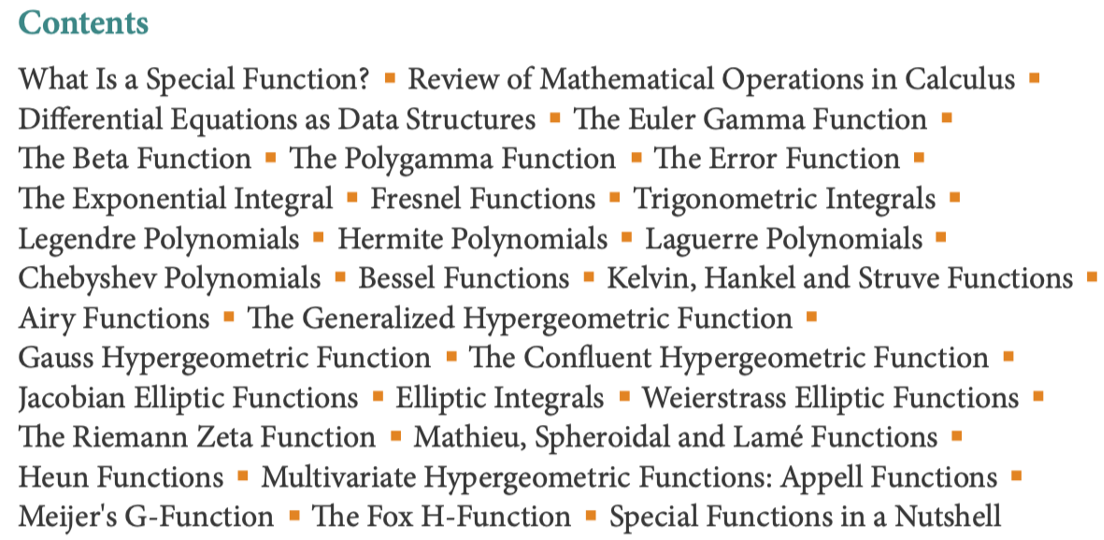
Special functions are a class of mathematical functions that arise when solving differential equations, summing series and calculating integrals. They originated in the eighteenth century, when mathematicians studying problems in physics, engineering and mathematics sought to describe increasingly complex scientific phenomena. Special functions are more general than the well-known elementary ones that every high-school student is familiar with.
Although the topic is not new, researchers and engineers continue working with special functions to solve various real-world practical problems. This book, along with the course, showcases a gentle, computational approach through the Wolfram Language, which offers a uniquely powerful environment for studying both the theory and applications of special functions, combining symbolic and numerical computation with rich visualization tools. Special functions have been part of the Wolfram system since Version 1.0 in 1988, and today nearly all functions found in the mathematical literature are implemented. This book highlights 100 of the most fundamental special functions from the collection of 300 mathematical functions available in Wolfram Language, providing a foundation for exploring these functions in greater depth and uncovering new insights and applications.
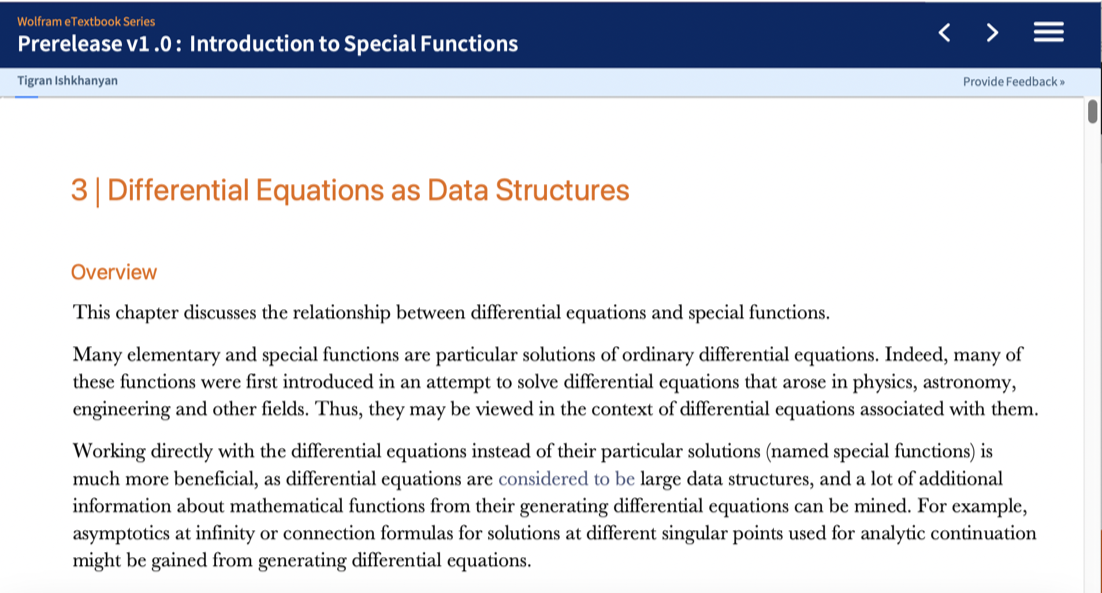
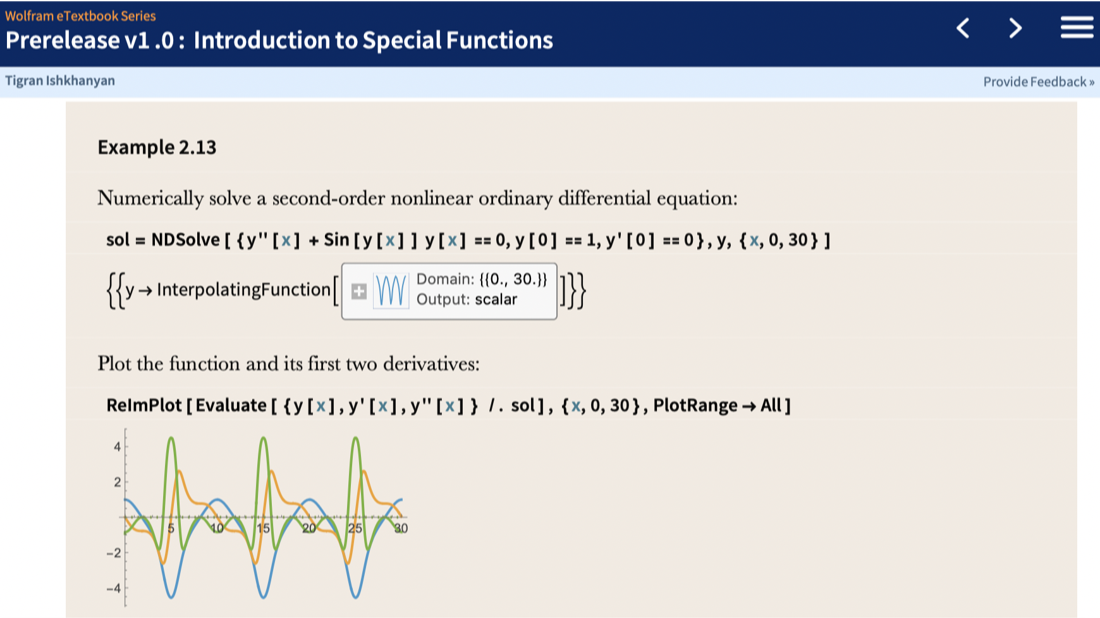
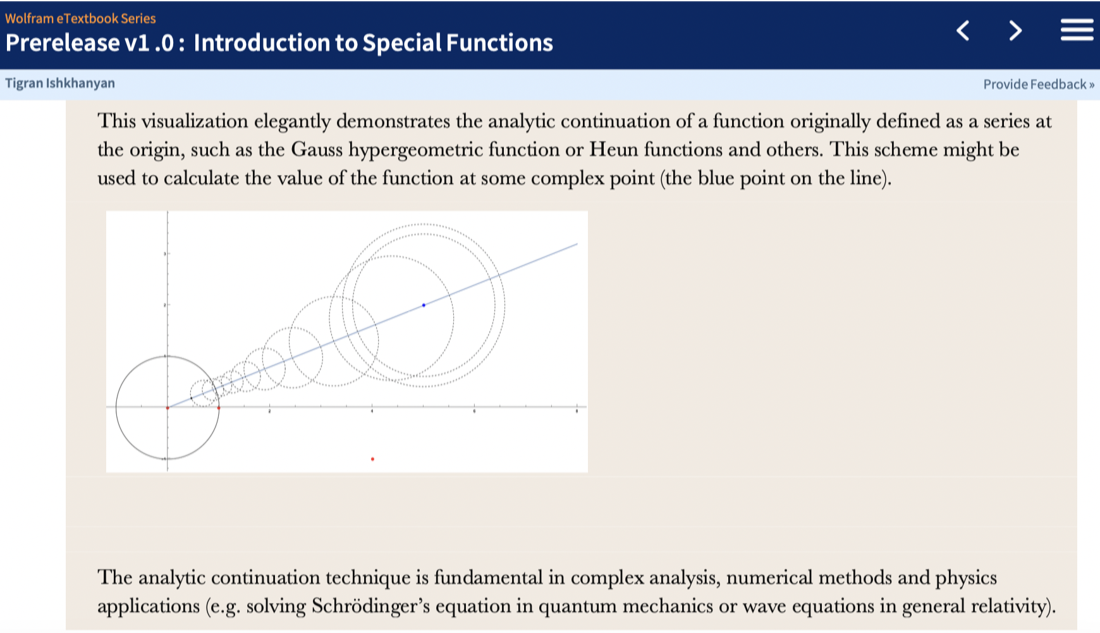
To the best of our knowledge, this is the first book ever to offer such comprehensive coverage of concepts and groups of special functions alongside their applications using various frameworks of the computer algebra systems. Readers can fully view all code used in the book:
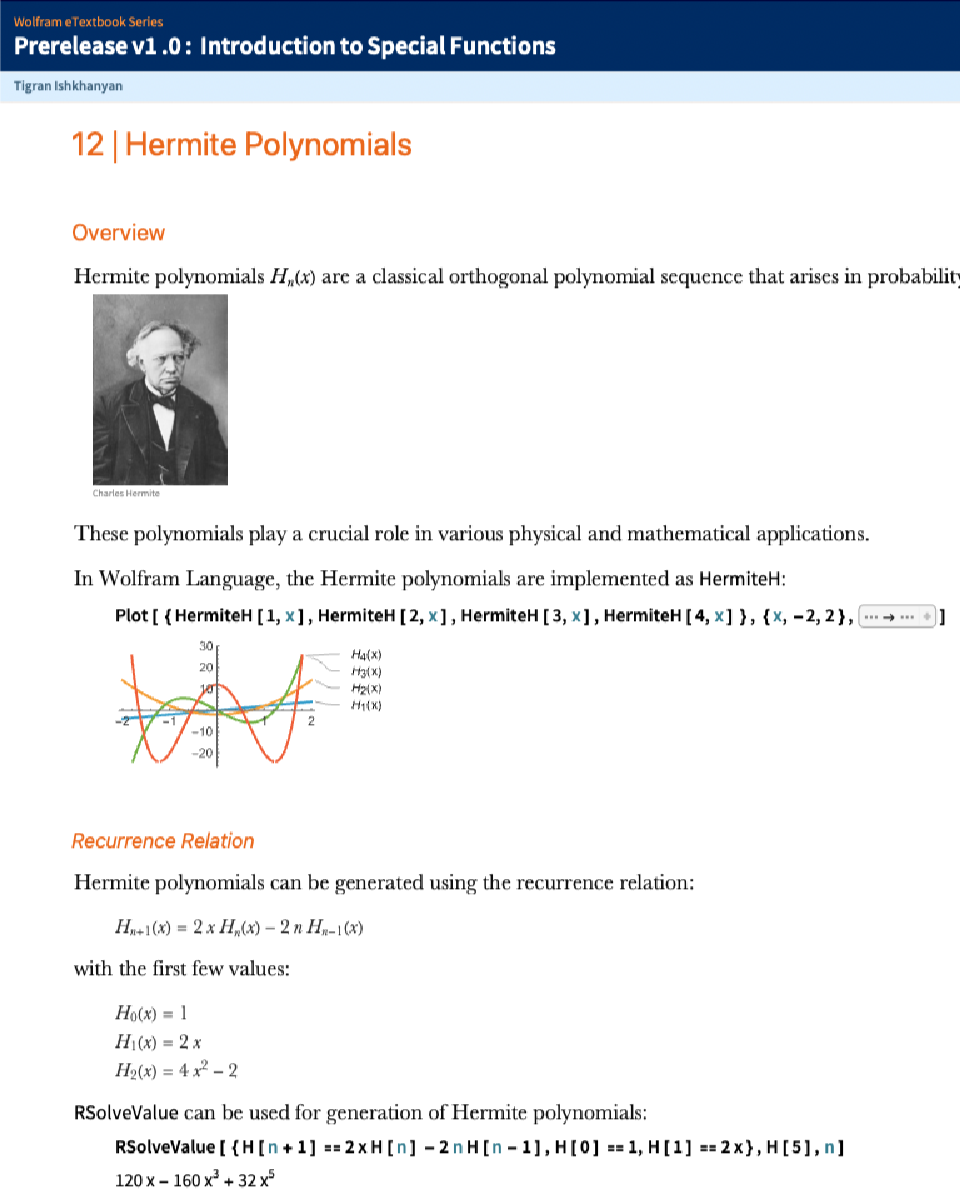
The topics covered are the same as in the Wolfram U course, sometimes expanded in greater detail and depth.
The ebook contains many solved exercises, graphics and interactive demonstrations in Wolfram Language.
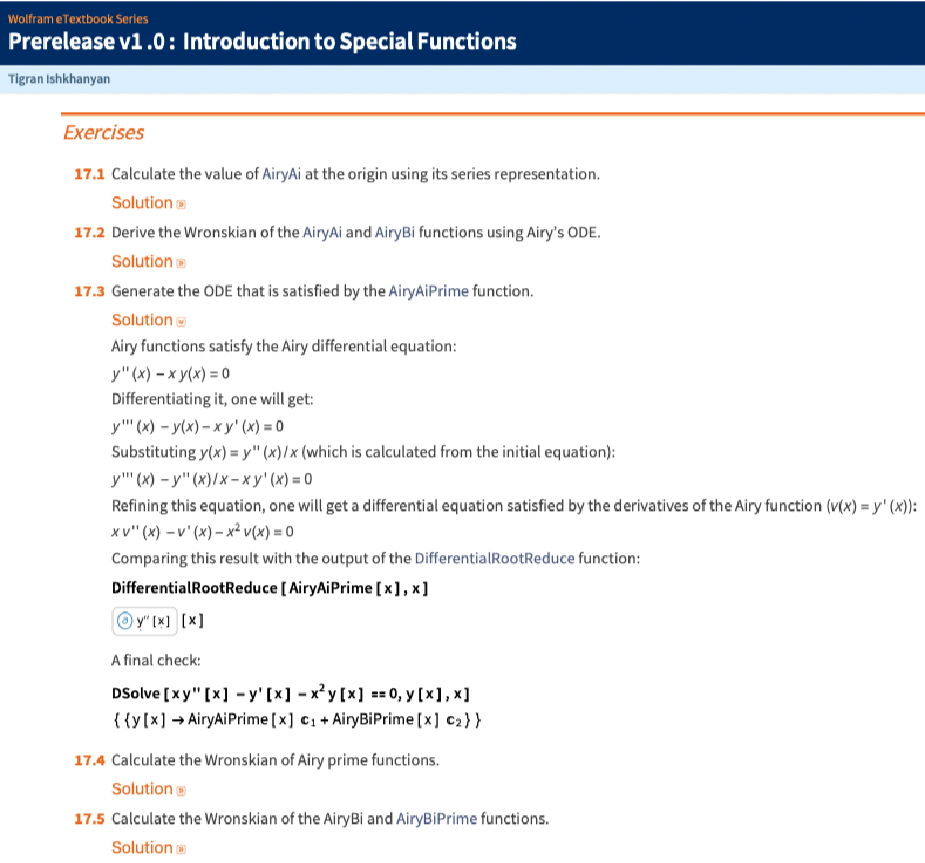
Your free copy of the ebook can be found here: https://www.wolfram-media.com/products/introduction-to-special-functions/.
This is the prerelease Wolfram Notebook version of the Introduction to Special Functions: A Computational Approach book and any feedback is appreciated. You might contact us here in this community thread or by email tigrani@wolfram.com and publishing@wolfram.com.
Book Introduction
Book Introduction
Mathematics shaped our understanding of the world through various models of real-world phenomena. Calculus, trigonometry, linear algebra, mathematical physics and other areas linked theoretical developments with practical applications. Special functions, which appeared naturally in the solutions of differential equations, integrals and series, played a key role in science and engineering.
Special functions offer solutions to problems encountered in quantum mechanics, electromagnetism, fluid dynamics and number theory, among many other disciplines. Their study connects the work of mathematical pioneers such as Euler, Gauss and Riemann to contemporary research and applications.
This book is a gentle introduction to the theory of special functions. This book is special because the underlying fundamental principles and mathematical techniques are intertwined with a computational approach based on the powerful Wolfram Language.
It begins with the basics of calculus, complex analysis and differential equations, building a solid groundwork for studying special functions. Chapters of this book cover various topics, from gamma, zeta and Bessel-related functions to elliptic and hypergeometric functions, special integrals and orthogonal polynomials. It also includes advanced topics such as the Mathieu, spheroidal and Heun functions; multivariate hypergeometric Appell functions; and the Meijer G- and Fox H-“superfunctions.”
This book aims to make the study of special functions accessible and engaging for mathematicians, physicists, engineers and students. Each section combines rigorous theory with practical applications, visualizations and computational techniques using the advanced mathematical capabilities of Wolfram Language. Exercises, available at the end of each section, are included to deepen understanding of the theory and encourage independent investigation.
We hope this book will be an excellent guide to the rich world of special functions and shed light on the analytical and numerical approaches of Wolfram Language applied to special functions—a domain of significant importance and a longstanding focus for Wolfram, alongside other foundational areas of mathematics.
The Wolfram Mathematical Computation Team
December 2024
Below is a sample chapter from the book
Overview
Overview
Trigonometric integrals occur frequently in the analysis of oscillatory phenomena, signal processing and mathematical physics. Defined as integrals of basic trigonometric functions, they extend elementary functions and play a key role in evaluating integrals involving sine and cosine terms.
Some Properties of Trigonometric Integrals
Some Properties of Trigonometric Integrals
The approximate function range of SinIntegral:
Approximate function range of CosIntegral:
Trigonometric integrals have these values at infinities:
Trigonometric integrals are related to the incomplete gamma function:
Indefinite integrals of trigonometric integrals:
Differentiation
Differentiation
The derivatives of the trigonometric integrals:
Higher derivatives of SinIntegral:
Higher derivatives of CosIntegral:
Hyperbolic Integrals
Hyperbolic Integrals
The derivatives of hyperbolic integrals:
Applications
Applications
Trigonometric integrals have different applications in physics and mathematics. They are particularly useful in mathematics, quantum mechanics, electromagnetic theory and Fourier analysis, solving problems involving oscillatory integrals, evaluating radiation integrals for antennas and waveguides, and others.
◼
Average radiated power for a thin linear half-wave antenna:
◼
Real part of the Euler–Heisenberg effective action written in trigonometric integrals:
◼
Trigonometric integrals appear in the solution of various differential equations:
Summary
Summary
◼
The trigonometric integrals are defined as integrals of basic trigonometric functions.
◼
These integrals extend elementary functions and play a key role in evaluating integrals involving trigonometric terms.
◼
These integrals have important applications in problems involving oscillatory integrals, particularly in antenna radiation analysis.
Exercises
Exercises
Example 1
Example 1
Example 2
Example 2
Example 3
Example 3
Example 4
Example 4
Example 5
Example 5
Example 6
Example 6
CITE THIS NOTEBOOK
CITE THIS NOTEBOOK
Special Functions: A Computational Approach now available in Wolfram Notebook format
by Tigran Ishkhanyan
Wolfram Community, STAFF PICKS, March 5, 2026
https://community.wolfram.com/groups/-/m/t/3649769
by Tigran Ishkhanyan
Wolfram Community, STAFF PICKS, March 5, 2026
https://community.wolfram.com/groups/-/m/t/3649769