This essay contains the draft for a systematic theory of self-replication in discrete systems evolving on a distinguishable background, based on splitting lineage trees. For demonstration purposes, we will use hypergraph rewriting systems (also known as Wolfram models) as the substrate for self-replication, but the framework could be easily extended to any substitution system. We also provide nomenclature and properties for some common regularities across self-replicating systems.
Definitions
Definitions
Wolfram Model
Wolfram Model
Stephen Wolfram introduced the Wolfram Model in the book A Class of Models with the Potential to Represent Fundamental Physics, applying rewritings on hypergraphs. A rule applies on each subgraph that’s isomorphic to the left-hand side of the rule, until the system eventually produces a rather complex structure. The book acknowledges the existence of splitting systems (with disconnected components), but did not explore further this idea. This model allows for several updating orders, and it introduces multiple problems that are extensively detailed in the book. In this essay, we will work under causal invariance, which means that the update order never matters.
Naive Self-Replication
Naive Self-Replication
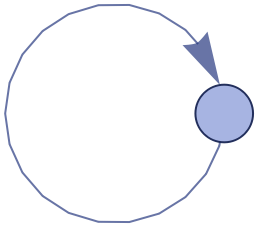
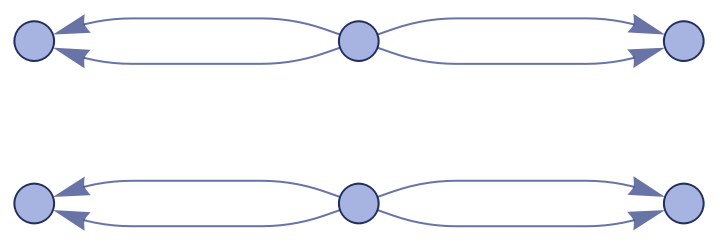
Given the state list of a system, we can define as the initial condition and as the “splitting point”, i.e. the first state with more than one connected component. The easiest way to test for self-replication would be to define a predicate for direct cloning: with being the equivalence operator and being the set of connected component of the system. Here, the equivalence relation is hypergraph isomorphism. This predicate checks if a system instantly produces copies of itself after the first split: it would detect, for example, systems that behave in the same way as the first replicating model shown in the book.
B
B
0
B
s
∃⊂C()|≅
S
i
B
s
S
i
B
s-1
≅
C(G)
Example of a rule matched by this predicate:
Out[]=
,
,

,

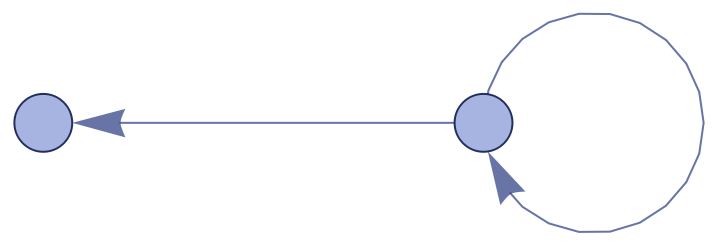
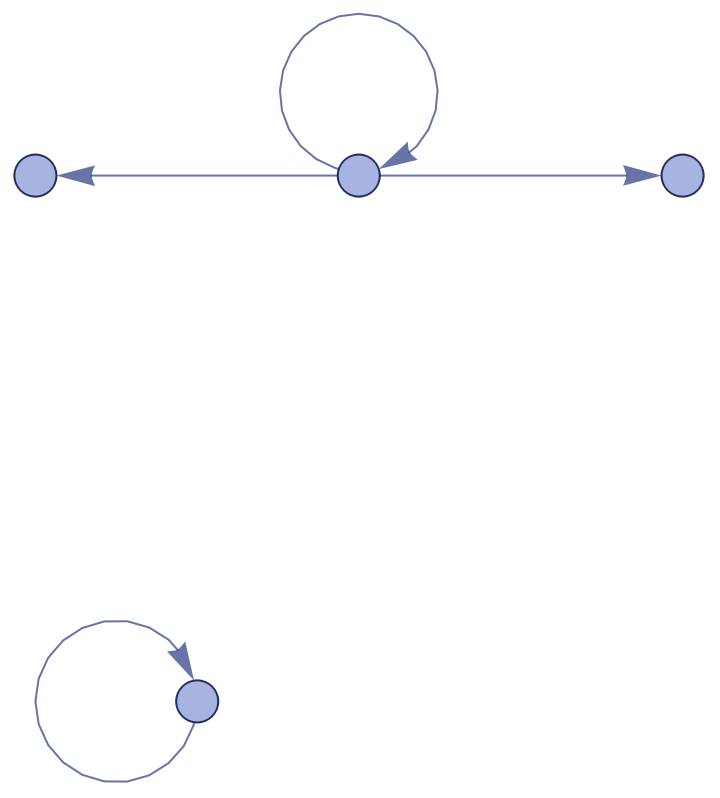
However, this definition does not capture anything very complex. One better approach would be to check if at least one of the pre-split states is equivalent to one or more of the post-split connected components: .
∃⊂C()∃∈…|≅
S
i
B
s
B
i
B
0
B
s-1
B
i
S
i
Example of a rule matched by this predicate:
Out[]=
,
,
Even if this describes easily the essence of self-replication, it does not allow complex self-replication that involves multiple intermediate states, or with multiple distinct self-replicating components, or that happen after the first split. To solve this problem, we must rephrase it differently.
Lineage Tree
Lineage Tree
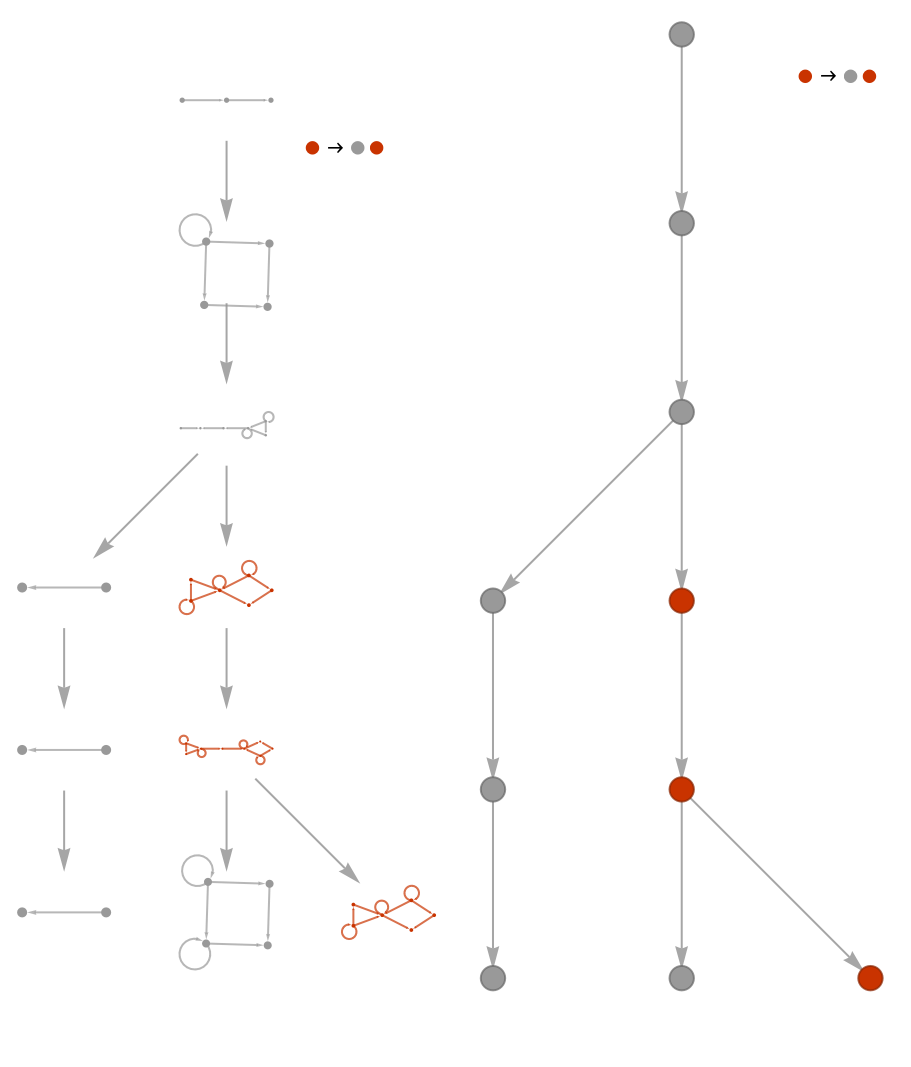
We define a lineage tree as a rooted tree, in which each node is a connected component of the system at a given moment and each edge is a local rewriting event on a connected component. The horizontal slices of the lineage tree are global events. Hence, branching means splitting. Under causal invariance, each equivalence class is always being rewritten into the same set of equivalence classes. This idea is embedded in the graphical representation, in the “grammar” style near the top.
Lineage Tree of a Wolfram Model and its abstraction:
Out[]=
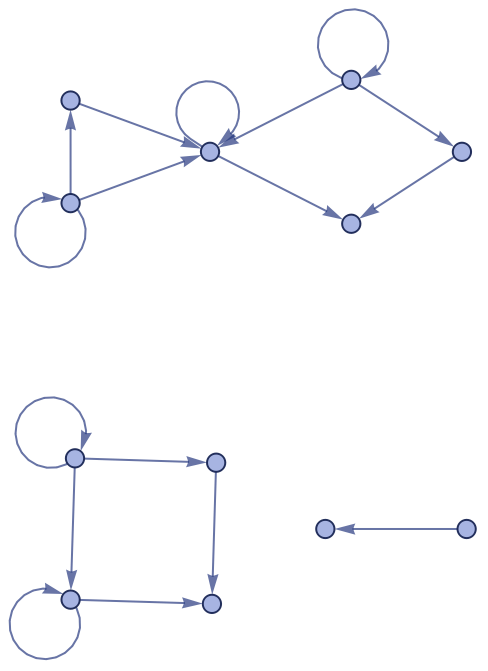
The final state of the Wolfram Model at the end of the tree:
Out[]=
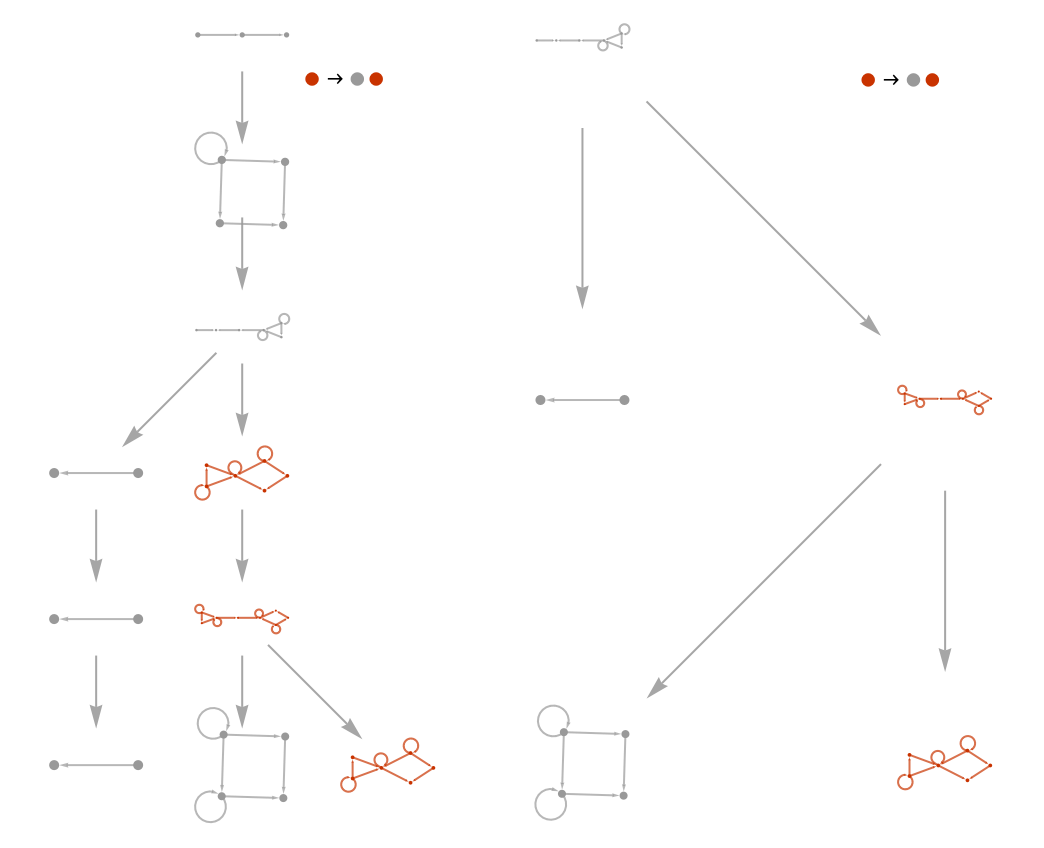
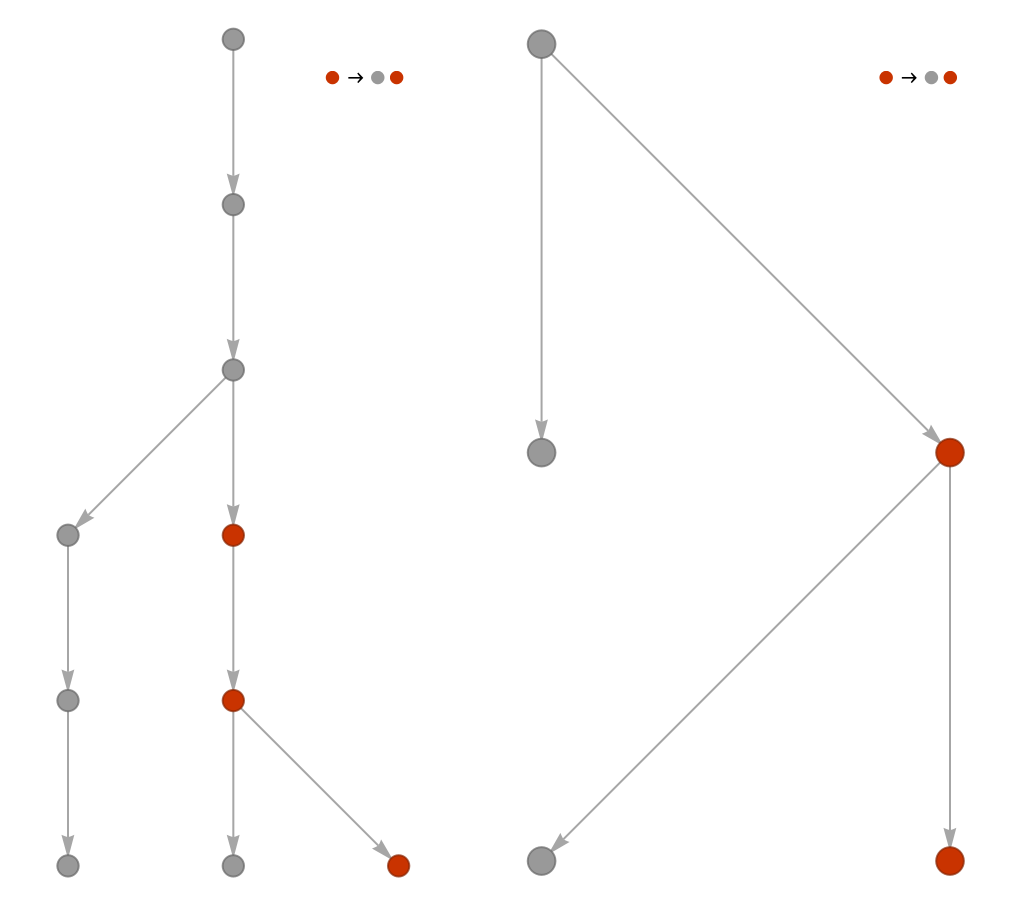
One alternative way of representing this tree would be to reduce each chain into a single node, so that we focus specifically on the branching patterns. In this essay, we will use both the representations and will always refer to the second one as the “reduced” lineage tree, usually on the right-hand side of the figures that include two lineage trees.
Lineage Tree (left) and Reduced Lineage Tree (right):
Out[]=
Same Lineage Tree (left) and Reduced Lineage Tree (right):
Out[]=
Chain Legacy
Chain Legacy
A node is a descendent of another node if and only if a directed path exists in the lineage tree between and . This property could be called . Chain legacy is a narrower property, requiring the path to be a chain (each node in the path, excluding , must have exactly one child).
w
z
w
z
Legacy(w,z)
z
Equivalence Classes
Equivalence Classes
Two chain lineages are equivalent if at least one of their states is equivalent. This is only true thanks to causal invariance; otherwise we would have to consider only the last state of the chain (before the component splits), and then apply a post-processing algorithm to merge the “baby” classes with the “grown-up” ones, i.e. to detect which leaf classes will eventually grow into one of the existing inner classes. Here, the equivalence classes are displayed as colors on the tree.
Phenotypes
Phenotypes
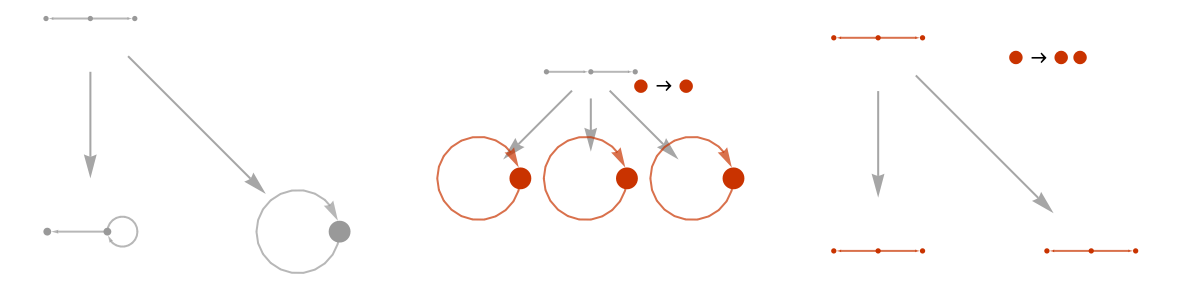
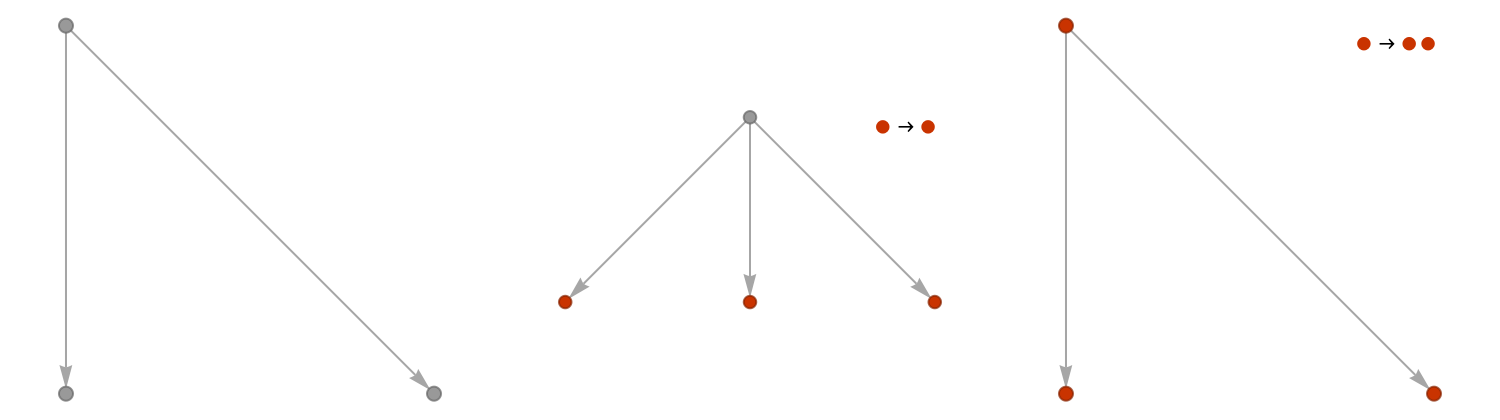
Let a residue be a chain of isomorphic components (a fixed point of the state space). We define a gun as a system that splits into at least one copy of itself and one other element. Chain guns produce growing or periodic elements that never split, and residue guns produce residues. A gun can also be a lineage with non-equivalent elements, such as an expanding gun. For readability purposes, we will define a n-splitter as a system that splits into connected components. It is a superset of n-isosplitters, which splits into equivalent elements, which include n-cloners, splitting into copies of themselves.
n
n
n
Examples of 2-splitter (left), 3-isosplitter (middle) and 2-cloner (right):
Out[]=
Out[]=
Metrics
Metrics
Replication paths are paths between two elements of the same equivalence class in a lineage tree. The splitting distance of such a path is the number of splits on this path. It must not be confused with the replication period of this path, which is the total amount of edges of this path (or the number of rewriting events that happened on this path). If an equivalence class has only one replication path in a given system, then we can talk about the splitting distance and about the replication period of the class itself. Otherwise, we might want to explicitly mention the path.
Self-replication
Self-replication
A rewriting system is self-replicating if one of the equivalence classes defined in its lineage tree has a replication path with a splitting distance equal or greater than one. This naturally filters out all the fixed points and chains. Mediated self-replication requires that this path include nodes from a different equivalence class than the first and last nodes of the path, which means it has to have a minimal splitting distance strictly greater than one.
Methodology
Methodology
In order to find interesting cases and explore the variety of rules, we first used a hard filter with arbitrary constraints on some variables: the number of equivalence classes, the replication splitting distance, the replication period, the slow-growthness (number of events before the first split) and the branchial metric (based on degrees, to assess the triviality of the underlying hypergraphs). After that, we implemented adaptive evolution to speed up the search for intriguing models, with the fitness function being a mixture of all the previously enumerated metrics. Most of the examples are from the {2,2} -> {4,2} signature as well as from the {2,2} -> {5,2} signature.
Exploration
Exploration
The first and most common attractor of splitting hyergraph rewriting systems is the gun, especially the residue gun where the residues are trivial components, such as self-loops or n-nodes lines. However, expanding guns, chain guns and expanding chain guns are also very numerous. Besides, an interesting fact is that guns replicates in an instant fashion, while expanding guns are not replicating but act as an intermediate state for the replication of some pattern.
Chain gun (red) producing circular growing structures (blue):
The final state of this Wolfram Model after 500 steps:
Expanding residue gun (grey) producing self-loops residues (red):
The final state of this Wolfram Model after 500 steps:
Cloner Gun
Cloner Gun
The most interesting rules following this pattern are the ones in which a gun produces other self-replicating patterns. One can easily distinguish the main lineage from the n-cloners. This is not mediated self-replication yet, but it is arguably more interesting than simple cloning. Here, the gun (in red) does not multiply but stays unique over time, while the n-cloners replicate exponentially.
2-class rule with 2-cloners (blue) and their gun (red):
Mediated Replication
Mediated Replication
Some rules (less than 0.1%) show complex mediated self-replication, with a minimal replication splitting distance up to 6 in some cases for the tested signatures. In this particular case, the red component has an infinite amount of distinct replication paths, of the shape RED -> BLUE * n -> RED. The blue component also has the same property, but its replication splitting distance for any path is always 1 or 2.
3-class rule with minimal splitting distance (red) = 1:
The same rule, ran for a larger number of steps:
Slow Growth
Slow Growth
Some other rules exhibit an interesting slow-growing behaviour, which results in long chains in the expanded tree with very few splitting events, compared to the majority of other similar systems. This slow growth allows for bigger connected structures to emerge, suggesting the existence of more complex, possibly globular (see the Wolfram Physics book) self-replicating patterns.
4-class slow-growing self-replicating rule:
The final state of this Wolfram Model after 500 steps:
Multiple Classes
Multiple Classes
Among these interesting rules, a few have way more equivalence classes than others, and hence are comparable in some sense to complex systems in biology, chemistry or computer science. In addition to that, such rules can also allow for rather non-trivial substrates and for high minimal splitting distance, or highly mediated replication.
6-class rule (minimal splitting distance for red = 5):
Conclusion
Conclusion
Non-trivial, mediated self-reproduction is very rare and hence highly improbable but it exists, even in very small rewriting systems. We believe this is a hint towards finding the origin of life, and hope that this framework will help discovering new properties in various research contexts.
Future Work
Future Work
One very important piece of work to be done would be to characterize the interaction between self-replication and updating order, using multiway graphs. In the context of hypergraph rewriting systems, it would also be nice to extend the rulial state exploration to larger signatures and to search for a globular structure. Outside of this realm, our framework should be compared and connected to existing work on self-replication and rewriting systems. Mapping this to other systems, such as chemical networks, autocatalytic sets, etc... could also be interesting.
Acknowledgements
Acknowledgements
The author wants to sincerely thank Willem Nielsen, his primary mentor, for its time and involvement in the project as well as for the many whiteboard scribbles; Pedro Marquez-Zacarias for its various reviews and book recommendations; Anusha Asthana for suggesting multiple clever changes to the model and Stephen Wolfram for the project proposal and numerous advices.
References
References
1
.S. Wolfram (2020) “A Class of Models with the Potential to Represent Fundamental Physics”
AI Disclosure
AI Disclosure
The following generative AI tools were used in this project: Anthropic Claude, Pro. They were used for literature review and debugging only. All the edits were reviewed, understood and approved by the author. All code and prose were written by the author.
CITE THIS NOTEBOOK
CITE THIS NOTEBOOK
Self-Replication in Rewriting Systems
by Matheo Tripnaux
Wolfram Community, STAFF PICKS, July 16, 2026
https://community.wolfram.com/groups/-/m/t/3762980
by Matheo Tripnaux
Wolfram Community, STAFF PICKS, July 16, 2026
https://community.wolfram.com/groups/-/m/t/3762980