ABSTRACT: We recently described a quantum analogue of the classical double-pendulum clock developed over 350 years ago by Christiaan Huygens. Huygens observed that two identical pendulum clocks, when weakly coupled through a substantial beam, rapidly synchronized with identical periods and amplitudes, yet with the pendula oscillating in antiphasing directions. Our model introduces the escapement via a Lindblad operators. One of the surprising results of this work is that otherwise decoupled quantum bits can become entangled via their mutual interaction with a correlated environment. Similarly, in our paper, we show that the noise-induced correlations between the qubits are largely quantum mechanical. Here we provide some working examples of the calculations we performed using the Wolfram Quantum Framework. Citation (original article): Bhavay Tyagi, Hao Li, Eric R. Bittner, Andrei Piryatinski, and Carlos Silva-Acuña, Noise-Induced Quantum Synchronization and Entanglement in a Quantum Analogue of Huygens’ Clock, The Journal of Physical Chemistry Letters 2024 15 (43), 10896-10902. https://doi.org/10.1021/acs.jpclett.4c02313
Introduction
Introduction
At the close of the 17th century, Christiaan Huygens observed that two identical pendulum clocks, when weakly coupled through a substantial beam, quickly synchronized with identical periods and amplitudes, yet the pendulums oscillated in opposite directions. Huygens presented his advancements in pendulum clock technology to the Royal Society to address the “longitude problem,” a critical challenge in determining a ship’s precise position at sea. While latitude could be easily determined by measuring the altitude of Polaris, determining longitude required measuring the time difference between local noon and a fixed reference point, such as the Royal Observatory at Greenwich. Although longitude could theoretically be calculated based on the transit times of Jupiter’s satellites, such calculations were labor-intensive, often taking around four hours to complete. Initially, Huygens attributed the synchronization of pendulum clocks to air currents, but later experiments led him to conclude that the weak coupling via the beam was responsible for this anti-phase synchronization. In his work Horologium Oscillatorium, Huygens analyzed pendulum clocks using sophisticated geometrical arguments. Following the publication of Newton’s Principia, infinitesimal calculus and differential equations became the preferred mathematical tools for such analyses. These methods were further developed into Lagrangian mechanics in the nineteenth century and were later enhanced by powerful numerical methods in the mid-twentieth century. One of the most thorough studies of Huygens’ clocks was conducted by Bennett et al., who used mathematical modeling, numerical computation, and physical experiments to explore pendulum clock synchronization. Today, oscillator synchronization is recognized as a fundamental concept in nonlinear science, encompassing both classical and quantum domains.
1
2
3
In a recent paper, we proposed a quantum analogue of the Huygens clock, wherein the phases of two spins achieve synchronisation through their interaction with a shared environment. In our proposed model, the environment functions analogously to the escape mechanism in a mechanical clock, regulating the gear train and permitting the advancement of time in discrete intervals. The escapement also imparts a nominal amount of kinetic energy to the pendulum by releasing potential energy stored in a coiled spring or a series of weights. In our framework, the escapement is represented by a stochastic term that induces the transition from |0〉 to |1〉 at a specified rate. Our results and analysis indicate that both synchronisation and antisynchronization can be achieved within this model, depending upon the degree of correlation between the escapement mechanisms acting on the two states. Here, we provide a look into the details of our model as implemented in the Wolfram Quantum Framework.
4
The model
The model
The model is described by a system Hamiltonian:
H=-(Δ/2)+(τ/2)+(+)
2
∑
j=1
z
σ
j
x
σ
j
J
xy
+
σ
1
-
σ
2
-
σ
1
+
σ
2
(
1
)where the ’s are Pauli spin operators acting on spin i and the escapement is introduced via the Lindblad operators: =±).
σ
i
c
±
γ
2
(ξ±1)
(+
σ
1
+
σ
2
Implementation (based on Wolfram Research Team article https://community.wolfram.com/groups/-/m/t/3259263 )
Implementation (based on Wolfram Research Team article https://community.wolfram.com/groups/-/m/t/3259263 )
Our calculations can performed using the Wolfram Quantum Framework
In[]:=
Quit[]
In[]:=
PacletInstall["https://www.wolfr.am/DevWQCF",ForceVersionInstall->True]<<Wolfram`QuantumFramework`
Out[]=
PacletObject

Hamiltonian: and parameters:
H=-(Δ/2)+(τ/2)+(+)
2
∑
j=1
z
σ
j
x
σ
j
J
xy
+
σ
1
-
σ
2
-
σ
1
+
σ
2
In[]:=
Δ=1;(*detuning*)τ=1;(*Rabi*)tf=100;(*overalltimeofevolution*)j=.25;(*interactioncoupling*)γ=.05;(*strengthofdampingrate*)
In[]:=
h=-(QuantumOperator["Z"]+QuantumOperator["Z",{2}])+(QuantumOperator["X"]+QuantumOperator["X",{2}])+j(QuantumOperator["Up"]@QuantumOperator["Down",{2}]+QuantumOperator["Down"]@QuantumOperator["Up",{2}]);
Δ
2
τ
2
Here we define the Lindblad jump operator as . This describes the “escapement” mechanism for the clock and provides a random “kick” whenever the one of the spins is in the |0〉 state. Since this acts on both spins when ξ≠0, the two spins become synchronized via correlations in the environment.
c=±)
γ
2
(ξ±1)
(+
σ
1
+
σ
2
In[]:=
Ls[ξ_]:=MapThread{ev,evec}|->
ev
Sum[Sqrt[γ]evec[[k]]QuantumOperator["Up",{k}]["Ordered",{1,2}],{k,2}],QuantumOperator[{{1,ξ},{ξ,1}}]["Eigensystem"]In[]:=
Δ=1;(*detuning*)τ=1;(*Rabi*)tf=100;(*overalltimeofevolution*)j=.25;(*interactioncoupling*)γ=.05;(*strengthofdampingrate*)
Time evolution of 2-qubit quantum state
In[]:=
ρt[ξ_]:=QuantumEvolve[h,Ls[ξ],QuantumState["01"],{t,0,tf}]
Given ξ and time (as a list), returns expectation-value of for qubits:
σ
z
In[]:=
qubitExpectation[ξ_,trange_]:=With[{ρ=ρt[ξ]},Table[Table[Evaluate[QuantumPartialTrace[ρ,{q}]["ProbabilitiesList"].{1,-1}],{t,trange}],{q,2}]]
For the last 20% portion of time, find phase difference:
In[]:=
phaseDiff[ξ_]:=Subtract@@(ArcTan[#,ResourceFunction["DiscreteHilbertTransform"][#]]&[#-Mean[#]]&/@qubitExpectation[ξ,Range[.8tf,tf,0.1]])
Bloch visualization
Bloch visualization
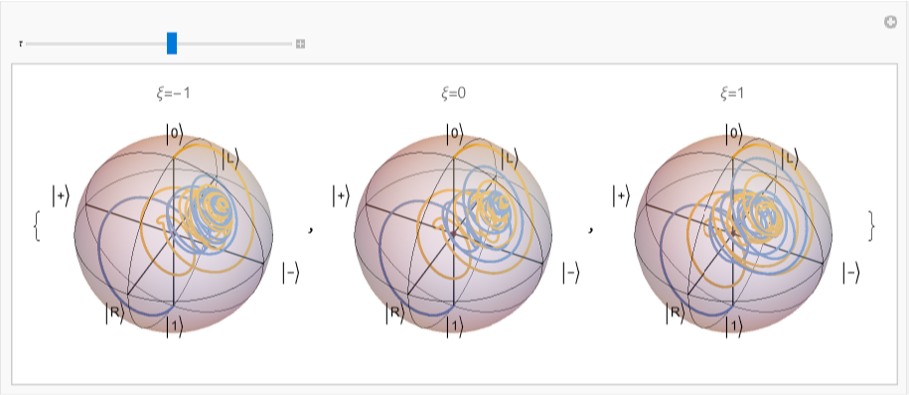
Trajectory of each particle in the Bloch sphere (blue one is qubit-1, orange one is qubit-2)
In[]:=
Manipulate[Table[With[{r=ρt[ξ]},Show[QuantumState["UniformMixture"]["BlochPlot"],ParametricPlot3D[{Evaluate@Re@QuantumPartialTrace[r[t],{1}]["BlochVector"],Evaluate@Re@QuantumPartialTrace[r[t],{2}]["BlochVector"]},{t,0,τ}],ViewPoint{-π,2π,2π},ImageSize->200,PlotLabel->"ξ="<>ToString[ξ]]],{ξ,{-1,0,1}}],{τ,.01,tf},SaveDefinitions->True]
Out[]=
In[]:=
Table[With[{r=ρt[ξ]},Show[QuantumState["UniformMixture"]["BlochPlot"],ParametricPlot3D[{Evaluate@Re@QuantumPartialTrace[r[t],{1}]["BlochVector"],Evaluate@Re@QuantumPartialTrace[r[t],{2}]["BlochVector"]},{t,0,tf}],ViewPoint{-π,2π,2π},ImageSize->200,PlotLabel->"ξ="<>ToString[ξ]]],{ξ,{-1,0,1}}]
Out[]=
 ,
 ,

Expectation values
Expectation values
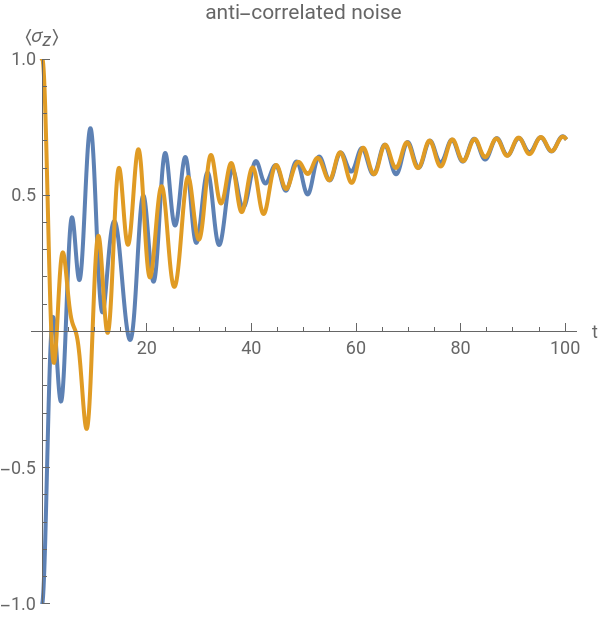
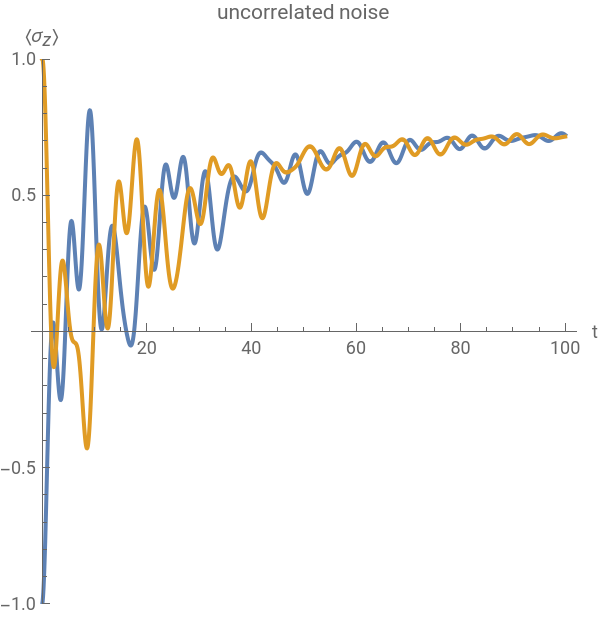
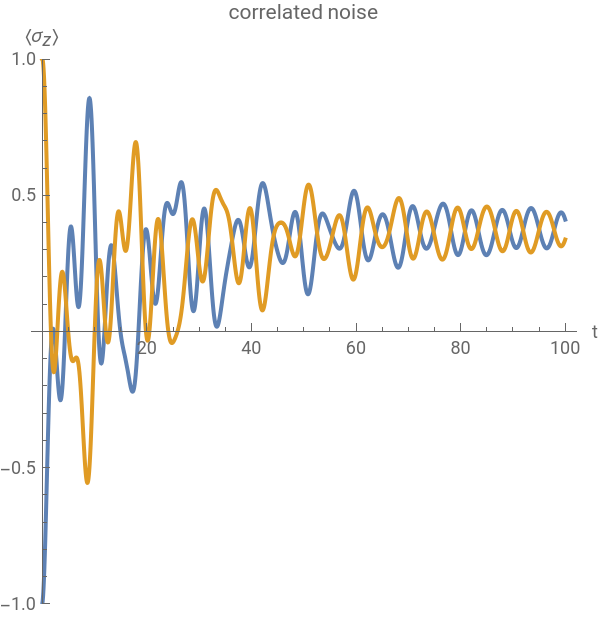
Mean value of for qubits. Notice that anti-correlated noise results in synchronized oscillations while correlated noise leads to anti-phase synchronization. In the classical Huygens model of two suspended pendulums, the angular displacements exhibit several key symmetries that are also present in our quantum analogue. Firstly, the system is symmetric under the exchange of the two oscillators. Secondly, in an ideal mechanical system, the torque generated by the escapement mechanism is an odd function of the angular variables, as the escapement provides a small momentum boost in the direction of motion at the turning points, resulting in in-phase oscillations. However, in real-world systems, this symmetry is often disrupted by variations in the design and manufacturing of the escapement ratchet. In our model, the escapement’s symmetry can be odd, even, or absent altogether, depending on the correlation parameter. In the cases of ξ = ±1, the Lindblad dissipator has only even or odd symmetry components, meaning that the opposite symmetry dynamics are completely decoupled from the environment.
σ
z
In[]:=
Row@Table[Plot[Evaluate@qubitExpectation[ξ,{t}],{t,0,tf},PlotRange->{-1,1},ImageSize->300,AspectRatio->1,PlotLabel->Replace[ξ,{-1->"anti-correlated noise",0->"uncorrelated noise",1->"correlated noise"}],AxesLabel->{"t","〈〉"}],{ξ,{-1,0,1}}]
σ
z
Out[]=
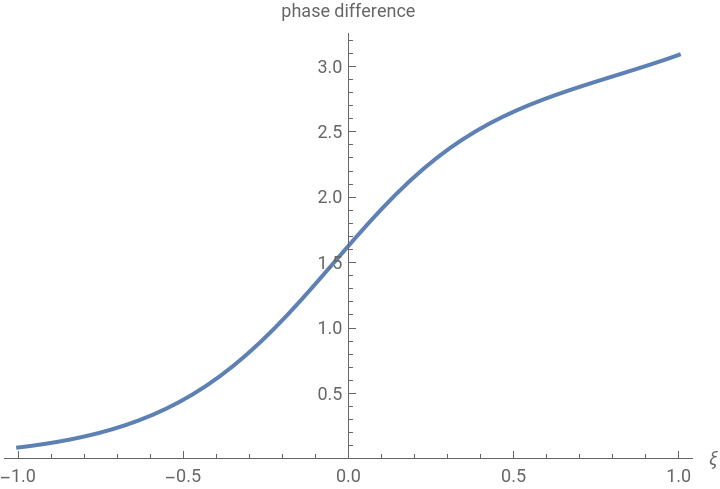
Phase difference, between last 20% of mean-value of
σ
z
In[]:=
Plot[phaseDiff[ξ][[-40]],{ξ,-1,1},PlotRange->{0,All},AxesLabel->{"ξ","phase difference"}]
Out[]=
phase-lock value
Entanglement Monotone
Entanglement Monotone
Discord
Discord
where |ψ〉 is the state of the entire system. The entropy of entanglement of subregion A is defined as the von Neumann entropy (vNE) of the reduced density matrix describing that subregion
This quantity is exactly zero when we know everything about the state and is equal to log d when the state is maximally mixed, i . e ., ρ = I/d . In order to distinguish between two quantum states we look at the relative entropy between them,
Thus, we define the discord as
This generally under-estimates the quantum correlation and, hence, provides a lower bound on the “quantumness”. It is also bound from above by the total mutual information. Surprisingly, for the model system most of the correlation between the two spins is quantum in nature even though these correlations are largely produced by the incoherent interaction with the environmental degrees of freedom.
Synchronization has been a fascinating and varied subject in both quantum and classical systems for over 350 years . Traditionally, studies in this area have focused on two oscillators directly connected through mechanical coupling, like in a classical pendulum, or through the exchange of quanta . In this work, we demonstrate that indirect coupling, facilitated by interaction with a shared stochastic environment, can also result in quantum entanglement and synchronization, even without direct coupling . When coupling to a shared resource occurs, the resulting correlation can originate from either quantum or classical sources. We propose that this can be quantified by subtracting the maximum amount of classical information shared between the two components from their total mutual entropy, I(A:B), which provides a lower bound for the quantum information shared between them. Our analysis suggests that correlated noise enhances the “quantum-ness” in a steady-state system, while anti-correlated noise results in a more classical-like correlation. Moreover, when the direct coupling between the spins is removed, nearly 100% of the correlation between the two qubits can be attributed to quantum contributions.
Acknowledgments
Acknowledgments
ERB acknowledges funding from the National Science Foundation (CHE-2404788) and the Robert A. Welch Foundation (E-1337). HL and CSA acknowledge funding from the Government of Canada (Canada Excellence Research Chair CERC-2022-00055) and the Courtois Institute, Faculte des arts et des sciences, Universite de Montreal (Chaire de Recherche de l’Institut Courtois). AP and BT (in part) acknowledge funding provided by the LANL LDRD program (grant number 20220047DR). This work was performed, in part, at the Center for Integrated Nanotechnologies, an Office of Science User Facility operated for the U.S. Department of Energy (DOE) Office of Science by Los Alamos National Laboratory (Contract 89233218CNA000001) and Sandia National Laboratories (Contract DE-NA-0003525). The authors also acknowledge Prof. Phillip Shushkov (Indiana University) for discussions at a recent Telluride (TSRC) workshop that led to this investigation.
References
References
[1] Huygens, C. Instructions concerning the use of pendulum-watches, for finding the longitude at sea. Philosophical Transactions of the Royal Society of London 1669, 4, 937–953.
[2] Huygens, C. Horologium oscillatorium sive de motu pendulorum ad horologia aptato demonstrationes geometricae; Apud F. Muguet, 1673.
[3] Bennett, M.; Schatz, M. F.; Rockwood, H.; Wiesenfeld, K. Huygens’s clocks. Proceedings of the Royal Society of London. Series A: Mathematical, Physical and Engineering Sciences 2002, 458, 563–579.
[4] Noise-induced Quantum Synchronization and Entanglement in a Quantum Analog of Huygens’ Clock, B. Tyagi, H. Li, ER Bittner, C Silva-Acuna, A. Piryatinski, J. Phys. Chem. Lett (in press, 2024)
CITE THIS NOTEBOOK
CITE THIS NOTEBOOK
A quantum analog of Huygen's clock: noise-induced synchronization
by Eric R Bittner, Bhavay Tyagi, Carlos Silva-Acuna, Hao Li, and Andrei Piryatinski
Wolfram Community, STAFF PICKS, October 9, 2024
https://community.wolfram.com/groups/-/m/t/3295421
by Eric R Bittner, Bhavay Tyagi, Carlos Silva-Acuna, Hao Li, and Andrei Piryatinski
Wolfram Community, STAFF PICKS, October 9, 2024
https://community.wolfram.com/groups/-/m/t/3295421