The transmission-line shunted plasma oscillation qubit, or transmon in short, is a variant of superconducting charge qubit that is insensitive to charge noise. It consists of two small superconducting islands tunnel coupled through two Josephson junctions (forming a dc-SQUID) and shunted by a large capacitor (see ). The key feature that distinguishes the transmon from the so-called Cooper-pair box (Nakamura, Pashkin and Tsai, 1999) is to reduce the sensitivity to charge noise using the capacitive shunt while maintaining a sufficient anharmonicity for selective control of a pair of levels to form a quantum bit (Koch et al., 2007).
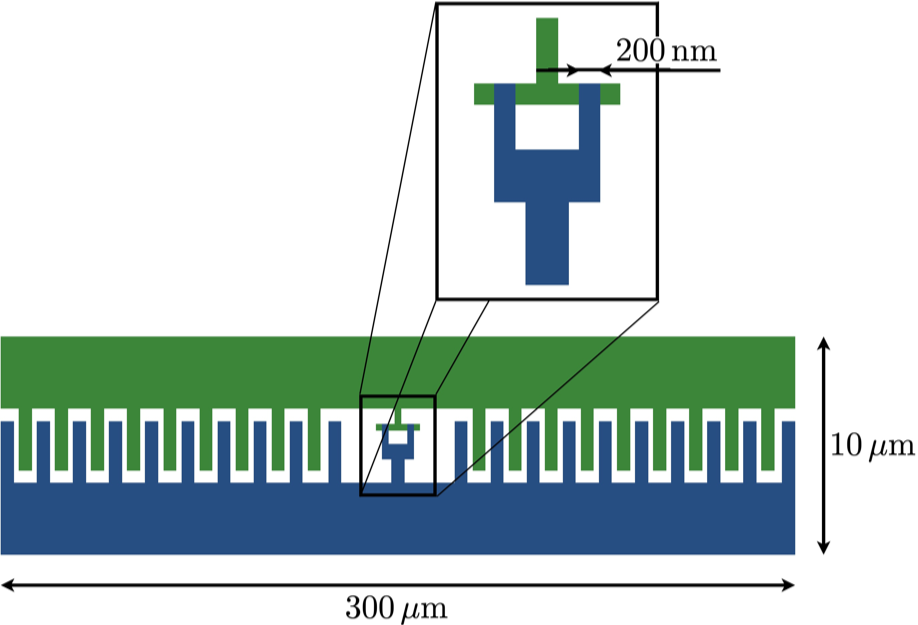
Figure 1. A schematic of transmon. It consists of two superconducting islands tunnel coupled through two Josephson junctions and shunted by a large capacitor.
The Transmon package is a part of QuantumPlaybook, but needs to be loaded separately.
In[]:=
PacletInstall["QuantumMob/QuantumPlaybook"]
Out[]=
PacletObject

In[]:=
Needs["QuantumMob`QuantumPlaybook`"]
Transmon Hamiltonian
Transmon Hamiltonian
A transmon is a small Josephson junction and is described by the Hamiltonian
H
E
C
2
-q
n
E
J
ϕ
where :2C is the charging energy associated with junction capacitance , is the Josephson energy, and is the dimensionless gate charge for gate capacitance and voltage (see Figure 2). Two operators and describe the number of Cooper pairs and the phase of the superconducting order parameter, respectively. The two operators and satisfy the commutation relation
E
C
2
e
C
E
J
q:2e
C
g
V
g
C
g
V
g
n
ϕ
n
ϕ
,i
ϕ
n
Due to this commutation relation, the phase and number are subjected to quantum fluctuations satisfying the uncertainty relation
Δϕ Δn≥
1
2
In this sense, the above transmon Hamiltonian is also called the quantum phase model.
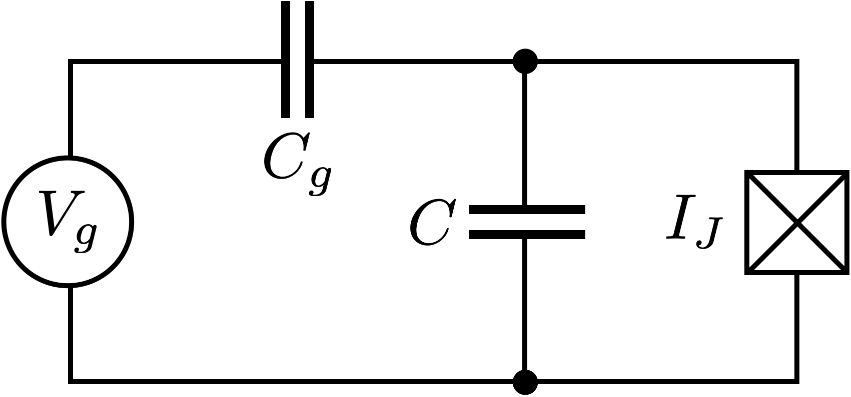
Figure 2. An equivalent circuit for transmon. A transmon is a small Josephson junction characterized by Josephson critical current and shunted by a large capacitance . The Josephson critical current determines the Josephson energy I/2e while the capacitance gives the charging energy scale 2C. The transmon device is often tuned by an external gate voltage via a gate capacitor of capacitance , inducing the dimensionless gate charge 2e.
I
J
C
I
J
E
J
C
E
C
2
e
V
g
C
g
n
g
C
g
V
g
The quantum fluctuations of the phase and number are governed by the two energy scales and in the transmon Hamiltonian. If ≫, then the first term dominates, and the number is well defined while the phase strongly fluctuates. In the opposite limit, ≪, the Josephson term dominates and the phase is well defined whereas the Cooper-pair number has a large uncertainty. It is thus convenient to characterize the quantum fluctuations with the ratio of the two energy scales, more precisely, with
E
C
E
J
E
C
E
J
E
C
E
J
α:
8
E
C
E
J
which is called the MacCumber parameter of the transmon device. Furthermore, we measure energies in units of the geometric mean of the two energy scales, that is,
8
8E
C
E
J
E
C
E
J
Then, the dimensionless transmon Hamiltonian reads as
H
1
2
2
-q
n
1
α
ϕ
In the ϕ-space representation, the corresponding Schrödinger equation is given by
+(1-cosϕ)ψ(ϕ)ϵψ(ϕ)
α
2
2
-i-q
∂
ϕ
1
α
∂
ϕ
∂
∂ϕ
Phases 0 and 2π are equivalent, so physically meaningful wave function must satisfy the periodic boundary condition
ψ(ϕ+2π)ψ(ϕ)
Bloch States
Bloch States
Here, we consider a slightly different model described by the Hamiltonian
H
1
2
2
n
1
α
ϕ
and the open boundary condition (instead of the ). In the ϕ-space representation, the Schrödinger equation reads as
-α+(1-cosϕ)ψ(ϕ)ϵψ(ϕ)
1
2
2
∂
ϕ
1
α
We call the above Hamiltonian the Mathieu Hamiltonian and the model consisting of the Mathieu Hamiltonian (or equivalently the Mathieu-Schrödinger equation) with the open boundary condition the Mathieu model.
Notice the absence of the dimensionless gate charge from this Hamiltonian (cf. the above specification of the or the corresponding ). Without the periodic boundary condition, the dimensionless gate charge can always be "gauged away". To see this, assume a solution of the form in the with finite . Then, one can see that (ϕ) satisfies the above without .
q
q
ψ(ϕ)(ϕ)
iqϕ
e
ψ
q
ψ
q
Bloch Theorem
Bloch Theorem
Note that the Hamiltonian has a discrete translational symmetry. More specifically, let (θ)exp(-iθ) be the translation operator by amount θ such that
T
n
†
T
ϕ
T
ϕ
The Hamiltonian commutes with any translation by integer multiples of 2π,
,(2πm)0
H
T
for every integer .
m
According to the Bloch (or Floquet) theorem, the discrete translational symmetry allows us to choose eigenstates of the Hamiltonian of the form
ψ
ν
iν ϕ
e
f
ν
where (ϕ) is a periodic function of period 2π and real parameter ν is called the characteristic exponent (or the quasi-momentum) of the wave function. A state with wave function of the above form is called a Bloch (or Floquet) state. Note that the Bloch wave functions are defined only up to multiples of 2π; that is, if (ϕ) is an eigenstate of the Bloch Hamiltonian , then (ϕ) is also an eigenstate of with the same energy as (ϕ) for any integer .
f
ν
ψ
ν
H
2πmx
e
ψ
ν
H
ψ
ν+m
m
In the Transmon package, the wave function (ϕ) for MacCumber parameter α is given by , and the corresponding energy by .
ψ
ν
In[]:=
Get["QuantumMob`Transmon`"]
Consider an eigenfunction with a specific characteristic exponent:
In[]:=
α=2.;ν=1.25;sol[x_]=BlochFunction[ν,α,x*Pi];
The wave function itself is not periodic due to the non-integer value of the characteristic exponent.
In[]:=
ReImPlot[sol[x],{x,-2,2},FrameLabel->{"ϕ / π","ψ"}]
Out[]=
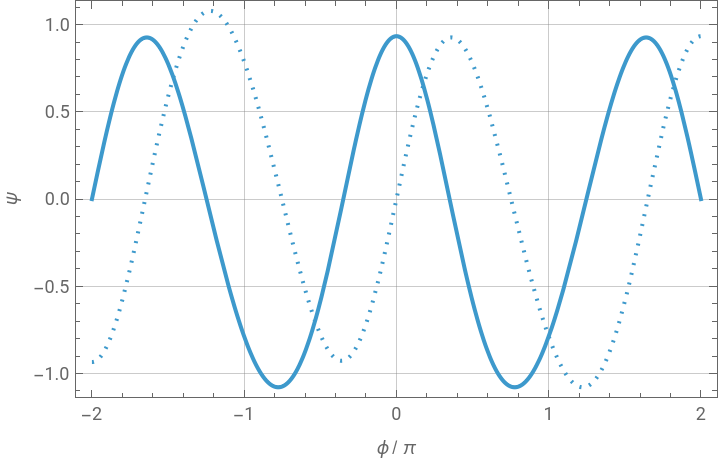
However, with the plane-wave factor removed, the remaining part is periodic.
The energy depends on the characteristic exponent. The dispersion relation forms bands.
Mathieu Functions
Mathieu Functions
Transmon Eigenstates
Transmon Eigenstates
and wave function
As an example, consider the first excited state of the transmon Hamiltonian:
Clearly, the above wave function satisfies the Schrödinger equation:
Consider another example in the opposite limit.
As the MacCumber parameter α varies, the spectrum gradually changes from the Josephson to charging limit.
The degeneracy in the Josephson limit is lifted for finite dimensionless gate charge q.
Related Links
Related Links
◼
Y. Nakamura, Y. A. Pashkin and J. S. Tsai (1999), Nature 398, 786 (1999), “Coherent control of macroscopic quantum states in a single-Cooper-pair box.”
◼
J. Koch et al. (2007), Physical Review A 76, 042319 (2007), “Charge-insensitive qubit design derived from the Cooper pair box.”
◼
G. Blanch (1972), “Mathieu Functions” in Handbook of Mathematical Functions with Formulas, Graphs, and Mathematical Tables, edited by M. Abramowitz and I. A. Stegun (John Wiley & Sons, 1972).
CITE THIS NOTEBOOK
CITE THIS NOTEBOOK
Transmon: a system for superconducting quantum computers
by Mahn-Soo Choi
Wolfram Community, STAFF PICKS, August 7, 2025
https://community.wolfram.com/groups/-/m/t/3526952
by Mahn-Soo Choi
Wolfram Community, STAFF PICKS, August 7, 2025
https://community.wolfram.com/groups/-/m/t/3526952