Nomography for Beginners
Nomography for Beginners

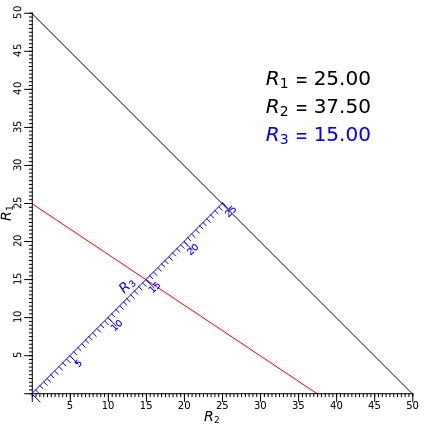
A nomogram (or nomograph) is a two-dimensional diagram designed to quickly approximate the computation of a function.
Nomography was invented by the French mathematicians Massau and Ocagne in 1889 and used until the 1970s to provide scientists with fast graphical calculations with reasonable precision.
Basic nomograms are parallel-scale or concurrent-scale nomograms but many other types exist.
This Demonstration shows a simple concurrent-scale nomogram used to calculate the result of formulas of the type =+ (resistances in parallel, spring constants, lens focal lengths, or capacitances in series, etc.).
1
R
3
1
R
2
1
R
1
Use the locators to move the red line, called the index line or isopleth, that goes from to . The result is read at the intersection of the isopleth with the scale.
R
1
R
2
R
3
Details
Details
References
References
[1] R. Doerfler, "The Lost Art of Nomography," The UMAP Journal 30(4), 2009 pp. 457–493.
External Links
External Links
Permanent Citation
Permanent Citation
Erik Mahieu
"Nomography for Beginners"
http://demonstrations.wolfram.com/NomographyForBeginners/
Wolfram Demonstrations Project
Published: May 2, 2011