Propylene gas at 10 bar and 373.15 K is throttled to a lower pressure equal to 6.2 or 7.8 bar. The process does not produce any shaft work. In addition, there are no appreciable changes in the kinetic or potential energies. Thus, if the process is adiabatic, we get a reduction of pressure at constant enthalpy (or ). This means that for an ideal gas , since the enthalpy of an ideal gas is a function of temperature only. For most real gases, a reduction in pressure at constant enthalpy leads to a reduction in temperature (i.e. ). Indeed, this situation corresponds to a positive Joule–Thompson coefficient, .Here, we compute the temperature change using the Peng–Robinson equation of state based on the methodology described in [1]. In addition, we compare our results (blue curve) with the data obtained (red dots) with the Aspen-HYSYS process simulator[2]. As can be seen, excellent agreement is observed between the results derived from both methods.Hydrogen or Helium gas at 20 bar and 373.15 K is throttled to a lower pressure equal to 2.8 bar. Contrary to all other gases, a reduction in pressure at constant enthalpy leads to an increase in temperature (i.e. ) for both Helium and Hydrogen. Indeed, this situation corresponds to a negative Joule–Thompson coefficient, . References:[1] J. M. Smith, H. C. Van Ness and M. M. Abbott, Introduction to Chemical Engineering Thermodynamics, 7th ed., Boston: McGraw-Hill, 2005.[2] Aspentech. “Aspen-HYSYS.” (Dec 15, 2016) www.aspentech.com/products/aspen-hysys.
ΔH=0
ΔT=0
ΔT<0
μ=>0
∂T
∂P
H
ΔT>0
μ=<0
∂T
∂P
H
In[]:=
Tin=100+273.15;Pin=10;(*inletconditions*)
In[]:=
Tc=365.6;Pc=46.65;ω=0.14;(*criticaltemperatureandpressureandaccentricfactorforPROPYLENE*)
In[]:=
Tre1=Tin/Tc;Pre1=Pin/Pc;(*reducedtemperatureandpressure@inlet*)
In[]:=
R=8.314;(*universalgasconstant*)
In[]:=
α[x_?NumericQ]:=(1+(0.37464+1.54226ω-0.26992ω^2)(1-x^0.5))^2;q[x_?NumericQ]:=0.45724/0.07780α[x]/x;dq[x_]:=D[q[x],{x,1}];β=0.07780Pre1/Tre1;ϵ=1-Sqrt[2];σ=1+Sqrt[2];f1[Z_]:=1+β-q[Tre1]β(Z-β)1/((Z+ϵβ)(Z+σβ));sol1=NestList[f1,β,10];Zin=Last[sol1];(*compressibilityfactor*)Irin=1/(σ-ϵ)Log[(Zin+σβ)/(Zin+ϵβ)];Hresidual[1]=RTin(Zin-1+Tre1(dq[x]/.xTre1)Irin);(*residualenthalpyatinlet*)Hideal[1]=RNIntegrate[1.637+22.70610^-3x-6.91510^-6x^2(*HeatCapacitiesofGasesintheIdeal-GasState*),{x,298.15,Tin}];(*idealgascontributionatinlet*)Tre2[T_?NumericQ]:=T/Tc;Pre2[Po_?NumericQ]:=Po/Pc;β1[T_?NumericQ]:=0.07780Pre2/Tre2[T];α[x_?NumericQ]:=(1+(0.37464+1.54226ω-0.26992ω^2)(1-x^0.5))^2;q[x_?NumericQ]:=0.45724/0.07780α[x]/x;βo[T_?NumericQ,Po_?NumericQ]:=0.07780Pre2[Po]/Tre2[T];f[T_?NumericQ,Z_?NumericQ,Po_?NumericQ]:=1+βo[T,Po]-q[Tre2[T]]βo[T,Po](Z-βo[T,Po])1/((Z+ϵβo[T,Po])(Z+σβo[T,Po]));Irout[T_?NumericQ,Z_?NumericQ,Po_?NumericQ]:=1/(σ-ϵ)Log[(Z+σβo[T,Po])/(Z+ϵβo[T,Po])];Hresidual[2][T_?NumericQ,Z_?NumericQ,Po_?NumericQ]:=RT(Z-1+Tre2[T](dq[x]/.xTre2[T])Irout[T,Z,Po]);(*residualenthalpyatoutlet*)Hideal[2][T_?NumericQ]:=RIntegrate[1.637+22.70610^-3x-6.91510^-6x^2,{x,298.15,T}];(*idealgascontributionatoutlet*)sol2[Po_?NumericQ]:=FindRoot[{f[T,Z,Po]Z(*equationforcompressibilityfactor*),Hresidual[1]+Hideal[1]Hresidual[2][T,Z,Po]+Hideal[2][T](*adiabaticthrottlingvalve*)},{T,350,650},{Z,0.9,1}]//Chop;
Po=7.8;(*dischargepressure(bars)*)Graphics[{Darker@Blue,Arrowheads[0.1],Arrow[{{0.25,0},{1,0}}],Green,EdgeForm[{Darker@Green,Thick}],Opacity[0.3],Triangle[{{1.15,0.},{1,0.15},{1,-0.15}}],Triangle[{{1.15,0.},{1.3,0.15},{1.3,-0.15}}],Opacity[1],Darker@Red,Arrowheads[0.1],Arrow[{{1.3,0},{2.05,0}}],Thick,Darker@Green,Line[{{1.15,0},{1.15,0.25}}],Line[{{1.05,0.25},{1.25,0.25}}],Circle[{1.15,0.25},0.1,{0,Pi}],Style[Text[Row[{"inlet","\n",NumberForm[100,{3,2}]," °C","\n",NumberForm[10,{3,2}]," bars"}],{0.35,-0.25},{0,0}],Darker@Blue,16],Style[Text[Row[{"outlet","\n",NumberForm[-273.15+T/.sol2[Po],{6,3}]," °C","\n",NumberForm[Po,{3,2}]," bars"}],{1.80,-0.25},{0,0}],Darker@Red,16],Style[Text["throttling valve",{1.15,-0.25},{0,0}],Darker@Green,16],Style[Text[Row[{"Δ",Style["T",Italic]," = ",NumberForm[(T/.sol2[Po])-373.15,{4,3}]," °C"}],{1.15,-0.375},{0,0}],Darker@Green,16]},ImageSize{300,300}]
Out[]=
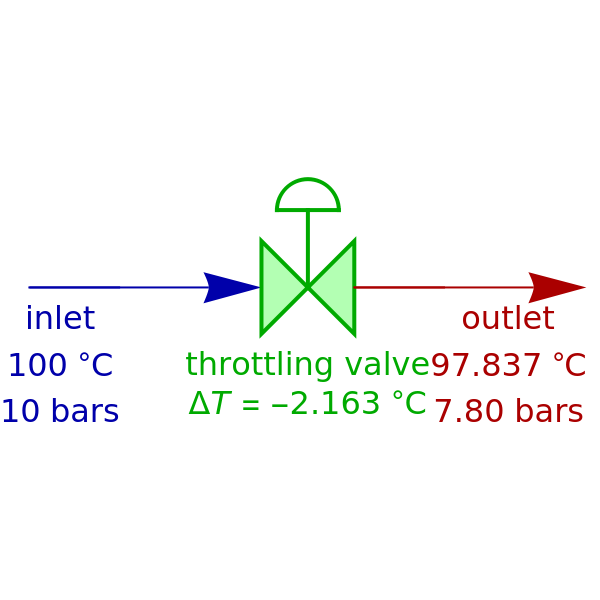
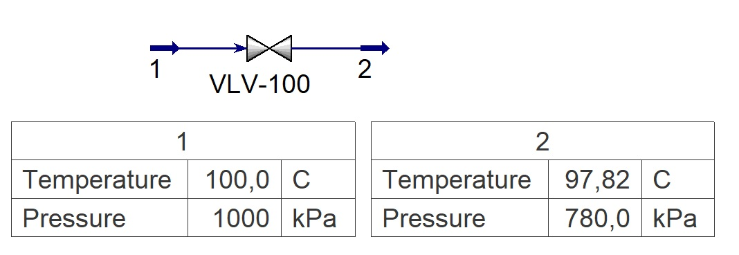
We get a close agreement with Aspen - HYSYS:
In[]:=
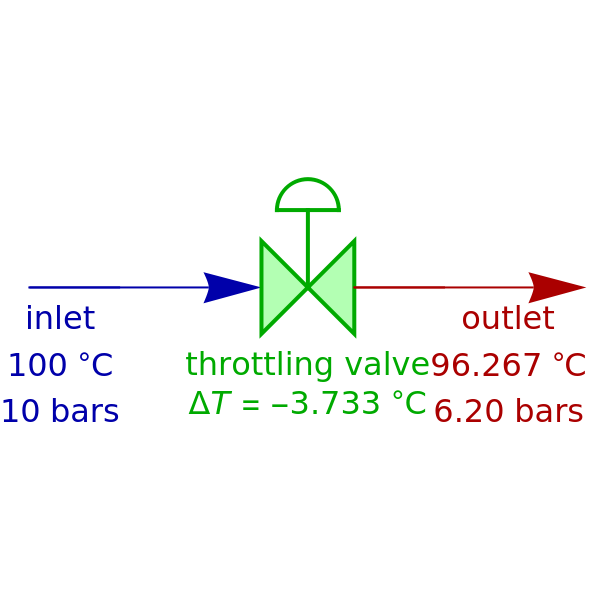
Po=6.2;(*dischargepressure(bars)*)Graphics[{Darker@Blue,Arrowheads[0.1],Arrow[{{0.25,0},{1,0}}],Green,EdgeForm[{Darker@Green,Thick}],Opacity[0.3],Triangle[{{1.15,0.},{1,0.15},{1,-0.15}}],Triangle[{{1.15,0.},{1.3,0.15},{1.3,-0.15}}],Opacity[1],Darker@Red,Arrowheads[0.1],Arrow[{{1.3,0},{2.05,0}}],Thick,Darker@Green,Line[{{1.15,0},{1.15,0.25}}],Line[{{1.05,0.25},{1.25,0.25}}],Circle[{1.15,0.25},0.1,{0,Pi}],Style[Text[Row[{"inlet","\n",NumberForm[100,{3,2}]," °C","\n",NumberForm[10,{3,2}]," bars"}],{0.35,-0.25},{0,0}],Darker@Blue,16],Style[Text[Row[{"outlet","\n",NumberForm[-273.15+T/.sol2[Po],{6,3}]," °C","\n",NumberForm[Po,{3,2}]," bars"}],{1.80,-0.25},{0,0}],Darker@Red,16],Style[Text["throttling valve",{1.15,-0.25},{0,0}],Darker@Green,16],Style[Text[Row[{"Δ",Style["T",Italic]," = ",NumberForm[(T/.sol2[Po])-373.15,{4,3}]," °C"}],{1.15,-0.375},{0,0}],Darker@Green,16]},ImageSize{300,300}]
Out[]=
In[]:=
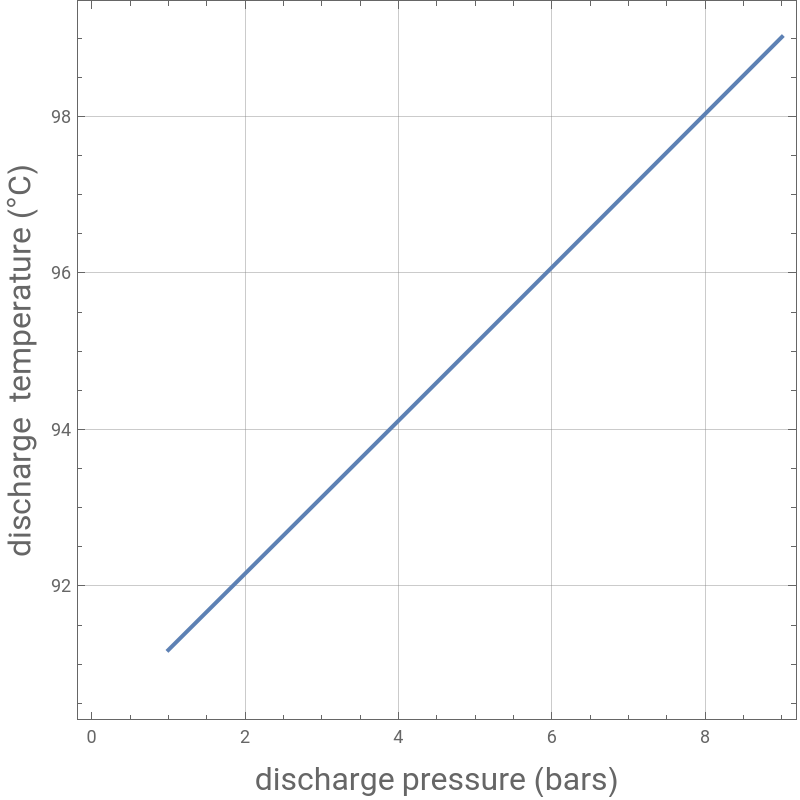
tbl1=Table[{i,-273.15+T/.sol2[i]},{i,1,9,0.5}];(*ouroutlettemperatureversusdischargepressure*)
In[]:=
tbl2={{1.,91.1025},{1.5,91.5949},{2.,92.0875},{2.5,92.5804},{3.,93.0736},{3.5,93.567},{4.,94.0607},{4.5,94.5545},{5.,95.0486},{5.5,95.5429},{6.,96.0374},{6.5,96.5322},{7.,97.0271},{7.5,97.5222},{8.,98.0174},{8.5,98.5129},{9.,99.0084},{9.5,99.5041}};(*outlettemperatureversusdischargepressureascalculatedwithAspen-HYSYS*)
In[]:=
p1=ListPlot[tbl1,ImageSize{400,400},FrameLabel{Style["discharge pressure (bars)",16],Style["discharge temperature (°C)",16]},Frame->True,GridLines->Automatic,AspectRatio->1,Joined->True]
Out[]=
CASE OF HYDROGEN
CASE OF HELIUM