ORIGINAL ARTICLE: Rafael G González-Acuña, Simon Thibault (2023), General diffraction integral for converging freeform vectorial fields. Phys. Scr. 98 115503. DOI: https://doi.org/10.1088/1402-4896/acfad2
Article Abstract: Herein it is presented a new vector diffraction integral capable to compute the diffraction patterns for aspheric and freeform wavefronts, with different pupil shapes, and different polarization states. The aforementioned vector diffraction integral is based on the energy conservation theorem, the far field approximation, and the angular spectrum representation of optical fields. The integral is validated through illustrative examples whose results are as expected and coincides with the related works.
Introduction
Introduction
RayleighSommerfeld and scalar Kirchhoff beam propagation models are convenient ways to describe the propagation of light in paraxial conditions. Nevertheless, these wavefront propagation methods cannot be used for high-numerical aperture optical systems. This is due to the scalar nature of these methods which do not account for the state of polarization of light. Therefore, the propagation of light phenomena should be extended to account for the vector character of the light. The first formalism that considers the vector character of the fields is Ignatowski’s study of Maxwell’s equations [1, 2]. Then, Kottler proposed a model considering the problem as an integral equation using Green’s function techniques [3]. Later, the method of Kottler was generalized by Stratton and Chu [4]. Richards and Wolf obtained another diffraction integral to describe the focusing of light [5–8]. The foundations of this integral are energy conservation and far-field approximation. It is important to remark that all these formalisms have been conceived for monochromatic light.
The models of Stratton and Chu and Richards and Wolf had been widely used to study tight focusing [9–24]. In particular the model of Richards and Wolf it is limited only to stigmatic systems and non-aberrated systems [25]. The modelling of vectorial beams is important in several areas of science, optical trapping [15], including high-resolution microscopy [11–14], electron acceleration [16], and recently, optical vortex knots [26, 27].
This paper introduces a new vector diffraction integral, not yet published according to the best authors’ knowledge, capable of computing the diffraction patterns for aspheric, freeform wavefronts in different shapes of pupils and polarization states. This vector diffraction integral is based on energy conservation, the far-field approximation and the angular spectrum representation of optical fields. This manuscript is divided as follows: In section 2 the mathematical derivation of this new vector diffraction integral is presented. In section 3, examples of diffraction patterns computed with the aforementioned integral are shown and in section 4 are presented the conclusions.
Mathematical model
Mathematical model
The model presented here is based on the angular spectrum representation of the optical fields. Angular spectrum representation mathematically describes optical fields on homogeneous media using concepts of the Fourier analysis. The idea is that optical fields are described as a superposition of plane waves and evanescent waves, which both are solutions to Maxwells equations. Those plane waves contribute to the field and their direction of propagation coincides with the direction of geometric optical rays. Acknowledging the aforementioned considerations, the electric field E(r, ϕ, z), where (r, ϕ, z) are cylindrical coordinates, at focus can be expressed as

where the Fourier transform of the E(r, ϕ, z) respect to kx and ky at z = 0. kx , ky and kz are the Cartesian transverse spatial frequencies. If we set the far field approximation and the energy conservation theorem [28] over equation (1) to eliminate the evanescent waves, equation (1) turns to,
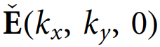

E0 is a constant amplitude setting the far field approximation and the energy conservation theorem. is the wave vector and is the position vector of the focus. . q(kx , ky ) is the apodization factor, which is the factor obtained from the energy conservation theorem, l0(kx , ky ) is the amplitude distribution of the beam and is a unit vector representing the polarization direction of the electric field near the focus.
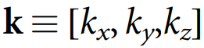


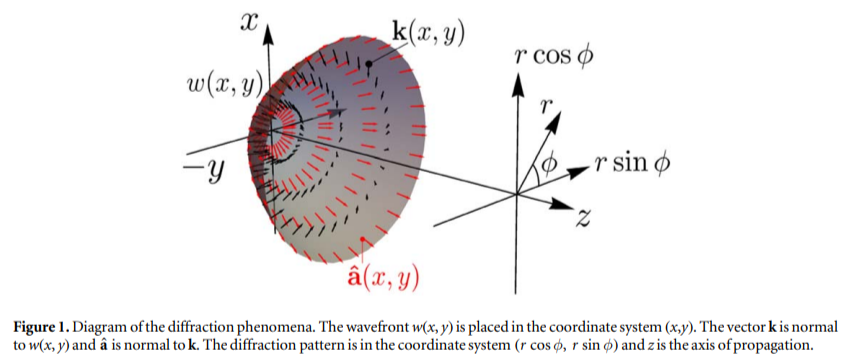
Equation (2) seems very abstract and cumbersome since the integration is over the frequency domain defined by kx , and ky . It will be more understandable if equation (2) will be in terms of the spatial domain since the wavefronts are represented in the spatial domain. In other words a wavefront is typical represented by a function w(x, y), that depends in two independent variables x and y instead of kx , and ky . The main goal of this manuscript is to express equation (2) in a more intuitive way in the spatial domain. In figure 1 we observe that equation (2) considers only plane waves, then [kx , ky , kz ] are given just by real values. Therefore, acknowledging the Malus-Dupin theorem [29], we can get the propagation vector of a wavefront w(x, y) as the normal vector towards w(x, y),

where ∂x w ≡ ∂ w/∂x is the partial derivative of w respect to x and ∂y w ≡ ∂ w/∂y is the partial derivative of w respect to y. kx , ky and kz are the cosine directors in x, y and z directions, respectively, of the wave vector k. In order to express the integration in terms of x and y instead of kx , and ky . The Jacobian can be computed using equation (3), and changing the integrands [30],
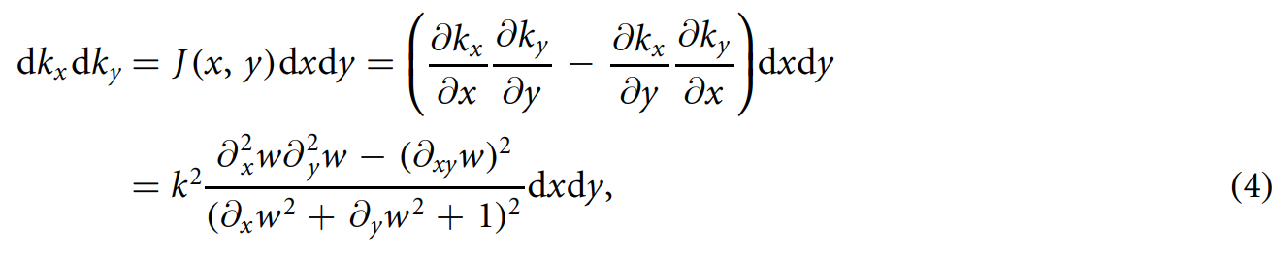
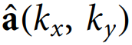
where ∂xy w is the derivative of w respect to x and y. Let us focus on . In fact can adopt several forms depending on the polarization state of the wavefront; the only condition required is that must be orthogonal to k. According to Rodrigues’ rotation formula, [31], all the possible vectors orthogonal to k can be represented as

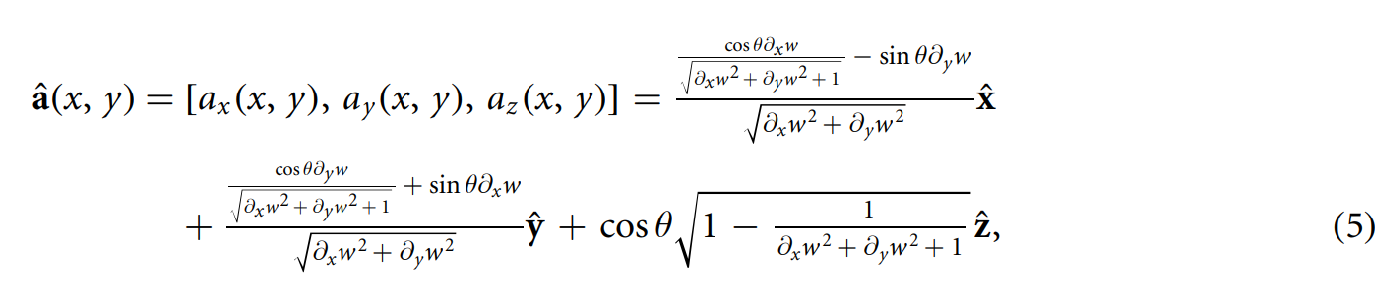
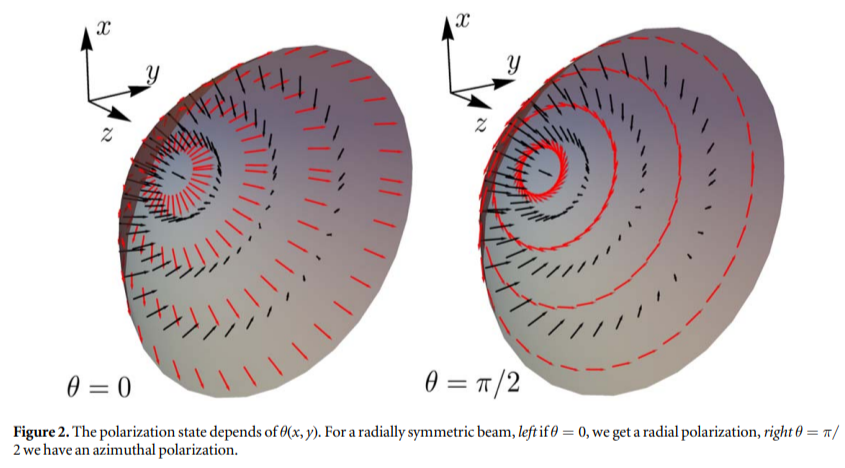
Rodrigues’ rotation formula rotates a vector given an axis and angle of rotation. The axis in this case is the propagation vector k and the vector rotated is the polarization state â, θ is the rotation angle along the plane perpendicular to k. Depending on the value of θ is the polarization state. For example, for a radially symmetric beam, if θ = 0, we have a radial polarization, or if θ = π/2 we get an azimuthal polarization, as shown in figure 2. More generally θ(x, y) can be a function that depends on the position and expresses the polarization aberration function. We recall that â in equation (5) is a unit vector. Notice that equations (3) and (5) are orthogonal.
Finally, if we replace equations(3),(4) and (5) in equation (2), we get the new vector diffraction integral proposed for this article,
Finally, if we replace equations(3),(4) and (5) in equation (2), we get the new vector diffraction integral proposed for this article,
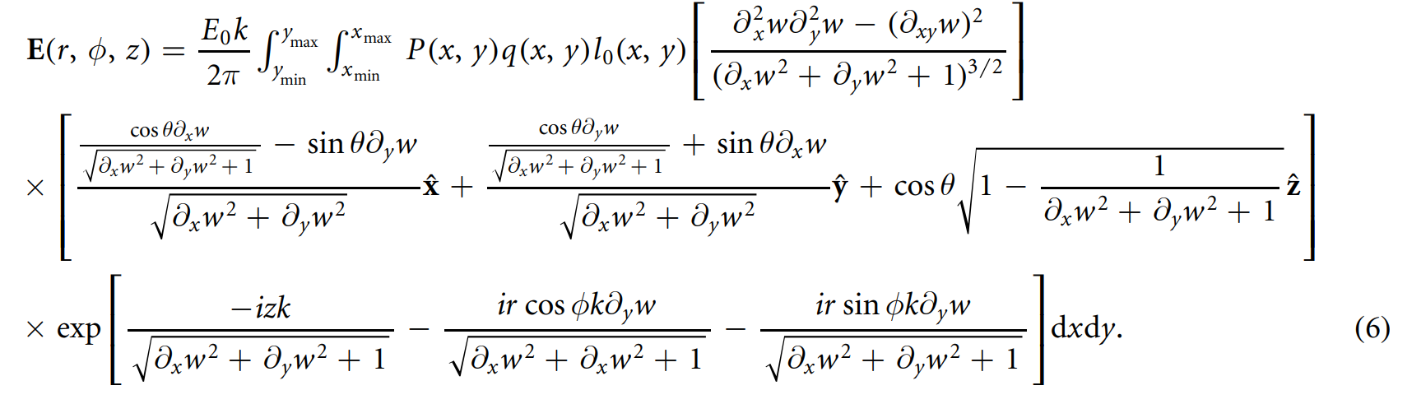
Equation (6) is the most important equation of the manuscript. It describes the diffraction pattern of a polarized freeform wavefront. The wavefront must be a continuous function w(x, y), for example, it can be expressed in terms of Zernike polynomials or any other real smooth continuous function. The polarization depends directly on the function θ(x, y). Without losing generalization, we added the mask P(x, y) in equation (6). P(x, y) can be the information on the mask’s shape. The mask’s shape can be elaborated as P(x, y). By default, equation (6) has a rectangular pupil shape since it is integrated along dx and dy.
Illustrative example
Illustrative example
In this section, we present an illustrative example of diffraction patterns directly computed with equation (6). The caption of each figure indicates the input values of the example being considered. For all the examples q(x, y) = 1 and l0(x, y) = 1.
We present the normalized intensity of the diffraction pattern of a freeform wavefront with a polarization given by . Due to the aberration suffered by the wavefront, the diffraction patterns along x and y differ as expected. Also at the centre of both diffraction patterns, the electric field is zero. The following Mathematica code computes the diffraction pattern
We present the normalized intensity of the diffraction pattern of a freeform wavefront
w[x_,y_]:=c*(+(1/2))
2
x
2
y
θ[x_,y_]:=+y
2
x
ClearAll["`*"]
w[x_,y_]:=c*(+(1/2));wdx[x_,y_]:=2cx;wdy[x_,y_]:=cy;wx[x_,y_]:=++1;wy[x_,y_]:=++1;wz[x_,y_]:=++1;θ[x_,y_]:=+xρα[ρ_,α_]:=ρCos[α];yρα[ρ_,α_]:=ρSin[α];wdxρα[ρ_,α_]:=wdx[ρCos[α],ρSin[α]];wdyρα[ρ_,α_]:=wdy[ρCos[α],ρSin[α]];wρα[ρ_,α_]:=w[ρCos[α],ρSin[α]];wxρα[ρ_,α_]:=wx[ρCos[α],ρSin[α]];wyρα[ρ_,α_]:=wy[ρCos[α],ρSin[α]];wzρα[ρ_,α_]:=wz[ρCos[α],ρSin[α]];
2
x
2
y
-wdx[x,y]
2
wdx[x,y]
2
wdy[x,y]
-wdy[x,y]
2
wdx[x,y]
2
wdy[x,y]
1
2
wdx[x,y]
2
wdy[x,y]
2
x
2
y
FullSimplify[wρα[ρ,α]]
1
4
2
ρ
FullSimplify[wdxρα[ρ,α]]
2cρCos[α]
FullSimplify[wdyρα[ρ,α]]
cρSin[α]
FullSimplify[wxρα[ρ,α]]
-
2cρCos[α]
1+(5+3Cos[2α])
1
2
2
c
2
ρ
Simplification of the aberrated wavefront
Simplification of the aberrated wavefront
This one is in z along z
This one is in y along x - y
This one is in y along x - y
Conclusions
Conclusions
In this manuscript, it was introduced new diffraction integral that considers the shape of the wavefront w(x, y), the polarization state θ, and the form of the mask P(x, y). This integral is mathematically described by equations (6) or (9). Equations (6) and (9) have been tested for several scenarios and the results are as expected, and particularly coincide with [8]. For example, the wavefront is spherical and radially polarized. Also when the wavefront is spherical and the field is linearly polarized. Equations (6) and (9) represent the same integral but the first equation is more friendly to be computed for the polarization that depends on the angle θ(x, y) like radially and azimuthally polarized wavefronts. Equation (9) is more friendly to be computed for input polarization vector. It is important to mention that both integrals are valid if and only if the wavefront w(x, y) is convergent and it is a real smooth continuous function.
References
References
[1] Ignatowsky W V 1907 Diffraktion und reflexion, abgeleitet aus den maxwellschen gleichungen Ann. Phys. 328 875–904
[2] Ignatowsky W V 1908 Diffraktion und reflexion, abgeleitet aus den maxwellschen gleichungen Ann. Phys. 330 99–117
[3] Kottler F 1923 Zur theorie der beugung an schwarzen schirmen Ann. Phys. 375 405–56
[4] Stratton J A and Chu L J 1939 Diffraction theory of electromagnetic waves Phys. Rev. 56 99–107
[5] Green H S and Wolf E 1953 A scalar representation of electromagnetic fields Proc. Phys. Soc.A 66 1129
[6] Wolf E 1959 A scalar representation of electromagnetic fields: II Proc. Phys. Soc. 74 269
[7] Wolf E 1959 Electromagnetic diffraction in optical systems-I. An integral representation of the image field Proc. R. Soc. Lond.A 253 349–57
[8] Richards B and Wolf E 1959 Electromagnetic diffraction in optical systems, II. structure of the image field in an aplanatic system Proc. R. Soc. Lond.A 253 358–79
[9] Dumont J, Fillion-Gourdeau F, Lefebvre C, Gagnon D and MacLean S 2017 Efficiently parallelized modeling of tightly focused, large bandwidth laser pulsesJ. Opt. 19 025604
[10] Guha S and Gillen G D 2007 Vector diffraction theory of refraction of light by a spherical surface J. Opt. Soc. Am.B 24 1–8
[11] Thériault G, De Koninck Y and McCarthy N 2013 Extended depth of field microscopy for rapid volumetric two-photon imaging Opt. Express 21 10095–104
[12] Fahrbach F O, Gurchenkov V, Alessandri K, Nassoy P and Rohrbach A 2013 Light-sheet microscopy in thick media using scanned bessel beams and two-photon fluorescence excitation Opt. Express 21 13824–39
[13] Liu J, Tan J, Wilson T and Zhong C 2012 Rigorous theory on elliptical mirror focusing for point scanning microscopy Opt. Express 20 6175–84
[14] Liu J (ed) 2018 Elliptical Mirrors (2053–2563)(IOP Publishing)
[15] Zhan Q 2004 Trapping metallic rayleigh particles with radial polarization Opt. Express 12 3377–82
[16] Varin C, Piché M and Porras M A 2005 Acceleration of electrons from rest to gev energies by ultrashort transverse magnetic laser pulses in free space Phys. Rev.E 71 026603
[17] Jahn K and Bokor N 2013 Solving the inverse problem of high numerical aperture focusing using vector slepian harmonics and vector slepian multipole fields Opt. Commun. 288 13–6
[18] Kant R 1993 An analytical solution of vector diffraction for focusing optical systemsJ. Mod. Opt. 40 337–47
[19] April A, Bilodeau P and Piché M 2011 Focusing a tm 01 beam with a slightly tilted parabolic mirror Opt. Express 19 9201–128 Phys. Scr. 98 (2023) 115503 R G González-Acuña and S Thibault
[20] Quabis S, Dorn R, Eberler M, Glöckl O and Leuchs G 2001 The focus of light-theoretical calculation and experimental tomographic reconstruction Appl. Phys. B 72 109–13
[21] Dehez H, April A and Piché M 2012 Needles of longitudinally polarized light: guidelines for minimum spot size and tunable axial extent Opt. Express 20 14891–905
[22] April A and Piché M 2010 4π Focusing of TM01 beams under nonparaxial conditions Opt. Express 18 22128–40
[23] González-Acuña R G 2022 Stigmatic singlet with a user-defined apodization pupil function J. Opt. Soc. Am. A 39 213–8
[24] González-Acuña R G, Borne J and Thibault S 2021 On the diffraction of a high-na aplanatic and stigmatic singlet J. Opt. Soc. Am.A 38 1332–8
[25] Kim J, Wang Y and Zhang X 2018 Calculation of vectorial diffraction in optical systemsJ. Opt. Soc. Am.A 35 526–35
[26] Sugic D, Dennis M R, Nori F and Bliokh K Y 2020 Knotted polarizations and spin in three-dimensional polychromatic waves Phys. Rev. Res. 2 042045
[27] Ferrer-Garcia M F, D’Errico A, Larocque H, Sit A and Karimi E 2021 Polychromatic electric field knots Phys. Rev. Res. 3 033226
[28] Novotny L and Hecht B 2012 Principles of Nano-optics (Cambridge University Press) (https://doi.org/10.1017/CBO9780511794193 )
[29] González-Acuña R G and Chaparro-Romo H A 2020 Stigmatic Optics (Institute of Physics Publishing) (https://doi.org/10.1088/978-0-7503-3463-1 )
[30] Boas M L 2006 Mathematical Methods in the Physical Sciences (Wiley)
[31] Rodrigues O 1840 Des lois géométriques qui régissent les déplacements d’un système solide dans l’espace, et de la variation des coordonnées provenant de ces déplacements considérés indépendamment des causes qui peuvent les produire J. Math. Pures Appl. 5 380–440
[32] Zeng X and Chen X 2019 Characterization of tightly focused vector fields formed by off-axis parabolic mirror Opt. Express 27 1179–98
[33] Panneton D, St-Onge G, Piché M and Thibault S 2016 Exact vectorial model for nonparaxial focusing by arbitrary axisymmetric surfacesJ. Opt. Soc. Am.A 33 801–10
[34] Borne J, Panneton D, Piché M and Thibault S 2019 Analytical inversion of the focusing of high-numerical-aperture aplanatic systems J. Opt. Soc. Am.A 36 1642–7
[35] Kant R 1995 An analytical method of vector diffraction for focusing optical systems with seidel aberrations II: astigmatism and coma J. Mod. Opt. 42 299–320
[36] Kant R 1993 An analytical solution of vector diffraction for focusing optical systems with seidel aberrations: I. spherical aberration, curvature of field, and distortion J. Mod. Opt. 40 2293–310
[37] Wang Z, Baladron-Zorita O, Hellmann C and Wyrowski F 2020 Generalized debye integral Opt. Express 28 24459–70
[38] González-Acuña R G and Thibault S 2022 Exact vectorial model for nonparaxial focusing of freeform wavefronts Opt. Express 30 23656–63
CITE THIS NOTEBOOK
CITE THIS NOTEBOOK
General diffraction integral for converging freeform vectorial fields
by Rafael G. González-Acuña
Wolfram Community, STAFF PICKS, October 23, 2023
https://community.wolfram.com/groups/-/m/t/3054293
by Rafael G. González-Acuña
Wolfram Community, STAFF PICKS, October 23, 2023
https://community.wolfram.com/groups/-/m/t/3054293