Pipe Flow for Power-Law and Carreau Fluids
Pipe Flow for Power-Law and Carreau Fluids


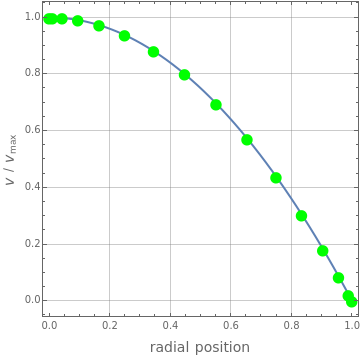
The velocity profile versus radial position is obtained for the steady-state laminar flow of power-law and Carreau fluids in a pipe. The pipe radius is and the applied pressure gradient is =1. For both the power-law and Carreau fluids, the green dots represent the solutions obtained using the Chebyshev collocation technique. The velocity profile for a power-law fluid (the blue curve) is obtained from the analytical solution given by [1, 2]. The velocity profile for a Carreau fluid (the red curve) is obtained using the shooting technique and the built-in Mathematica function NDSolve. For both fluids, you can vary the exponent (see Details section).
R=1
ΔP
L
v(r)=(-)/(1+1/n)
1/n
ΔP
2Lκ
1+1/n
R
1+1/n
r
Details
Details
A non-Newtonian fluid has a viscosity that changes with the applied shear force. For a Newtonian fluid (such as water), the viscosity is independent of how fast it is stirred, but for a non-Newtonian fluid the viscosity is dependent on the stirring rate. It gets either easier or harder to stir faster for different types of non-Newtonian fluids. Different constitutive equations, giving rise to various models of non-Newtonian fluids, have been proposed in order to express the viscosity as a function of the strain rate.
In power-law fluids, the relation is assumed, where is the power-law exponent and is the power-law consistency index. Dilatant or shear-thickening fluids correspond to the case where the exponent in this equation is positive, while pseudo-plastic or shear-thinning fluids are obtained when . The viscosity decreases with strain rate for , which is the case for pseudo-plastic fluids (also called shear-thinning fluids). On the other hand, dilatant fluids are shear thickening. If , the Newtonian fluid behavior can be recovered. The power-law consistency index is chosen to be . For the pseudo-plastic fluid, the velocity profile is flatter near the center, where it resembles plug flow, and is steeper near the wall, where it has a higher velocity than the Newtonian fluid or the dilatant fluid. Thus, convective energy transport is higher for shear-thinning fluids when compared to shear-thickening or Newtonian fluids. For flow in a pipe of a power-law fluid, an analytical expression is available[1, 2].
η=κ
n-1
γ
n
κ
n<1
n<1
n=1
κ=1.5
-5
10
According to the Carreau model for non-Newtonian fluids, first proposed by Pierre Carreau, .
μ-=(-)
(γ)
μ
∞
μ
0
μ
∞
n-1
2
1+
2
λ
2
γ
For , this reduces to a Newtonian fluid with . For , we obtain a power-law fluid with .
λ≪1
γ
μ=
μ
0
λ≫1
γ
μ=κ
n-1
γ
The infinite-shear viscosity and the zero-shear viscosity of the Carreau fluid are taken equal to and , respectively. The relaxation parameter is set equal to .
η
∞
η
0
0
2.04×
-3
10
λ
0.2
For the flow of a Carreau fluid in a pipe, only numerical solutions are available.
References
References
[1] H. Binous, "Introducing Non-Newtonian Fluid Mechanics Computations with Mathematica in the Undergraduate Curriculum," Chemical Engineering Education, 41(1), 2007 pp. 59–64.
[2] J. O. Wilkes, Fluid Mechanics for Chemical Engineers, Upper Saddle River, NJ: Prentice Hall, 1999.
Permanent Citation
Permanent Citation
Housam Binous
"Pipe Flow for Power-Law and Carreau Fluids"
http://demonstrations.wolfram.com/PipeFlowForPowerLawAndCarreauFluids/
Wolfram Demonstrations Project
Published: January 14, 2014