Corrosion Mechanism for Stainless Steel
Corrosion Mechanism for Stainless Steel


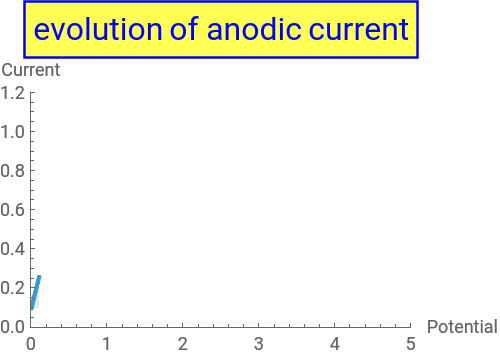
Corrosion degrades materials, which is a source of significant expense. This Demonstration explains how steel corrodes. A steel plate (whose main component is iron) is corroded in an acid solution. This plate plays the role of a working electrode in an electrochemical cell, for which the current and potential can be measured.
Details
Details
When the metal is dissolved in a corrosive environment, the anodic reaction takes place at the interface.
In the activity domain, the anodic current increases and the overall reaction is .
Fe→FeOH→
+
)
ads
2+
Fe
In the prepassivity domain, the formation of the oxide film protects the metal from the corrosive environment. The anodic current decreases according to the reaction
Fe(OH)
2
+
Fe(OH)
ads
H
2
Fe(OH)
2
+
H
-
e
In the passivity domain, the protective layer totally separates the metal from the environment. The anodic current is stable and at a minimum.
In the transpassivity domain, the layer ruptures. The metal continues to corrode and the anodic current again increases via
Fe→+2
2+
Fe
-
e
Permanent Citation
Permanent Citation
Quang-Dao Trinh
"Corrosion Mechanism for Stainless Steel"
http://demonstrations.wolfram.com/CorrosionMechanismForStainlessSteel/
Wolfram Demonstrations Project
Published: December 1, 2011