I have created an open source, open access (free) electronic textbook, an ebook, introducing the concepts of communication systems. The purpose of this ebook is to bring the material alive through the use of student driven interactive graphics and dynamic performance metric calculations. In-line interactive questions are included to provide the students with rapid feedback regarding their understanding of the material. The ebook is distributed as a CDF file and was used as the required text in EECS 562 Introduction to Communication Systems (a 3 hour lecture and 1 hour lab course) at the University of Kansas in the spring of 2021.
The ebook contains 348 figures of which 104 are interactive graphics. The instructor version of the ebook is compatible with Mathematica desktop version 12.3. In the spring of 2021 I lectured directly from the notebook using Mathematica’s “Classic Slide Show” functionality. Separate Mathematica notebooks containing solutions for the end-of-chapter questions are available enabling instructors the ability to change the problems and obtain new solutions. The instructor and homework notebooks are available to upon request (contact vsfrost@ku.edu).
Introduction to Communication Systems: An Interactive Approach Using the Wolfram Language
Publisher: University of Kansas Libraries
Year: 2021
ISBN: 9781936153251 (ebook)
Here is a link to the ebook: https://kuscholarworks.ku.edu/handle/1808/31779
A paper describing the ebook has been submitted to the 2021 American Society for Engineering Education Midwest Section Conference, see Teaching the Basic Concepts of Communications Systems Using Interactive Graphics and Calculations.
Overview
Overview
This ebook provides a pedagogical approach to teaching the fundamentals of communication systems using interactive graphics and in-line questions. After a review of signals and systems the material opens with describing the transformation of bits into digital baseband waveforms. Double-sideband suppressed carrier modulation and quadrature modulation then provide the foundation for the discussions of Binary Phase Shift Keying (BPSK), Quadrature Phase Shift Keying (QPSK), M-ary Quadrature Amplitude Modulation (M-QAM), M-ary Phase Shift Keying (MPSK), and the basic theory of Orthogonal Frequency Division Multiplexing (OFDM). Traditional analog modulation systems are also described. Systems trade-offs, including link budgets, are emphasized. Interactive graphics allow the students to engage with and visualize communication systems concepts. Interactivity and in-line review questions enables students to rapidly examine system tradeoffs and design alternatives. The topics covered build upon each other culminating with an introduction to the implementation of OFDM transmitters and receivers, the ubiquitous technology used in WiFi, 4G and 5G communication systems.
Philosophy
Philosophy
◼
Keep it simple.
◼
Ease of access; entire ebook in one file (recent comparable example, Fourier Transforms Using Mathematica, by Joseph W. Goodman, 2020).
◼
Create Open Educational Resources (OER) material, e.g., see Open Textbook Library https://open.umn.edu/opentextbooks/.
◼
Student version of the ebook only requires Wolfram Player, free to the students.
Topics covered
Topics covered
1. Introduction to Communication Systems: The components of a communication system are introduced and the need to design systems to overcome path loss, distortion and noise described.2. Signals and Systems Review: Understanding signals and systems is a prerequisite for the study of communications systems and are reviewed first. 3. Baseband Data Transmission: Communication systems transport information represented as bits. The transformation of bits into baseband signals is discussed, including the concepts of M-ary signals and intersymbol interference (ISI). 4. Time-Division Multiplexing: Communication resources (time and frequency) are shared. Here TDM is discussed.5. Double Sideband-Suppressed Carrier Modulation: A method for translating a baseband information signal to a specific carrier frequency is discussed. This core function of a communication system; DSB-SC is discussed here. 6. Quadrature Multiplexing and Modulation: With only knowledge of DSB-SC, quadrature multiplexing and quadrature modulation techniques are presented, including binary phase shift keying (BPSK), quadrature phase shift keying (QPSK) and quadrature amplitude modulation (QAM).7. Frequency Division Multiplexing and Orthogonal Frequency Division Multiplexing: Next another resource sharing method,FDM, is discussed. The knowledge of FDM and quadrature modulation are combined to develop the concept of Orthogonal Frequency Division Multiplexing (OFDM). 8. Double sideband-large carrier (DSB-LC)- Commercial AM: The underlying theory of DSB-LC and the architecture of different types of DSB-LC transmitters and receivers is presented.9. Single sideband (SSB) and vestigial sideband (VSB): The underlying theory of SSB and VSB and the architecture of different types of SSB and VSB transmitters and receivers is presented10. Frequency and Phase Modulation (FM/PM): The underlying theory of FM and PM and the architecture of different types of FM and PM transmitters and receivers is presented.11. Superheterodyne Receiver: The superheterodyne receiver architecture is discussed. 12. Communications Channels, Noise and Link Budgets: Communication systems must deal with “noisy” signals. The characterization of noise and overcoming noise by using additional transmitter power, low noise devices, and/or larger antennas, is addressed via the definition of noise figure, noise temperatures, and antenna gain. The associated system tradeoffs are exposed using link budgets. 13. Performance of Analog Communications Systems in Noise: The impact of noise on analog communication techniques, DSB-SC, DSB-LC, SSB, and FM is presented. The post detection signal-to-noise (S/N) is derived. 14. Performance of Digital Communications Systems in Noise: The impact of noise on digital RF systems is discussed and formulas for the bit error rate presented.15. Multimegabit/sec Terrestrial Wireless Communication Systems: Applying OFDM to achieve high speed data transfer over terrestrial channels using the real-life examples of LTE/5G and Wi-Fi is discussed.16. Introduction to Error Detection and Correction Techniques: An introduction to error control coding (ECC) techniques is provided; these methods are used to detect and/or correct transmission errors. Shannon channel capacity is introduced. Appendix- net*TIMS FreeWire Laboratory Experiments: In the spring of 2021 my class had students attending the lectures and the associated hardware laboratory in-person as well as some individuals who could only attend both remotely. Remote access to laboratory experiments using real hardware was enabled by using the Emona net*TIMS FreeWire system see https://www.emona-tims.com/emona-product/nettims-freewire/. Communication systems experiments are included in an appendix that can performed remotely using the Emona net*TIMS FreeWire system.
Sample segments from the book
Sample segments from the book
From Section 3.4 Intersymbol Interference and Pulse Shaping
From Section 3.4 Intersymbol Interference and Pulse Shaping
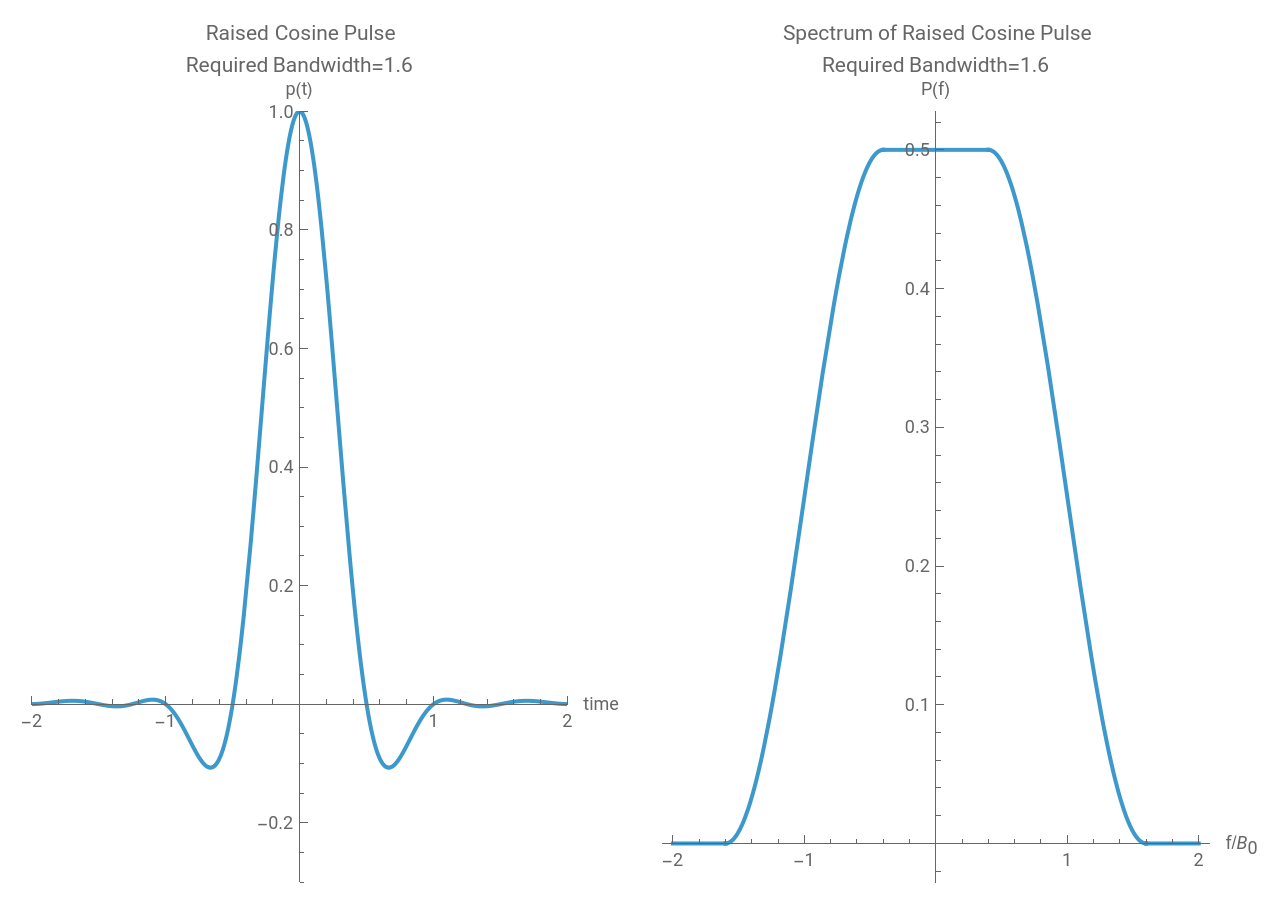
Unfortunately, it is not practical to construct a system with p(t) from an ILPF as required above. However, there are other pulse shapes that meet the Nyquist criterion as required to remove ISI. A common pulse shape that meets the Nyquist criterion is called the raised cosine pulse shape and is given as,
In[]:=
p(t)=;
sin(2πt)cos(2παt)
B
0
B
0
2πt1-16
B
0
2
α
2
B
0
2
t
Note when α=0 p(t) becomes a sinc function. is the minimum system bandwidth = and the parameter α is called the roll-off factor and controls the system (or transmission) bandwidth = associated with the raised cosine pulse shape. The transmission bandwidth can be shown to be
B
0
r
s
2
B
T
B
T
B
T
B
0
The bandwidth required over the minimum, i.e., the excess required bandwidth, when using a raised cosine pulse shape is .
αB
0
Keep in mind that the transmission bandwidth is the bandwidth of the baseband signal.
B
T
Example: Consider a 4-ary baseband signal with a symbol rate of 6000 symbols/sec the = 3000 Hz. If a raised cosine pulse shape is used with α=1, then the required transmission bandwidth would be 6000 Hz.
B
0
Out[]=
Below is an interactive plot showing raised cosine pulse and its spectrum as a function of the roll-off factor α. Observe that as roll-off factor approaches zero the transfer function approaches an ILPF.
P(f)=
1 2 B 0 | 0≤f< B 0 |
1 4 B 0 π(Abs[f]- B 0 2 B 0 | B 0 B 0 B 0 |
0 | 2* B 0 B 0 |
Out[]=


From Section 7.3 Orthogonal Frequency Division Multiplexing
From Section 7.3 Orthogonal Frequency Division Multiplexing
The guard bands wastes bandwidth, that is, the spectrum used by guard bands cannot be used to directly send user information. Guard bands are the cost (overhead) needed for implementation of the receiver BPFs. Thus, minimizing the size of the guard band is desirable.
Next we will consider using FDM for a special case of transmitting two NRZ signals using BPSK with a special relationship between the the bit (symbol) time, , and difference between the carrier frequences Δf.
T
s
This form of FDM is given the special name of orthogonal frequency division multiplexing, ODFM.
In this case the signals can be received even though the spectrum of the two signals significantly overlap. There is no explicit guard band.
The OFDM signal is written as
This form of FDM is called orthogonal frequency division multiplexing, ODFM and is used in WiFi and LTE and 5G.
Additional Examples
Additional Examples
Several examples are given below to provide a flavor of the student driven interactive graphics and dynamic performance metric calculations included in the ebook.
The mathematics of intersymbol interference (ISI) are not conducive to understanding the underlying concept; the figures below shows two cases of an interactive graphic explicitly showing impact of ISI as the bandwidth and roll-off factor changes; this interactive is particularly useful for explaining the benefit of using the additional bandwidth required by raised cosine pulses.
Link budgets are commonly calculated using a spreadsheet. An imbedded interactive table in the ebook provides spreadsheet functionality. A link budget with parameters modeling the Perseverance Mars rover communications system is given below where parameters in black system are user input and red indicates calculated values.
To help the students visualize the detection process for digital RF modulation techniques interactive graphs are included to show the samples of output of the in-phase (I) and quadrature (Q) integrate-and-dump filters. An example for 8-PSK is given below. The students can change to noise variance to see how the distribution of the points in the I/Q graphs changes or change the signal amplitude to see how the signaling point spread out as the signal power is increased; this process enables them to visualize the minimum distance detection algorithm.