Comparing Wolfram Model and causal set entanglement entropies
by Julia Dannemann - Freitag
Imperial College London
by Julia Dannemann - Freitag
Imperial College London
This project aims to establish computational evidence for a proposed relation between spacetime entanglement entropy as calculated in Causal Set Theory through scalar fields and in the Wolfram Model through multiway systems. Tools are built to compare the two and minimise issues of dimensional dependence in the calculation. Despite some encouraging preliminary results, due to time and computational constraints it is not possible to come to a definitive conclusion regarding the question posed. It is recommended that these tools be applied to multiway systems of greater size.
Background
Background
Causal Set Theory is an approach to Quantum Gravity proposed in the 1980s (Bombelli et al 1987), with the core premise that spacetime consists of discrete points and the causal connections between them. Causal sets mathematically are discrete sets with an acyclic partial ordering relation. Unsurprisingly, connections between this theory and the Wolfram Model (WM) have been found, perhaps most crucially that causal networks can be seen as analogous to causal sets (Gorard 2020). Each have their own approach to calculating entanglement entropy for regions of spacetime. In the WM, the entropy is tied to the branchial graph, while for Causal Set Theory it can be deduced from scalar fields on the sets. Showing that these two methods are equivalent would allow calculations of, for instance, black hole entropies using not only the Causal Set approach but also branchial graphs. While these are generally more computationally intensive to calculate, they more reliably produce results.
Key Concepts
Key Concepts
Causal Networks: In the WM, hypergraphs are considered the analogue of spatial hypersurfaces, while the update rules determine how the hypergraphs develop in time. This evolution is represented by a causal network, graphs where each vertex is an updating event on the hypergraph and two vertices are causally connected if the edges resulting from the first update are the input for the second update. Thus, a causal network is both directed and acyclic.
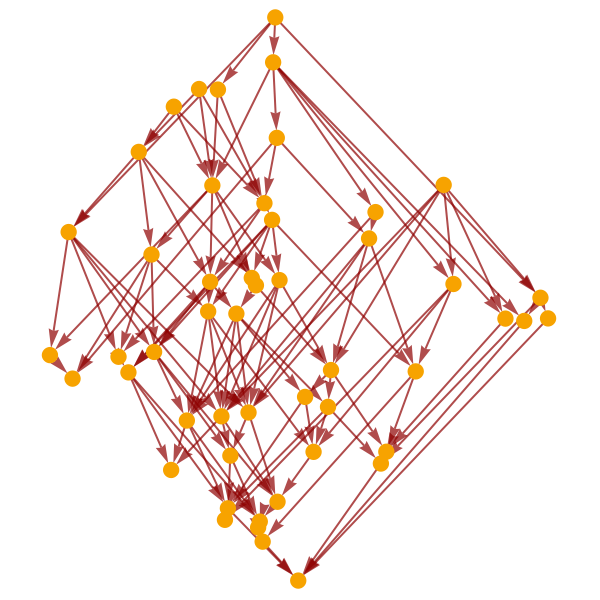
Causal Sets and Hasse Diagrams: The points of a causal set are most commonly visualised through the use of Hasse Diagrams, where each vertex is a point and the directed edges represent the immediate causal relations. Thus, taking the transitive reduction of a causal network yields the Hasse Diagram of the related causal set.
Figure 1: The Hasse Diagram of a 50-point causal set sprinkled into a 1+1D causal diamond
SeedRandom[2345];sprinkling=ResourceFunction["CurvedSpacetimeRegionSprinkling"][Abs[x]+Abs[y]<N[(Sqrt[0.5]/2)],{x,y},{{-0.5,0.5},{-0.5,0.5}},50];caugraph=Graph[sprinkling["CausalGraph"],ImageSize{300,300}]
Out[]=
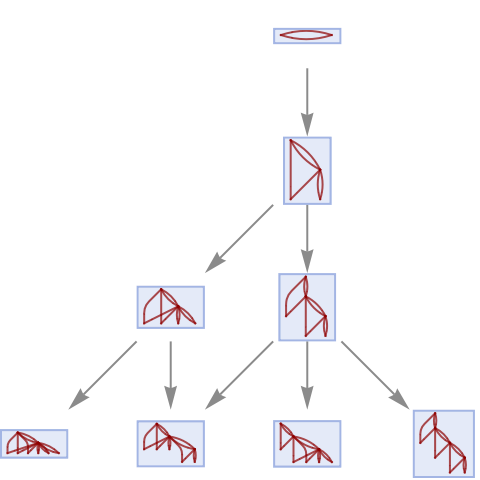
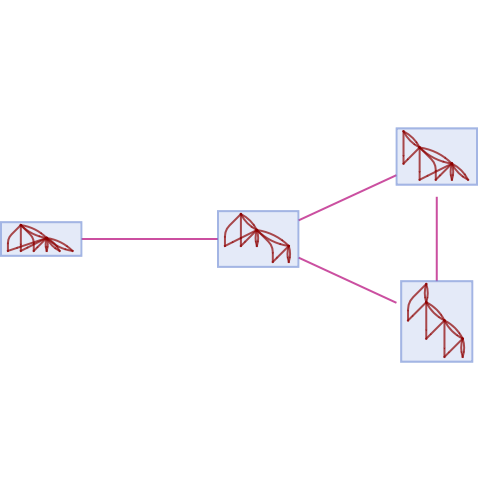
Multiway and Branchial Graphs: In many cases there is ambiguity as to how a rewrite rule is to be applied to a given hypergraph. A multiway evolution graph represents all possible rewritings. Relevant here is the multiway evolution causal graph, where each vertex is a possible causal network and there exists an edge between two vertices if one can be transformed into the other by applying an update rule. A branchial graph shows how closely related the elements of the last layer are. In the WM, entanglement entropy is measured in terms of these two graphs. Thus, it is expected that the causal sets corresponding to two causal networks close on the branchial graph will have similar entropy, while this is less likely if they are greatly separated.
Spacetime Entanglement Entropy: Entanglement entropy is traditionally defined locally in time. This becomes less useful when discretising spacetime itself and thus both the WM and Causal Set Theory define it across both space and time. This can find use especially when studying black holes, which are inherently non-local.
Figure 2: A multiway evolution causal graph after three steps and its branchial graph.
WMCausalMultiwaySystem[{{x,y},{y,z}}{{x,y},{y,z},{z,w}},{{0,0},{0,0}},3]WMCausalMultiwaySystem[{{x,y},{y,z}}{{x,y},{y,z},{z,w}},{{0,0},{0,0}},3,"BranchialGraph"]
Out[]=
Out[]=
Method
Method
Scalar fields can be defined on a causal set by taking their value at each point on the set instead of them forming a continuous function. From these scalar fields the Pauli-Jordan operator and the Wightman Function can be constructed and through them entanglement entropy can be defined (Sorkin 2012):
Out[]=

Out[]=

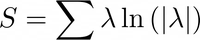
Where Δ is the Pauli-Jordan operator, W is the Wightman Function and both are defined for a pair of points j,k. This in turn allows the entanglement entropy of a subset of the causal set to be defined in terms of the eigenvalues solving the equation:
Out[]=

For Δ, W defined over the subset. If the scalar fields are linearly independent, then the λs will be defined and the entropy S is given by:
Out[]=
The first step of the project is to implement this entropy calculation for a sprinkled causal set. The most immediate problem is that of determining the relevant scalar fields to construct the operators from. Since the causal set D'Alembertian is defined by how it acts on scalar fields, and is thus not generally invertible, this is a non-trivial problem.
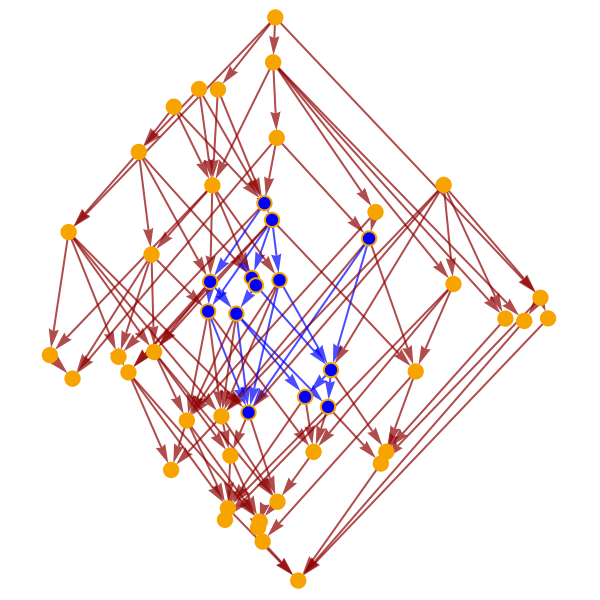
Figure 3: The Hasse diagram of the sprinkled causal set, where the subgraph within an inner region corresponding to a causal diamond of half the radius of the outer diamond is highlighted in blue. Given below is the entanglement entropy of the highlighted region.
coords=VertexList[caugraph];subPoints=Select[coords,Abs[First[#]]+Abs[Last[#]]<N[(Sqrt[0.125]/2)]&];HighlightGraph[caugraph,{Style[Subgraph[caugraph,subPoints],Blue]},ImageSize{300,300}]
Out[]=
Out[]=
0.559526
As the Minkowski space Green's Functions are well defined for integer dimensions, these can instead be used to construct the Pauli-Jordan operator and Sorkin-Johnston (vacuum) Wightman Function (X et al 2017).

Where and are the retarded and advanced Causal Set Green's Functions respectively. The Wightman Function can then be found by restricting to the positive eigenspace of Δ. However, while this can yield entropy values, it does not do so consistently as the Pauli-Jordan operator is no longer constructed from linearly independent scalar fields. The severity of this phenomenon is likely due to edge effects, so entropy calculations for small causal sets are expected to be indeterminate more often. The Eigenvalue equation can be solved in two ways, the first is by inverting the Wightman Function and calculating the eigenvalues of the resulting matrix. While this is the faster approach, it is less robust as the function is not always well behaved. The alternative is to construct the vector v in the image of the Pauli-Jordan operator, which is slower but more robust.


The next step is to apply this calculation to the causal sets analogous to the causal networks in a multiway evolution graph. Here the primary issue is computation time. As the causal networks are still small after several steps, calculating their entropy is not always possible. Furthermore, while the size of the networks grows slowly, the multiway evolution graph does not. Due to this, and the time constraints inherent in the project, only the first five steps of the above multiway system have been calculated completely, along with part of the system after six steps. To combat the issue of indeterminate values, both versions of the entropy calculation are used. Preference is given to the more robust method, but if it is unable to determine a value and the faster method can, then the value of the faster method is chosen.
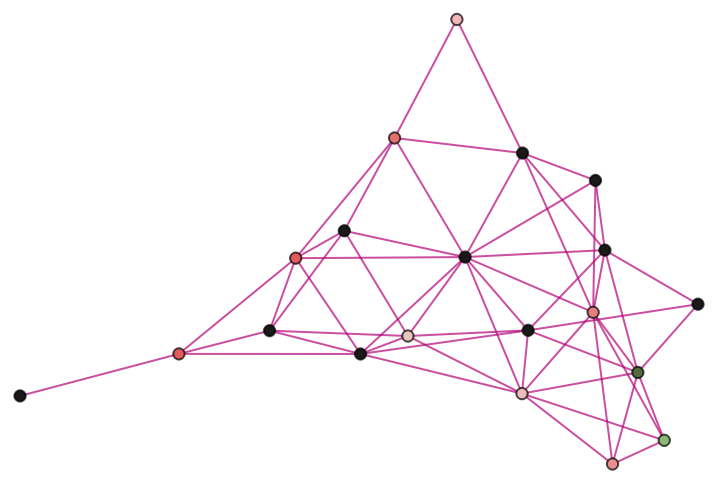
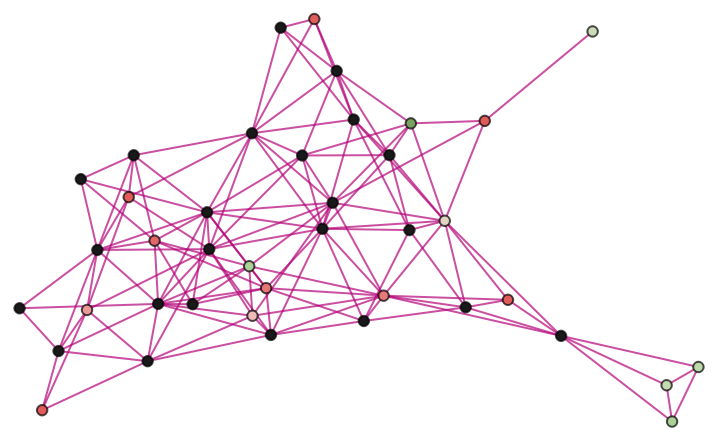
Figure 4 shows the branchial graphs for the same multiway evolution as in figure 2 but evolved for five and six steps respectively. Due to the great computational cost involved in calculating these, the six-step branchial graph was constructed through Monte-Carlo sampling of individual branches of the multiway graph and may thus be incomplete.
Figure 4 shows the branchial graphs for the same multiway evolution as in figure 2 but evolved for five and six steps respectively. Due to the great computational cost involved in calculating these, the six-step branchial graph was constructed through Monte-Carlo sampling of individual branches of the multiway graph and may thus be incomplete.
Figure 4: The branchial graphs after evolving the multiway system for five and six steps. The entanglement entropy for a subset slightly smaller than each set is represented by the colour of the vertex from highest to lowest white-black. Indeterminate entropies are also marked as black. The second graph has been produced via Monte Carlo sampling, and therefore is potentially incomplete.
Out[]=
Out[]=
The other main issue is that the current Causal Set entropy analysis is both dimension-dependent and, since it depends on the Green's Functions, only designed for integer-dimensional causal sets. The grown causal sets are, based on Myrheim-Meyer estimators (Meyer 1989), not of integer dimension (they are, however, in this case all closest to 1+1D) and so this is another source of uncertainty. This can be mitigated somewhat by calculating the entropy for the closest integer dimension.
Figure 5: List plot of the average difference in entropy of points separated by the same number of edges on the branchial graph after 6 steps, where points are separated from themselves by 1.
Out[]=
Despite all confounding factors, figure 5 nevertheless suggests that causal networks close to each other on average have a lower difference in entropy than causal networks with a greater separation. While this is an encouraging result, it is not sufficient to conclude that there is indeed a relation. Alongside computational evidence, an analytic proof would be valuable in confirming or denying the hypothesis of this project.
Concluding remarks
Concluding remarks
The work so far, though showing some encouraging results, does not provide enough evidence either way as to whether there exists a relation between Causal Set and WM entanglement entropy. However, the tools developed here are sufficiently general that they could easily be applied to larger multiway systems. It is especially recommended to select those multiway systems that develop larger causal sets in fewer steps. If a relation between the two approaches can be established, it would further be important to determine its exact nature.
Keywords
Keywords
◼
Entanglement Entropy
◼
Causal Sets
◼
Multiway Systems
◼
Branchial Graphs
Acknowledgments
Acknowledgments
I would like to thank my mentor, Jonathan Gorard. He provided crucial insight into the project and taught me much about physics, mathematics and functional programming. This project would not have gotten where it did without him.
I would also like to thank Cameron Beetar, who acted as my second mentor and guided me through the process of learning a new programming language.
Both created a welcoming environment at the summer school for myself and their other students, who I now consider friends.
I would also like to thank Cameron Beetar, who acted as my second mentor and guided me through the process of learning a new programming language.
Both created a welcoming environment at the summer school for myself and their other students, who I now consider friends.
References
References
◼
Bombelli, L., Lee, J., Meyer, D. & Sorkin, R.D. 1987, "Space-time as a causal set", Physical review letters, vol. 59, no. 5, pp. 521-524.
◼
Gorard, J. 2020, "Algorithmic Causal Sets and the Wolfram Model".
◼
Sorkin, R.D. 2012, "Expressing entropy globally in terms of (4D) field-correlations".
◼
X, N., Dowker, F. & Surya, S. 2017, "Scalar field Green functions on causal sets", Classical and quantum gravity, vol. 34, no. 12, pp. 124002.
◼
Meyer, David A. (David Alan) The dimension of causal sets, Massachusetts Institute of Technology.