ORIGINAL ARTICLE: Dainotti, Maria Giovanna, Giada Bargiacchi, Aleksander Łukasz Lenart, and Salvatore Capozziello (2024). The Scavenger Hunt for Quasar Samples to Be Used as Cosmological Tools, Galaxies 12, no. 1: 4. https://doi.org/10.3390/galaxies12010004
Article Abstract: Although the Λ Cold Dark Matter model is the most accredited cosmological model, information at high redshifts (z) between type Ia supernovae and the Cosmic Microwave Background is crucial to validate this model further. To this end, we have discovered a sample of 1132 quasars up to exhibiting a reduced intrinsic dispersion of the relation between ultraviolet and X-ray fluxes, = 0.22 vs. = 0.29 (24% less), than the original sample. This gold sample, once we correct the luminosities for selection biases and redshift evolution, enables us to determine the matter density parameter with a precision of 0.09. Unprecedentedly, this quasar sample is the only one that, as a standalone cosmological probe, yields such tight constraints on while being drawn from the same parent population of the initial sample.
(𝑧=2.26)
(𝑧=1100)
𝑧=7.54
𝛿
F
𝛿
F
Ω
M
Ω
M
Introduction
Introduction
This Wolfram notebook describes How to derive luminosity distance of QSOs from the - relation
L
X
L
UV
Import your sample of QSOs
Import your sample of QSOs
We called our file “total_final _sources.txt” (attached) and it is stored in the same directory as the notebook itself. The structure of the columns should be as follow: {id, redshift, Flux in UV, error on flux in UV, Flux in X, error on flux in X}
SetDirectory[NotebookDirectory[]]data=Import["total_final_sources.txt","Data"];
C:\Users\ahmed\Documents\MOD trials\SP Processed posts\The Scavenger Hunt for Quasar Samples to Be Used as Cosmological Tools
Derivation of observational luminosity distance dL
Derivation of observational luminosity distance
d
L
The luminosities in the X-ray band and in the UV band are connected through an empirical equation (Dainotti et al. (2023)):We rewrite the above equation from the definition of luminosity distance and use the κ factor to convert Mpc to cm:We present further steps of algebraic operations to obtain equation for luminosity distance:The final equation:Thus if the coefficients of the correlation are known, we can compute the observational luminosity distance and compare it with models
Log10[]-Log10[1+z]=γLog10[]-Log10[1+z]+β
L
X
k
L
X
L
UV
k
L
UV
Log10[*4Pi]-Log10[1+z]=γLog10[*4Pi]-Log10[1+z]+β
F
X
2
(*κ)
d
L
k
L
X
F
UV
2
(*κ)
d
L
k
L
UV
Log10[]+Log10[4Pi]+2Log10[*κ]-Log10[1+z]=γLog10[]+Log10[4Pi]+2Log10[*κ]-Log10[1+z]+β
F
X
d
L
k
L
X
F
UV
d
L
k
L
UV
2(1-γ)Log10[*κ]=γLog10[]-Log10[]+-γLog10[1+z]+(γ-1)Log10[4Pi]+β
d
L
F
UV
F
X
k
L
X
k
L
UV
Log10[]=Log10[]-Log10[]+Log10[1+z]+-Log10[κ]
d
L
γ
2(1-γ)
F
UV
1
2(1-γ)
F
X
-γ
k
L
X
k
L
UV
2(1-γ)
(γ-1)Log10[4Pi]+β
2(1-γ)
Now we apply it to our data
Now we apply it to our data
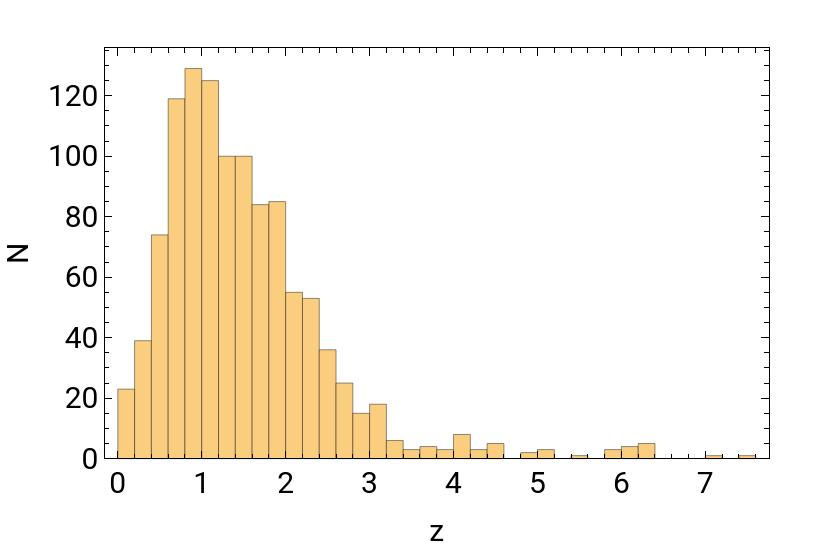
Check the distribution of redshift
Histogram[data[[All,2]],PlotRangeAll,FrameTrue,FrameLabel{{"N",""},{"z",""}},FrameStyleDirective[Black,15]]
Set parameters of the correlation
γ=0.61;β=7.8;γerr=0.01;βerr=0.2;δ=0.084;kLX=3.31;kLXerr=0.08;kLUV=4.39;kLUVerr=0.12;
units=3.086×;
24
10
Define formula for luminosity distance
LumDist[γ1_,β1_,kLX1_,kLUV1_,Log10FUV_,Log10FX_,z_]:=(Log10FUV)-(Log10FX)+Log10[1+z]+-Log10[units]
γ1
2(1-γ1)
1
2(1-γ1)
(kLX1-kLUV1*γ1)
2(1-γ1)
(γ1-1)Log10[4Pi]+β1
2(1-γ1)
Compute equation for errorbars with the derivative method
Clear[LumDist]Clear[FUV,FX]Sqrt++
2
(D[LumDist[γ1,β1,kLX1,kLUV1,FUV,FX,z],γ1]*γ1err)
2
(D[LumDist[γ1,β1,kLX1,kLUV1,FUV,FX,z],β1]*β1err)
2
(D[LumDist[γ1,β1,kLX1,kLUV1,FUV,FX,z],kLX1]*kLX1err)
2
(D[LumDist[γ1,β1,kLX1,kLUV1,FUV,FX,z],kLUV1]*kLUV1err)
2
(D[LumDist[γ1,β1,kLX1,kLUV1,FUV,FX,z],FUV]*FUVerr)
2
(D[LumDist[γ1,β1,kLX1,kLUV1,FUV,FX,z],FX]*FXerr)
2
δ1
+[γ1,β1,kLX1,kLUV1,FUV,FX,z][γ1,β1,kLX1,kLUV1,FUV,FX,z][γ1,β1,kLX1,kLUV1,FUV,FX,z][γ1,β1,kLX1,kLUV1,FUV,FX,z][γ1,β1,kLX1,kLUV1,FUV,FX,z]+[γ1,β1,kLX1,kLUV1,FUV,FX,z]
2
δ1
2
FUVerr
2
FXerr
2
kLUV1err
2
kLX1err
2
β1err
2
(0,0,0,0,0,1,0)
LumDist
2
(0,0,0,0,1,0,0)
LumDist
2
(0,0,0,1,0,0,0)
LumDist
2
(0,0,1,0,0,0,0)
LumDist
2
(0,1,0,0,0,0,0)
LumDist
2
γ1err
2
(1,0,0,0,0,0,0)
LumDist
LumDistErr[γ1_,β1_,kLX1_,kLUV1_,FUV_,FX_,z_,γ1err_,β1err_,δ1_,kLX1err_,kLUV1err_,FUVerr_,FXerr_]:=++
2
δ1
2
FUVerr
2
FXerr
2
kLUV1err
2
kLX1err
2
β1err
4
γ1
4
Log[1+z]
1024
10
(1-γ1)
4
Log[10]
2
γ1err
2
-++++-+
FX
2
2
(1-γ1)
FUV
2(1-γ1)
FUVγ1
2
2
(1-γ1)
Log[4π]
2(1-γ1)Log[10]
β1+
(-1+γ1)Log[4π]
Log[10]
2
2
(1-γ1)
kLUV1Log[1+z]
2(1-γ1)Log[10]
(kLX1-kLUV1γ1)Log[1+z]
2Log[10]
2
(1-γ1)
Finally we can apply formulas to our data
mudiagram=Table[{data[[i,2]],Around[25+5*LumDist[γ,β,kLX,kLUV,data[[i,3]],data[[i,5]],data[[i,2]]],5*LumDistErr[γ,β,kLX,kLUV,data[[i,3]],data[[i,5]],data[[i,2]],γerr,βerr,δ,kLXerr,kLUVerr,data[[i,4]],data[[i,6]]]]},{i,1,Length[data]}];
p=Graphics[{EdgeForm[{Black}],FaceForm[Yellow],Disk[]}];pR=Graphics[{EdgeForm[{Black}],FaceForm[Red],Disk[]}];
Length[data]
1132
Compute theoretical luminosity distance for within ΛCDM model
Ω
M
=0.3
DistanceLuminosity[z_?NumericQ]:=Module{ckms=299792.5,h=0.7,Om=0.3},3.0856****(1+z)*NIntegrate,{ζ,0,z},MaxRecursion100;DistanceLuminosity[z_List,Om_?NumericQ,h_?NumericQ]:=Map[DistanceLuminosity[#,Om,h]&,z]
18
10
6
10
ckms
100*h
1
Om*+(1-Om)
3
(1+ζ)
flatLCDM=Table[{z,5*Log10[DistanceLuminosity[z]/units]+25},{z,0.0001,7.7,0.05}];
Show everything on the plot
HD1132=Show[ListPlot[mudiagram,PlotRangeAll,FrameTrue,PlotMarkers{p,.02},PlotStyleDirective[PointSize0.005,Yellow,"LineColor"Black],ImageSizeLarge,FrameStyleDirective[Black,20,Thick],FrameLabel{{"μ (5 [Mpc] + 25)",""},{"z",""}},IntervalMarkersStyleBlack],ListLinePlot[flatLCDM,PlotStyleGreen,PlotRangeAll]]
d
L
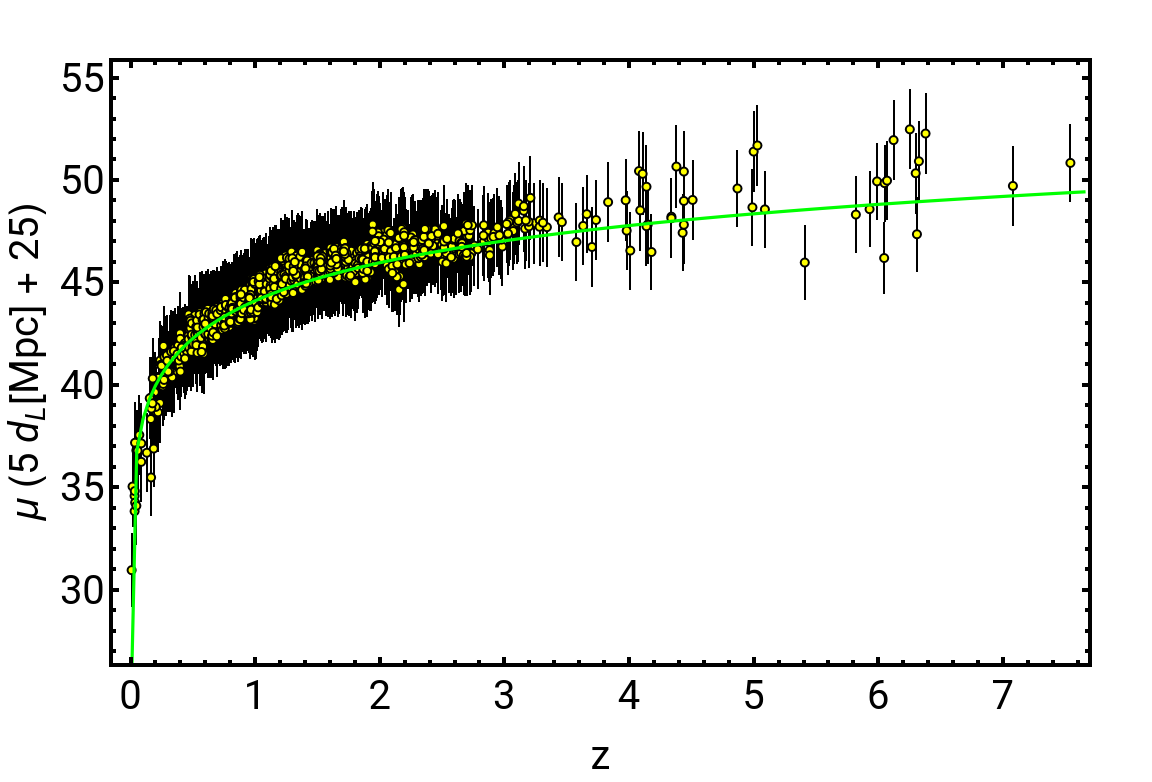
Distance Luminosity f(R) gravity, model from Dainotti et al. (2024)
◼
This is with Omega = 0.3 fixed
Show different models on plot
CITE THIS NOTEBOOK
CITE THIS NOTEBOOK
The scavenger hunt for quasar samples to be used as cosmological tools
by Maria Giovanna Dainotti, Giada Bargiacchi, Aleksander Łkasz Lenart & Salvatore Capozziello
Wolfram Community, STAFF PICKS, March 1, 2024
https://community.wolfram.com/groups/-/m/t/3133472
by Maria Giovanna Dainotti, Giada Bargiacchi, Aleksander Łkasz Lenart & Salvatore Capozziello
Wolfram Community, STAFF PICKS, March 1, 2024
https://community.wolfram.com/groups/-/m/t/3133472