ABSTRACT (original article): Superradiance, the phenomenon enabling energy extraction through radiation amplification, is not universal to all black holes. We show that semi-classical backreaction can induce superradiance, even when absent at the classical level. Specifically, we compute the quasinormal modes of a massless scalar field probing a family of rotating ‘quantum’ black holes in three-dimensional anti-de Sitter space, accounting for all orders of backreaction due to quantum conformal matter. A subset of these modes is identified as superradiant, leading to the formation of quantum black hole ‘bombs’. All such quantum black holes have curvature singularities shrouded by horizons. Thus, while backreaction enforces cosmic censorship, it also renders the black holes dynamically unstable. Further, we find all thermally unstable black holes are dynamically unstable, though the converse does not hold generally. Our findings thus suggest a semiclassical version of the Gubser-Mitra conjecture on black hole stability. This motivates us to propose a stability criterion for quantum black holes. CITATION (original article): Casey Cartwright, Umut Gürsoy, Juan F. Pedraza, Andrew Svesko (2025), Quantum induced superradiance, arXiv:2501.17231. https://doi.org/10.48550/arXiv.2501.17231
Introduction
Introduction
Superradiance is the phenomena by which the amplitude of reflected radiation is larger than the amplitude of incident radiation. In the context of gravitational physics, superradiance represents a dynamical instability of spacetimes with Anti-de-Sitter (AdS) asymptotics i.e. for large distances the geometry to leading order is equivalent to an Anti-de-Sitter geometry, a maximally symmetric spacetime. The instability is due to the reflective boundary conditions typically imposed, leading to radiation continuing to increase in amplitude, eventually destabilizing the system.
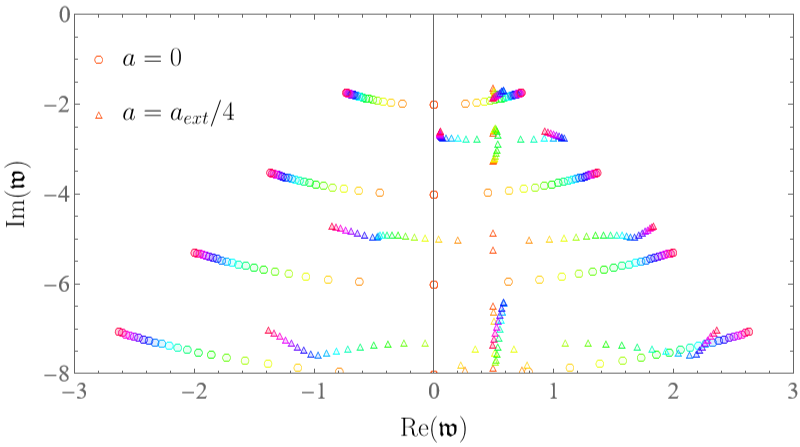
In our work, we study a scalar field, acting as a probe, in a quantum corrected spacetime known as the quantum BTZ black hole. We conduct this study by making use of the symmetries of the background spacetime to decompose our field into Fourier modes, and under a special choice of boundary conditions (infalling at the horizon i.e. nothing can escape a black hole, and reflective at the boundary) solutions to the Fourier transformed equations of motion are known as quasinormal modes. In particular it is the value of ω, the angular frequency, which is referred to as a quasinormal mode (QNM). These are similar to the normal modes of say a standing wave on a guitar string, except one end of the string is tied to the black hole horizon and hence is allowed to dissipate energy. As a result, these QNM frequencies are not real valued, but complex valued . For <0 the mode expansion shows these modes have an exponentially decreasing amplitude. An instability in the spacetime is reflected in the existence of a QNM with positive imaginary part leading to an exponentially growing amplitude.
ω+i
ω
r
ω
i
ω
i
(>0)
ω
i
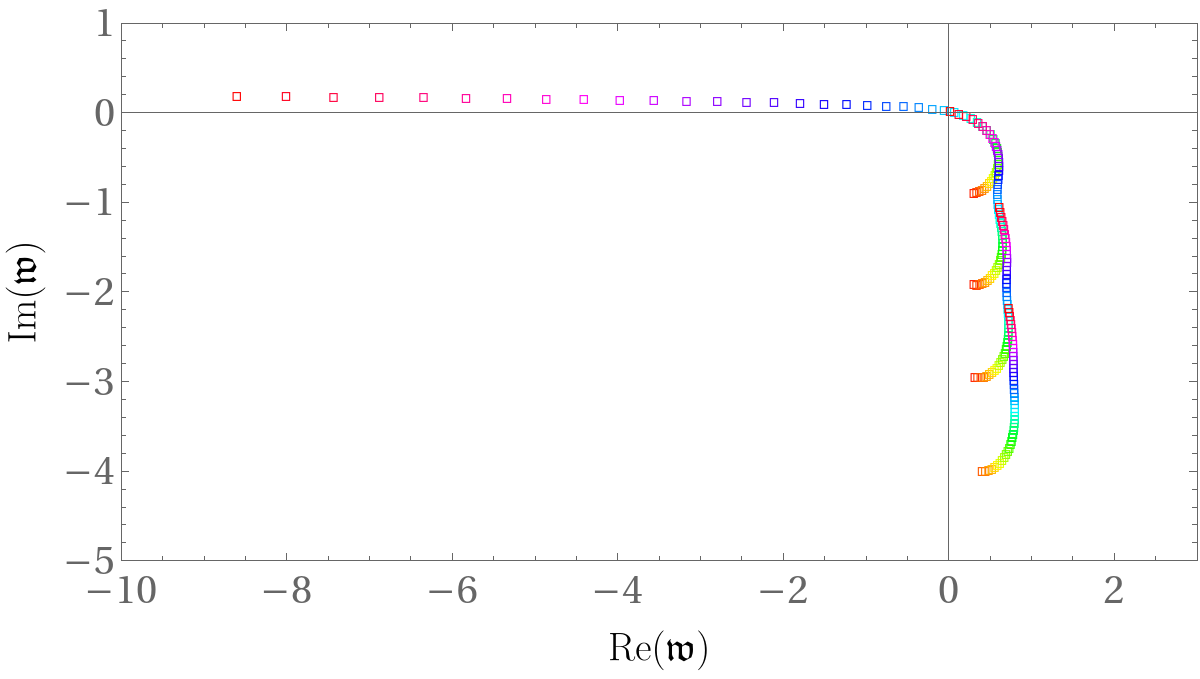
In our work we show that QNMs which satisfy a well-known criteria, (demonstrated to hold in this case as well), can display superradiant behavior, where is the angular frequency of the mode, the angular momentum of the mode and ω the angular velocity of the outer horizon. If , superradiance does not occur, hence is what is referred to as the onset of superradiance. Therefore, the problem is clear, one needs to search for values of the angular velocity of the outer horizon such that there exists a QNM with . The Mathematica code shows how to obtain precisely this. It includes how to obtain the Fourier transformed equations of motion of the scalar field, how to obtain the asymptotic behavior of these fields (to impose the boundary conditions) and how to solve these equations making use of a Chebyshev pseudo-spectral discretization of the differential equation. The code then implements a root-finding algorithm to search for values of the angular velocity at the horizon at which a QNM exists with . Results are displayed in terms of thermodynamic data of the black hole (i.e. temperature, angular momentum, entropy etc. ) hence the notebook also displays how to obtain all of this information. In addition, the notebook also displays how to compute an object known as the Hessian of the generalized entropy (the entropy of the black hole plus the entropy associated with the quantum matter supporting the geometry). The eigenvalues of the Hessian provide information about the thermal stability of the spacetime geometry.
ω≤mΩ
ω
m
ω>mΩ
ωmΩ
ωmΩ
ωmΩ
Set the geometry, Obtain EOMs
Numerics
Images of superradiance
QNM Images
QNM Images
The QNM code for the modes will be released once the QNMs are detailed in an upcoming publication.
Display an example mode spectrum
Display an example mode spectrum
In[]:=
<<MaTeX`SetOptions[MaTeX,FontSize20,"Preamble"{"\\usepackage{mathrsfs}\\usepackage{amsfonts}\\usepackage{xcolor}"}]
Out[]=
{BasePreamble{\usepackage{lmodern,exscale},\usepackage{amsmath,amssymb}},Preamble{\usepackage{mathrsfs}\usepackage{amsfonts}\usepackage{xcolor}},DisplayStyleTrue,ContentPaddingTrue,LineSpacing{1.2,0},FontSize20,Magnification1,LogFileFunctionNone,TeXFileFunctionNone}
locateData=NotebookDirectory[]<>"Complete_Publication_Data/"locateImages=NotebookDirectory[];
Out[]=
/home/casey/Documents/Quantum_Corrected_Black_Holes/Rotating_q_BTZ/Public_Code/Complete_Publication_Data/
In[]:=
{displist,displistp}=Get[locateData<>"figure_1_data_refined.dat"];
In[]:=
Clear[plotsR]plotsOuter[list_,astart_,astop_,astep_,lrange_,lstep_,Marker_,leg_]:=TableTableIfj==1&&i==astart,ComplexListPlotlist[[j,i]]+,PlotRange->{{-4,4},{2,-12}},PlotStyle->{Hue[j/22]},PlotMarkers->{Marker(*,Scaled[j/500]*)},PlotLegends->Placed[{leg},{0.12,0.8}],FrameLabel->{MaTeX["\\text{Re}(\\mathfrak{w})"],MaTeX["\\text{Im}(\\mathfrak{w})"]},ComplexListPlotlist[[j,i]]+,PlotRange->{{-4,4},{2,-12}},PlotStyle->{Hue[j/22]},PlotMarkers->{Marker(*,Scaled[j/500]*)},{i,astart,astop,astep},{j,1,lrange,lstep}//Flatten[#,1]&;plotsInner[list_,astart_,astop_,astep_,lrange_,lstep_,Marker_]:=TableTableComplexListPlotlist[[j,i]]+,PlotRange->{{-4,4},{2,-12}},PlotStyle->{Hue[j/22],Opacity[j/100]},PlotMarkers->{Marker(*,Scaled[j/500]*)},FrameLabel->{MaTeX["\\text{Re}(\\mathfrak{w})"],MaTeX["\\text{Im}(\\mathfrak{w})"]},{i,astart,astop,astep},{j,1,lrange,lstep}//Flatten[#,1]&;
displistp[[j,i,2]]
2πdisplistp[[j,i,3]]
displistp[[j,i,2]]
2πdisplistp[[j,i,3]]
displistp[[j,i,2]]
2πdisplistp[[j,i,3]]
In[]:=
testI0=plotsInner[displist,1,1,1,21,1,"●"];testO0=plotsOuter[displist,1,1,1,21,1,"○",{MaTeX["a=0"]}];
In[]:=
testI20=plotsInner[displist,20,20,1,21,1,"▲"];testO20=plotsOuter[displist,20,20,1,21,1,"△",MaTeX["a=a_{ext}/4"]];
In[]:=
test=plotsInner[displist,1,1,21,1,"●"];test0=plotsOuter[displist,1,1,21,1,"○"];
In[]:=
qnm=Show[testI0~Join~testO0~Join~testI20~Join~testO20,Frame->True,FrameTicksStyle->Directive[18,"TR"],PlotRange->{{-3,3},{0,-8}},AspectRatio->1/2,ImageSize->600]
Out[]=
In[]:=
Export[locateImages<>"sample_QNM_kappa_minus.pdf",qnm]
Out[]=
/home/casey/Documents/Quantum_Corrected_Black_Holes/Rotating_q_BTZ/Images/sample_QNM_kappa_minus.pdf
In[]:=
pltgif=TableShowComplexListPlotNdisplist[[;;,i]]+,PlotRange->{{-4,4},{0,-12}},Frame->True,FrameTicksStyle->Directive["TR",18],AspectRatio->12,PlotStyle->Hue[i/43],PlotMarkers->"○",FrameLabel->{MaTeX["\\text{Re}(\\mathfrak{w})"],MaTeX["\\text{Im}(\\mathfrak{w})"]},PlotLegends->Placed[{MaTeX["a="<>ToString[N[(i-1)/80]]<>" a_{ext}"]},{0.12,0.8}],ImageSize->600,{i,1,40,1};
displistp[[;;,i,2]]
2πdisplistp[[;;,i,3]]
In[]:=
pltgifDat=Flatten[Thread[{pltgif,pltgif,pltgif}]];
In[]:=
Export[locateImages<>"Scalar_n_0_mode_spectrum.gif",pltgifDat]
Out[]=
/home/casey/Documents/Quantum_Corrected_Black_Holes/Rotating_q_BTZ/Images/Scalar_n_0_mode_spectrum.gif
Superradiant mode solutions
Superradiant mode solutions
In[]:=
superModesPlus=Get[locateData<>"Radiance_cone.dat"];
In[]:=
pltDat=Table[ComplexListPlot[superModesPlus[[i]],PlotRange->{{-10,10},{-10,10}},Frame->True,PlotStyle->Hue[i/50],PlotMarkers->□],{i,1,Length[superModesPlus]}];
In[]:=
conePlt=Show[pltDat,PlotRange->{{-10,3},{-5,1}},FrameTicksStyle->Directive["TR",20],ImageSize->600,AspectRatio->1/2,FrameLabel->{MaTeX["\\text{Re}(\\mathfrak{w})"],MaTeX["\\text{Im}(\\mathfrak{w})"]}]
Out[]=
In[]:=
Export["~/Documents/Quantum_Corrected_Black_Holes/Rotating_q_BTZ/Images/Conical_Superradiance.pdf",conePlt]
Out[]=
~/Documents/Quantum_Corrected_Black_Holes/Rotating_q_BTZ/Images/Conical_Superradiance.pdf
In[]:=
superModesMinus=Get[locateData<>"Temp_Data_superModes_minus_Corrected.dat"];
In[]:=
superModesPlus=Get[locateData<>"Data_superModes_Plus_Corrected.dat"];superModesPlusParameters=Get[locateData<>"Data_superModes_Plus_Corrected_para.dat"];
In[]:=
Clear[magnify]magnify[in_]:=(Re[in]+IIm[in])magnify[superModesMinus[[1,1,1,1]]]
2
10
Out[]=
-31.2939972527124619710214536487527667851196491628601692247920384404943322284309969914493226258373845116922618340555760266-1980.28902345458631033211727341538922040437025918372513573297053870295488700695493191296601539530847181527401902765700769
In[]:=
originalRange={{-1,0.5},{-12/1000,15/1000}};magRange={{-1,0.5},{-12/1000,15/1000}}
2
10
Out[]=
{-1,0.5},-,
6
5
3
2
In[]:=
minus=Show[Table[ComplexListPlot[magnify[#]&/@superModesMinus[[j,3]],PlotRange->magRange,PlotStyle->Hue[j/40],AspectRatio->1/2,PlotMarkers->],{j,1,30}]];plus=Show[Table[ComplexListPlot[magnify[#]&/@superModesPlus[[j,3]],PlotRange->magRange,PlotMarkers->"□",PlotStyle->Hue[j/40],AspectRatio->1/2,ImageSize->600],{j,1,30}]];
Superradiant onset images
Superradiant onset images
κ=-1
κ=-1
κ=+1
κ=+1
Now κ=+1
Cut the data for large Ω
Constructing the Hessian for rotating qBTZ
Check data
Check data
Set commands to generate needed data
Set commands to generate needed data
Select stToEx as an integer 1-10, which takes steps towards extremality. With stToEx=0 you are sitting at the value of a which causes the onset of instability for a scalar field.
κ=-1
κ=-1
Check, are the eigenvalues negative for all of the data.
Create some cool plots
CITE THIS NOTEBOOK
CITE THIS NOTEBOOK
Quantum induced superradiance
by Casey Cartwright, Umut Gürsoy, Juan F. Pedraza & Andrew Svesko
Wolfram Community, STAFF PICKS, March 10, 2025
https://community.wolfram.com/groups/-/m/t/3413980
by Casey Cartwright, Umut Gürsoy, Juan F. Pedraza & Andrew Svesko
Wolfram Community, STAFF PICKS, March 10, 2025
https://community.wolfram.com/groups/-/m/t/3413980