Limits of the Continued Fraction method
from Dec 10
Limits of the Continued Fraction method
from Dec 10
from Dec 10
IwantedtotestthelimitsoftheBurns,Mathematica,AI,ContinuedFractionmethod
Steps
1) Get AI to understand what I want .
1) Get AI to understand what I want .
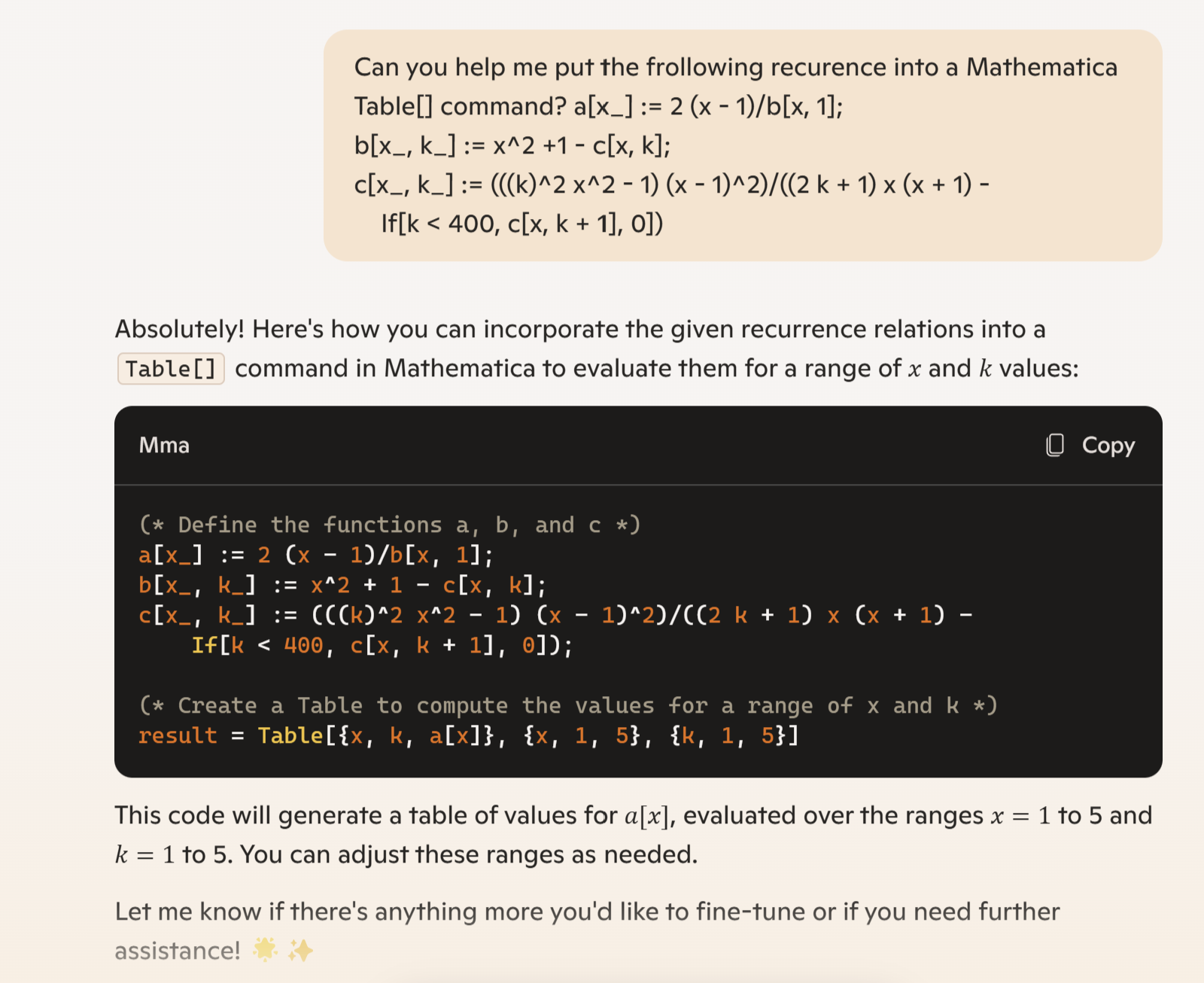
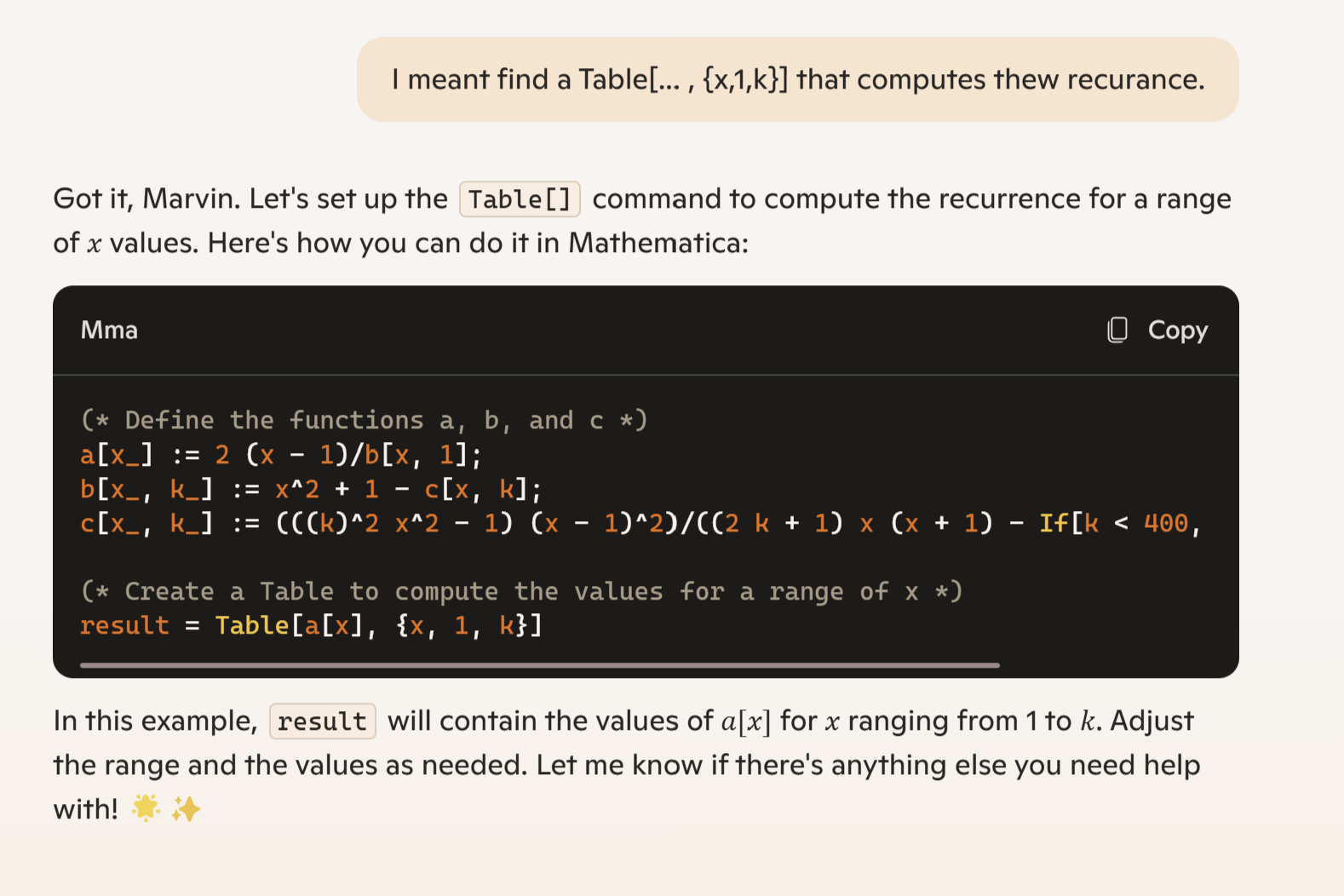
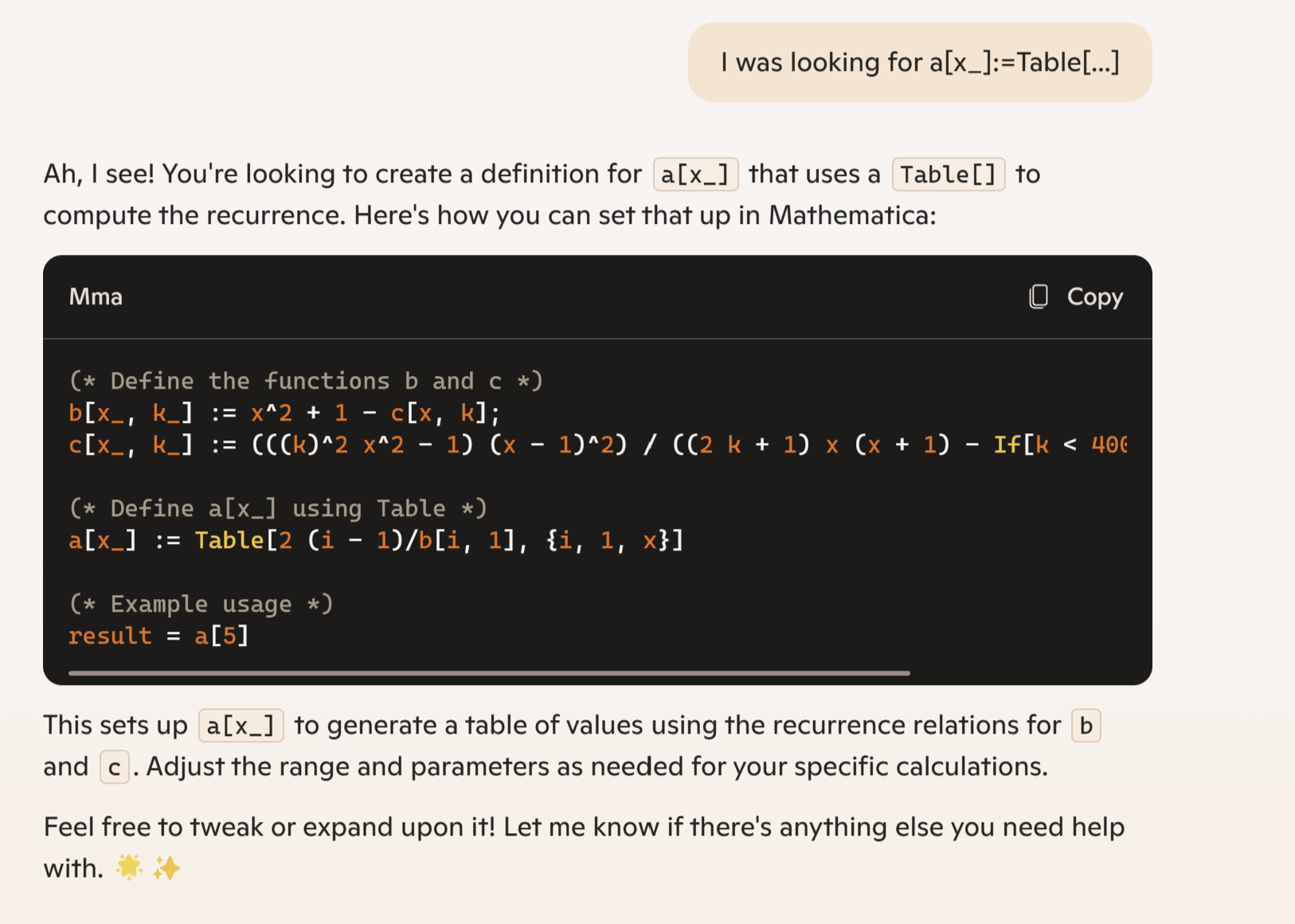
2) Use what I know to “customize.”
2) Use what I know to “customize.”
In[]:=
Clear[a,b,c]
In[]:=
Print[Style["Using the Burns, Mathematica, AI, Continued Fraction method",FontSize->24]];(*Definethefunctionsbandc*)b[x_,k_]:=x^2+1-c[x,k];c[x_,k_]:=(((k)^2x^2-1)(x-1)^2)/((2k+1)x(x+1)-If[k<800,c[x,k+1],0]);(*Definef1[x_]usingTable*)f1[x_]:=ParallelTable[2(i-1)/b[i,1],{i,1,x}](*DefineActualvaluesusingTable*)f2[x_]:=ParallelTable[-1,{i,1,x}](*Test*)r=N[f1[10]-f2[10],1000]//Quiet;Table[Print["General ContFrac of ",n,"-(",n,"^(1/",n,")-1)=",N[r[[n]],20]],{n,1,10}];
1/i
i
Using the Burns, Mathematica, AI, Continued Fraction method
General ContFrac of 1-(1^(1/1)-1)=0
General ContFrac of 2-(2^(1/2)-1)=0.×
-1050
10
General ContFrac of 3-(3^(1/3)-1)=-3.6778621721791711175×
-917
10
General ContFrac of 4-(4^(1/4)-1)=-2.9890397005915381667×
-765
10
General ContFrac of 5-(5^(1/5)-1)=-1.5686114341635038827×
-670
10
General ContFrac of 6-(6^(1/6)-1)=-3.4384473462884150272×
-604
10
General ContFrac of 7-(7^(1/7)-1)=-2.2189403948206005821×
-554
10
General ContFrac of 8-(8^(1/8)-1)=-3.3524246269570616230×
-515
10
General ContFrac of 9-(9^(1/9)-1)=-2.4536406249153663457×
-483
10
General ContFrac of 10-(10^(1/10)-1)=-9.2510006285357289075×
-457
10
2) Use what I know to “customize.”
2) Use what I know to “customize.”
Clear[a,b,c,f,r]
In[]:=
mm=NSum[(-1),{n,1,Infinity},Method->"AlternatingSigns",WorkingPrecision->2000];Print[Style["Some digits of the MRB constant using the Burns, Mathematica, AI, Continued Fraction method",FontSize->24]];(*Definethefunctionsbandc*)b[x_,k_]:=x^2+1-c[x,k];c[x_,k_]:=(((k)^2x^2-1)(x-1)^2)/((2k+1)x(x+1)-If[k<400,c[x,k+1],0]);(*Definef1[x_]usingTable*)f1[x_]:=2(x-1)/b[x,1](*DefineActualvaluesusingTable*)
n
(-1)
1/n
n
Some more digits of the MRB constant using the Burns, Mathematica, AI Method
Some more digits of the MRB constant using the Burns, Mathematica, AI Method
mm-TableImNIntegrate,{u,0,n(I)},WorkingPrecision->200,{n,61,80}//Quiet;
f1[u+1]
Sin[Piu]
In[]:=
TableForm[%//N]
Out[]//TableForm=
-2.58345× -85 10 |
-1.1025× -86 10 |
-4.70583× -88 10 |
-2.00898× -89 10 |
-8.57809× -91 10 |
-3.66338× -92 10 |
-1.56475× -93 10 |
-6.68465× -95 10 |
-2.85615× -96 10 |
-1.22054× -97 10 |
-5.21657× -99 10 |
-2.22989× -100 10 |
-9.53327× -102 10 |
-4.07625× -103 10 |
-1.74317× -104 10 |
-7.45543× -106 10 |
-3.18906× -107 10 |
-1.36429× -108 10 |
-5.83718× -110 10 |
-2.49776× -111 10 |
There’s a problem here. Raise recursion limit from 400 to 550:
Theoretically, if we had stuck to the CMRB series with the four basic arithmetic operations (+,-,*,/) in our recursion, and If we had enough time or mathematicians, we could have just there calculated 177 or so digits of the MRB constant, with an abacus.