Dynamics of 3-point Map in a Circle:
Closures,Porisms, and Limit Cycles
Dan S. Reznik, Nov. 1st, 2021
Dynamics of 3-point Map in a Circle:
Closures,Porisms, and Limit Cycles
Dan S. Reznik, Nov. 1st, 2021
Closures,Porisms, and Limit Cycles
Dan S. Reznik, Nov. 1st, 2021
Consider a circle C, a point P1 on its boundary, and three fixed points O1,O2,O3 in its interior. Consider the following iteration: (i) shoot a ray from P1 thru O1 meeting C at P2. (ii) shoot a ray from P2 through O2, meeting C at P3; (iii) shoot a ray from P3 through O3, meeting C at P4. In this case there are N=3 iterations but in general we are interested in maps with N=3M iterations, where M is an integer ≥ 1.
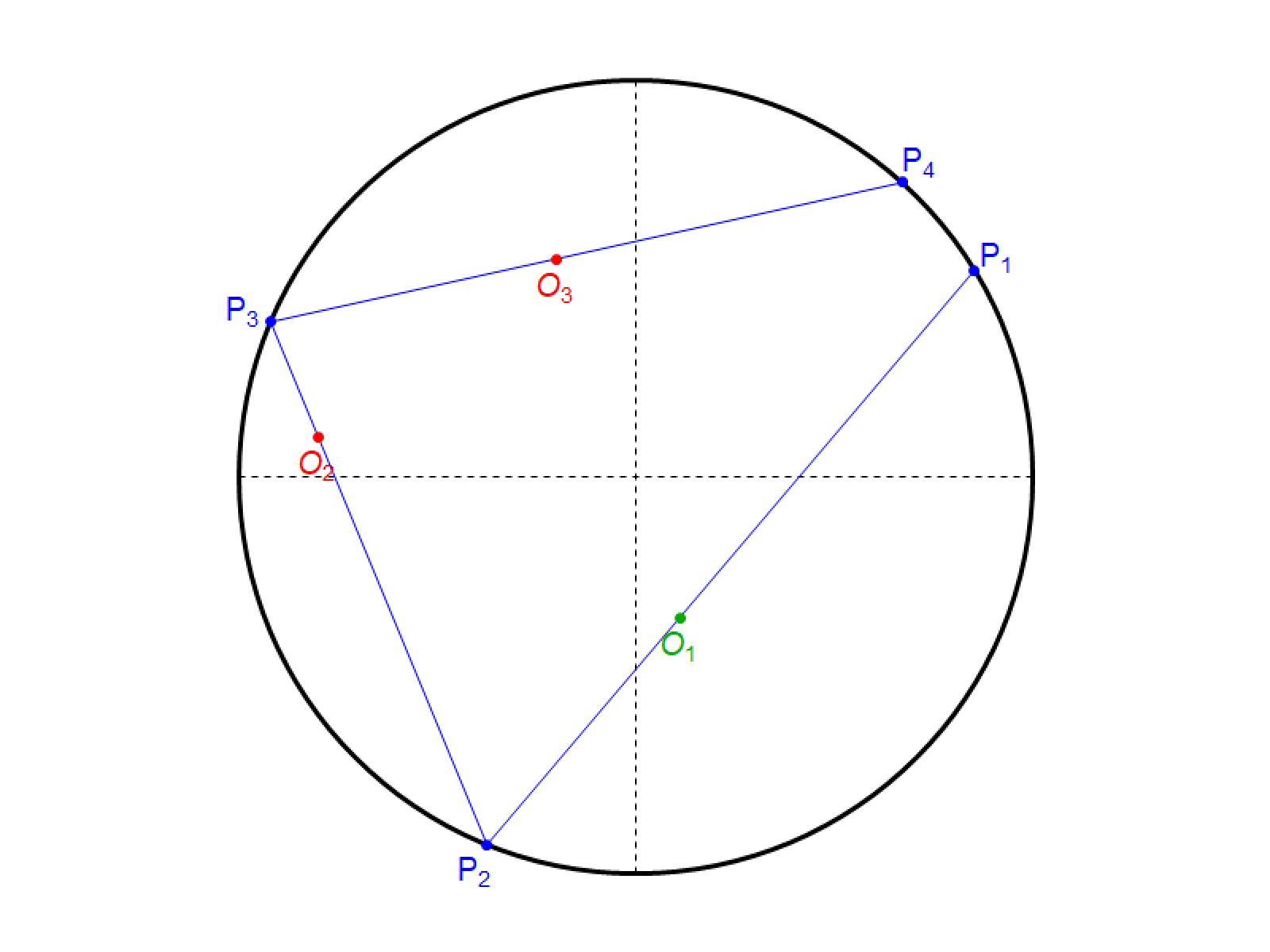
Keeping P1, O2, and O3 above fixed, there are certain choices of O1 such that the 3-map closes a triangle (i.e., P4=P1).
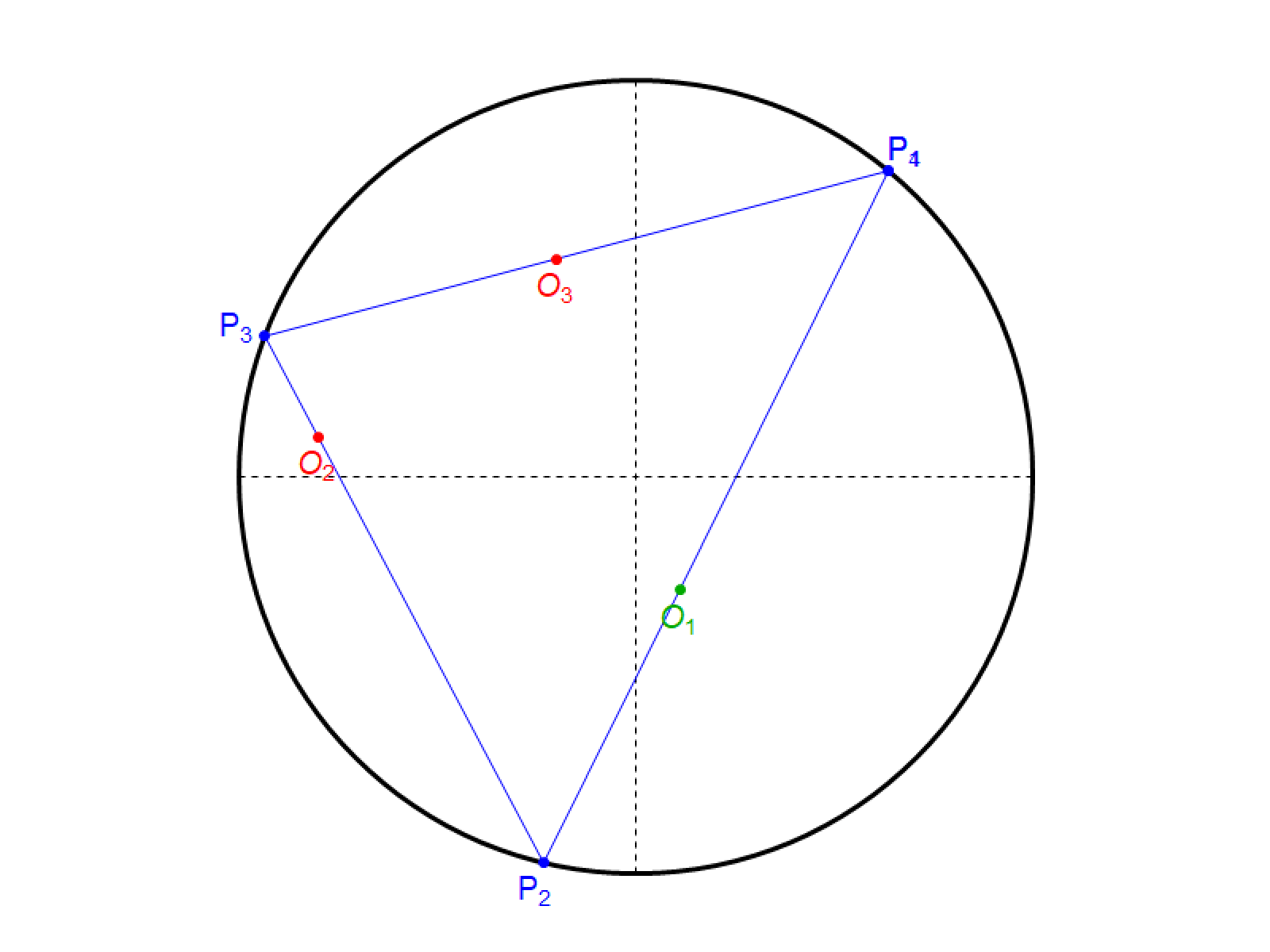
Interestingly, if after closing a triangle P1 is slid over C, we lose “closure”, i.e., the N=3 map is not “poristic” (closure is not maintained for all P1).
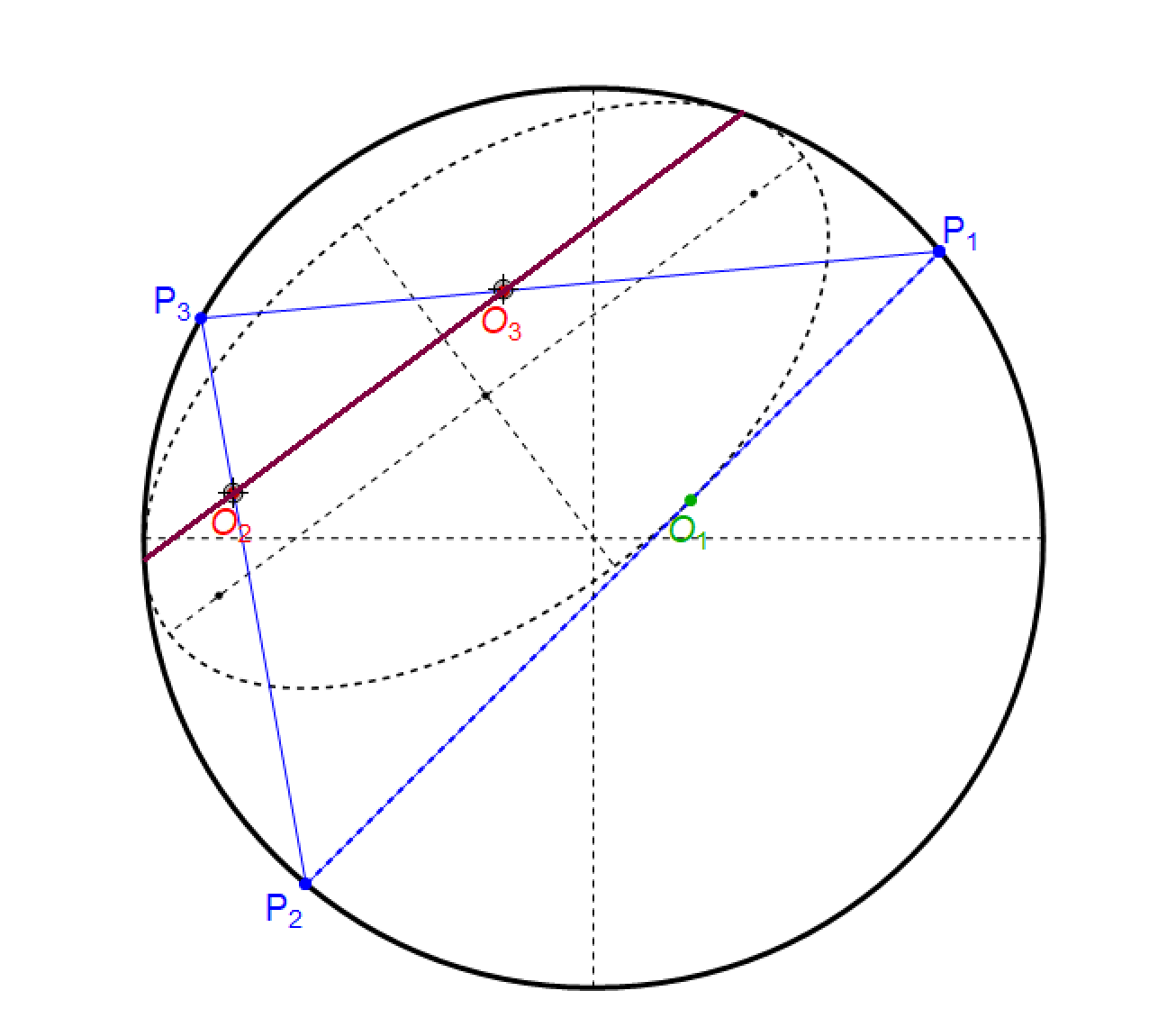
We can ask the following question: given O2,O3 fixed, what are positions for O1 such that for some P1 the N=3 map closes? It turns that if O1 is on the boundary to the dashed black ellipse below, called here E3, the P1 which is the intersection of the tangent to E3 at O1 with C is a triangle. Notice that O1 can be anywhere along that tangent, so the proper answer to the question is: any O1 exterior or on the boundary of E3 is associated with a P1 for which N=3 closes. It turns out E3 is a boundary for aperiodic vs. limit cycle behavior for large N iterations, see below.
We can ask the following question: given O2,O3 fixed, what are positions for O1 such that for some P1 the N=3 map closes? It turns that if O1 is on the boundary to the dashed black ellipse below, called here E3, the P1 which is the intersection of the tangent to E3 at O1 with C is a triangle. Notice that O1 can be anywhere along that tangent, so the proper answer to the question is: any O1 exterior or on the boundary of E3 is associated with a P1 for which N=3 closes. It turns out E3 is a boundary for aperiodic vs. limit cycle behavior for large N iterations, see below.
N=6
N=6
Consider an N=6 polyline starting from P1 below and passing thru O1,O2,O3 in round-robin fashion twice, and ending on P7. For a generic choice of O1,O2,O3, the polyline won’t close...
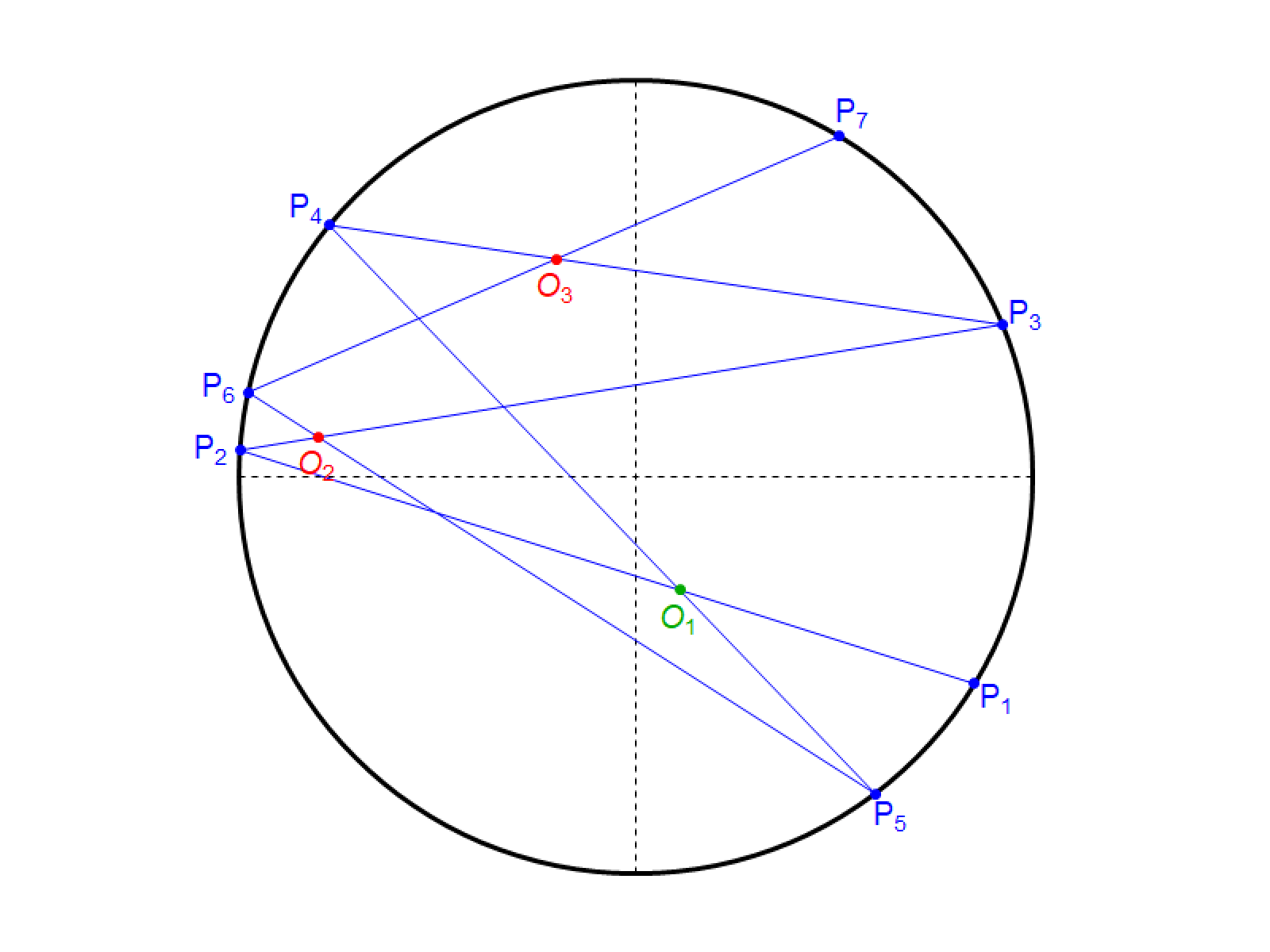
However,wheneve the three Oi are collinear, the iteration closes in a kind of “reverse” Pascal theorem. Recall that the latter says that the 3 intersections of opposing sides of a conic-inscribed hexagon are collinear:
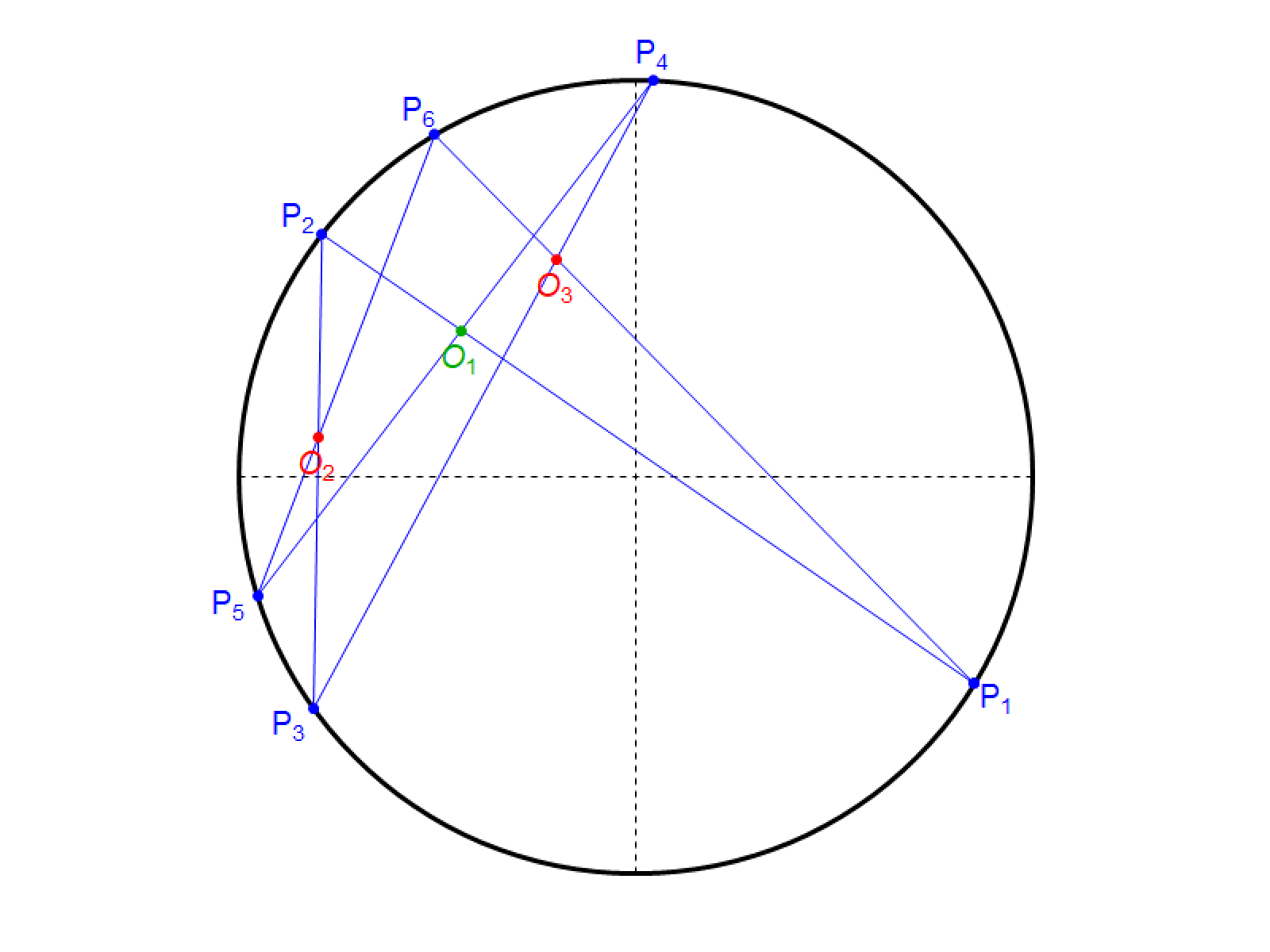
If the collinear triad O1,O2,O3 is kept fixed, as P1 slides P1 along C, closure of the hexagon is magically maintained, i.e., we say this map is “poristic” (this was not the case with N=3...):
N=9
N=9
This is even more interesting.
Hold O2,O3 at some fixed positions below. What is the locus of O1 such that we close a 9-gon? It turns out the answer is the green ellipse E9 below. As with N=6, an N=9 closure is also poristic, i.e., once a triad is found for which N=9 closes, closure will be maintained for all P1. It is a thing of beauty to watch the dynamic geometry of these 9-gons as P1 smoothly glides along the circle.
Hold O2,O3 at some fixed positions below. What is the locus of O1 such that we close a 9-gon? It turns out the answer is the green ellipse E9 below. As with N=6, an N=9 closure is also poristic, i.e., once a triad is found for which N=9 closes, closure will be maintained for all P1. It is a thing of beauty to watch the dynamic geometry of these 9-gons as P1 smoothly glides along the circle.
Here are a few further notes about E9: its major (resp. minor) axis (dashed green) is parallel (resp. perpendicular) to O2O3. We are working on a proof using a combination of analytic and hyperbolic geometry.
N=12,15,18
N=12,15,18
As you investigate loci of O1 for closures of higher multiples of 3, you get a sequence of ellipses tangent to C at the same spot as the N=9 locus (and E3). Below N=9,12,15,18 are shown green, orange, magenta (two ellipses) and cyan (also two ellipses where the inner one coincides with the green one). Below O1 is placed somewhere on the N=12 ellipse (orange) showing that a 12-gon is closing at P1. All cases are poristic, i.e., P1 can be slid on C and closure is maintained.
Superposing E3 (dashed black), on the above we notice it is external to the poristic loci of O1.
Limit Cycle vs Aperiodic
Limit Cycle vs Aperiodic
It turns out that if O1 is outside the N=3 ellipse E3, the map after a large number of iterations will find a limit cycle which is equal to the triangle formed if P1 were on the tangent to E3 passing through O1:
Interestingly, if one slides O1 to the interior of E3, the map “explodes” to what is in general a space-filling, aperiodic shape, with a measure-zero set of 3M-periodic choices, such as the one we have seen above (N=6,9,...)
Underlying this is the fact the composition of three iterations is producing a constant shift (in the space of lines which cut the circle) which is a rational multiple of 2pi (similar to Poncelet’s porism). So there is a countable collection of elliptic loci where such a shift is rational immersed in an ocean of irrational shifts, which give rise to space-filling trajectories.
YouTube Videos
YouTube Videos
For a live walkthru check out these videos (and/or the manipulate app below):
Video 2 (5 min), Symmetric O2, O3, N = 9 : https : // youtu.be/hvTYkkvhePQ
1) Load Required File
1) Load Required File
3) Manipulate App
3) Manipulate App