Introduction
Introduction
In Stephen Wolfram’s minimal model, evolution is framed as an adaptive process over cellular automaton rules rather than over biological entities. At each step, the current rule undergoes a small random modification—such as changing entries in its local update table—and the modified rule is evaluated by evolving a cellular automaton from a specified initial condition. A fitness measure, commonly defined in terms of how long nontrivial structure persists, determines whether the mutation is accepted. Mutations that preserve or improve fitness are retained, generating a stepwise trajectory through rule space that mirrors mutation, selection, and neutrality in biological evolution, but in a purely computational setting.
In “Why Does Biological Evolution Work? A Minimal Model for Biological Evolution and Other Adaptive Processes”, Wolfram shows that this extremely simple evolutionary mechanism can nonetheless produce sustained adaptive progress. Using a one-dimensional cellular automaton initialized from a single active red cell, he demonstrates that many random sequences of rule mutations lead to rules that support increasingly persistent and structured behavior. The resulting evolutionary paths frequently contain extended neutral regions punctuated by occasional fitness gains, indicating that large portions of rule space are accessible without precise tuning. These observations suggest that successful evolution may be a widespread feature of complex rule spaces rather than an exceptional outcome.
What remains uncertain is how dependent these results are on the specific choice of initial condition. The examples in the essay focus on evolution evaluated from a random multiple colored cells seed configuration. My goal is to examine whether the same qualitative evolutionary behavior appears when the system is instead tested using random sequences, such as random initial conditions or randomized evaluation inputs. Specifically, I aim to determine whether adaptive walks through rule space continue to produce long-lived, nontrivial dynamics under these conditions, and whether characteristic features like neutral drift, fitness plateaus, and intermittent improvements remain statistically reproducible across many independent runs.
Results
Results
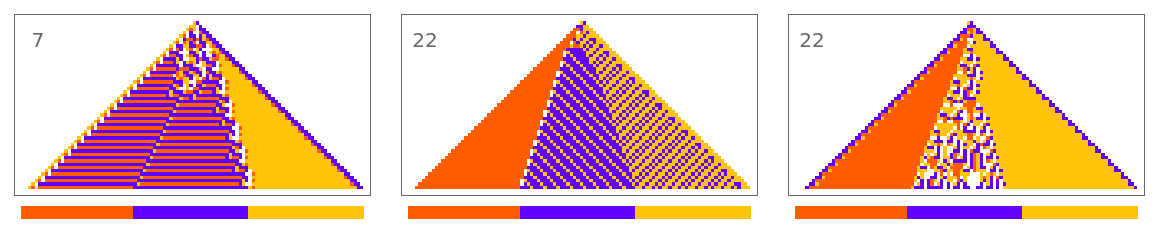
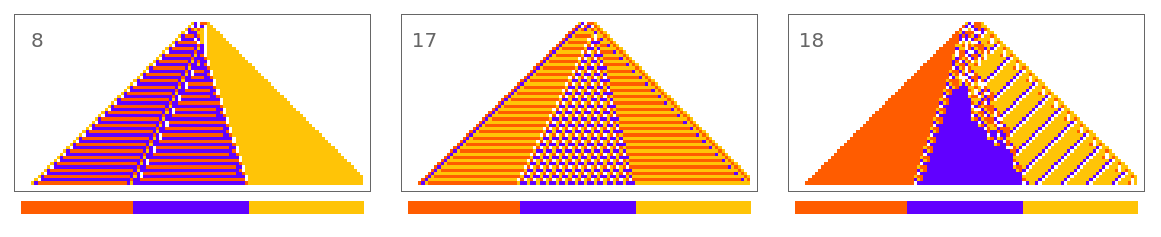
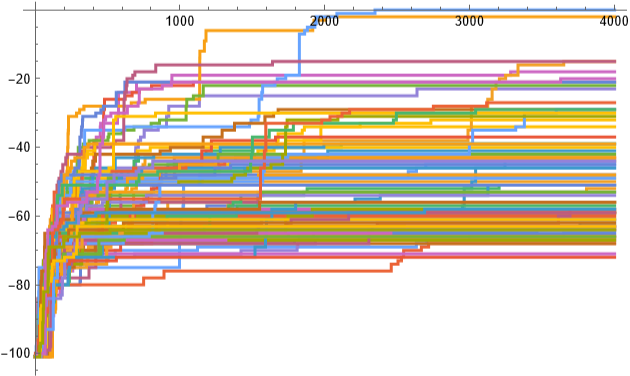
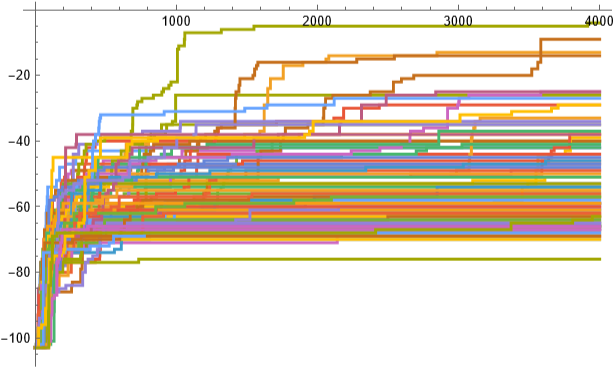
Below are examples of how the system evolves, along with the fitness paths associated with each run, starting from different initial setups. Notably, many of the observed patterns resemble those produced when evolution begins from the single red cell used in Wolfram’s original model.
Out[]=
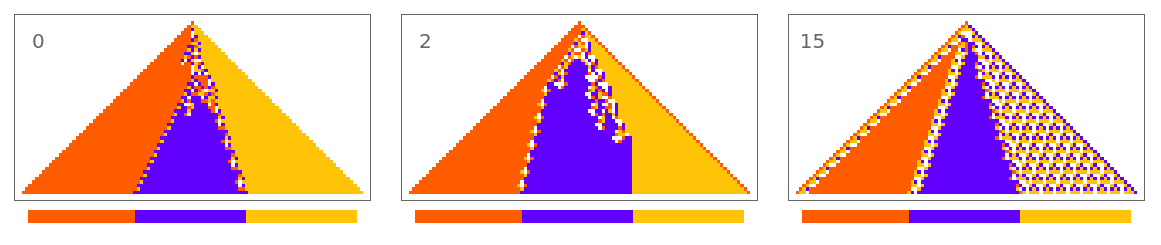
These plots show that when the initial condition is expanded to multiple randomly colored cells, the resulting patterns become more diffuse and less similar to those generated from a single starting cell. Adding more initial “bits” of information appears to introduce additional randomness rather than clearer structure.
Out[]=
Out[]=
Out[]=
Out[]=
Out[]=
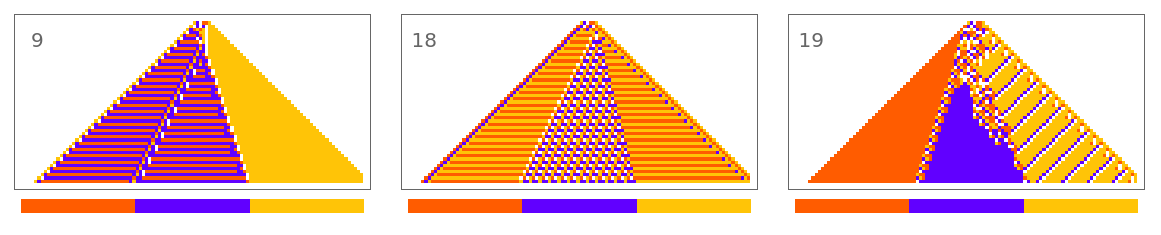
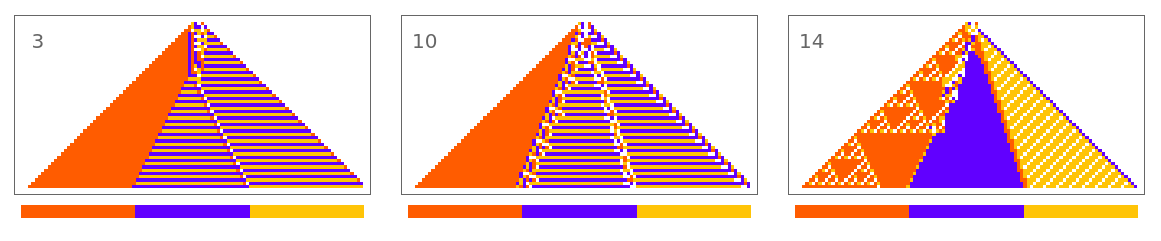
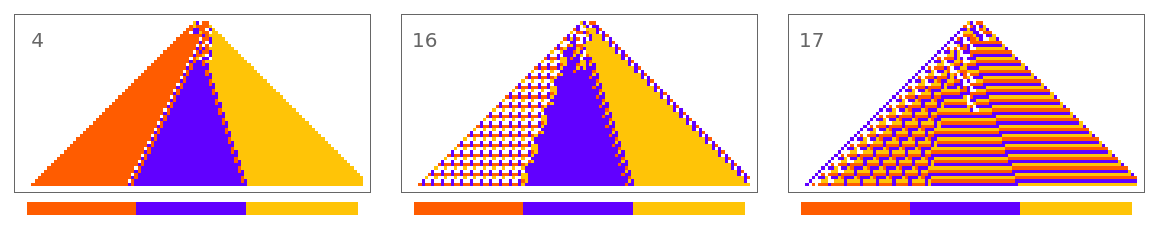
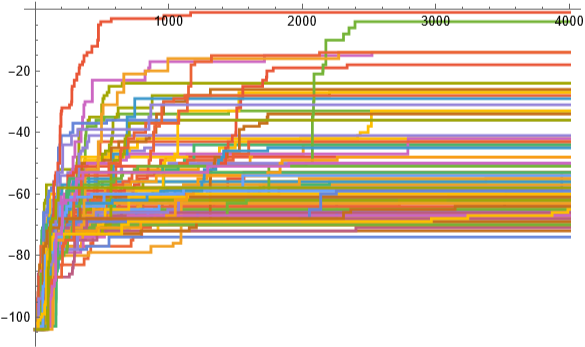
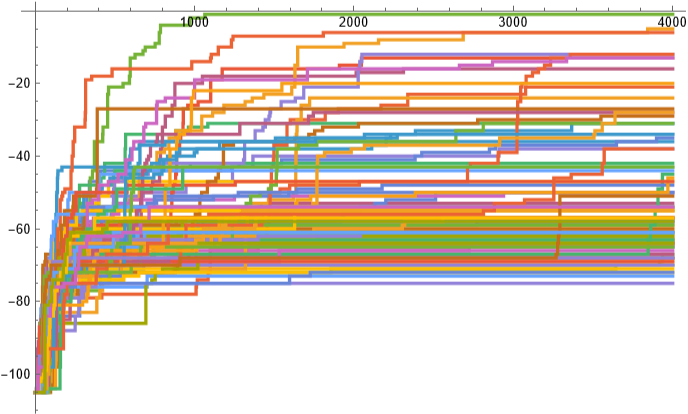
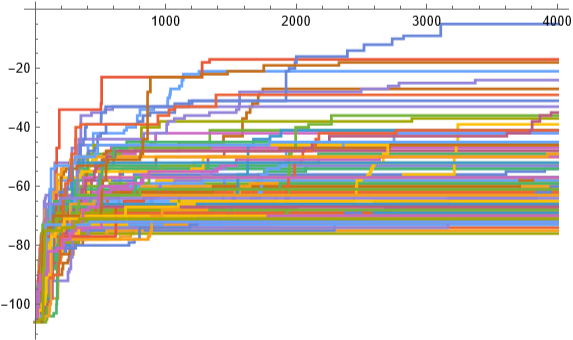
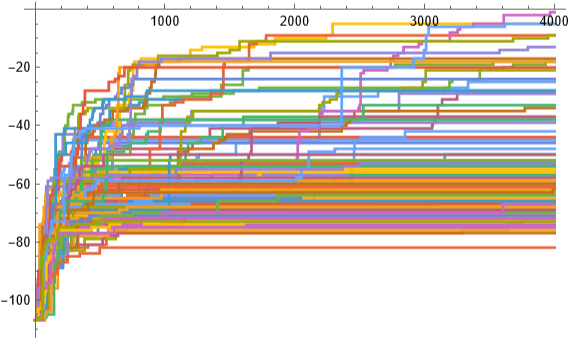
In these plots, as you can see there aren’t significant difference that we can actually point out. In fact, any differences appear to be stochastic rather than structural.
Out[]=
Out[]=
Out[]=
Out[]=
Out[]=
Out[]=
Code
Code
Concluding Remarks
Concluding Remarks
The findings imply that, under the same mutation and selection criteria, changing the initial conditions from a single colored cell to several randomly assigned colored cells does not result in a substantially different evolutionary trajectory within this limited evolutionary framework. While the fitness (or longevity) curves reveal overlapping trajectories with no consistent distinction between different initializations, the generated plots visually demonstrate similar triangular development patterns and the emergence of structured regions across runs. This is consistent with Wolfram’s finding that the structure of the rule space and the selection mechanism, rather than specific characteristics of the beginning state, are what drive evolutionary progress in this model.
In other words, under the current setup, there is no discernible benefit from multi-cell or multi-color seeding because the evolutionary dynamics seem to quickly “forget” the initial configuration and converge toward similar regions of rule space, even when additional diversity is introduced at the beginning.
My primary focus during the winter school was to build a solid understanding of the Wolfram Language and to fully grasp the code I was writing. The discussions throughout the program were especially impactful in deepening that understanding. While the progress may seem incremental, it feels significant to me in the broader context of my work, and I’m excited to continue building on this foundation at the summer school rather than starting from scratch.
Future Directions
Future Directions
These findings imply that evolutionary dynamics in this simple evolutionary model are driven by mutation and selection in rule space, with long-term effects being essentially unaffected by the selection of beginning conditions. Investigating whether this robustness breaks down—by altering selection pressure, mutation schemes, or fitness measurements that are more sensitive to early-time structure and diversity—is a logical next step. Subtler forms of path dependence that are not covered here may be found by looking beyond final fitness and analyzing evolutionary trajectories, fleeting behaviors, and reactions to environmental disturbances. When taken as a whole, these approaches seek to make clear when initial diversity is important and when evolution truly “forgets” its origins.
Acknowledgments
Acknowledgments
I would want to thank Stephen Wolfram for this foundational research that helped me get started, my mentor Willem Nielsen for all of his hard work and guidance, as well as Every employee, but especially Stephanie Bowyer, for her assistance and for reviewing the post.
References
References
1- Stephen Wolfram (2024), “Why Does Biological Evolution Work? A Minimal Model for Biological Evolution and Other Adaptive Processes,” Stephen Wolfram Writings. writings.stephenwolfram.com/2024/05/why-does-biological-evolution-work-a-minimal-model-for-biological-evolution-and-other-adaptive-processes.
CITE THIS NOTEBOOK
CITE THIS NOTEBOOK
Many paths, similar outcomes adaptive evolution in cellular automata
by Merna Melad
Wolfram Community, STAFF PICKS, January 26, 2026
https://community.wolfram.com/groups/-/m/t/3626449
by Merna Melad
Wolfram Community, STAFF PICKS, January 26, 2026
https://community.wolfram.com/groups/-/m/t/3626449